That viral cucumber jump is usually a startle response in a “safe” spot—not fear of vegetables. Learn what’s happening, why pranks can harm cats, and...
Article
•
Designer Mixes
Why Cats Are Afraid of Cucumbers

Shari Shidate
Designer Mixes contributor
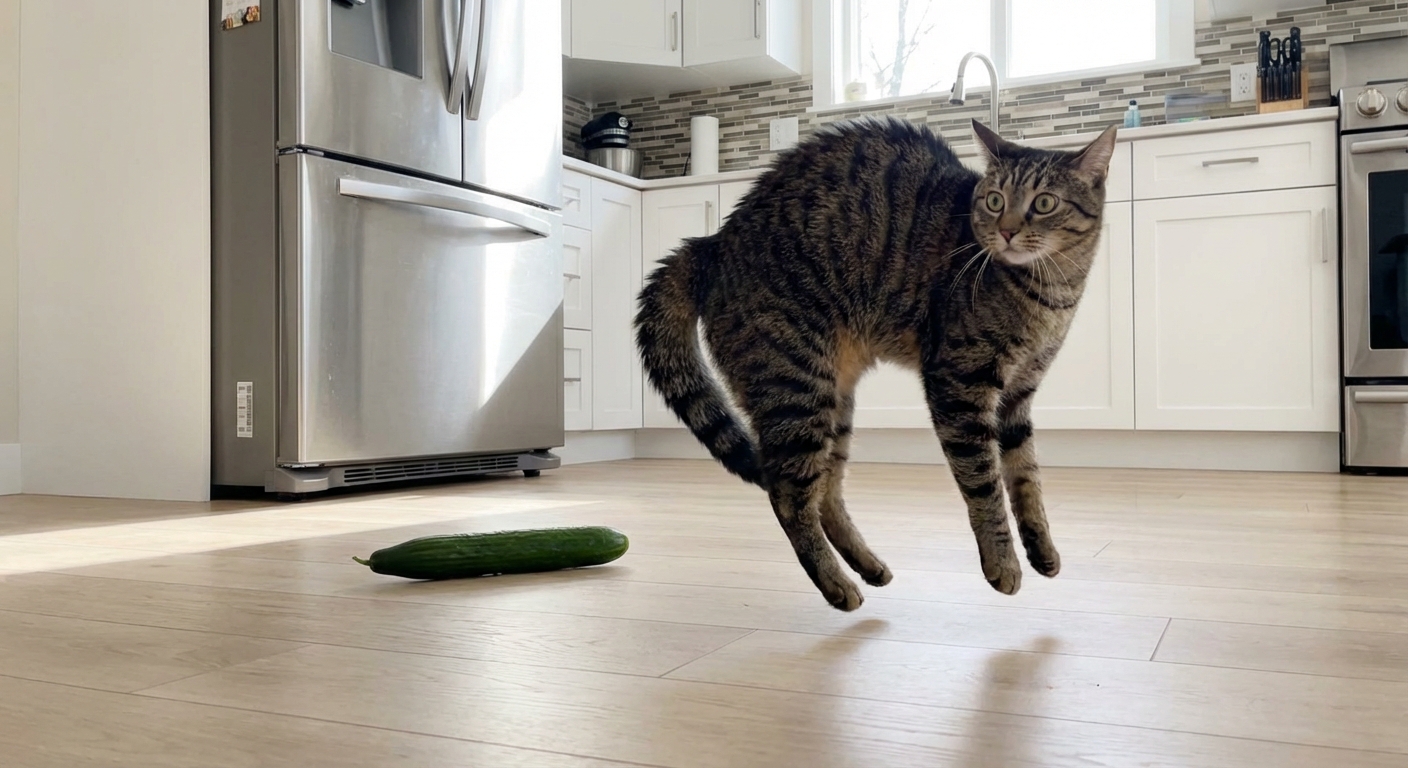
If you have ever seen a video of a cat launching into the air after noticing a cucumber, you might wonder if cats are truly “afraid of cucumbers” or if something else is going on. As a veterinary assistant, I can tell you this is less about cucumbers specifically and more about surprise, instincts, and how cats interpret sudden changes in their environment.
Let’s break down the most evidence-aligned explanations, what those viral clips leave out, and how to keep your cat feeling safe at home.
Quick facts
- Cucumbers are not “magically scary” to cats. Most cats do not have a built-in fear of cucumbers.
- The big trigger is usually surprise. In many videos, an object appears behind the cat while it is eating or distracted.
- Shape may play a small role for some cats. An elongated object can sometimes register as a potential threat at a glance, but context is usually the main driver.
- Scaring a cat on purpose can backfire. It can increase anxiety and contribute to stress-related behavior issues.
What’s happening in prank videos
In many viral clips, a cucumber is placed silently behind a cat while the cat is eating. When the cat turns around, the object has “appeared” where it was not before. This is a classic setup for a startle response.
Cats are hunters, but they are also small enough to be vulnerable to larger animals. That is part of why their brains are tuned for fast reactions. When something shows up unexpectedly in their safe zone, their nervous system may choose flight first, questions later.
Why the reaction can be intense
1) Cats prefer consistency
Cats are routine-driven. They build a mental map of their territory, including where food, water, and favorite paths are. When an unfamiliar object suddenly appears near a resource like food, it can trigger, “Wait, what is that and why is it here?”
2) Peripheral vision is built for detection
Cats excel at noticing small changes around them. Even if the cucumber is not moving, the unexpected presence can be enough to set off an alarm response, especially when they notice it close-up.
3) The “snake” idea is possible, but not proven
You may hear that cucumbers “look like snakes.” The shape-and-color resemblance can be plausible at a quick glance, especially in peripheral vision, but research is limited and most guidance from cat behavior professionals emphasizes that surprise and context are the primary triggers.
Is it fear of cucumbers?
Usually, no. Many cats will sniff a cucumber calmly if it is introduced normally, like any other household item.
What many cats are reacting to is:
- Novelty (it is unfamiliar)
- Placement (it is too close to food, a resting spot, or a common walkway)
- Timing (it appears when the cat is distracted)
- Startle (the cat notices it suddenly)
If you tried the same setup with a banana, a zucchini, a rolled-up sock, or a hairbrush, you might get the same jump in some cats.
Also, individual variation matters. A naturally skittish cat, a cat with a rough past, or a senior cat with hearing or vision changes may startle more easily than a confident, curious cat.
Why scaring your cat is a bad idea
I know those clips can look funny, but from an animal-care perspective, the risk is real. A severe startle can lead to:
- Injury from slipping, crashing into furniture, or landing awkwardly
- Resource-related anxiety if the scare happens near the food bowl
- Increased stress, which can worsen issues like hiding, overgrooming, or inappropriate urination
- Reduced trust in the people in the home
Stress is not just emotional for cats. It can affect appetite, sleep, and overall health. In some cats, stress is associated with flare-ups of urinary issues such as feline lower urinary tract disease (FLUTD) and feline idiopathic cystitis (FIC).
If you want a calmer, healthier cat, protect their sense of safety, especially around food, litter boxes, and favorite resting spots.
Don’t do this
If you want the quick takeaway, here are the biggest no-gos:
- Do not place objects behind your cat while it is eating, drinking, using the litter box, or sleeping.
- Do not block escape routes. A trapped cat is more likely to panic or lash out.
- Do not chase, corner, or force interaction for a reaction.
- Do not film at the expense of welfare. If your cat startles, stop immediately and give space.
Curiosity test (no scare)
If you are genuinely curious how your cat will react to a cucumber, do it in a low-stress, respectful way:
- Place it in plain view several feet away while your cat is relaxed.
- Let your cat approach on their own terms.
- Reward calm investigation with gentle praise or a small treat.
- Remove it if your cat shows stress signs like crouching, ears pinned back, tail puffing, freezing, or bolting.
This is a better “science experiment,” and it supports your cat’s confidence instead of undermining it.
If you already did it
If you have already tried the prank, focus on restoring safety:
- Give your cat space and let them choose when to re-engage.
- Reset the environment by removing the object and keeping the area calm and predictable.
- Return to routine with normal feeding and play times.
- Add comfort options like a quiet hiding spot and vertical spaces (cat tree, shelf perch).
Stress signs and what to do
Cats can be subtle. After a scare, watch for:
- Hiding more than usual
- Reduced appetite or eating only when no one is around
- Aggression or swatting when approached
- Overgrooming
- Changes in litter box habits
If you notice these, return to basics:
- Predictable routine for feeding and play
- Safe escape routes and vertical spaces like cat trees
- Quiet “reset zones” away from foot traffic
- Interactive play (wand toys) to release stress in a healthy way
When to call the vet sooner: If your cat does not eat for about 24 hours, if you see vomiting, marked lethargy, or any urinary signs like straining, frequent trips, crying in the litter box, or blood in the urine, contact your veterinarian promptly. If you notice bald patches or skin sores (not just extra shedding), that is also worth a vet check since skin issues can be medical, not only stress-related.
Common questions
Do cats hate the smell of cucumbers?
Most cats are not bothered by cucumber smell alone. Reactions are typically about surprise and context, not odor.
Is it cruel to prank a cat with a cucumber?
It can be. Intentionally triggering a fear response is stressful, and the physical risk of injury is not trivial. There are much kinder ways to enrich your cat’s life.
What if my cat is not scared at all?
That is normal too. Cats have different temperaments, past experiences, and comfort levels with novelty.
Bottom line
Cats are not universally afraid of cucumbers. Most of the dramatic reactions come from a startle response caused by an object appearing unexpectedly, often near a high-value area like the food bowl. A cucumber’s shape may add an extra “potential threat” signal for some cats, but the real issue is how it is introduced.
If you love your cat, the best takeaway is simple: protect their sense of safety, introduce new things gently, and choose enrichment that builds confidence rather than fear.