Bring home a kitten with confidence. Get vet-backed tips on kitten-proofing, nutrition, litter training, vaccines, grooming, play, stress, and safe pet intro...
Article
•
Designer Mixes
What Vaccinations Do Cats Need

Shari Shidate
Designer Mixes contributor
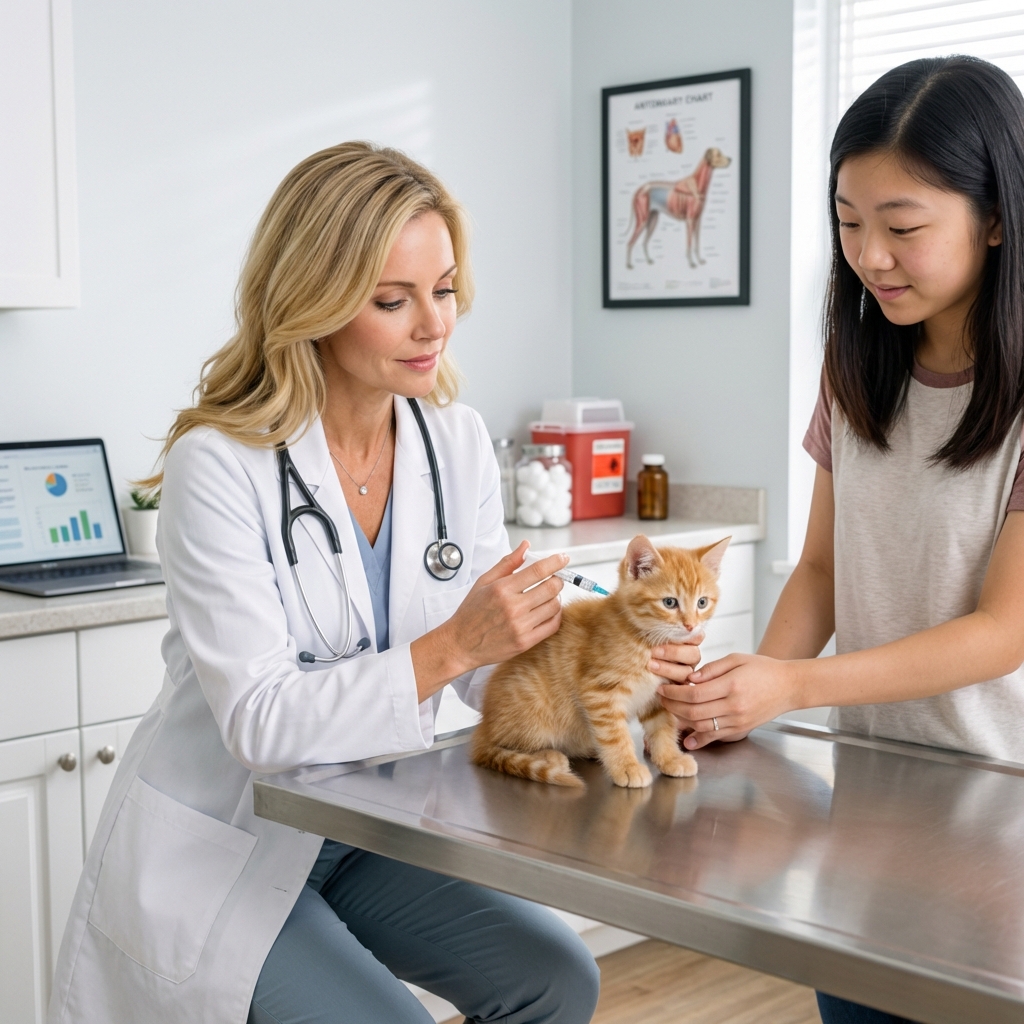
As a veterinary assistant here in Frisco, Texas, I hear this question all the time: “What shots does my cat actually need?” The honest answer is that every cat’s plan should be tailored to their lifestyle, age, and health, but there are clear guidelines most veterinarians follow.
This quick guide will help you understand the core vaccines nearly all cats need, which vaccines are lifestyle-based, and how to time them so your cat stays protected without overdoing it.
Core vaccines most cats need
Veterinary groups like the American Association of Feline Practitioners (AAFP) publish feline vaccination guidelines that divide vaccines into core and non-core. Core vaccines protect against diseases that are widespread, severe, and hard to avoid.
FVRCP (core combo)
You will often see this listed as FVRCP (feline viral rhinotracheitis, calicivirus, panleukopenia). It protects against three common and contagious illnesses:
- Feline panleukopenia virus (FPV): a serious, often deadly viral disease, especially in kittens.
- Feline viral rhinotracheitis (herpesvirus): upper respiratory disease that can flare up over a cat’s lifetime.
- Calicivirus: another major cause of feline upper respiratory illness, sometimes with mouth ulcers.
This is a core vaccine for both indoor and outdoor cats. Most exposure comes from contact with other cats (new cats in the home, foster situations, boarding, or vet visits), and some viruses can also be carried on hands, clothing, carriers, and other objects.
Rabies
Rabies vaccination is core because rabies is fatal and is a public health concern. Rabies rules vary by location. Many Texas municipalities and counties require rabies vaccination for cats, so check your local ordinance and your veterinarian’s guidance.
Even indoor-only cats can be exposed if a bat or other wildlife gets inside, or if your cat slips out the door.
Non-core vaccines (risk-based)
Non-core does not mean “unimportant.” It means your vet will recommend it when your cat’s exposure risk is higher.
FeLV (feline leukemia virus)
FeLV is spread mainly through close, cat-to-cat contact, especially saliva during grooming and shared spaces, and through bite wounds. The virus is fragile and does not survive long in the environment, so casual “surface” spread is not the usual concern. FeLV can lead to immune suppression, anemia, and cancer.
- Common recommendation: The AAFP considers FeLV vaccination core for kittens (even if they are expected to live indoors), then it becomes risk-based as they mature.
- Higher-risk cats: outdoor cats, cats who go on patios or supervised walks, cats living with FeLV-positive cats, and cats who may fight.
FIV (feline immunodeficiency virus)
You may see older references to an FIV vaccine. In the United States, it has been discontinued and is generally not available, and it was never a routine recommendation in most general practice settings. If you are concerned about FIV, talk with your vet about prevention strategies, especially limiting outdoor roaming and avoiding fights.
Bordetella
This is an occasional recommendation for cats with a known exposure risk, like during outbreaks in shelters, boarding facilities, or other high-density environments where respiratory disease is circulating. It is not routinely needed for the average house cat.
Chlamydia (Chlamydophila felis)
Sometimes added for cats with higher risk of certain respiratory infections, typically in multi-cat households or breeding settings where it is known to be a problem.
Quick schedule
Your veterinarian will tailor the schedule, and timing can vary by product label and your local regulations. These are common starting points.
Kittens (usually starting at 6 to 8 weeks)
- FVRCP: every 3 to 4 weeks until at least 16 weeks of age (sometimes to 20 weeks in higher-risk situations).
- Rabies: often given around 12 to 16 weeks (timing depends on local law and product label).
- FeLV: commonly a 2-dose series starting around 8 weeks for kittens.
Why so many boosters? Kittens have maternal antibodies that fade at different rates. That series helps make sure the vaccine “sticks” once those antibodies drop.
Adult cats (unknown history)
If you adopted an adult cat with no records, your vet will typically treat them like unvaccinated and start an initial series:
- FVRCP: 2 doses, spaced 3 to 4 weeks apart.
- Rabies: 1 dose (then boosters based on local law and the vaccine label).
- FeLV: often recommended if there is any chance of exposure, with 2 initial doses.
Boosters (ongoing)
After the initial kitten series or adult starter series, boosters depend on your cat’s risk and the product used:
- FVRCP: often boosted at 1 year, then every 1 to 3 years depending on risk and veterinary guidance.
- Rabies: boosted according to the labeled vaccine and local law (commonly 1-year initially, then every 1 or 3 years).
- FeLV: boosted yearly for at-risk cats.
Indoor cats and vaccines
I completely understand the thought: “My cat never goes outside, so why vaccinate?” Here is the reality we see in clinics:
- Door-dashing happens. Even a few minutes outside can mean exposure.
- Wildlife gets inside. Bats are a big rabies concern.
- Cat-to-cat exposure still happens. New cats, foster situations, boarding, grooming, or even a quick vet visit can increase risk.
For most indoor cats, FVRCP and rabies are the baseline conversation, and FeLV depends on the cat’s situation (and is commonly recommended for kittens).
Before vaccinating
FeLV/FIV testing
Before starting FeLV vaccination, many vets recommend testing for FeLV (and often FIV too), especially in newly adopted cats or cats with unknown exposure.
Health exam first
Vaccines are typically given when a cat is healthy. If your cat is sick, stressed, or running a fever, your vet may reschedule.
Vaccine reactions
Most cats do great. Mild sleepiness or a tender injection site for a day or two can be normal. Call your vet promptly if you notice:
- Facial swelling
- Vomiting or diarrhea shortly after vaccination
- Hives or intense itching
- Labored breathing
- Collapse or severe weakness
Important: If a lump appears where a vaccine was given, ask your veterinarian about the “3-2-1” rule for monitoring injection-site lumps: if it lasts 3 months, is larger than 2 cm, or is still growing 1 month after the shot, it should be checked.
Injection sites
You might notice your clinic gives certain vaccines in specific limbs. That is intentional. It helps with monitoring and follow-up if a vaccine-site lump ever develops.
Build the right plan
If you want the simplest next step, bring these details to your appointment:
- Indoor-only, indoor with patio access, or outdoor roaming
- Any new cats in the home, fostering, or frequent visitors with cats
- Boarding or grooming plans
- Travel plans (especially across state lines)
- Prior vaccine records (if you have them)
Then ask your vet two questions I love because they keep the plan clear and evidence-based:
- “Which vaccines are core for my cat, and why?”
- “Which ones are risk-based, and what risk are we preventing?”
Good vaccination is not about giving the most shots. It is about giving the right protection for your cat’s real-life risk.
Quick recap
- Core for most cats: FVRCP and rabies.
- Common risk-based vaccine: FeLV, and it is commonly recommended for all kittens.
- Schedule varies: kittens need a series; adults typically need an initial set and then periodic boosters.
- When in doubt: ask your veterinarian to tailor a plan based on risk, not routine.
If you are unsure where your cat falls, start with an exam and a simple risk conversation. That is usually all it takes to feel confident you are protecting your cat without guesswork.