
Know the difference between choking and coughing, what to check first, how to remove visible objects safely, when to use abdominal thrusts or back blows, and...
Article
•
Designer Mixes
What to Do If Your Dog Is Choking

Shari Shidate
Designer Mixes contributor
Choking is one of those emergencies that can go from scary to life-threatening in seconds. The good news is that many dogs can be helped quickly if you know what to look for and what to do next. As a veterinary assistant in Frisco, Texas, I have seen these moments happen fast, and I have also seen how calm, simple steps can save a life.
This guide walks you through how to recognize choking, what you can safely do at home, and when you need emergency veterinary care right away. This is first aid, not a substitute for veterinary care.
First: Is it choking or something else?
Not every coughing, gagging, or noisy breathing episode is a true airway obstruction. Dogs can gag from nausea or reflux, regurgitation, eating grass, respiratory infections, or throat irritation. But you should treat any suspected choking as urgent until you are sure your dog is stable.
Common signs of choking
- Pawing at the mouth or face
- Sudden distress while eating or chewing a toy
- Ineffective coughing, gagging, or retching with little or no air moving
- Excessive drooling or foamy saliva
- Difficulty inhaling, noisy breathing, or high-pitched breathing (stridor)
- Blue, gray, or very pale gums and tongue
- Collapse or severe weakness
Common signs it might be a reverse sneeze
- Repeated snorting or honking sounds
- Neck extended, elbows out, dog looks startled but stays able to stand
- Episode lasts seconds to a minute, then resolves
Also keep in mind that dogs with known airway issues (like a collapsing trachea or laryngeal paralysis) can look like they are choking and still need urgent evaluation.
If your dog’s gums are turning blue or your dog cannot breathe, assume choking and act immediately.
What to do right away
1) Stay safe and call for help
Your dog may bite unintentionally when panicking. If someone is with you, ask them to call your emergency vet or the nearest ER while you help the dog.
- Do not muzzle a dog that is struggling to breathe.
If you are alone, you may need to act first, then drive immediately. If you can, call the ER on the way so they can be ready.
2) Look quickly, only if it is safe
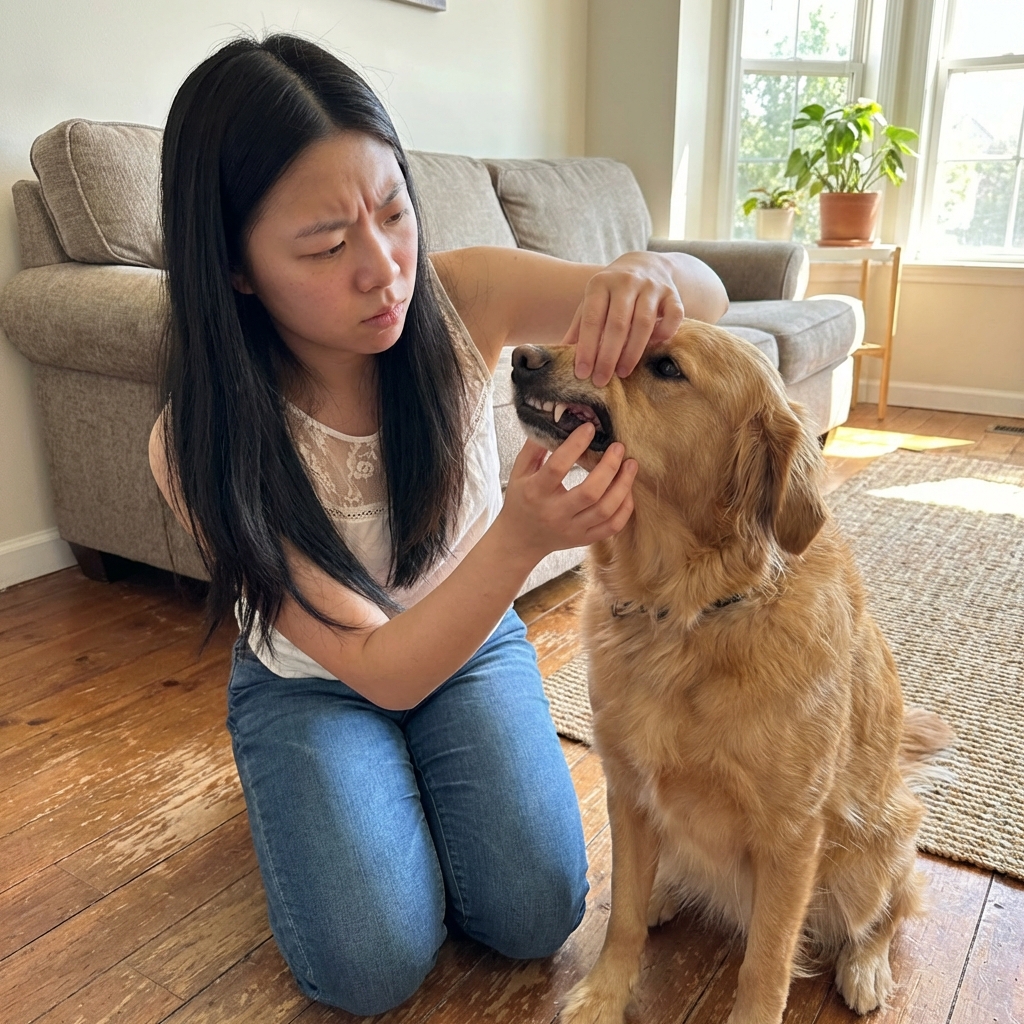
If your dog is conscious, open the mouth and look for an object you can clearly see and safely grasp.
- If you can see it and grasp it: Use your fingers to gently hook and pull it out.
- If you cannot see it clearly: Do not blindly sweep the mouth. You can push the object deeper and make the obstruction worse.
Avoid tools like tweezers or pliers unless you are trained and have excellent visibility. In real life, tools can slip and injure the mouth or throat.
Heimlich and other options
The Heimlich uses quick pressure to force air out of the lungs and hopefully expel the object. Use it when your dog is truly choking and cannot breathe adequately.
Important safety note: Abdominal thrusts can cause injury. Use only when you believe your dog is choking and cannot move air. Use extra caution and consider faster transport and an immediate call to the ER if your dog is pregnant, has known abdominal trauma, recently had abdominal surgery, or is a very tiny toy breed.
For small dogs
Some small dogs respond well to back blows first, especially if they are too tiny for strong abdominal thrusts.
- Hold your dog with their chest in your palm and their back against your other hand, keeping the head and neck supported.
- Angle the head slightly downward if you can do so safely.
- Give 5 firm back blows between the shoulder blades.
- Check the mouth. Remove the object only if you can clearly see it.
If your dog is still choking, move to thrusts:
- Hold your dog with their back against your chest if possible.
- Make a fist and place it just below the ribcage (the soft belly area behind the ribs).
- Give 5 quick inward and upward thrusts.
- Stop and check the mouth. Remove the object only if you can clearly see it.
For medium and large dogs
- Stand behind your dog. If your dog is lying down and cannot stand, you can still do thrusts with your dog on their side.
- Place your arms around the abdomen, just behind the ribcage.
- Make a fist, place it in the soft area behind the ribs, and grab your fist with your other hand.
- Give 5 quick inward and upward thrusts, like you are trying to lift the dog’s belly toward the spine and chest.
- Check the mouth after each set.
For brachycephalic or barrel-chested dogs
Some dogs (like Bulldogs and other broad-chested or brachycephalic breeds) can be trickier to position. If standard abdominal thrusts are not working, you can try chest thrusts:
- Place your hands on either side of the chest, over the widest part.
- Compress the chest firmly and quickly 5 times.
- Check the mouth and repeat if needed.
If you are unsure about technique, ask your veterinary team to demonstrate during a wellness visit. It is much easier to learn when no one is panicking.
When to stop and go
If there is no improvement after 2 to 3 cycles (a cycle is 5 blows or 5 thrusts, then a quick mouth check), start transport to the ER immediately and call on the way. If you have a passenger, you can continue attempts while someone else drives.
If your dog becomes unconscious, you are in a true emergency. Go to the ER immediately and begin CPR if you are trained. Even if your dog seems fine after the object comes out, your vet should still check them.
If your dog collapses
If your dog is unresponsive, this is not a wait and see moment.
Quick steps
- Check breathing by watching the chest and feeling for airflow at the nostrils.
- Check gum color: pink is good, pale or blue is bad.
- Open the mouth and look: remove the object only if you can see it.
- Get moving: have someone drive while you monitor the dog.
- Call the ER on the way if you can.
If you know canine CPR, begin CPR while someone else drives or while you wait for a ride. If you do not, focus on fast transport. Seconds matter.
After: why a vet visit matters
Even when the object comes out, dogs can have irritation, swelling, or injury to the throat. Sometimes small pieces remain behind. In other cases, aspiration can occur, meaning saliva, food, or material is inhaled into the lungs, which can lead to aspiration pneumonia over the next few days.
Go to a vet urgently if you notice
- Coughing that continues or worsens after the event
- Labored breathing, noisy breathing, or persistent high-pitched breathing
- Lethargy, weakness, or collapse
- Refusing food or water
- Fever or acting unwell in the next several days
Choking hazards and prevention
Prevention is not about never letting your dog enjoy life. It is about choosing safer options and supervising the risky ones.
High-risk items
- Chunks of rawhide or digestible chews once they get small
- Bones that splinter or are small enough to lodge in the throat
- Round, slippery foods like meatballs, large blueberries for tiny dogs, cherry tomatoes, or big chunks of apple
- Hard rubber balls that perfectly fit the back of the throat
- Small toys, squeakers, or ripped plush toy stuffing
Important: Grapes and raisins are potentially toxic to dogs and should not be fed at all, even if cut into smaller pieces.
Safer habits
- Choose chews sized appropriately for your dog, and remove them when they become small
- Supervise chewing, especially for power chewers
- Use puzzle feeders or slow feeders for dogs who inhale food
- Cut slippery foods into thin slices or small pieces
- Keep trash secured. Many choking emergencies begin in the kitchen
Home tip: If your dog is a fast eater, try feeding smaller, more frequent meals. Speed eating increases choking risk and can also increase regurgitation and stomach upset.
What not to do
- Do not do a blind finger sweep in the throat.
- Do not delay care if gum color is pale or blue.
- Do not assume your dog is fine just because the object came out.
- Do not offer food or water immediately after choking. Your dog may have throat swelling or injury.
Make a plan now
In an emergency, you do not want to be searching online with shaky hands. Take five minutes today to set yourself up for success.
- Save your veterinarian’s number in your phone.
- Save the closest 24-hour emergency hospital number and address.
- Keep a pet first-aid kit accessible, including a flashlight.
- Consider taking a pet first-aid and CPR class in your area.
If you ever suspect your dog is choking and you are unsure, it is always okay to treat it as an emergency and get help. Your dog’s airway is not the place to guess.