
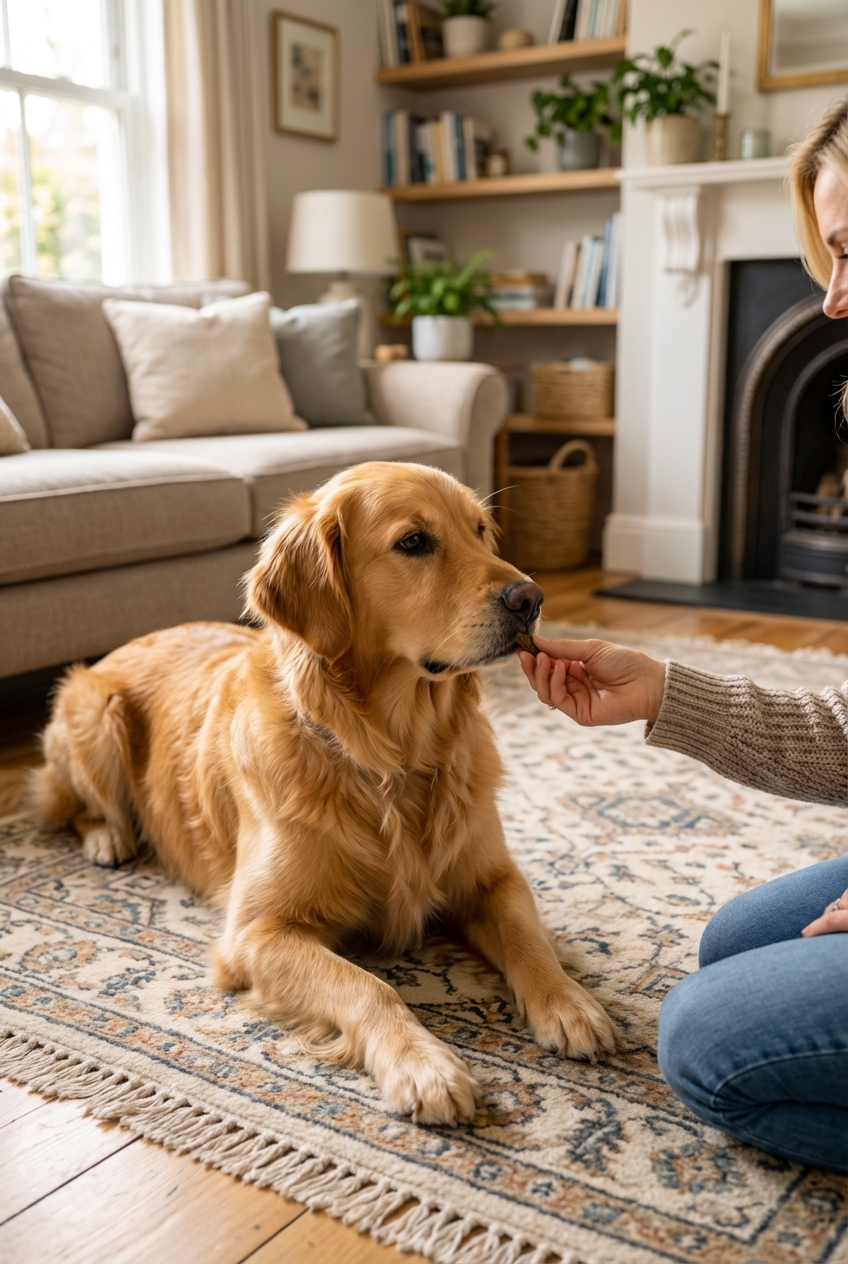
Teach a reliable “Down” with simple lure, capture, or shaping methods. Learn how to add a cue and release word, build duration, troubleshoot issues, and ...
Article
•
Designer Mixes
Train Dog to Lie Down: Must-Know Tips

Shari Shidate
Designer Mixes contributor
Teaching a dog to lie down on cue is one of those skills that looks simple, but it can solve a whole list of real-life problems. A reliable “down” helps with polite greetings, staying calm around distractions, and building impulse control for everything from door manners to leash walking.
As a veterinary assistant, I also love this cue because it can support safe handling at home. When your dog understands how to settle their body on request, you can more easily check paws, look at ears, brush, or administer vet-recommended care with less stress.
What “down” really means
In training terms, “down” means your dog places their elbows and chest on the floor and stays there until released. The release word matters. Without it, many dogs pop right back up because they do not understand the duration part yet.
Pick your words and stick with them
- Cue: “Down” (or “Lay down” if that is your chosen cue, but pick one and stay consistent).
- Release: “Okay,” “Free,” or “All done.”
- Marker: “Yes” or a clicker to tell your dog the exact moment they did it right.
Consistency is where the magic happens. Same cue, same hand signal (if you use one), same release word.
Before you start: comfort and safety check
If your dog seems reluctant to go down, it is not always a training attitude issue. Sometimes it is physical discomfort.
- Surface matters: Many dogs dislike slippery floors. Start on carpet, grass, or a yoga mat.
- Body comfort: Senior dogs or dogs with arthritis, hip dysplasia, elbow pain, or recent surgery may struggle. If lying down looks stiff, slow, or painful, talk with your veterinarian before pushing this cue.
- Reward choice: Use small, soft treats that are easy to chew quickly, so your dog stays engaged.
The easiest method: lure into a down
This is the go-to approach for many dogs because it is clear and gentle. You are guiding your dog into position using a treat, then paying them the moment they succeed.
Step-by-step
- Start in a sit (optional but helpful for beginners).
- Bring a treat to your dog’s nose, then slowly move it straight down toward the floor.
- Once their nose follows, slide the treat forward a few inches along the floor so their body naturally folds into a down.
- Mark the instant elbows hit the ground: say “Yes” or click.
- Reward right between the front paws to keep the down position strong.
- Release after one second: “Okay.” Then reset and repeat.
Pro tip: Move the treat slowly. Fast lures can make dogs hop, paw, or get frustrated.
If your dog backs up or will not go down
Some dogs avoid the down because they feel vulnerable, they are unsure what you want, or your lure is pulling them out of position.
Try these fixes
- Use a low space: Practice next to a sofa or under a coffee table edge (safely). Many dogs naturally lower themselves in a slightly confined space.
- Switch surfaces: Grass outside or a thick rug inside can be a game changer.
- Smaller lure motion: Go down, then slightly forward. If you go too far forward, your dog may stand to follow.
- Reward partial progress: First reward a head dip, then elbows bending, then elbows down. Shaping builds confidence.
Training should feel like a puzzle your dog can win, not a test they keep failing.
Add the cue the right way
A common mistake is saying “down” over and over while luring. Instead, teach the motion first, then attach the word.
Simple cue timing
- Do a few successful lures.
- Right before you move your hand down, say “Down” one time.
- Lure, mark, reward, release.
After your dog is predicting what comes next, start fading the lure by using an empty hand motion and rewarding from your other hand or pocket.
Build duration: teach your dog to stay down
A down that lasts one second is a start, but the real value is a dog who can relax in that position while life happens.
Duration plan
- Ask for down.
- Feed one treat between the paws while your dog is still holding the position.
- Wait 1 to 2 seconds.
- Feed another treat between the paws.
- Release (“Okay”), then reset.
- Repeat and slowly increase the time between treats: 3 seconds, 5 seconds, 8 seconds.
Important: Early on, avoid letting your marker become the signal that the exercise is over. If your dog tends to pop up when they hear “Yes” or a click, save the marker for the first moment they hit the down, then switch to calm treat delivery between the paws to build duration. Release is what ends the behavior.
Generalize: make “down” work anywhere
Dogs do not automatically apply cues everywhere. A perfect living-room down may disappear at the park. That is normal.
Change one thing at a time
- Locations: kitchen, backyard, driveway, quiet park.
- Distance: one step away, then two, then across the room.
- Distractions: toy on the floor, someone walking by, mild sounds.
When you raise difficulty, lower your expectations. If your dog struggles, go back a step and rebuild success.
Hand signal (optional, but helpful)
Many dogs respond beautifully to a visual cue, especially in noisy environments.
- Common signal: palm facing down, moving toward the floor.
- Use the same motion every time.
- Pair it with the verbal cue until your dog understands both.
Common mistakes that slow progress
- Repeating the cue: “Down, down, down” teaches your dog to wait until the third or fourth time.
- Pushing on the shoulders: This can create fear or avoidance. Use guidance and rewards, not force.
- Long sessions: Keep it short and upbeat. Think 3 to 5 minutes.
- No release word: Your dog cannot learn duration clearly without a consistent “you are done” cue.
Troubleshooting: quick answers
My dog crawls forward instead of lying down
Reward when elbows touch, then deliver the treat between the paws. If your dog keeps creeping, place your treat hand closer to the chest and lure less forward.
My dog lies down, then pops up immediately
You are probably rewarding too late or releasing too soon. Reward in position, feed between the paws, and build duration in tiny steps before you ask for more.
My dog will not lie down outside
Outside is harder. Use higher-value treats, reduce distractions, and practice on grass or a mat. Start with easy wins, then gradually work up.
My small dog seems to hate the down position
Some dogs feel vulnerable. Pair downs with calm, gentle rewards and safe environments. Never force. If discomfort is possible, consult your vet.
A simple 7-day “down” plan
If you like structure, here is an easy weekly approach. Adjust slower if your dog needs it.
- Days 1 to 2: Lure into down, reward immediately, release. 10 reps per day.
- Days 3 to 4: Add the cue once before the lure. Begin fading the lure. Add 2 to 3 seconds of duration with calm treat delivery while your dog stays down.
- Days 5 to 6: Practice in a second location. Reward duration up to 5 to 10 seconds.
- Day 7: Add gentle distractions and a little distance. Keep success high with good treats.
Remember, the goal is not perfection in a week. The goal is a confident dog who understands the game.