
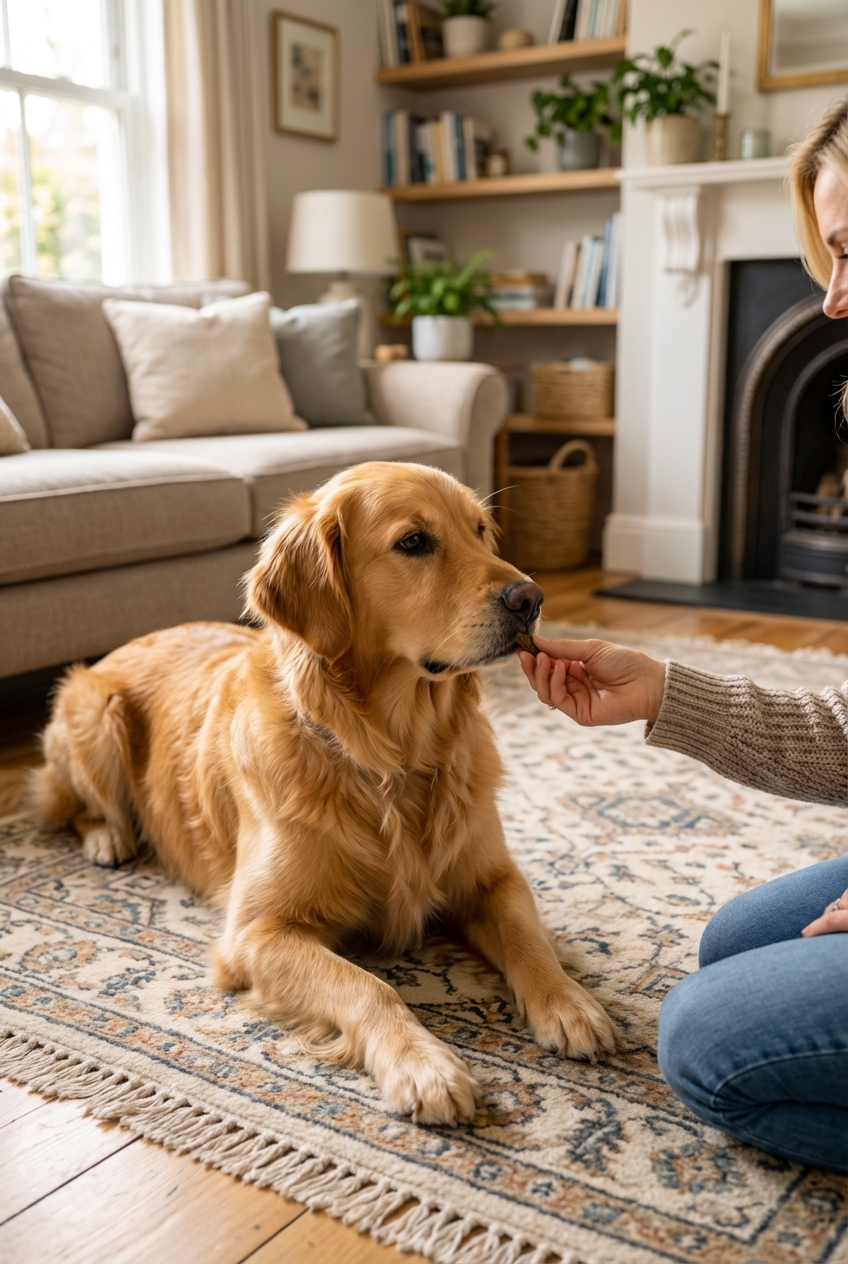
Teach a reliable “Down” with simple lure, capture, or shaping methods. Learn how to add a cue and release word, build duration, troubleshoot issues, and ...
Article
•
Designer Mixes
Teach Your Dog to Lie Down

Shari Shidate
Designer Mixes contributor
Teaching “down” is one of my favorite basic skills because it helps dogs settle, focus, and feel safe. From a veterinary assistant point of view, it is also a practical life skill. A dog who can calmly lie down on cue is often easier to examine, groom, and handle during everyday care.
This quick guide will walk you through simple, reward-based steps you can start today, even if your dog is wiggly, easily distracted, or new to training.
Quick note: “Down” means lie down. If you also use “down” to mean “get off the couch” or “don’t jump,” pick a separate cue like “Off” for that. Clear cues help dogs learn faster.
Before you start
Keep sessions short and upbeat
Aim for 3 to 5 minutes, 1 to 3 times a day. Many dogs learn faster with short, successful sessions than with long drills.
Pick the right rewards
Use soft, pea-sized treats your dog can swallow quickly. Many dogs also love praise, gentle petting, or a quick toy toss as a reward. If your dog is not food-motivated, try training before a meal.
Set up the environment
- Start on a non-slip surface like carpet, a yoga mat, or a bath mat.
- Choose a low-distraction space.
- If you have a large or senior dog, a soft rug can help reduce joint pressure.
The fastest method: lure into down
This method uses a treat to guide your dog into the position. It is simple and usually very quick for beginners.
Step-by-step
- Start in “sit” if your dog knows it. If not, you can start from standing.
- Hold a treat at your dog’s nose.
- Slowly move the treat down toward the floor, then slightly forward between the front paws.
- The moment your dog’s elbows touch the floor (chest down, all the way down), say “Yes” (or click) and give the treat.
- Repeat 5 times, then take a break.
Tip: Move the treat slowly. If you move too fast, many dogs pop up, paw at your hand, or get frustrated.
Add the cue word at the right time
Many people accidentally say “down” over and over while the dog is still figuring it out. A clearer approach is to add the cue once the motion is predictable.
When to add “down”
- After your dog successfully follows the lure into a down 8 out of 10 times.
How to add it
- Say “Down” once.
- Pause for half a second.
- Do the lure motion.
- Mark and reward when elbows hit the floor.
After a few sessions, start making the lure smaller so your dog responds more to the word and your hand signal than to the treat itself.
Fade the lure and build a real behavior
The goal is for your dog to lie down even when you do not have a treat in your fingers.
Try this simple progression
- Lure: treat in hand guides the dog.
- Empty hand: same hand motion, but treat comes from the other hand or your pocket after the mark.
- Hand signal: smaller motion, like pointing down.
- Verbal cue: “Down” with minimal movement.
If your dog struggles at a new step, simply go back one level and rebuild confidence.
Training tip: Keep the total reps low enough that your dog stays happy. Stop before frustration, and end on a win.
Common problems and quick fixes
“My dog just sits or stands there.”
- Use a higher value treat (tiny bits of chicken, turkey, or cheese).
- Train when your dog is slightly hungry.
- Practice after a short walk when energy is lower.
“My dog backs up instead of lying down.”
- Lure straight down first, then slightly forward.
- Try next to a couch or wall so there is less room to scoot backward.
“My dog goes into a play-bow but not all the way down.”
- Reward the bow briefly, then lower your lure closer to the floor and wait a beat.
- Sometimes switching to a softer surface helps a dog who is hesitant to put elbows down.
“My dog seems uncomfortable lying down.”
If your dog is reluctant to lie down, especially a senior dog, a large breed, or a dog with a history of injury, consider joint discomfort. Choose a padded surface and keep reps low. If you notice limping, stiffness, yelping, or a sudden change in willingness, check in with your veterinarian.
“My dog will not down from a sit.”
- Try from standing: Some dogs find it easier to fold into a down from a stand.
- Use a mat: Practice on a comfy mat or rug to make the position more inviting.
- Capture it: If your dog lies down on their own, calmly say “Yes,” deliver a treat to them on the floor, then start pairing the cue once it happens often.
Make it useful: real-life practice
Dogs learn best when they understand the skill works in different places, not just in the kitchen.
Where to practice
- Living room
- Backyard
- Front porch
- On leash at a quiet park
- During TV time as a “settle” moment
Down vs. settle: “Down” is the position. “Settle” is the relaxation that can come after. Once your dog knows down, you can reward calm breathing, a hip roll, or a head resting down to build a true settle.
Build duration slowly
Once your dog can lie down on cue, begin rewarding for staying down:
- Reward at 1 second, then 2 seconds, then 5 seconds.
- Add a release word like “Okay” so your dog knows when the down is finished.
Vet-assistant bonus: A down on a mat can become a cooperative care routine for gentle handling, brushing, and quick body checks at home.
Safety notes
- Avoid forcing your dog into position by pushing on the shoulders or back. It can create stress and can be uncomfortable.
- For brachycephalic dogs like Bulldogs and Pugs, keep sessions short, avoid training in heat, and monitor breathing. If your dog sounds strained, struggles to recover, or seems distressed, stop and let them rest.
- Puppies have short attention spans. Keep it fun and end while they are still winning.
Kind training builds trust. Trust is what makes skills like “down” reliable when you truly need them.
A simple 7-day plan
Days 1 to 2
- Practice luring into down for 3 minutes, twice daily.
Days 3 to 4
- Add the cue “Down” right before you lure.
- Start using an empty hand every other repetition.
Days 5 to 6
- Fade the lure further and reward from your pocket.
- Practice in one new location.
Day 7
- Begin duration: reward after 1 to 3 seconds down.
- Add your release word.
If it takes longer than a week, that is totally normal. The goal is steady progress, not perfection.
Want the “why” behind reward-based training? The American Veterinary Society of Animal Behavior (AVSAB) has a clear position statement supporting reward-based methods and cautioning against punishment-based techniques.