
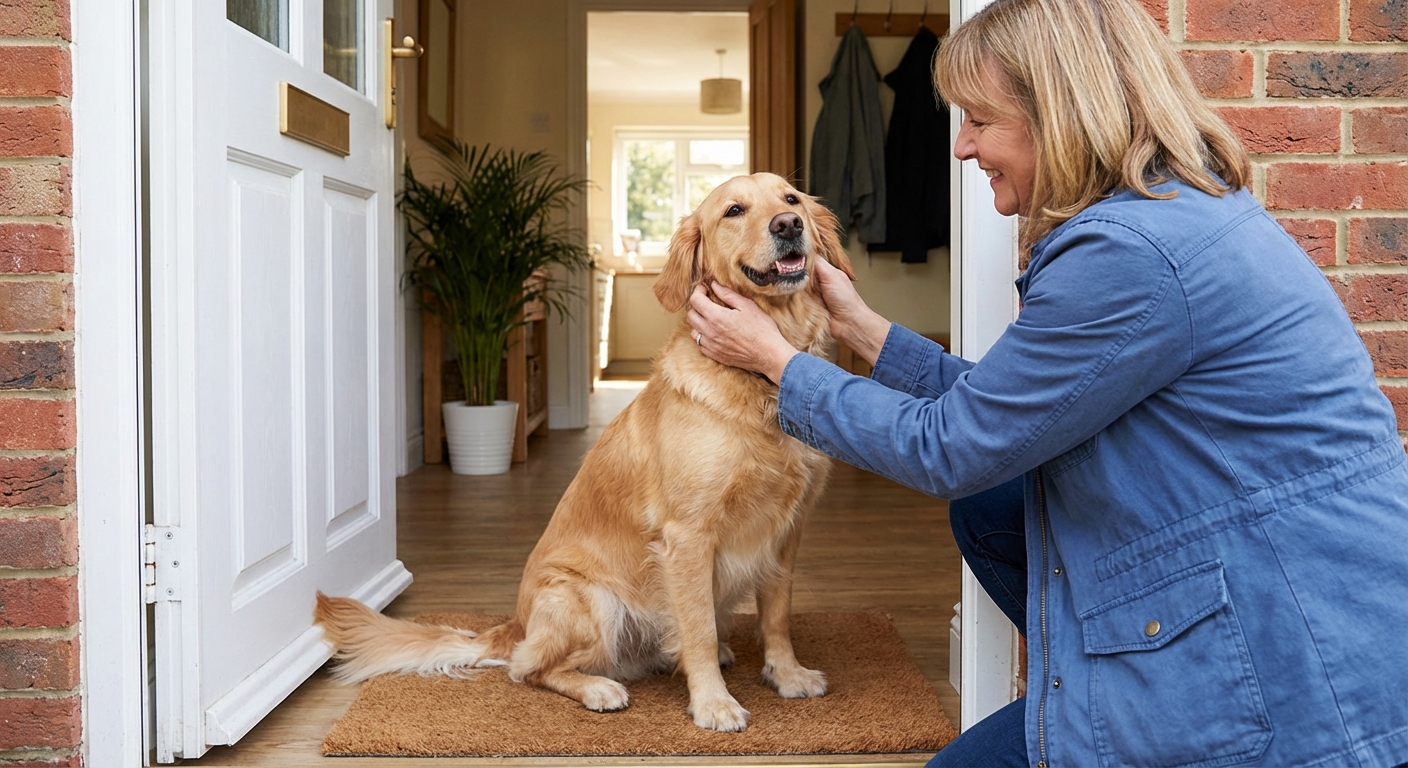
Jumping isn’t dominance—it’s a rewarded greeting habit. Learn vet-approved, positive steps to stop it: ignore jumps, reward four paws down, teach sit/m...
Article
•
Designer Mixes
Teach Your Dog Not to Jump

Shari Shidate
Designer Mixes contributor
Jumping is one of the most common “oops” behaviors I see in friendly pet dogs, especially social, people-loving mixes. The good news is you do not need harsh corrections to fix it. You can teach a polite greeting step-by-step, using clear cues, consistency, and rewards that make sense to your dog.
As a veterinary assistant, I also want to share a quick safety note: jumping is not just a manners issue. It can lead to scratches, knocked-over kids or seniors, and it can be harder on dogs with arthritis, prior injuries, or other orthopedic concerns. Teaching a calm greeting helps everyone.
Why dogs jump
Dogs jump because it often works. For some attention-seeking dogs, even “No!” can be rewarding because it still brings eye contact, talking, touching, or movement. If your dog has learned that jumping makes humans engage, the behavior sticks.
- Greeting is exciting: Your arrival spikes arousal and your dog’s body wants to move.
- Face-to-face access: Jumping gets them closer to your hands and face.
- Inconsistent rules: Some people allow it, others do not, so the dog keeps trying.
Set up for success
Pick one goal behavior
Choose what you want your dog to do instead of jumping. The easiest options are:
- Sit for greetings
- Four paws on the floor (standing calmly)
- Go to mat when the door opens
Choose rewards that matter
Use small, soft treats your dog loves, or a favorite toy if that is more motivating. For many dogs, the best reward is still attention, but you will deliver it only when paws are on the floor.
Manage the environment for 1 to 2 weeks
Training goes faster when jumping is not being “paid” in the meantime.
- Keep a leash by the door for arrivals.
- Use baby gates or an exercise pen if your dog rushes the entryway.
- Ask guests to ignore jumping completely and reward calm behavior.
Household rule: Everyone needs to respond the same way, every time. If one person rewards jumping with attention, the behavior will keep coming back.
Size note: For large dogs, prioritize management first (leash, gate, mat work) to prevent injuries. For small dogs, protect them from getting stepped on during busy door greetings and consider greeting behind a gate until things settle.
Teach four paws on the floor
This is my favorite starting plan because it is simple and works for many dogs.
Step 1: Capture paws-down
Stand still. The moment your dog has four paws on the floor, calmly drop a treat to the ground between their front paws. Repeat until your dog starts offering paws-down quickly.
- Tip: Dropping the treat down low keeps the dog’s head and body down, which makes jumping harder.
Step 2: Add attention as the reward
When your dog has four paws down, give a treat and then brief calm petting or a soft “Hi!” If they jump, attention stops and you become boring again.
Step 3: Practice real-life triggers
Many dogs jump when you move your hands, bend over, or talk excitedly. Practice tiny “real life” moments:
- Reach toward the collar, then reward if paws stay down.
- Take one step away and come back, reward paws-down.
- Pick up your keys, reward paws-down.
Step 4: Add the door
Work at the front door with your dog on leash.
- Touch the doorknob. If paws stay down, treat.
- Open the door one inch. Paws down, treat.
- Open the door wider. Paws down, treat.
- Step outside and back in. Paws down, treat.
If your dog jumps at any point, simply close the door and reset. Your dog learns: calm makes the door open.
If your dog is struggling: make it easier. Increase distance from the door, lower your criteria, and reward calm behavior like simply standing with four paws down or even looking at the door calmly.
Teach sit to say hi
If your dog already knows “sit,” this can be a fast win. The key is that sitting makes attention happen.
Step 1: Ask for sit before greeting
Approach your dog. If all four paws stay on the floor, cue “sit.” The moment their bottom hits the floor, reward with a treat and calm petting.
Step 2: If they jump, pause the greeting
Do not scold. Just stand up straight, turn slightly away, and wait. When four paws return to the floor, cue “sit” again.
Step 3: Add visitors gradually
Start with someone your dog is only mildly excited about. Keep sessions short and predictable:
- Visitor enters quietly.
- Dog sits.
- Visitor delivers one treat low and gives one calm pet.
- Visitor steps away for a reset.
Teach go to mat
This is ideal for dogs who explode at the door. You are giving them a job and a predictable routine.
Step 1: Build value for the mat
Place a washable mat or bed near the entryway. Toss a treat on the mat. When your dog steps onto it, toss another. Keep it upbeat and easy.
Step 2: Add a cue
When your dog is reliably moving to the mat, say “Mat” (or “Place”) right before they step onto it, then reward.
Step 3: Add duration
Feed multiple small treats while your dog stays on the mat. Start with 2 seconds, then 5, then 10.
Step 4: Add a release word
Add a simple release cue like “Okay” to let your dog know when they are done. Reward on the mat, say “Okay,” and toss a treat away from the mat to reset.
Step 5: Practice the door routine
Knock lightly or ring the bell sound on your phone. Cue “Mat.” Reward. Then touch the knob. Reward again. Over time, your dog learns that the bell predicts “go to mat,” not “launch at the guest.”
Tip: If your dog does not go to the mat, avoid repeating “Mat” over and over. Reset, make it easier (closer mat, higher value treats, less distraction), and try again.
In the moment: when your dog jumps
Real life happens. Here is a simple emergency plan that protects training:
- Freeze: Stand still, arms close to your body.
- Look away: Remove eye contact.
- Be quiet: Attention can be rewarding, even negative attention, for some dogs.
- Reward the reset: The instant paws hit the floor, treat low and praise calmly.
If your dog is large or intense, use a leash, gate, or a crate break during high-traffic times. Management is not failure. It is part of smart training.
Guest safety tip: Ask visitors to turn slightly sideways and keep hands low. Some dogs jump more if people step backward quickly, which can trigger chasing and bouncing.
Kids: Adult supervision matters. Do not have children deliver treats or manage the leash unless you are confident it is safe. Use a gate or leash so greetings stay calm and controlled.
Common mistakes
- Treating too late: If the treat comes after the jump, your dog may connect the reward to the jumping, not the paws-down moment.
- Rewarding high: Treats delivered near your chest can cue bouncing. Reward low, between the front paws.
- Excited voice: High energy “Hi baby!” can rev some dogs up. Calm voice helps.
- Bending over too soon: Leaning in can trigger jumping. Stay upright until your dog is steady.
- Inconsistent follow-through: Everyone should use the same plan, including frequent guests.
Quick behavior notes
- Jumping is normal puppy behavior that often gets accidentally reinforced because it is cute at 12 weeks and not so cute at 12 months.
- Dogs repeat what gets rewarded. Even a quick pat can pay the behavior if it happens right after a jump.
- Treat placement matters. Rewarding low helps keep paws on the floor.
- Overtired dogs jump more. Just like toddlers, some dogs lose impulse control when they need rest.
Troubleshooting
“My dog only jumps on guests, not on me.”
That is very common. Your dog has practiced with you, but guests are extra exciting. Rehearse with “fake guests” and coach visitors ahead of time. Keep treats in a bowl by the door so guests can reward the first moment of calm.
“My dog jumps even when I ignore him.”
Ignoring works best when it is consistent and the dog has a clear alternative that earns rewards. Teach “sit” or “mat” proactively, and pay generously for calm behavior at first.
“My dog gets mouthy when excited.”
Mouthiness often travels with jumping. Give your dog a safe outlet:
- Hand them a toy as you enter.
- Scatter a few treats on the floor to encourage sniffing and calming.
- Keep greetings short and calm.
“My dog is anxious at the door.”
If jumping comes with barking, pacing, or frantic behavior, consider working with a qualified force-free trainer. In some cases, anxiety needs a broader plan.
Safety notes
If jumping is new or escalating suddenly, it can sometimes be associated with pain, sensory changes, stress, or a change in routine. Consider a veterinary check if you also notice limping, stiffness, irritability, sleep changes, or a big shift in appetite.
For dogs with known joint issues, heart disease, or seniors who get winded easily, choose low-impact greeting behaviors like “go to mat,” keep excitement controlled, and avoid repetitive jumping practice.
7-day practice plan
- Days 1 to 2: Reward four paws on the floor inside the house, no door work yet.
- Days 3 to 4: Add doorknob and door-crack practice on leash.
- Days 5 to 6: Add one calm “fake visitor” session with a friend.
- Day 7: Try a real visitor with management tools (leash or gate) and a treat bowl by the door.
Progress is not linear. If your dog backslides, it usually means the situation got harder faster than their skills. Go back one step, practice, and try again.