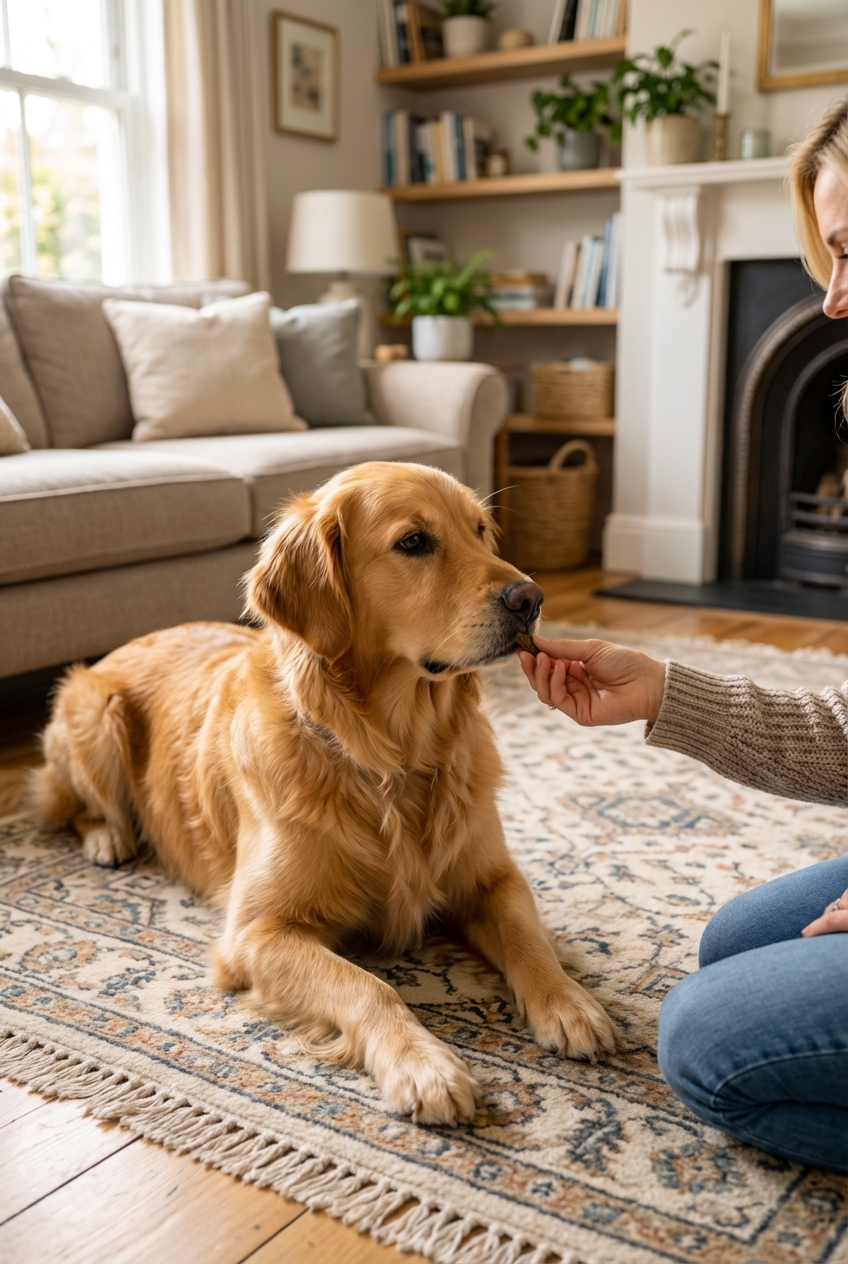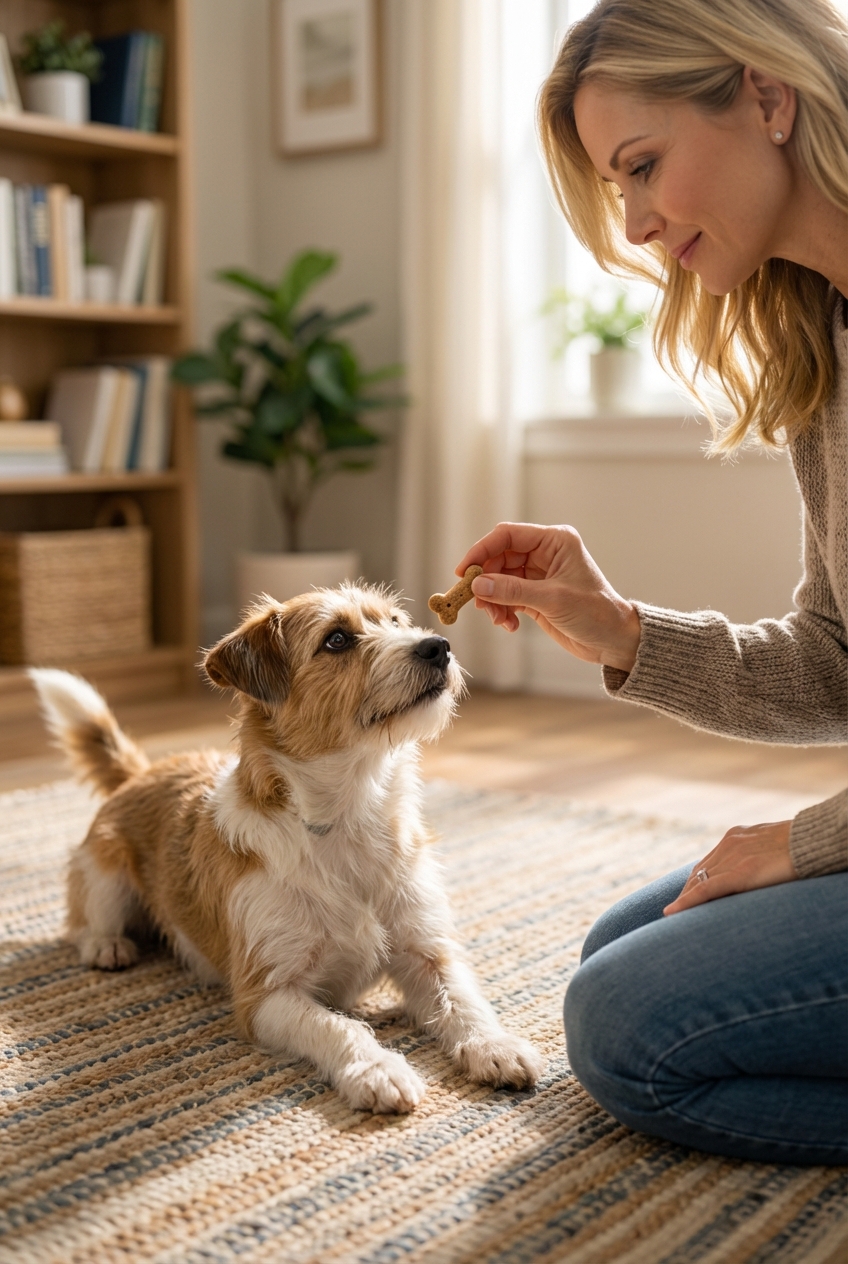
Teach a reliable “down” with calm, positive training. Try luring from sit, the under-the-leg method, or capturing, then add a cue, duration, a release wo...
Article
•
Designer Mixes
Teach a Dog to Lie Down

Shari Shidate
Designer Mixes contributor
“Down” is one of those cues that quietly makes life better with a dog. It helps with greetings, vet visits, impulse control, and calming big feelings. As a veterinary assistant here in Frisco, Texas, I also love it because a dog who can settle into a down is often easier to examine and less stressed during handling.
The best part is that teaching down does not have to be a wrestling match. With a few tiny steps and the right rewards, most dogs learn quickly and happily.
Before you start
What you need
- Soft, pea-sized treats your dog truly loves
- A clicker or a consistent marker word like “Yes”
- A non-slip surface like carpet, a yoga mat, or a rug
- 2 to 5 minutes of quiet time
Pick the right time
Train when your dog is not overly hungry, overly full, or wired. If your dog just did a quick walk or sniff session, that is often perfect because their brain is ready to focus.
Safety and comfort matter
If your dog avoids lying down, seems stiff, or pops back up immediately, consider comfort first. Slippery floors, sore joints, long nails, or anxiety can make down feel unsafe. If you suspect pain, check in with your veterinarian before pushing training.
The easiest method: Lure from sit
This is my go-to approach for most family dogs because it is simple and clear.
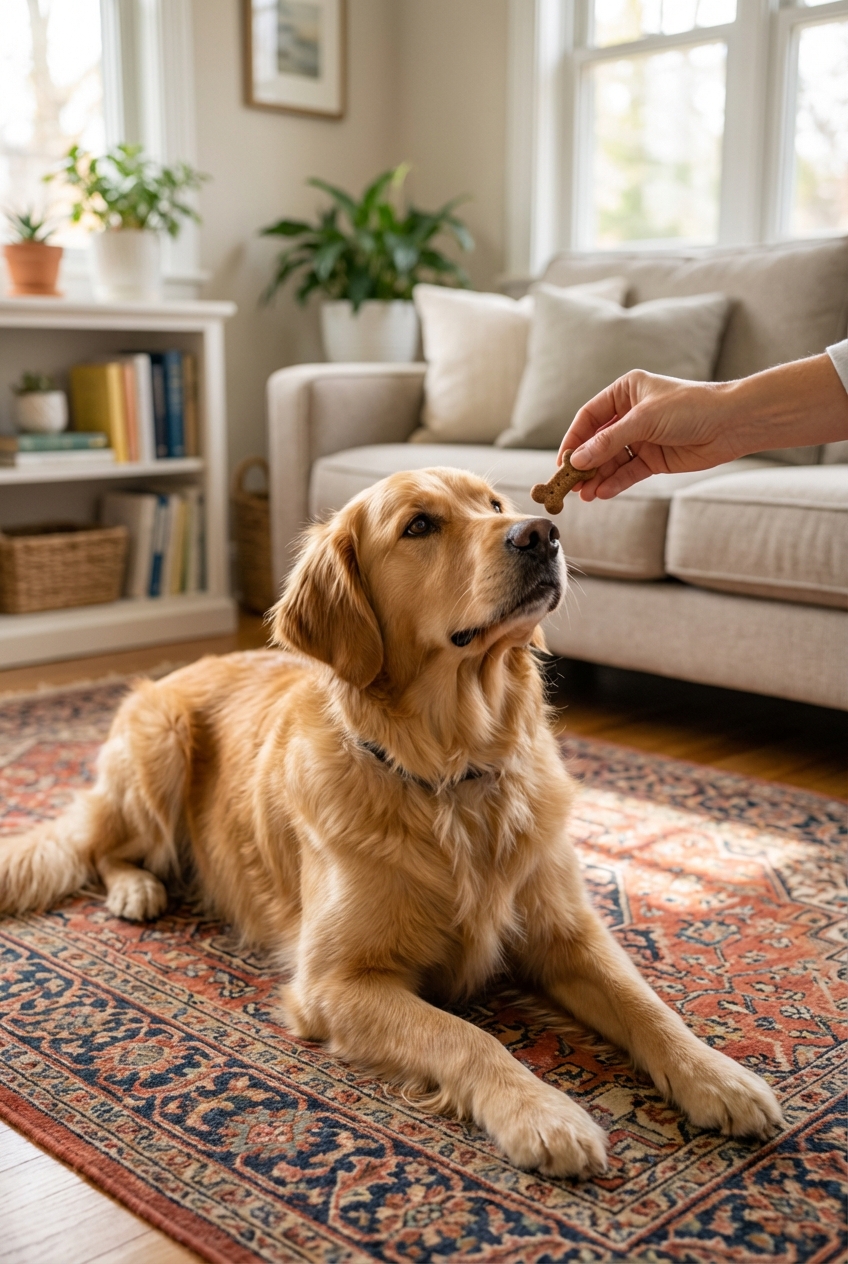
- Start in a sit. Hold a treat right at your dog’s nose.
- Move the treat straight down toward the floor, slowly.
- Then move the treat slightly forward along the floor between your dog’s front paws. This forward motion encourages elbows to fold down.
- Mark the moment both elbows touch the ground. Click or say “Yes.”
- Reward low. Deliver the treat between the paws to keep the down position strong.
- Reset calmly. Toss one treat a few feet away so your dog stands up and returns for the next repetition.
When to add the word “Down”: Wait until your dog is reliably following the hand motion. Then say “Down” once, pause half a second, and do the lure. Over time, fade the lure into a smaller hand signal.
If your dog keeps standing up, try this instead
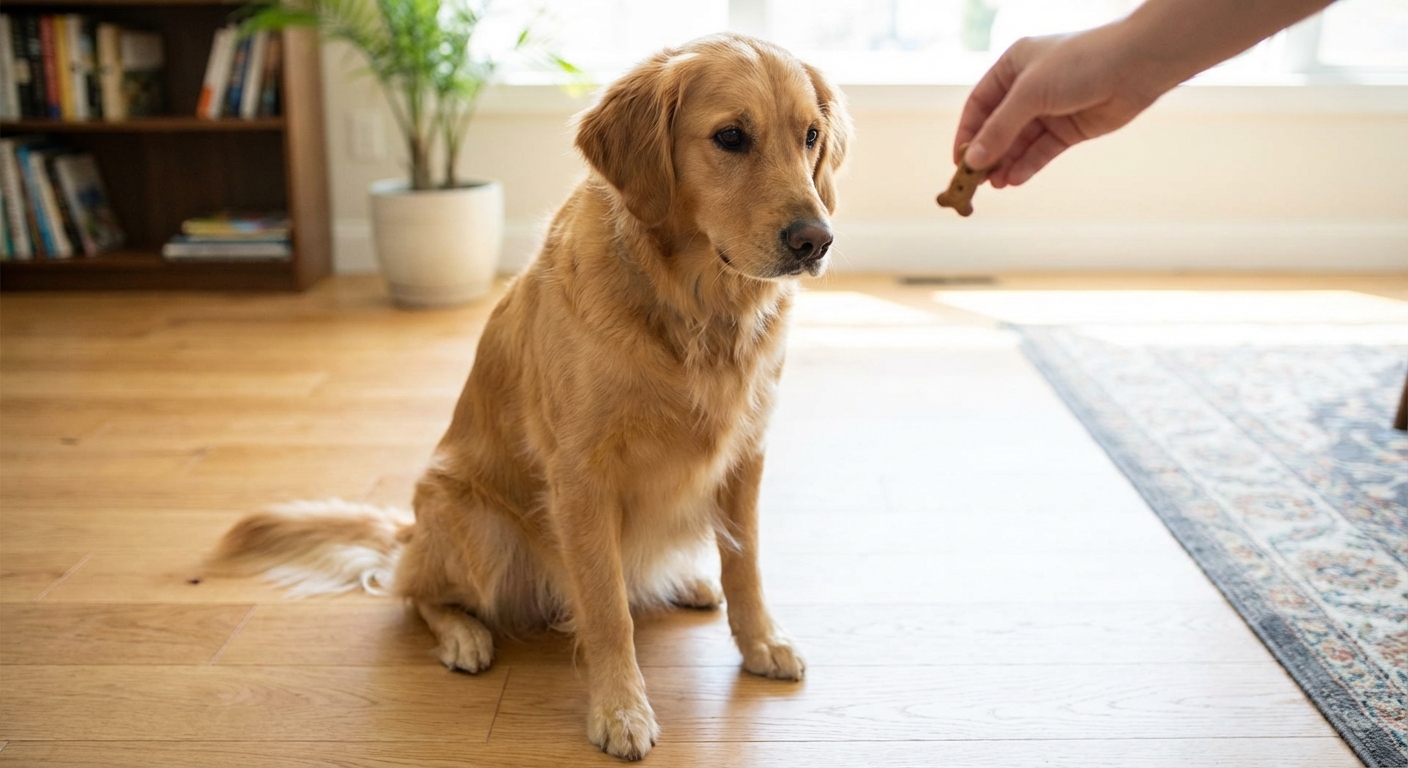
Option 1: Lure from a stand
Some dogs find it easier to fold into a down from standing rather than sitting, especially long-bodied dogs.
- Start with your dog standing.
- Bring the treat to the nose, then down to the floor.
- Move the treat slightly back toward the dog’s chest. Many dogs will “fold” down to reach it.
- Mark and reward when elbows hit the floor.
Option 2: Capture the behavior
If your dog naturally lies down during the day, you can teach down without luring at all.
- Keep treats nearby.
- When your dog lies down on their own, calmly mark “Yes.”
- Walk over and place a treat between the paws.
- After a few days, start saying “Down” right as they are about to lie down, then mark and reward.
Capturing is especially helpful for dogs who dislike hands near their face or who get too excited by lures.
Troubleshooting common problems
“My dog crawls forward but won’t put elbows down.”
- Use a lower value treat if your dog is too excited and popping up.
- Train on a soft, non-slip surface.
- Slow your lure and reward the smallest progress, like a head dip, then a shoulder dip, then one elbow.
“My dog backs up instead of going down.”
- Move the treat slower and keep it close to the nose.
- Try the stand-to-down method, which often reduces backing up.
“My dog downs only when I have a treat.”
- Keep marking and rewarding, but begin to hide treats in a pocket or on a counter.
- Reward from your pocket after the down happens so the cue, not the treat, becomes the predictor.
- Start using life rewards too: a leash clip, going outside, greeting, tossing a toy.
“My dog is scared or shuts down.”
Stop and make it easier. Use softer body language, sit sideways, and lower your expectations. A relaxed dog learns faster than a pressured dog.
Build a reliable “Down” in real life
Practice in tiny locations
Dogs do not automatically generalize cues. Once your dog knows down in the kitchen, practice in the living room, backyard, driveway, then on calm walks.
Add duration
When your dog lies down, count “one Mississippi,” then mark and reward. Slowly increase to 2, 3, and 5 seconds. Keep it easy enough that your dog wins.
Add mild distractions
- Take one step back, then return and reward.
- Set a toy on the floor a few feet away.
- Have a family member walk past calmly.
If your dog pops up, you did not fail. The distraction was just too big. Make it simpler and rebuild.
Teach a release word
Down is clearer when your dog also knows when it is over. Use a cheerful release like “Free” or “All done,” then encourage your dog to stand and move. This prevents the common problem of a dog who self-releases and turns down into a guessing game.
A simple 7-day training plan
- Days 1 to 2: 3 mini sessions per day, 5 reps each. Focus on smooth lures and quick rewards.
- Days 3 to 4: Start saying “Down” before the lure. Reward between paws.
- Day 5: Begin fading the lure into a smaller hand signal. Add 1 to 3 seconds of duration.
- Day 6: Practice in a second location like the backyard or garage.
- Day 7: Add one mild distraction and practice polite downs before meals or going outside.
Keep it light. Consistency beats marathon training every time.
When to ask your vet for help
Reach out to your veterinarian if your dog struggles to lie down, seems painful, limps, has trouble rising, or avoids slippery floors. Training should never require your dog to “push through” discomfort. In clinic, we often see subtle orthopedic issues first show up as a dog who suddenly will not sit or down.
Final encouragement
Teaching down is really about trust. You are showing your dog that calm choices pay off, and that you will guide them clearly. Celebrate the small wins, keep sessions short, and remember that a gentle, evidence-based approach is not only kinder. It is usually the fastest path to a reliable cue.