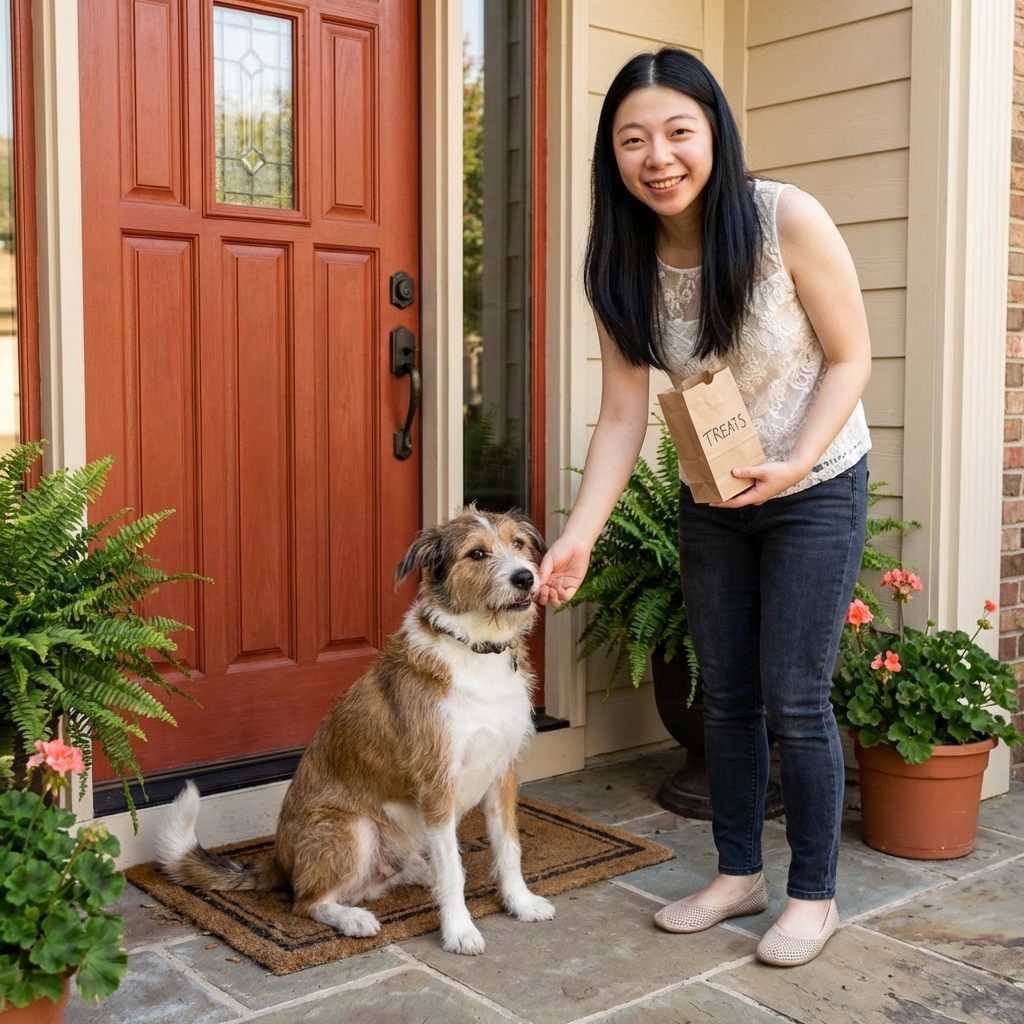
Learn why dogs jump and how to stop it with positive, practical steps. Use sit, go to mat, or touch, manage door greetings, and reward four paws on the floor.
Article
•
Designer Mixes
Stop Your Dog From Jumping On You

Shari Shidate
Designer Mixes contributor
As a veterinary assistant here in Frisco, Texas, I hear this one all the time: “My dog is sweet, but the jumping is out of control.” The good news is that jumping is usually not “dominance” or bad intent. Most often, it is a normal greeting behavior that got accidentally rewarded. That means you can change it with calm, consistent training, and you can start today.
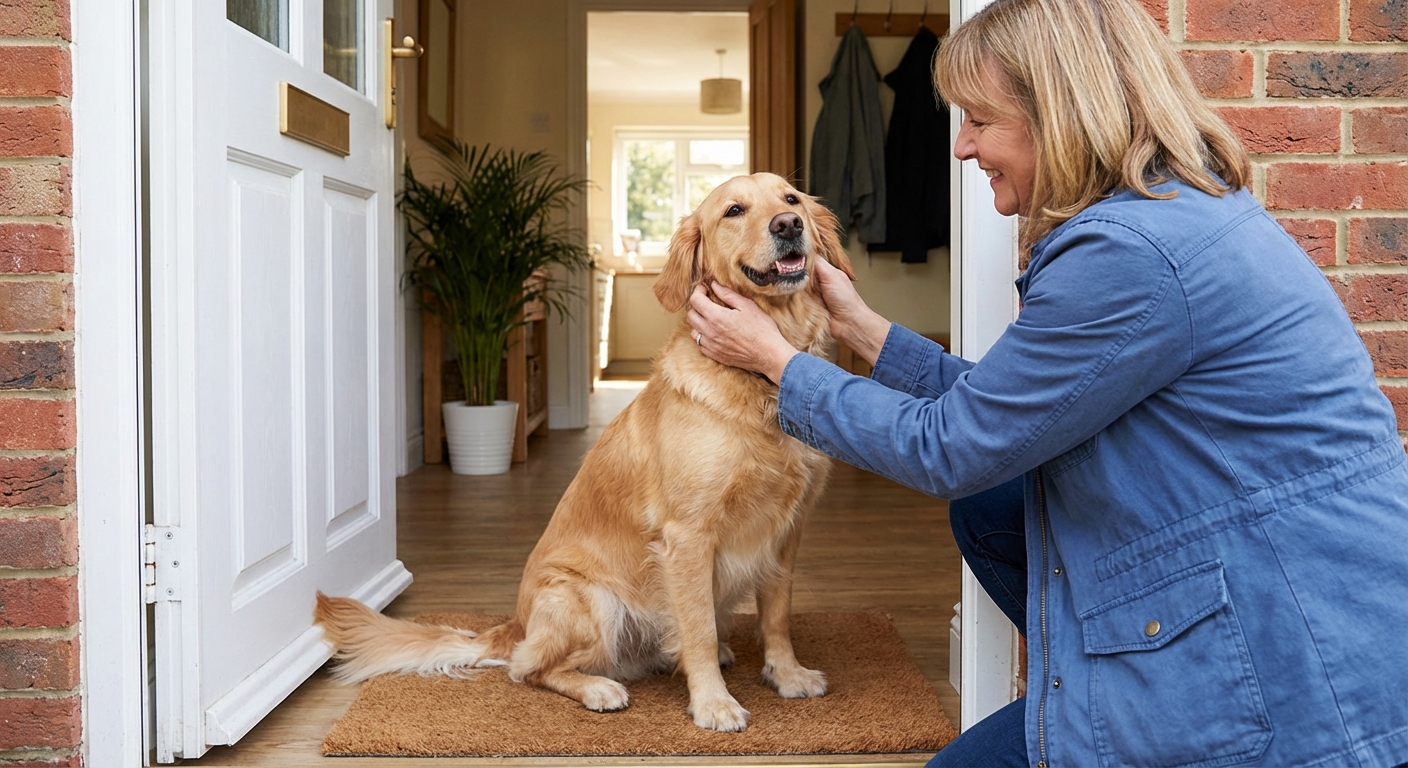
Below are the most effective, reward-based ways to reduce jumping quickly, plus the details most people miss, like how your timing, your doorway setup, and your dog’s reinforcement history can make or break progress.
Why dogs jump
Jumping is a natural way for dogs to get close to faces and hands. Dogs also repeat whatever works. If jumping makes you talk, touch, laugh, push, or even make eye contact, many dogs experience that as attention, and attention is a powerful reinforcer.
Common reasons dogs jump:
- Excitement and anticipation (especially when you come home or guests arrive).
- Attention seeking (even “No!” can be rewarding if it comes with eye contact and interaction).
- Overarousal from pent-up energy or stress.
- Inconsistent rules (allowed sometimes, discouraged other times).
- Accidental reinforcement (petting while the dog is still up, or greeting before the dog settles).
Quick caveat: behavior is often multifactorial. Some dogs jump because they are anxious, overwhelmed, or unsure at the door. The training plan below still helps, but those dogs usually need more distance, slower steps, and earlier professional support.
Once you see jumping as a learned behavior that pays off, the path forward becomes much clearer: remove the payoff for jumping and heavily reward an incompatible behavior, like sitting or standing with four paws on the floor.
The core idea
To stop jumping, you need two things working together:
- Management: prevent rehearsals of the jumping habit.
- Training: teach a specific greeting behavior and pay it well with treats, praise, or access to greeting.
If jumping ever “works,” it will keep showing up. Consistency is not about being strict. It is about being predictable.
Secret #1: No touch, talk, or eye contact
This is the part that feels simple but is surprisingly hard in real life. If your dog jumps, immediately become boring:
- Turn your body slightly away.
- Fold arms or keep hands high and still.
- Look up or away, not at your dog’s face.
- Do not speak, scold, or push them down.
Why not push the dog away? Because many dogs interpret pushing as play or engagement. Even negative attention can keep the behavior alive.
The moment your dog’s paws hit the floor, calmly mark and reward. (A “marker” can be a clicker or a quick word like “Yes.”)
- Soft praise: “Good.”
- A treat delivered low, right to their mouth when all four paws are down.
- Gentle petting only when the dog stays grounded.

Secret #2: Teach a polite greeting
“Don’t jump” is not a behavior your dog can perform. “Sit,” “go to mat,” and “four paws on the floor” are.
Option A: Sit to say hi
This is ideal for most family dogs because it is simple and fast.
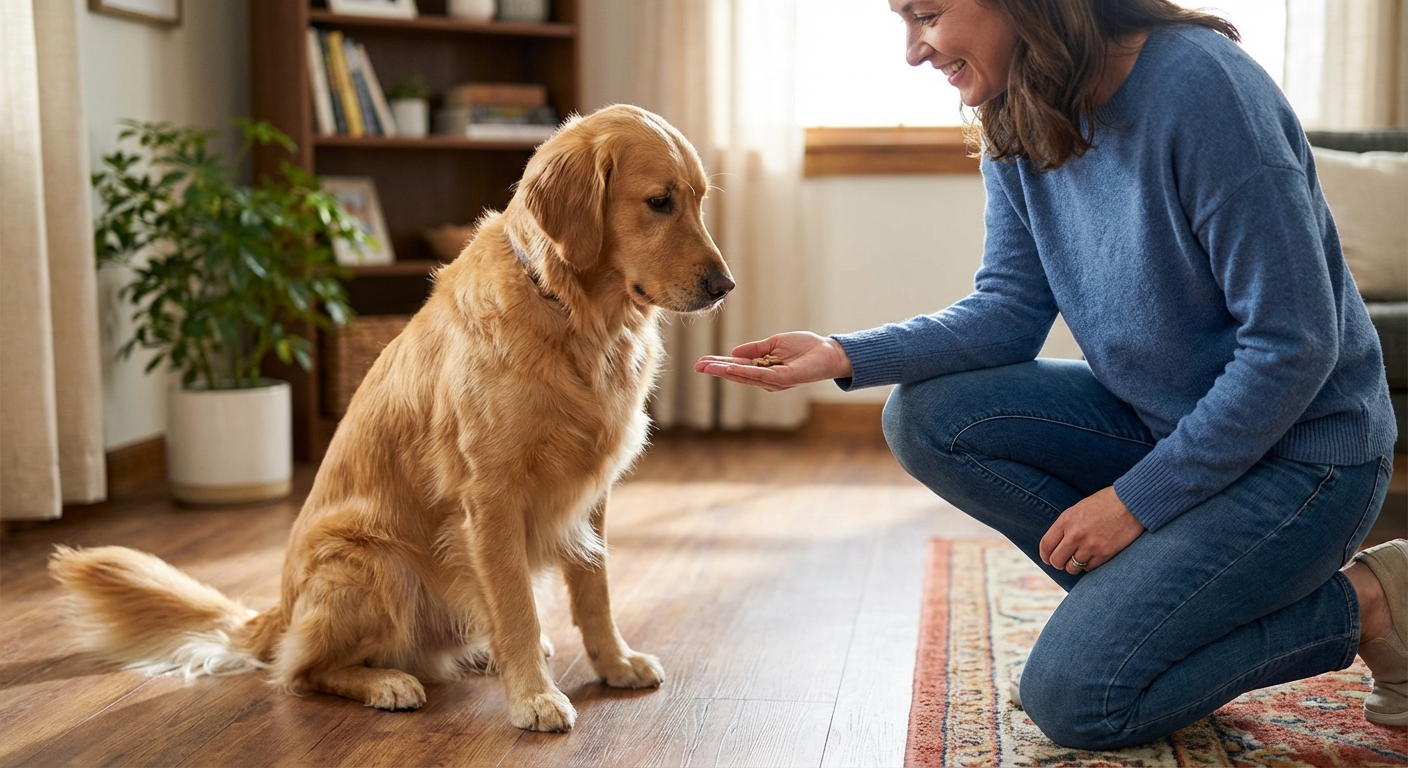
- Practice when nobody is arriving. Ask for a sit, reward.
- Add movement. Take one step away, come back, ask for sit, reward.
- Add door cues. Touch the doorknob, ask for sit, reward.
- Build duration. Reward the sit for 1 second, then 2, then 5.
Rule: greetings happen only when the dog is sitting or standing calmly.
Option B: Go to mat
This is my favorite for dogs who get especially wound up at the door.
- Place a mat or dog bed 6 to 10 feet from the front door.
- Toss a treat onto the mat. When your dog steps on it, feed 2 to 3 more treats on the mat.
- Add the cue “Mat” or “Place.”
- Practice with light door triggers: knock softly, touch the handle, open the door a crack, then reward on the mat.
With repetition, the doorbell becomes a cue to run to the mat instead of launching at people.
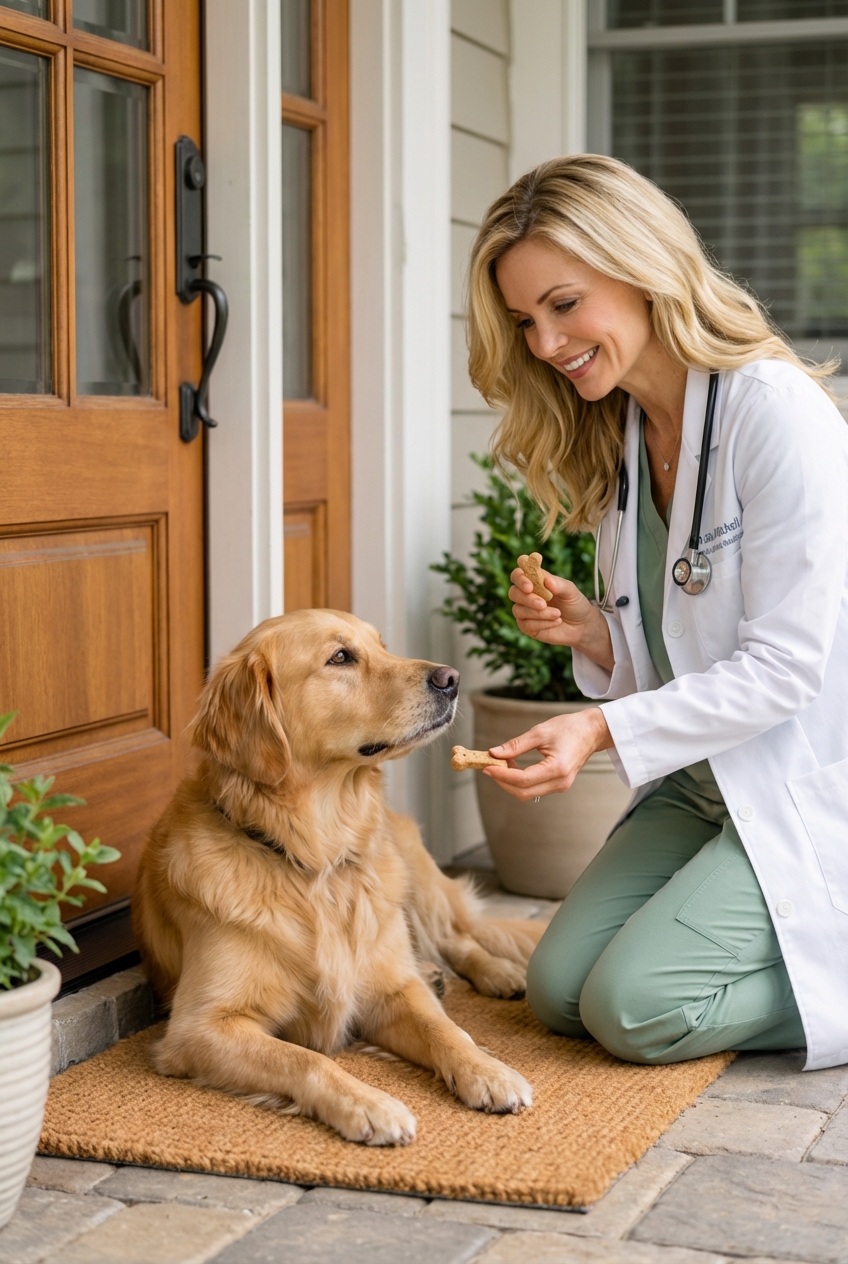
Option C: Four on the floor
Some dogs struggle to hold a sit during excitement and they pop right back up. In that case, train and reward a simple “four on the floor” stand.
- When your dog is standing calmly, mark (“Yes”) and deliver a treat low.
- Add the cue “Floor” or “Four.”
- Use it at the door the same way you would use “Sit.”
Emergency reset: Find it
If your dog is too excited to think, scatter 5 to 10 small treats on the floor and say “Find it.” Sniffing lowers arousal for many dogs and buys you a few seconds to reset. This is not a permanent fix, but it is a great emergency tool during arrivals.
Secret #3: Use a leash inside
This feels almost too easy, but it prevents the “practice reps” that keep jumping strong. Clip on a lightweight leash before guests arrive. Step on the leash so your dog can stand and sit comfortably but cannot jump high enough to make contact.
Then you can focus on rewarding the calm behavior instead of wrestling with the chaos.
Safety notes:
- Do not jerk the leash. This is management, not punishment.
- For many dogs, a back-clip harness is safer than attaching to a collar, especially for dogs with neck or back issues.
- Avoid thin slip leads for this setup.
- Do not leave your dog unattended while leashed.
Secret #4: Reward low and often
If treats are delivered up high, some dogs bounce upward to meet your hand. Deliver rewards low, close to your dog’s chest level, with calm hands.
In the beginning, you may reward every 1 to 2 seconds for keeping four paws on the floor. That is not “spoiling.” That is creating a strong reinforcement history for calm behavior. Once calm greetings are reliable, you can fade treats to intermittent rewards.
Secret #5: Fix your timing
Most jumping persists because the dog gets rewarded after jumping, even if it is accidental.
Example: Dog jumps, you turn away, dog drops down, then you say, “Okay, hi baby!” and pet. If the petting happens while the dog is bouncing back up, you just paid for the jump cycle.
What to do instead: wait for a brief moment of calm (for many dogs, 2 full seconds of four paws on the floor, or a steady sit) before greeting. Then greet calmly for a second, pause, and reward again if your dog stays grounded.
Secret #6: Practice fake arrivals
Dogs struggle most when the situation is emotionally charged. So we practice when it is boring.
Try 3 mini-sessions daily for one week:
- Walk out the door for 5 seconds, come back in, cue sit, mat, or four-on-the-floor, reward, then calmly move on.
- Pick up keys, put them down, reward calm.
- Knock on a wall, cue mat, reward.
This changes the emotional meaning of arrival cues, which reduces the spring-loaded jumping response.
What not to do
These methods can increase arousal, create fear, or accidentally turn jumping into a game:
- Kneeing the dog or “bumping” them off you.
- Yelling, fast movements, or frantic pushing.
- Shock, prong, or harsh collar corrections for greetings (higher risk of fallout, especially for anxious or sensitive dogs).
In clinic settings, we consistently see better long-term outcomes when training is focused on reinforcement, not intimidation.
What to tell guests
Your dog cannot learn a new habit if visitors keep rewarding the old one. Put a simple plan in place and make sure everyone in the home follows it (kids included).
Send this text to friends and family:
We’re training polite greetings. Please ignore our dog if they jump.
No talking, no touching, no eye contact.
When all four paws are on the floor (or they sit), you can say hi.
Kid-friendly version: “Be a tree.” Stand still, arms folded, look away until the dog is calm.
If your guests cannot follow the plan, use management: a leash, a baby gate, or have your dog on a mat with a chew until everyone is settled.
Puppies vs adult dogs
Puppies
Puppies jump because everything is exciting and their impulse control is still developing. Keep sessions short, reward heavily, and focus on teaching what to do instead. Also, protect kids from getting knocked over, and protect your puppy from accidentally learning that jumping makes fun things happen.
Adult dogs
Adult jumpers often have a long reinforcement history, meaning this habit has “worked” for months or years. You can still change it, but you need tighter management and more repetition. Many dogs show noticeable improvement within 1 to 2 weeks, with steadier reliability over the next month, depending on age, consistency, how often guests arrive, and how rewarding jumping has been in the past.
When it is a safety issue
If your dog is large, knocks people down, or mouths during greetings, treat this as a safety and training priority. Use a leash, baby gate, or crate-and-rotate plan during arrivals, and work on calm behaviors at a distance.
Consider hiring a credentialed trainer sooner rather than later if:
- You have small children, elderly family members, or frequent guests.
- Your dog shows signs of fear, reactivity, or guarding around the door.
- Jumping includes nipping, growling, or frantic behavior that is hard to interrupt.
Look for a trainer who uses reward-based methods and can explain their plan clearly.
Troubleshooting
You are accidentally rewarding it
Even one enthusiastic greeting after a jump can keep the behavior alive. Tighten up your timing and only greet when your dog is clearly grounded.
Your dog is under-exercised or over-stimulated
Exercise helps, but so does decompression. Add sniff walks, food puzzles, and short training games. A dog who can regulate their arousal learns faster.
The door routine is too hard
Step back. Practice the skills away from the door first. Then add door triggers gradually.
Guests are not cooperating
Manage the environment: leash, mat, gate. Training is what you do when you can control the situation. Management is how you prevent setbacks when you cannot.
A simple 7-day plan
- Days 1 to 2: Teach sit, mat, or four-on-the-floor in a calm room. Mark (“Yes”) and reward low and often.
- Days 3 to 4: Add light triggers: you walk to the door, touch the knob, open and close the door.
- Days 5 to 6: Add fake arrivals with a family member entering and exiting. Use a leash or gate if needed.
- Day 7: Practice with a real guest who agrees to ignore jumping and reward calm greetings.
Stay patient with yourself, too. You are not just training your dog. You are retraining your own habits around greetings, and that is where the real magic happens.
References
- American Veterinary Society of Animal Behavior (AVSAB) position statements on humane, reward-based training
- Overall, K.L. Clinical Behavioral Medicine for Small Animals. (Veterinary behavior reference text)
- Landsberg, G., Hunthausen, W., & Ackerman, L. Behavior Problems of the Dog and Cat. (Veterinary behavior reference text)