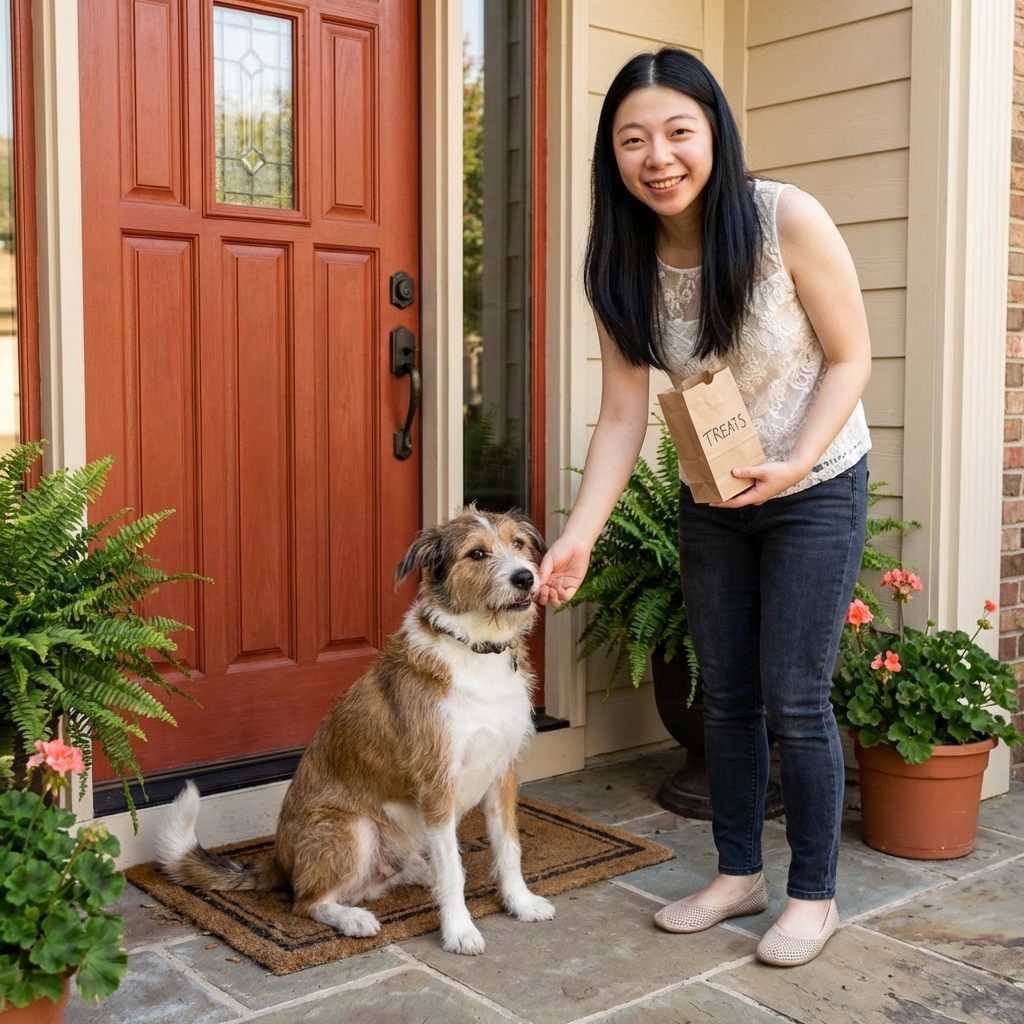
Stop jumping without harsh corrections. Follow simple, reward-based steps: teach four paws on the floor, sit to say hi, or go to mat—plus door practice, tr...
Article
•
Designer Mixes
Stop Your Dog From Jumping on People

Shari Shidate
Designer Mixes contributor
Jumping is one of the most common “problem behaviors” I hear about, and it is usually not bad manners so much as a dog being very social and very excited. The tricky part is that jumping gets rewarded easily. Your dog jumps, a person talks, laughs, touches, or even pushes them off, and your dog learns: Jumping makes people interact with me.
The good news is that with a few clear rules and some consistent practice, most dogs learn a polite greeting quickly. Below are kind, evidence-based training steps you can start today.
Why dogs jump (and why it is hard to stop)
Dogs jump because it works. From a learning standpoint, behaviors that are rewarded repeat. For many dogs, attention is a reward, even if the attention is negative, like talking, laughing, or physically moving them away.
- Excitement and social greeting: Many dogs try to get closer to faces during greetings. Jumping brings them closer to your face.
- Inconsistent reinforcement: If your dog is allowed to jump on family but not on guests, they will keep trying.
- Accidental rewards: Eye contact, talking, touching, or pushing can all reinforce jumping.
- Under-exercised or overstimulated: A dog with pent-up energy is more likely to bounce off people.
Our goal is simple: make four paws on the floor the behavior that gets the reward.
Safety first: manage before you train
Training works best when you prevent your dog from practicing the unwanted behavior. Management is not “giving up.” It is how you keep everyone safe while your dog learns.
- Use a leash indoors when guests arrive so you can calmly prevent jumping.
- Try a baby gate or exercise pen to create space for greetings.
- Provide a chew or stuffed food toy in a separate area for the first few minutes of company.
- Protect vulnerable guests: Kids, seniors, and anyone unsteady should not be your dog’s first “practice person.”
If your dog has a history of mouthing, knocking people down, or snapping when aroused, work with a qualified trainer and your veterinarian before practicing greetings with guests.
The core skill: teach an incompatible behavior
The easiest way to stop jumping is to teach something your dog cannot do while jumping. Three great options are Sit, Go to Mat, and Hand Target (Touch). Choose the one that fits your dog’s body, personality, and your home setup.
Note on comfort: If sitting is hard for your dog due to orthopedic issues, long-backed structure, or pain, skip Sit and focus on standing with four paws on the floor, Mat, or Touch. If your dog suddenly seems reluctant to sit, consider a veterinary check.
Before you start: marking
A “mark” is a quick sound that tells your dog, That is the behavior I want. You can say “Yes” or use a clicker. Mark the moment your dog is successful, then reward.
Option A: Sit to say hello
This is classic for a reason. Sitting keeps paws on the floor and gives your dog a clear job.
- Practice when nobody is at the door. Ask for a sit, mark (“Yes” or click), then reward with a small treat.
- Add mild excitement. Take one step back, then step toward your dog. If they hold the sit, mark and reward.
- Make greeting the reward. When your dog sits, calmly reach down to pet for 1 to 2 seconds, then stop. If they pop up, petting ends.
- Repeat short sessions. Many quick reps beat one long, frustrating session.
Option B: Go to Mat (often helpful for high-energy jumpers)
A mat behavior is wonderful because it creates distance from the action and helps your dog regulate excitement.
- Place a mat or bed in a spot with a clear view of the entryway.
- Lure and reward your dog for stepping onto the mat. Mark, then reward.
- Build duration by feeding several treats while your dog stays on the mat.
- Add the cue “Mat” or “Place” once they are reliably moving to it.
- Practice with door sounds like knocking or the doorbell at a low intensity first.
Option C: Hand target (Touch)
This is a great alternative for dogs who get too wiggly to sit or who find sitting uncomfortable. It also helps redirect your dog’s energy into a simple, repeatable action.
- Present your open palm a few inches from your dog’s nose.
- When they boop your hand, mark and reward.
- Add the cue “Touch” once the boop is predictable.
- Use it during greetings by cueing Touch before your dog has time to launch upward, then reward with a treat delivered low.
Training tip: If your dog is too excited to take treats, that is information. Increase distance, lower the difficulty, and practice with calmer setups first.
What to do when your dog jumps
Think of jumping like a vending machine behavior. If it never pays out, it fades. If it pays out sometimes, it gets stronger. Also, when you first stop paying out, you may see an extinction burst, meaning the jumping briefly gets worse before it gets better. Stay calm and consistent.
- Remove attention immediately: Turn your body slightly away, keep arms close, and be quiet.
- Do not push your dog off. Many dogs interpret pushing as play or attention.
- Reward the instant paws hit the floor: Mark “Yes” and drop a treat low to the ground, or calmly pet. Dropping treats low helps keep your dog’s head and weight down.
- Reset fast: If your dog jumps again, attention stops again. Calm consistency is the magic.
If your dog is large or very persistent, prevent launching by keeping them on a leash during greetings. For many dogs, a front-clip harness or flat collar is safer than training collars for this purpose. Avoid stepping on a leash attached to a slip lead, prong, or choke-style collar. Keep the leash short enough to prevent jumping but loose enough that your dog can stand comfortably and breathe easily, without pressure pulling upward on the neck.
Door greetings: the highest risk
The front door combines the biggest triggers: movement, new people, and a change in routine. A door plan prevents chaos and keeps your dog successful.
A simple door plan
- Before opening the door: Leash your dog or place them behind a gate.
- Ask for “Sit,” “Mat,” or “Touch.” Reward once they do it.
- Open the door only a little while your dog stays grounded.
- Coach your guest: No touching or talking until the dog is sitting, on the mat, or standing calmly with four paws down.
- Release to greet for 1 to 3 seconds, then call your dog back for another rep and reward again.
Short greetings are your friend. You are teaching your dog that calm behavior makes the fun continue.
A guest script (copy and paste)
- Please ignore them if they jump. No eye contact, no talking, no touching.
- When four paws are down, you can calmly say hello and pet briefly.
- If they jump again, pause and turn away again until they are grounded.
Common mistakes
- Talking during jumping: “Off” often becomes background noise or attention.
- Inconsistency: Allowing jumping sometimes, especially with family members.
- Waiting too long to reward: Reward the exact moment paws are on the floor.
- Skipping exercise and enrichment: A bored dog is a bouncy dog.
- Practicing only with real guests: Use staged sessions with friends so you can control the setup.
Exercise and enrichment
Training is the foundation, but daily lifestyle matters too. Dogs who have outlets for energy and natural behaviors tend to learn faster and jump less.
- Sniff walks: Let your dog explore at their pace. Sniffing lowers arousal for many dogs.
- Food puzzles and scatter feeding: Toss kibble or treats in the yard or on a snuffle mat.
- Short skill sessions: 3 to 5 minutes of training, 1 to 2 times daily, builds impulse control.
- Calm settling practice: Reward your dog for relaxed behaviors like lying down quietly.
When to ask your vet
Most jumping is behavioral, but sometimes arousal and impulsivity can be influenced by underlying health or anxiety. Consider a veterinary check-in if:
- Your dog’s jumping is paired with panic, pacing, or intense vocalizing.
- Your dog cannot settle even after exercise and training.
- The behavior suddenly worsens, especially in an adult dog.
- Your dog shows signs of pain when asked to sit or when handled.
A veterinarian can rule out discomfort and help you decide whether a behavior consultant or additional support is appropriate.
A quick weekly plan
If you like structure, here is a simple plan that works well for many families:
- Days 1 to 3: Practice Sit, Mat, or Touch with no visitors, 5 minutes daily.
- Days 4 to 7: Add door sounds and movement. Reward calm heavily.
- Week 2: Recruit a friend for staged greetings. Keep greetings short and repeatable.
- Week 3 and beyond: Generalize to real-life guests, using leash and gate management as needed.
Progress is rarely perfectly linear. Celebrate small wins. Every calm greeting is a step toward a dog who feels confident and polite.