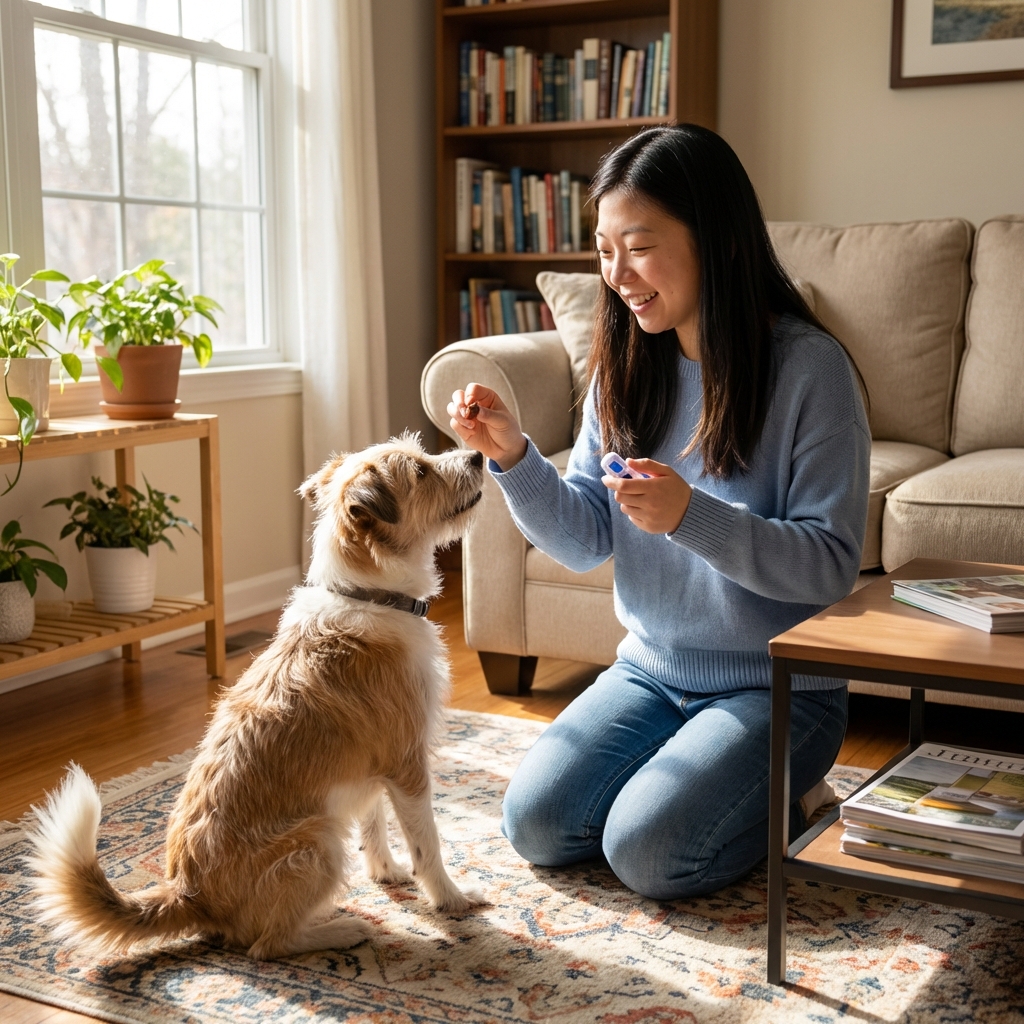
Learn why dogs jump and how to stop it with positive, practical steps. Use sit, go to mat, or touch, manage door greetings, and reward four paws on the floor.
Article
•
Designer Mixes
Stop Dog Jumping With Family-Friendly Training

Shari Shidate
Designer Mixes contributor
Jumping is one of the most common reasons families tell me, “My dog is sweet, but he’s just too much.” If you have kids, guests, or an older family member in the home, a dog who launches on people can turn a happy hello into scratched arms, knocked-over toddlers, and a lot of stress.
The good news is that jumping is not “bad dog” behavior. It is usually normal greeting behavior that accidentally got rewarded. With a few simple, consistent steps, you can teach a calmer greeting that works for the whole family.
Why dogs jump
Most dogs jump because it works. Even if you do not mean to reward it, your dog may be getting something valuable from the behavior. Common rewards include:
- Attention: eye contact, talking, laughing, or hands pushing the dog down can still feel like attention to many dogs.
- Access: jumping gets them closer to faces, hands, and the action at the door.
- Excitement release: some dogs have a hard time regulating big emotions during greetings.
- Inconsistent rules: one person allows jumping, another does not, and the dog learns to “try it” anyway.
In evidence-based training, we focus on two things at the same time: preventing the jump from being rewarded and teaching a new behavior that is easy to reward, like sitting or going to a mat.
Safety first with kids and guests
Before you train, set your household up for success. Management is not cheating. It is how you keep everyone safe while your dog learns.
- Use a leash indoors during busy times like guest arrivals so you can guide your dog without grabbing their collar.
- Try a baby gate or exercise pen to create space between your dog and the doorway.
- Teach kids “tree mode” (also called “statue”): stand still, arms tucked in, look up and away if the dog jumps. Running and squealing can fuel the behavior. This should always be supervised, and it is not the right tool if a dog is acting fearful or aggressive.
- Skip physical corrections like kneeing the dog or yelling. These can increase arousal, create fear around greetings, and do not teach what you actually want.
If your dog has a history of knocking people down, jumping on children, or mouthing during greetings, consider working with a certified force-free trainer for a personalized plan.
A fast, family-friendly plan
Step 1: Pick a default greeting
Choose a behavior every person in the home can recognize and reward. Two great options:
- Sit to say hi
- Go to mat (a bed or towel near the entry)
In most families, “sit” is the easiest place to start. Later, you can add “go to mat” for doorbell greetings.
Step 2: Practice away from the door
Training works best when you start in low-distraction moments. Grab small, tasty treats. For many dogs, soft treats that are easy to swallow keep the flow moving.
One quick note: when I say mark, I mean a short word like “Yes” (or a clicker) that tells your dog, “That exact moment earned a treat.”
- Stand in front of your dog.
- Wait quietly. The moment your dog’s paws are on the floor, mark with “Yes” and give a treat.
- If your dog jumps, simply step out of reach (or turn slightly away) and wait. No pushing, no talking. As soon as four paws are on the floor, mark and treat.
- Ask for a sit. Reward the sit.
- Take one step away and come back. Reward paws-on-floor and sit again.
You are building a pattern: four paws on the floor makes good things happen.
Step 3: Add greetings in tiny pieces
Once your dog is consistently offering a sit, practice with a family member acting as the “guest.” Keep sessions short, upbeat, and repeatable.
- Dog on leash (or behind a gate).
- Helper approaches calmly (no leaning over, no squealing, no revving the dog up).
- If the dog sits or keeps four paws on the floor, the helper gives calm attention and you feed treats while your dog stays grounded.
- If the dog jumps, the helper turns away and removes attention for 2 to 3 seconds. Keep your body safe. No pushing, no talking. Then try again.
This is not about ignoring your dog emotionally. It is simply removing the reward that keeps jumping alive.
Step 4: Teach a reset cue
Many dogs need help coming back down from excitement. A reset cue can be:
- Find it: toss 3 to 5 treats on the ground so sniffing can help lower arousal for many dogs
- Touch: your dog boops your hand target
Sniffing is often calming, and it gives busy families an easy tool during greetings. If your dog finds treat scattering too exciting, use “touch,” a simple treat handoff, or scatter fewer treats farther apart.
Doorbell routine
The doorway is where jumping is most intense because it stacks triggers: sound, movement, and social excitement. Here is a routine that works well for many homes.
Before guests arrive
- Have treats in a jar by the door.
- Set up a gate or leash station.
- Place a mat or bed 6 to 10 feet from the door.
When the bell rings
- Say “Find it” and scatter treats away from the door (or use “touch” if scattering ramps your dog up).
- Clip the leash on, or guide behind the gate.
- Ask for “sit” or “mat.” Reward.
When the guest comes in
- Tell the guest your rule: “Please greet only when he’s sitting (or has four paws on the floor).”
- If your dog jumps, the guest turns away and pauses attention.
- When your dog sits again, the guest can calmly pet under the chin or on the chest.
If guests do not follow the rules
Some guests forget, or they think jumping is cute. It happens. Use management so your dog does not get practice rehearsing the behavior:
- Keep your dog behind a gate or on leash until they are calmer.
- Use your mat routine and treat scatter away from the entry.
- Try a simple script: “We’re training polite greetings. Please wait for four paws on the floor, then you can say hi.”
It feels repetitive at first, but repetition is what makes the new habit stick. Many families notice some improvement within a couple of weeks with daily practice. Getting reliable, guest-proof greetings often takes longer, especially for adolescents, highly social dogs, and busy households.
Common mistakes
- Inconsistent attention: sometimes you laugh, sometimes you push the dog down, sometimes you pet. Your dog hears, “Keep trying.”
- Asking for too much too soon: practicing with a calm family member is very different from a squealing child or a guest carrying bags.
- Only training at the door: dogs need lots of easy reps away from the main trigger first.
- Accidentally hyping the greeting: fast movement, leaning over your dog, face-level hands, and excited voices can turn jumping into a full-body party.
- Using punishment: it may suppress behavior temporarily for some dogs, but it does not teach a calm greeting and can increase stress or arousal.
If you have kids
Kids can be amazing helpers with the right structure and supervision. Keep it simple and safe.
- Kids reward low: have children toss treats on the floor for four paws on the ground rather than holding treats at face level.
- Practice “tree mode”: kids stand still while an adult reinforces the dog for sitting or staying grounded.
- Short sessions: 2 minutes is plenty. Stop while everyone is still happy.
If your dog gets mouthy when excited, keep kids out of greeting practice until you have a calmer, more reliable sit (or four-on-the-floor) with adults first.
Troubleshooting
Big, bouncy adolescents
Teen dogs often jump because their bodies are full of energy and their brains are still learning impulse control. Increase daily enrichment and training breaks. Add a short sniff walk or tug session before expected greetings.
Small dogs who jump up your legs
Small dogs jump for the same reasons as large dogs, but they often get picked up, which can become the reward. Try rewarding sits before you lift them, and set them down if they paw and wiggle for attention.
Dogs who will not sit when excited
If your dog cannot sit in the moment, that is useful information. They may be too excited to do it yet. Start by rewarding four paws on the floor as your first goal, then shape toward a sit later as your dog gains skills.
Rescue dogs who jump and bark
Barking plus jumping can mean excitement, stress, or both. Use distance, gates, and “find it” to lower arousal. If you see fear signs like tucked tail, pinned ears, freezing, or retreating then lunging, do not force a sit at the door. Give your dog more distance and work with a credentialed trainer on a desensitization and counterconditioning plan so you do not accidentally worsen anxiety.
When to get help
Reach out to your veterinarian or a qualified positive-reinforcement trainer if:
- Jumping is paired with growling, snapping, or guarding the doorway
- Your dog cannot take treats during greetings (often a sign they are over threshold)
- Someone in the home is at higher risk of injury
As a veterinary assistant, I always like to mention this: if your dog suddenly starts acting unusually wild, restless, or touch-sensitive, it is worth ruling out pain or medical issues. Discomfort can lower a dog’s tolerance and make greetings harder.
Quick daily checklist
- Reward four paws on the floor throughout the day.
- Practice sit (or four-on-the-floor) greetings for 2 to 5 minutes when things are calm.
- Manage the door with a leash, gate, or mat routine.
- Coach guests: greet only when sitting or grounded.
- Celebrate progress. Calm greetings are a learned skill.
Bottom line: your dog is not trying to be rude. They are trying to connect. When you teach a sit, a mat, and a reset cue, you give them a clear, family-friendly way to say hello.