Start homemade dog food safely with this vet-informed starter plan. Learn what “vet approved” means, choose a balancer, follow a 14-day transition, and u...
Article
•
Designer Mixes
Stop Counter Surfing in Dogs

Shari Shidate
Designer Mixes contributor
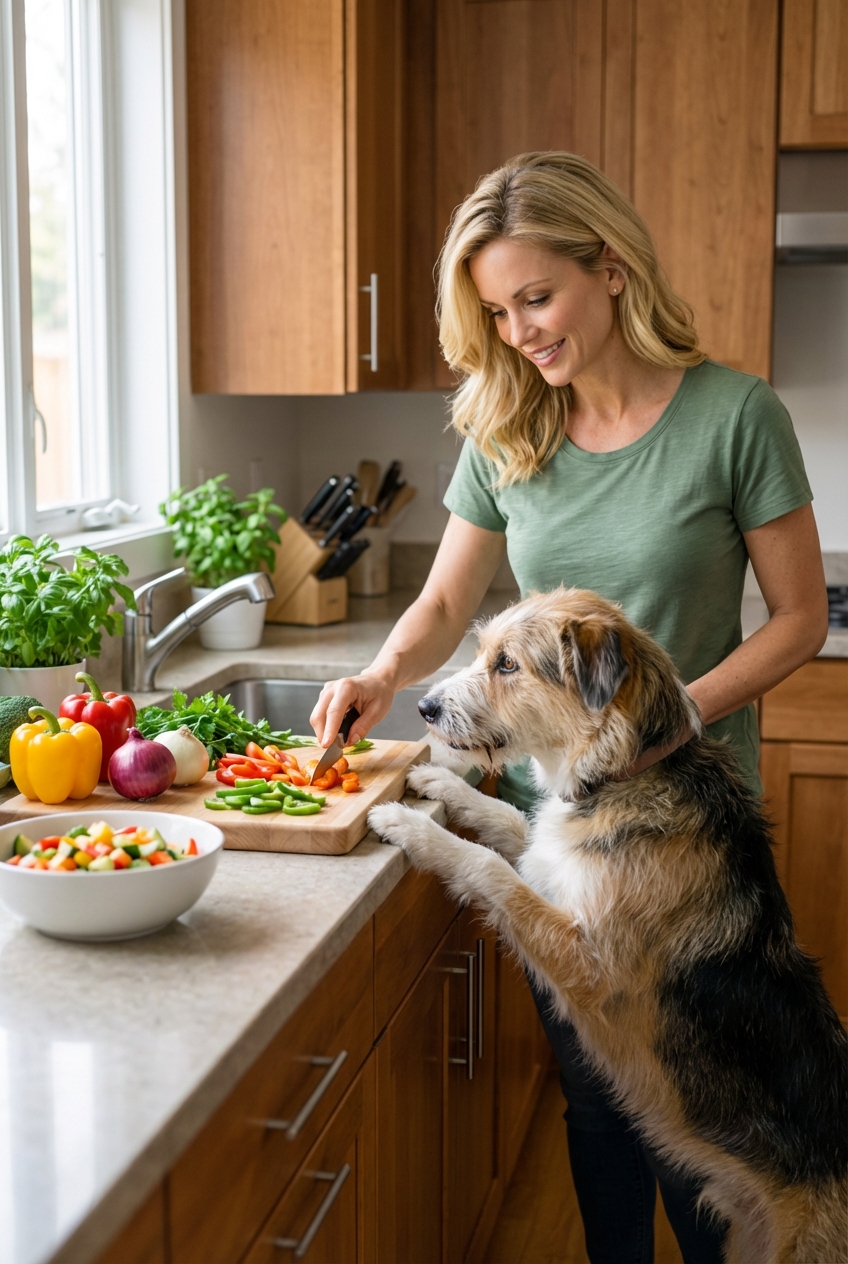
Counter surfing can feel sneaky and personal, but it is usually just a smart dog doing what works. Food smells amazing, counters are the perfect height, and most dogs have learned a simple rule: jump up, find something tasty, win. The good news is that counter surfing is often very improvable when you combine management, training, and a little honesty about what is rewarding your dog. Some dogs improve quickly, and some need more time, but the path is the same.
As a veterinary assistant here in Frisco, Texas, I want you to know this is not about having a “bad dog.” It is about building a home setup where stealing food stops paying off, and your dog learns exactly what to do instead.
Why dogs counter surf
Counter surfing is powered by reinforcement. Even if your dog finds food only once in a while, that “jackpot” is enough to keep them trying. In behavior science, this is called intermittent reinforcement, and it creates persistent habits.
Common triggers
- Smell: Dogs can detect food odors that humans barely notice.
- Opportunity: Chairs, stools, open dishwasher doors, or a low island become stepping stones.
- Boredom: A dog who is under-stimulated will invent entertainment.
- Anxiety or stress: Some dogs scavenge more when routines change.
- Hunger or a diet that is not satisfying for that dog: Not always, but some dogs are more driven when meals are too small, timed poorly, or not a good fit. If you think this might be part of it, talk with your vet before making big diet changes.
Key point you need to hear: your dog is not doing this out of spite. They are doing it because it works.
Secret 1: stop the payoff
If you train perfectly but leave rotisserie chicken on the counter twice a week, the chicken will train your dog right back. Start by making surfing unsuccessful every single day.
Kitchen setup that works
- Clear the counters: Put all food away immediately, including cooling baked goods.
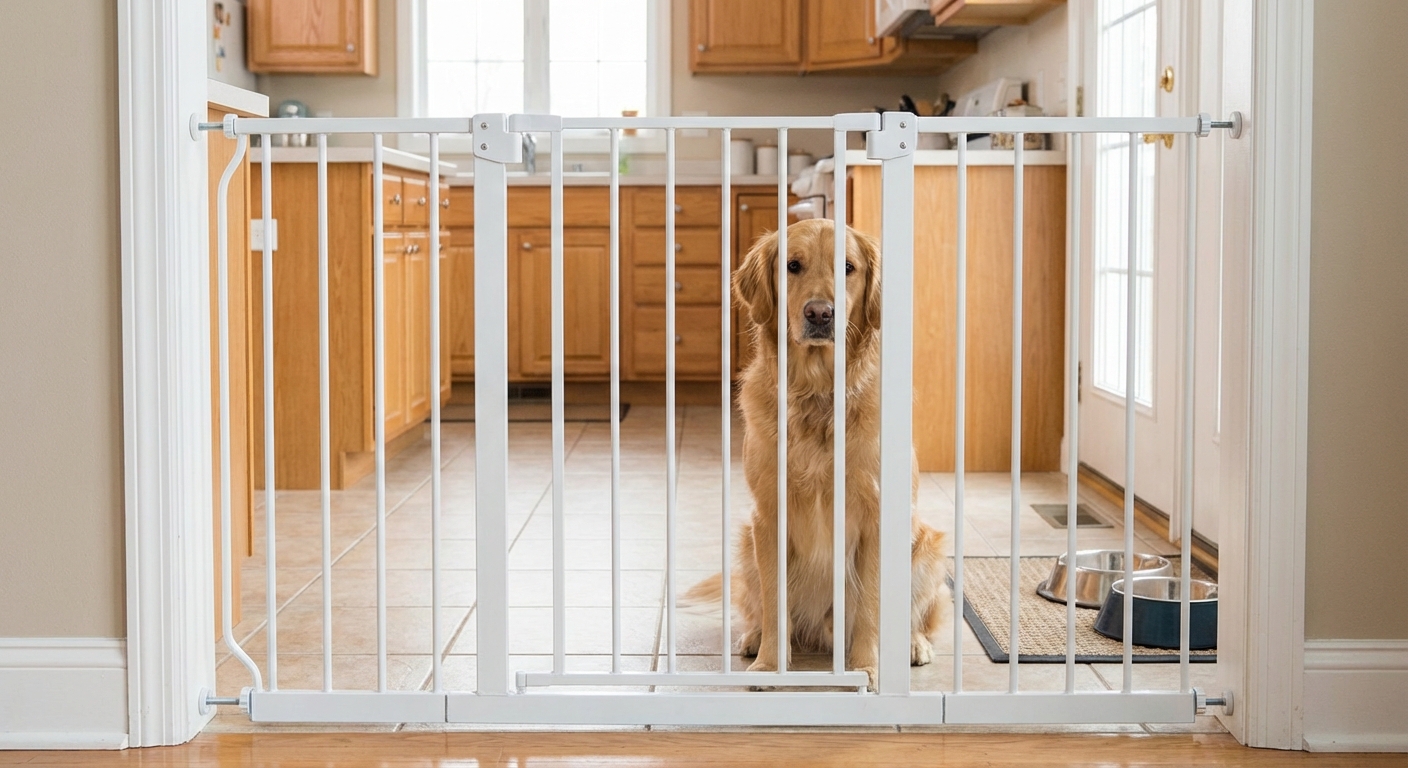
- Use physical barriers: Baby gates, exercise pens, or closing the kitchen during cooking time.
- Block launch points: Push chairs in, remove stools, keep dishwasher closed.
- Trash control: Use a lidded, heavy trash can or keep it behind a closed door.
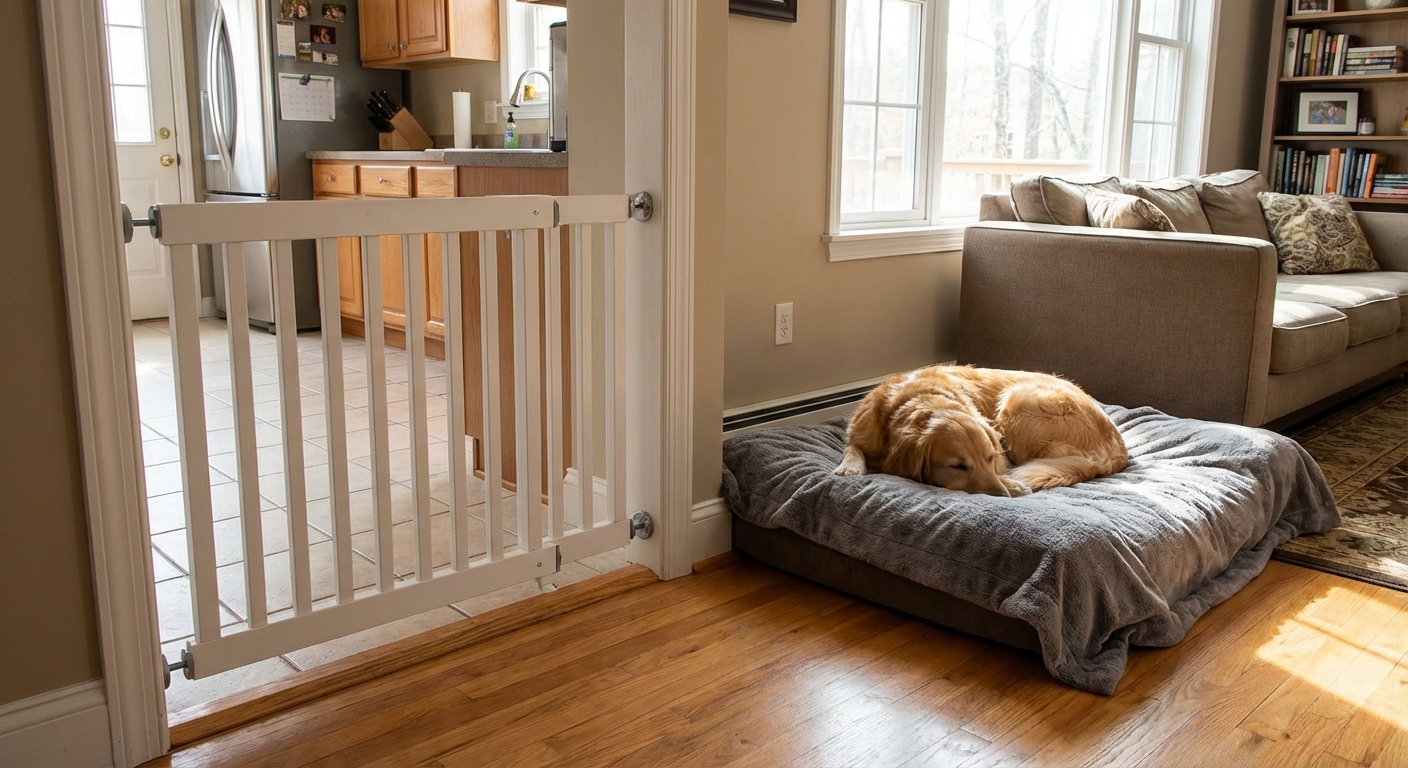
- Contain your dog when needed: Crate, pen, or a comfy bed area with a chew while you cook.
This step can feel strict, but it is kind. It prevents repeated successful practice of the habit.
Secret 2: teach what to do
You cannot just teach “don’t.” You want to teach a clear “do this instead” behavior that your dog can succeed at, even when food is present.
Quick note for beginners: when I say “Yes,” that is a marker word. It means “that right there earns a reward,” and then the treat follows.
Option A: Teach Place
Goal: When you are cooking or eating, your dog goes to a bed or mat and stays there.
- Put a mat or bed in a spot with good visibility of you, but away from the counter.
- Toss a treat onto the mat. When your dog steps on it, say “Yes” and give another treat.
- Add the cue “Place” right before they step on the mat.
- Build duration slowly: treat every few seconds at first, then space it out.
- Practice while you do small kitchen tasks, then work up to higher-value situations like chopping meat.
Pro tip: Give your dog a long-lasting project on Place, like a stuffed Kong, a lick mat, or a safe chew. Calm licking and chewing help many dogs settle. Choose size-appropriate chews, supervise, and avoid very hard chews that can crack teeth.
Option B: Teach Off
“Off” teaches your dog what to do when they are already up. Cue “Off,” then reward after your dog has fully redirected to the floor and either (1) stayed down for a couple of seconds, or (2) moved straight to “Place.” This helps prevent a common behavior chain where a dog learns: Jump Up, Get Off, Get Treat, Repeat.
After “Off,” immediately give your dog a job like “Place,” a sit, or a down, then reward that calm choice.
Option C: Teach Leave it
Start easy (treat in your hand), then progress to a treat on the floor with your foot nearby. For most dogs, you will get the best results by practicing on the floor first, not by setting up tempting counters.
If you do practice around counters, do it briefly and safely: keep your dog on leash, use low-value food, and set it up so your dog cannot successfully grab anything. The skill is not real until it works around distractions, but your dog should never get a “win” during training.
Secret 3: avoid accidental rewards
Many well-meaning owners accidentally reward counter surfing without realizing it.
Common traps
- Chasing your dog: It can become a game, and they keep the food.
- Yelling: Some dogs find the attention rewarding, and others get more anxious and more grabby.
- Trading too late: If you only offer a treat after they steal, you may be paying them for the theft.
Instead, focus on preventing the steal, then reward the alternative (Place, sitting politely, or staying behind a gate).
When you leave the room
That is extremely common. Dogs are great at pattern recognition. If surfing happens only when you turn your back, it is a management problem first.
Make your absence boring
- Before you step away, put your dog behind a gate or on Place with a chew.
- Remove food and food wrappers from counters, sink, and stovetop.
- Use containers: a microwave, oven, or closed pantry can be temporary storage while you eat. Safety note: only use appliances that are fully off and cool, and make sure everyone in the home knows food is inside so nobody preheats it by accident.
If you want extra help, a pet camera can show you what is happening, but remember: the goal is not catching your dog. The goal is preventing rehearsal.
Is it hunger or health?
Most counter surfing is about opportunity and learning, not starvation. Still, appetite can amplify the behavior.
Helpful questions
- Has your dog recently lost weight unintentionally?
- Are they on a restricted diet that leaves them frantic at mealtimes?
- Are treats and chews too rare, so they “scavenge” to meet chewing needs?
- Do they have gastrointestinal issues that increase hunger or food seeking?
If any of these sound familiar, it is worth a check-in with your veterinarian. In the clinic, we commonly see increased food-seeking with issues like intestinal parasites, endocrine disease (for example diabetes or Cushing’s disease), certain medications (especially steroids), or chronic GI upset.
Counter hazards to take seriously
One reason I take counter surfing seriously is that kitchens are full of fast, dangerous mistakes. Keep high-risk items secured and out of reach, even when you think your dog “would never.”
Common hazards
- Medications: both human and pet meds can be life-threatening.
- Xylitol: found in some sugar-free gum, candy, peanut butter, and baked goods.
- Chocolate, grapes, and raisins.
- Onions and garlic (including powders and leftovers).
- Cooked bones, skewers, and corn cobs (obstruction and puncture risk).
If your dog eats something potentially toxic or sharp, call your veterinarian right away. If they are closed, contact a pet poison hotline for time-sensitive guidance.
Enrichment that helps
A busy, fulfilled dog is less likely to patrol your counters. Enrichment does not have to be fancy, it just has to be consistent.
- Food puzzles: Feed part of meals in a snuffle mat or puzzle toy.
- Scatter feeding: Toss kibble in the yard for a sniffy “find it” game.
- Chew time: Appropriate chews help meet natural needs and reduce restless behavior. Supervise, choose the right size, and skip options that are hard enough to risk tooth fractures.
- Training mini-sessions: Two to five minutes of cues like sit, down, touch, and Place.
- Structured walks: Sniffing is exercise for the brain.
Think of enrichment as prevention. It is easier to guide behavior when your dog is not running on boredom.
What not to do
Some “viral” counter surfing tricks can be risky or can increase anxiety.
- Do not use punishment traps like startling devices or anything that could harm or frighten your dog.
- Do not use toxic deterrents on counters. Many substances that taste bad can still be dangerous if licked or ingested.
- Avoid baited counters unless you are working with a qualified trainer who can keep it safe and controlled.
Positive reinforcement plus smart management is not permissive. It is strategic, and it creates lasting change.
A 10-day plan
This plan is a starting point, not a stopwatch. Move to the next step only when your dog is reliably successful at the current level. Many dogs need longer than 10 days, and that is completely normal.
Days 1 to 3: Remove rewards
- Clear counters and block access during high-risk times.
- Identify your dog’s launch points and remove them.
- Start feeding at least one meal with enrichment (snuffle mat or puzzle).
Days 4 to 7: Build Place
- Practice Place for 1 to 3 minutes at a time, several times a day.
- Gradually add mild kitchen activity while rewarding calm.
- Give a chew or lick mat on Place during cooking.
Days 8 to 10: Add real-life practice
- Practice Place while you do simple food prep, then work up to plating food and sitting down.
- Use a gate or leash if needed so your dog cannot self-reward.
- Reward intermittently to make the behavior durable.
If you slip up and food disappears, do not panic. Tighten management, go back a step, and keep going. Consistency is what changes the habit. Also, behavior change is rarely perfectly linear. Expect a few wobbly days.
When to get help
If counter surfing is paired with growling over stolen items, do not try to pry things from your dog’s mouth. That can raise bite risk and can worsen guarding. Focus on prevention and reach out to a credentialed positive-reinforcement trainer for a plan.
If your dog’s appetite suddenly increases or they seem ravenous all the time, schedule a veterinary visit to rule out medical causes.
Counter surfing is not a character flaw. It is a habit with a payoff. Remove the payoff, teach a clear alternative, and your dog will choose the better option more and more often.