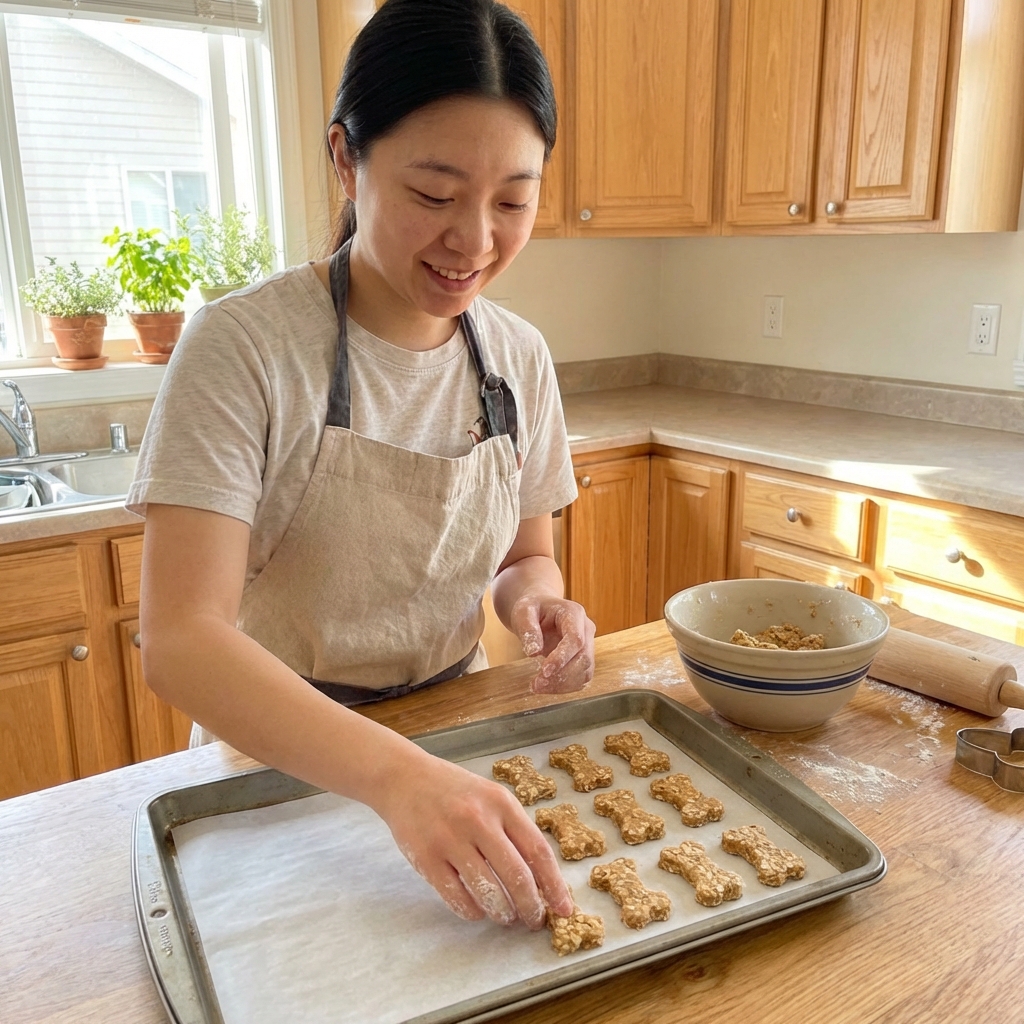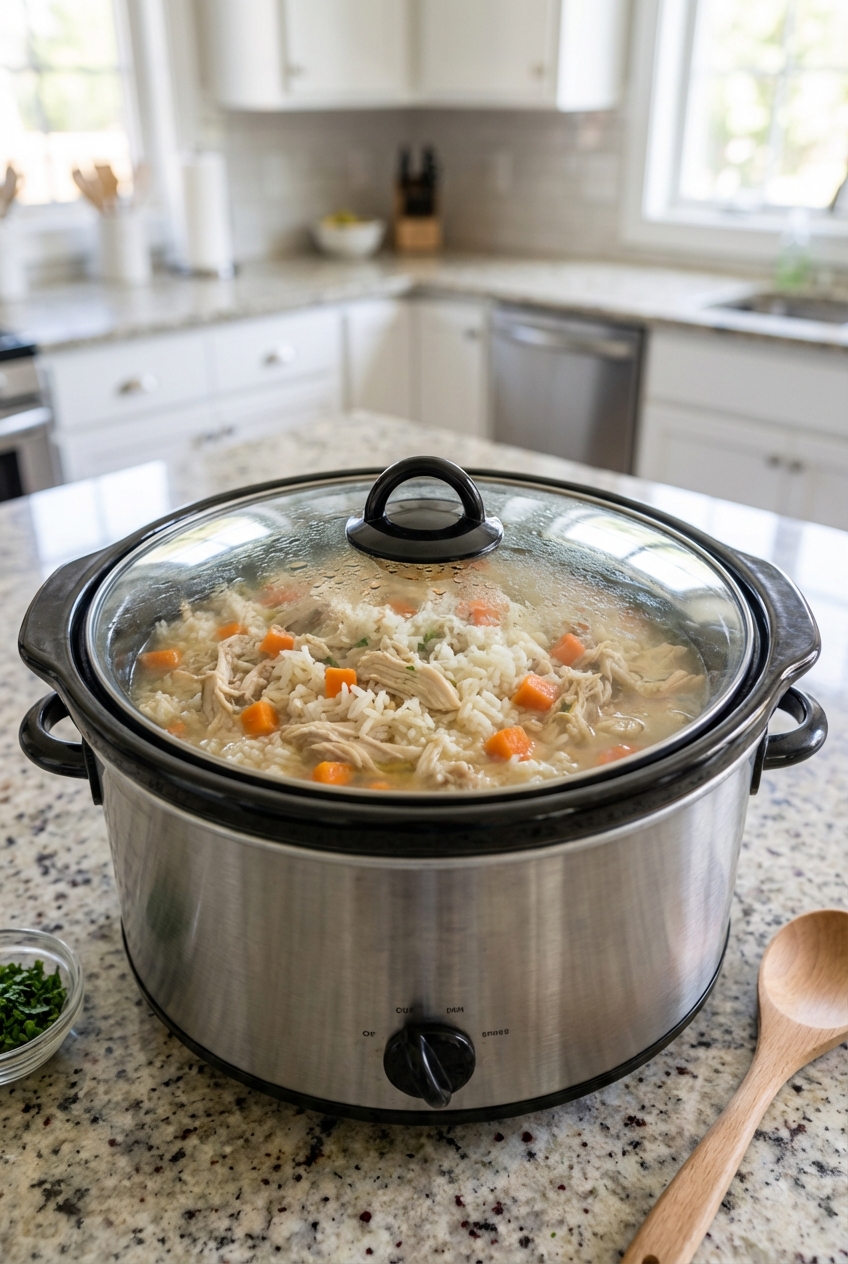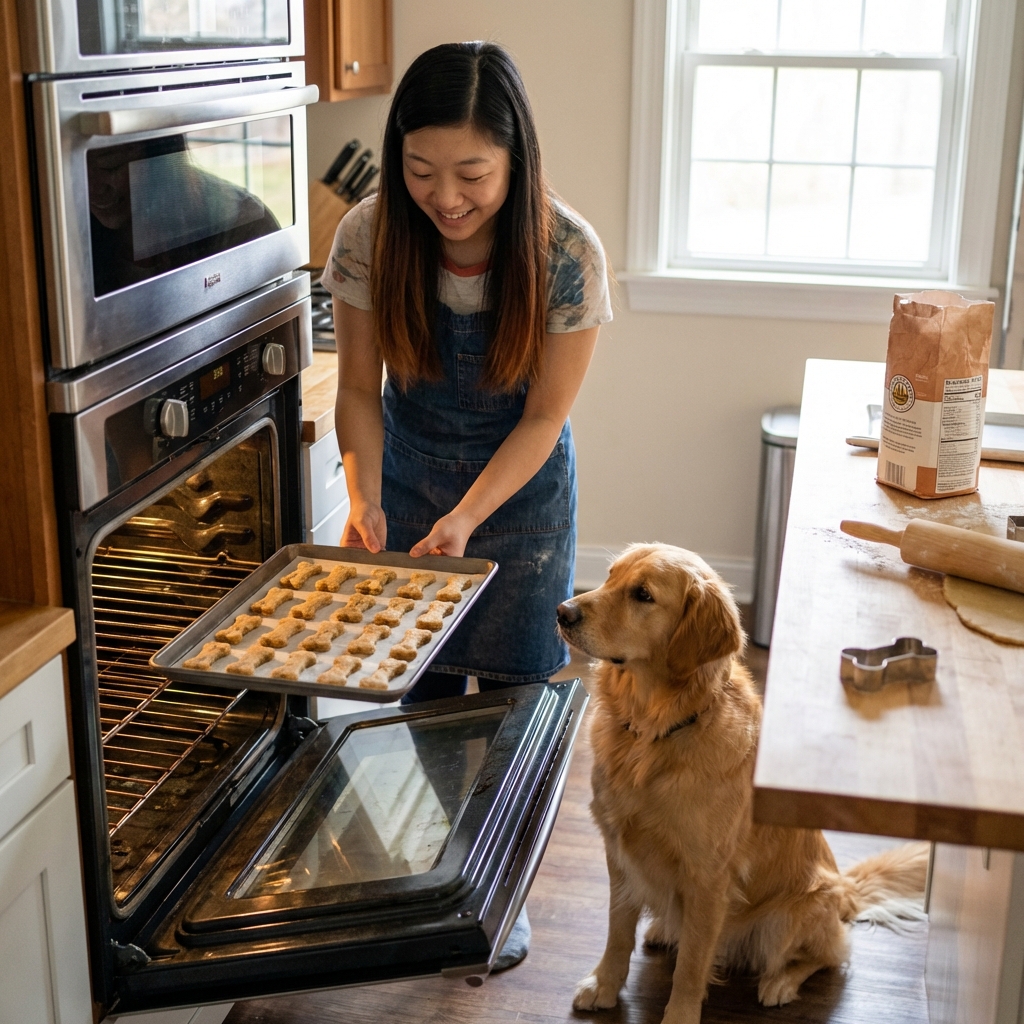
Skip mystery ingredients and bake simple veggie dog treats at home. Learn dog-safe vegetables, easy formulas, and 3 recipes—pumpkin oat crunch, sweet potat...
Article
•
Designer Mixes
Stop Attention Barking: The Real Fix

Shari Shidate
Designer Mixes contributor
If your dog barks for attention, it can feel personal, like they are trying to run the house. In reality, attention barking is often a learned behavior: barking has worked before, so your dog keeps using it. The good news is that means you can unteach it with a clear plan, consistent timing, and rewards for calm behavior.
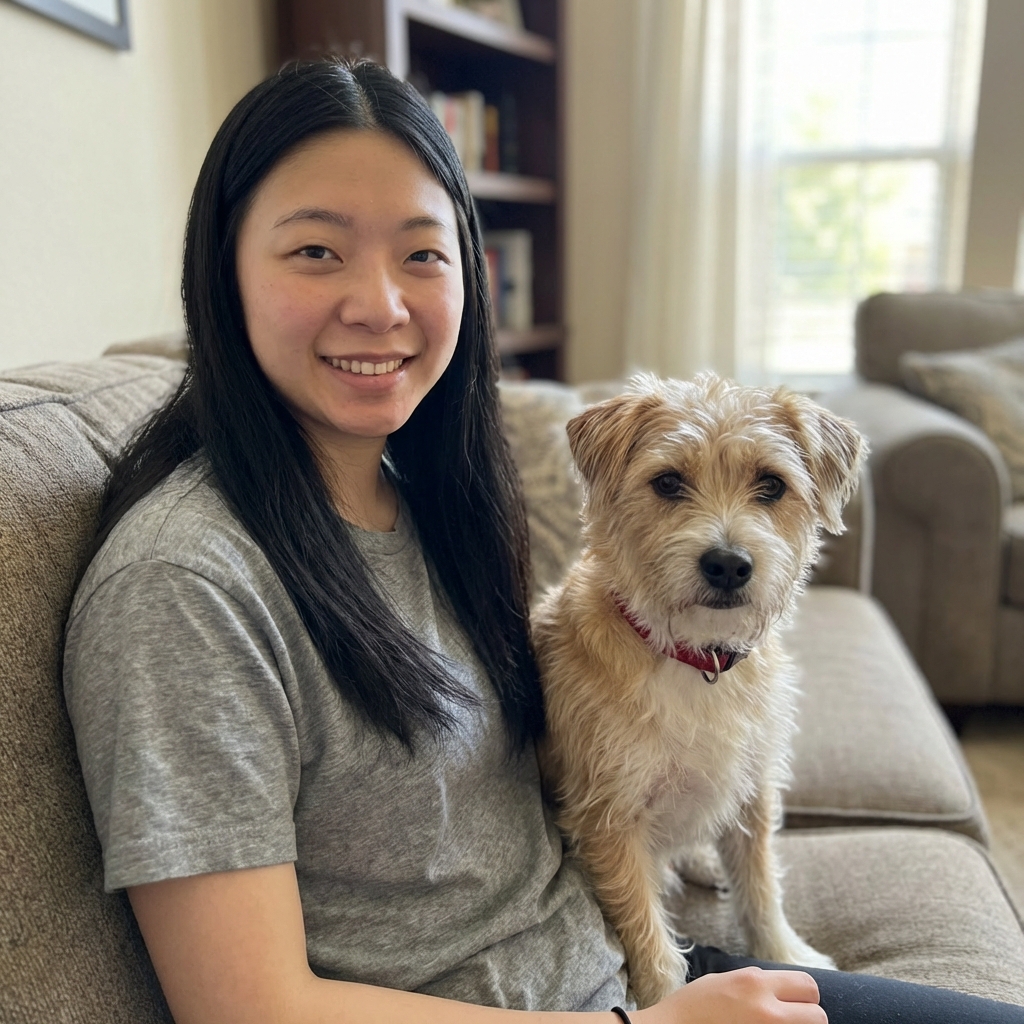
As a veterinary assistant here in Frisco, Texas, I see this pattern all the time. I also see how quickly things improve when families stop accidentally rewarding the barking and start rewarding the quiet.
What attention barking is
Attention barking is vocalizing that is designed to make something happen: you look, you talk, you touch, you toss a toy, you open the door, you share food, or you pick up the leash.
From your dog’s perspective, many responses can act like a reward. For a lot of dogs, even saying “No,” making eye contact, or walking over to them counts as attention.
Quick function check
Before you treat barking as “attention barking,” do a quick check on what is actually driving it. Barking can have more than one purpose.
- Attention: your dog looks at you, barks, pauses, and watches what you do next.
- Alert or territorial: your dog barks at windows, doors, or outdoor noises, even if you ignore them.
- Fear or anxiety: tucked posture, trembling, pacing, dilated pupils, hiding, or barking that seems panicky.
- Frustration: barking when they cannot reach something (leash barrier, fenced yard, behind a gate).
- Separation distress: barking mainly when alone, often paired with drooling, destruction, or house accidents.
- Pain or medical change: sudden new barking, especially in senior dogs or paired with mobility changes.
Common attention triggers
- You are on the phone, working, or talking to someone else
- Meal prep time, when you open the pantry, or when you sit down to eat
- Evening “witching hour” when your dog is tired or under-stimulated
- You come home and your dog wants interaction right now
- Your dog wants you to throw a toy, start a game, or open the back door
Important: If barking suddenly increases, seems frantic, or pairs with pacing, panting, trembling, accidents in the house, or aggression, take a step back and talk with your veterinarian or a qualified trainer. Pain, cognitive changes, and anxiety can all change vocal behavior.
Why it keeps happening
Here is the not glamorous truth: barking persists because it is rewarded.
In behavior science, this is called operant conditioning. If barking makes you do something your dog wants, barking gets stronger. Even worse, if you sometimes give in and sometimes do not, you create intermittent reinforcement, which is the same principle that makes slot machines so hard to stop playing. Your dog learns, “If I keep barking, it might work.”
To stop attention barking, you do two things: remove the payoff for barking, and pay generously for calm.
Step-by-step plan
Step 1: Pick the replacement
You cannot just teach “don’t bark.” You need a replacement behavior that is easy and realistic, such as:
- Four paws on the floor
- Sitting quietly
- Going to a bed or mat
- Bringing a toy and lying down
Pick one and stick with it for a while so your dog does not get mixed messages. Two weeks is a helpful guideline for many families, but some dogs need more time.
Step 2: Remove attention for barking
When barking is clearly attention-seeking (your dog is looking at you, barking, then pausing to see what you do), follow this routine:
- No talking. Even “quiet” can be attention.
- No eye contact. Look up and away.
- No touching. Do not pet, push away, or reach for the collar.
- Turn your body away or calmly step behind a baby gate for 10 to 20 seconds.
Expect an extinction burst: when a behavior that used to work suddenly stops working, many dogs try harder before they give up. For a few days, barking can get louder, faster, or more dramatic. This is normal, and it is often the point where people accidentally teach, “Bark extra hard and I give in.” Stick with the plan and reward the first calm moments.
This feels simple, but consistency is everything. If one person gives in, your dog learns barking still works. In homes with kids or multiple caregivers, make a clear household rule: barking never earns attention. Quiet earns attention.
Step 3: Reward quiet, not the bark
The moment your dog pauses barking, even for one second, reward immediately. Calm praise plus a treat works beautifully, or calmly deliver a chew or toy.
Timing matters: reward after a clear pause, not mid-bark. Many families do best with a marker word like “Yes” (or a clicker) to mark the exact second of silence, then deliver the treat.
A helpful pattern is: Bark → you disengage → quiet → you re-engage and reward. Your dog learns that quiet brings you back.
If your dog is not pausing at all, do not negotiate. Increase your distance, step behind the gate a bit longer, or give it a calm full minute. You are waiting for quiet so you do not accidentally teach a bark-pause-bark routine that keeps going all night.
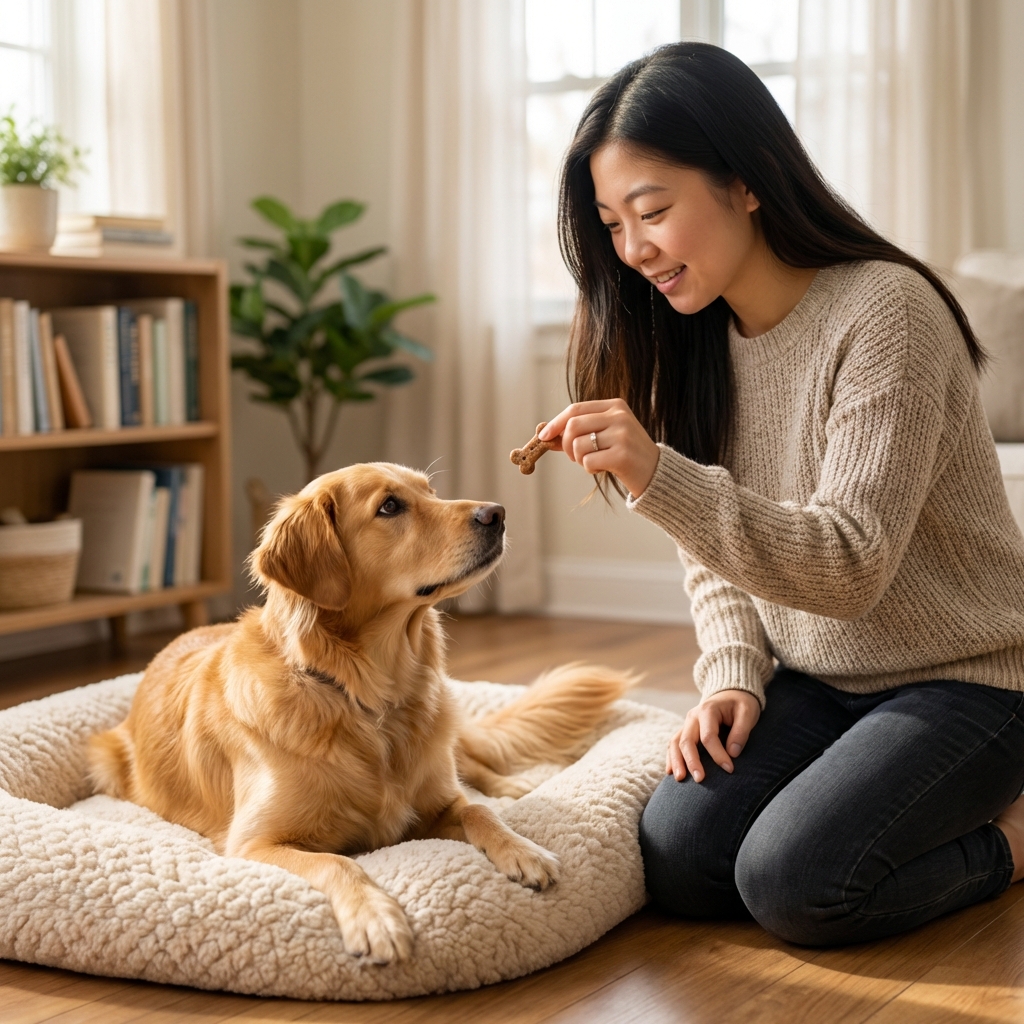
Step 4: Teach Place
Training a “Place” or “Go to bed” cue gives your dog a clear job instead of a habit loop.
- Put a bed or mat a few feet away.
- Toss a treat onto it. When your dog steps on it, calmly say “Yes” and give another treat on the mat.
- Add a cue like “Place” right before they step on.
- Gradually build duration: treat every few seconds while they stay there.
- Practice during easy times first, then use it when you know barking tends to start (phone calls, cooking, TV time).
For many dogs, this one skill lowers household stress because they finally understand what earns attention.
Step 5: Prevent practice
Behavior you rehearse is behavior you strengthen. While you are retraining:
- Use baby gates to create a calm “hangout zone.”
- Keep a leash on indoors for a few days if you need safe control without grabbing collars. Use a supervised drag line only, and remove it when you cannot watch your dog to prevent tangles.
- Close blinds or block windows if your dog gets amped up by people, dogs, or squirrels outside. This is more about reducing alert barking and overall arousal, which makes attention barking easier to work through.
- Provide an appropriate chew option before your busiest times.
Meet needs first
Many dogs bark for attention because their needs are not fully met yet, especially needs for predictable exercise, enrichment, and rest. This is not about blaming anyone or entertaining your dog all day. It is about building a daily rhythm so your dog does not have to demand it.
A simple daily rhythm
- Movement: two brisk walks or one walk plus a play session
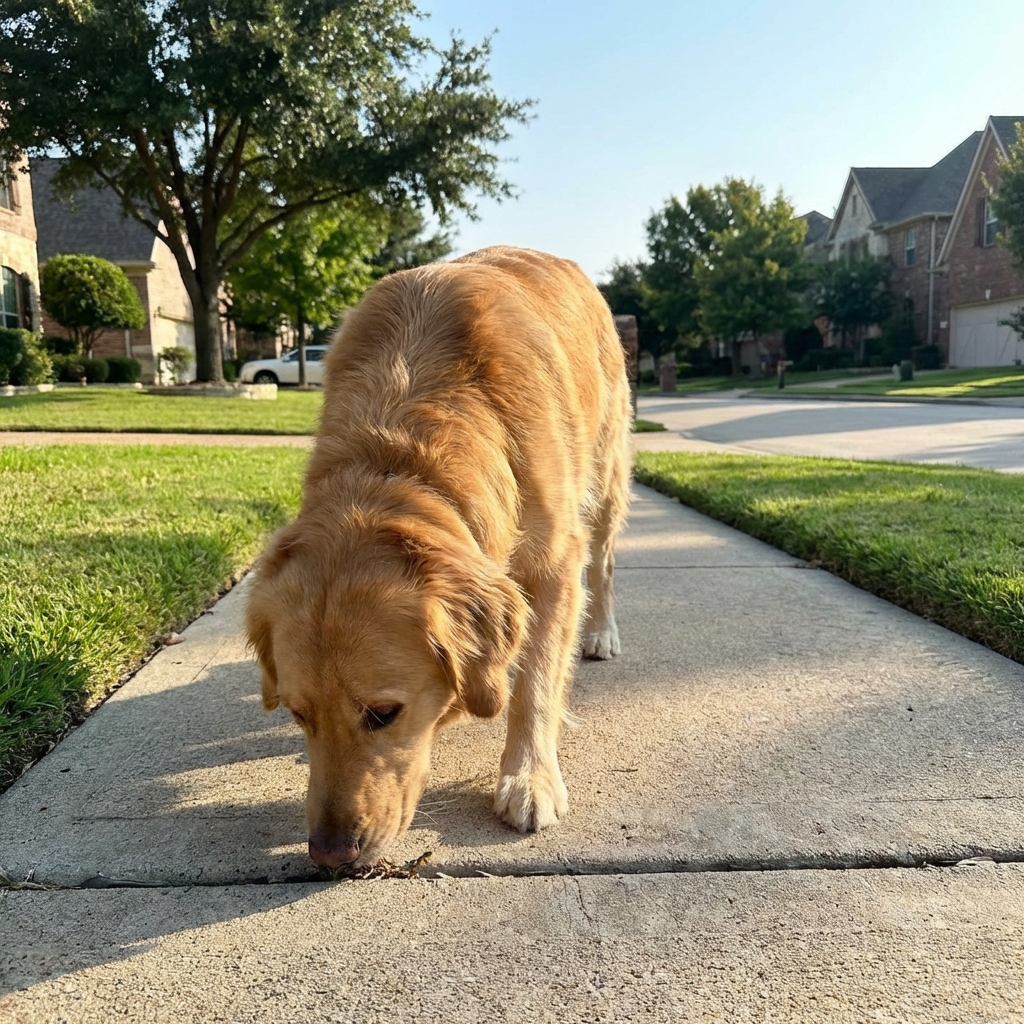
- Sniff time: at least 10 minutes of sniffing outdoors (sniffing is powerful mental work)
- Food enrichment: puzzle feeder, frozen Kong, snuffle mat, scatter feeding in grass
- Training: 3 to 5 minutes, 1 to 2 times daily (sit, down, place, touch)
- Rest: planned nap times in a quiet space (over-tired dogs can be barkier)
Attention on your terms
Set two or three mini attention appointments each day, even if they are only 2 minutes each. Invite your dog for cuddles or play, then end it calmly. This reduces demand behavior because your dog stops feeling like they must shout to be noticed.
Mistakes to avoid
- Rewarding barking accidentally: talking, eye contact, pushing them away, tossing a toy
- Giving in during the extinction burst: this is when barking often spikes before it improves
- Waiting too long to reward quiet: timing matters, reward the first seconds of calm
- Only training when you are annoyed: practice “Place” and calm behaviors when things are easy
- Punishment-based tools: yelling or harsh corrections can increase stress and worsen barking in sensitive dogs
- No plan for guests: have treats ready, use a gate, ask for “Place,” reward calm
What about Quiet?
“Quiet” can work, but only if it is trained like any other cue. If “quiet” is usually shouted after 30 seconds of barking, your dog may learn that barking is part of the routine.
How to teach it
- Wait for a moment of silence.
- Say “Quiet” once in a calm voice.
- Mark it (“Yes” or click) and immediately reward.
- Repeat many times in low-distraction settings.
Then, use it as a reminder, not a debate. If barking continues, return to disengaging and rewarding calm.
When to get help
Please get help sooner rather than later if you notice:
- Sudden barking changes, especially in older dogs
- Signs of pain (limping, sensitivity to touch, reluctance to jump)
- Separation anxiety signs (destructive behavior, drooling, panic barking when alone)
- Growling, snapping, or guarding around the barking episodes
Your veterinarian can rule out medical contributors and refer you to a credentialed trainer or a veterinary behaviorist if needed.
A quick 7-day reset
Days 1 to 2: Stop paying the bark
- Choose your replacement behavior (sit or place).
- Practice disengaging for 10 to 20 seconds when barking starts.
- Reward the first moment of quiet.
Days 3 to 5: Add structure
- Two short training sessions daily: “Place” and calm stays.
- One enrichment meal daily.
- Planned naps or quiet time after exercise.
Days 6 to 7: Raise the bar
- Reward slightly longer quiet periods.
- Practice around real triggers like cooking or phone calls.
- Keep rewards frequent enough that your dog stays successful.
If you stick with this plan consistently, many families see meaningful change within a couple of weeks, especially in mild to moderate cases. For some dogs, it can take 4 to 8 weeks or longer, particularly if anxiety, big habit history, or multiple triggers are involved. Consistency beats intensity every time.