Not sure how often to feed your puppy? Get a vet-inspired meal schedule by age, ideal feeding times, portion guidance, treat limits, and tips for healthy gro...
Article
•
Designer Mixes
Puppy Feeding Chart by Age and Weight

Shari Shidate
Designer Mixes contributor
Puppies grow fast, and their calorie needs change just as quickly. The easiest way to feed confidently is to use three anchors at the same time: your puppy’s age, their current weight, and their body condition (how lean or chubby they look and feel). This guide gives you a practical feeding framework from 8 weeks to 12 months across five size groups, plus wet versus dry tips, meal frequency, and the most common signs you’re feeding too much or too little.
Quick note from a veterinary assistant: Brand formulas vary widely in calories per cup. Use the charts below as a safe starting range, then fine-tune using your food’s label and your puppy’s body condition over 2 to 3 weeks. If your puppy has diarrhea, vomiting, poor growth, or a medical condition, check in with your veterinarian before making big changes.
Label reminder: Choose a food with an AAFCO statement for growth (or all life stages). If your puppy is expected to be over about 50 pounds as an adult, look for an AAFCO statement that includes growth including growth of large size dogs.
How to use these charts
- Step 1: Find your puppy’s age range.
- Step 2: Choose the size group that best matches their expected adult size (toy, small, medium, large, giant). If your puppy will be over about 50 pounds as an adult, choose a large-breed puppy formula even if their current weight looks more “medium” right now.
- Step 3: Use the current weight row to find a daily amount.
- Step 4: Split that daily amount into the meals per day listed for their age.
- Step 5: Re-check weight and body condition every 2 weeks and adjust by about 5% to 10% at a time.
Body condition cheat: You should feel ribs easily with a light touch but not see a sharp rib outline. From above, look for a visible waist. From the side, look for an abdominal tuck. A temporary “post-meal belly” can be normal in puppies, especially right after eating, but a persistent potbelly or distension can also point to parasites or GI issues. If there is no waist and ribs feel padded, reduce the daily amount.
Measuring tip: Cups are convenient, but they are not perfectly consistent. For best accuracy, use a standard measuring cup (not a mug), or weigh food on a kitchen scale if your bag lists kcal per gram or kcal per kilogram.
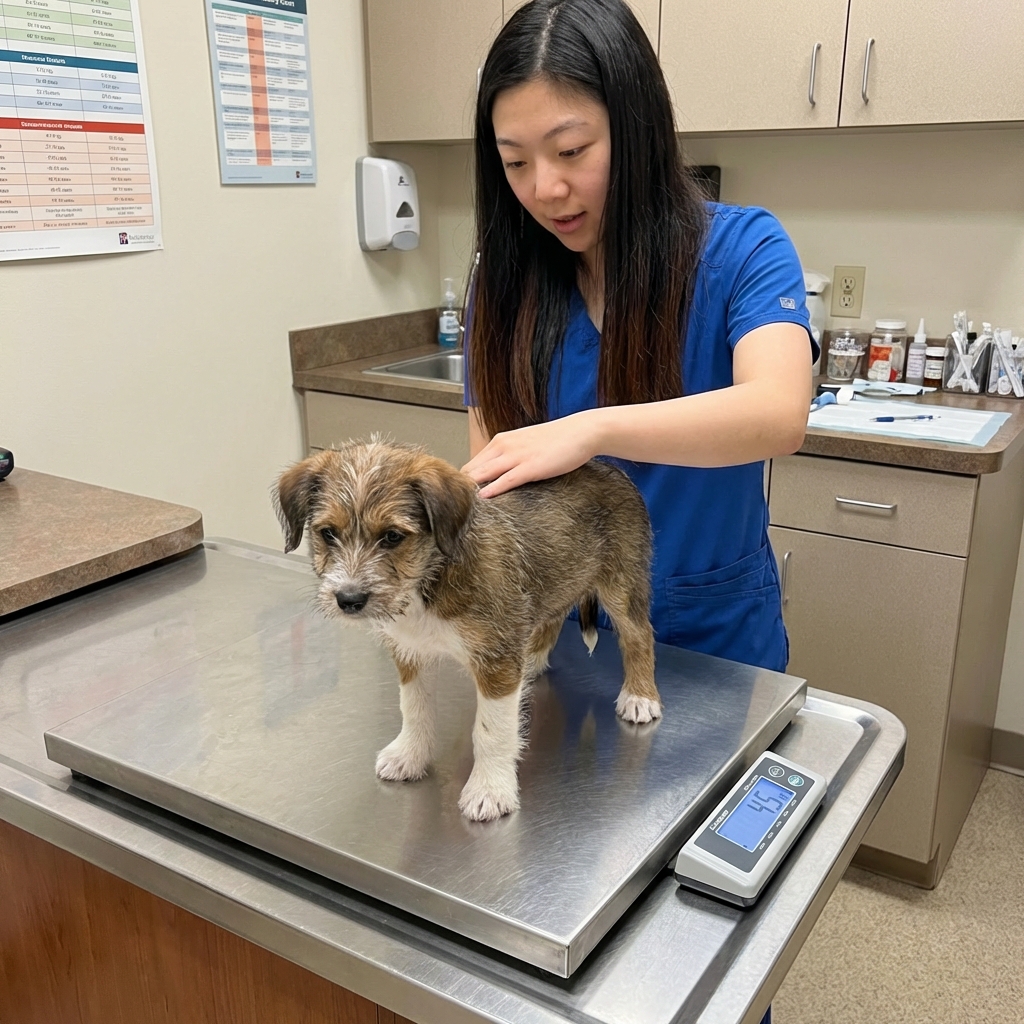
Weigh-in reminder: Most puppies benefit from monthly weigh-ins at home or the vet. Large and giant breed puppies often do best with more frequent checks.
Mixed-breed tip: If you are unsure of adult size, ask your veterinarian for an estimate based on breed mix clues, current growth, and (when known) parent size. If you are between two size groups, start with the smaller group and adjust using body condition.
Feeding frequency by age
Meal timing matters because puppies have small stomachs and high energy needs.
- 8 to 12 weeks: 4 meals per day
- 3 to 6 months: 3 meals per day
- 6 to 12 months: 2 meals per day (some small breeds do well staying at 3 smaller meals)
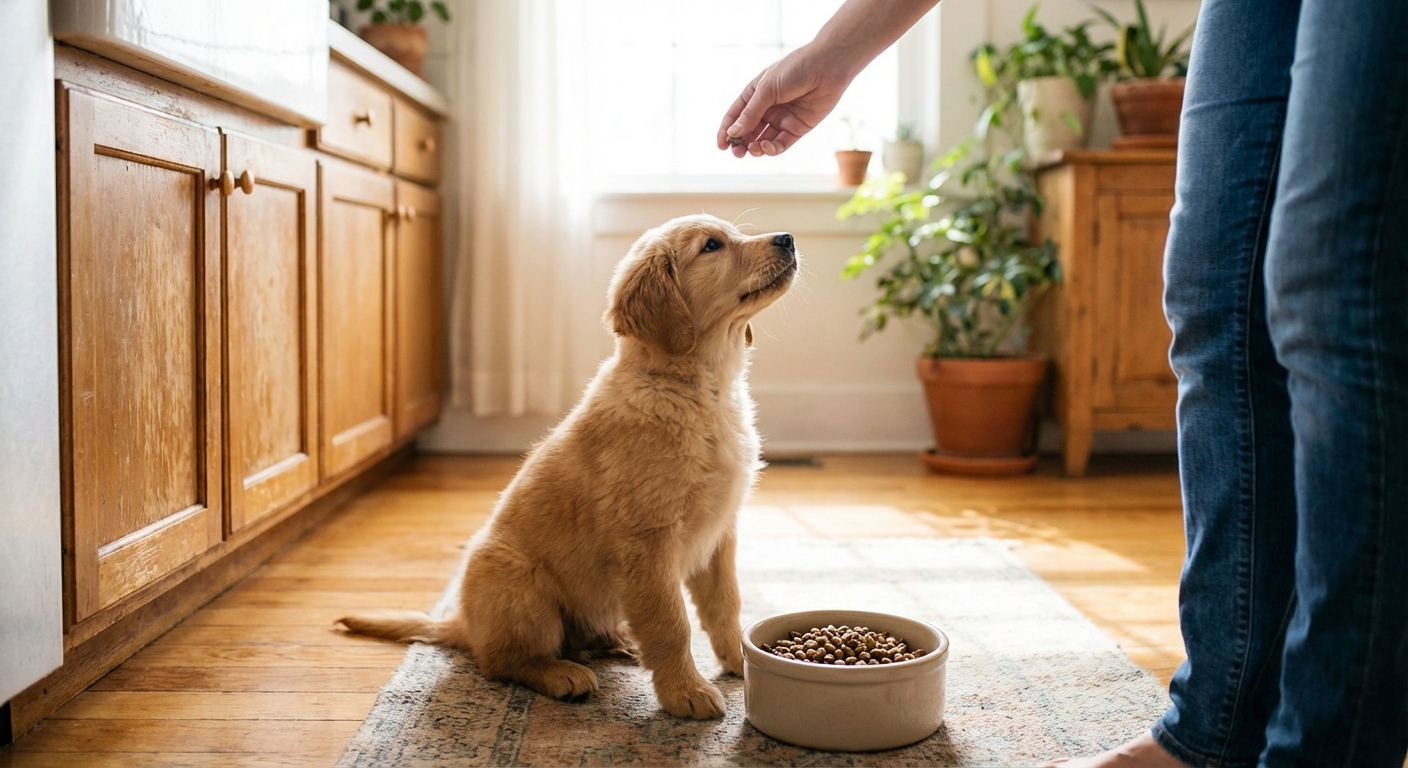
Puppy feeding chart (dry cups per day)
Important: The amounts below assume a typical puppy kibble around 350 to 430 kcal per cup. These are starting ranges that should line up with many quality puppy foods, but your puppy’s true needs can be higher or lower. If your kibble is much higher or lower in calories, adjust using the label, or use the calorie method section below.
Quick rule for calorie density: If your kibble is closer to 430 kcal/cup, you will usually land closer to the lower end of the range. If your kibble is closer to 350 kcal/cup, you may land closer to the higher end.
Why ranges: Activity level, genetics, and even recent spay or neuter can shift calorie needs. Many puppies need fewer calories after spay or neuter, so plan to re-check body condition 1 to 2 weeks after surgery and adjust down if needed.
Treat reminder: If you are training heavily, treats count. Keep treats under 10% of daily calories, and reduce meal portions accordingly (many people use part of the daily kibble as training rewards).
Mobile tip: This section is long. Use the jump links to get to your size group faster.
Jump to a size: Toy | Small | Medium | Large | Giant
Toy breeds (adult 2 to 12 lb)
How to choose a number in the range: Start near the lower end if ribs feel padded, your puppy is lower-energy, or your kibble is closer to 430 kcal/cup. Start near the higher end if your puppy is very active, ribs are easy to feel, or your kibble is closer to 350 kcal/cup.
8 to 12 weeks (4 meals/day)
- 2 lb: 1/4 to 1/3 cup/day
- 4 lb: 1/3 to 1/2 cup/day
- 6 lb: 1/2 to 2/3 cup/day
- 8 lb: 2/3 to 3/4 cup/day
- 10 lb: 3/4 to 1 cup/day
3 to 6 months (3 meals/day)
- 2 lb: 1/4 to 1/3 cup/day
- 4 lb: 1/3 to 1/2 cup/day
- 6 lb: 1/2 to 2/3 cup/day
- 8 lb: 2/3 to 3/4 cup/day
- 10 lb: 3/4 to 1 cup/day
6 to 12 months (2 meals/day)
- 2 lb: 1/4 cup/day
- 4 lb: 1/3 to 1/2 cup/day
- 6 lb: 1/2 to 2/3 cup/day
- 8 lb: 2/3 cup/day
- 10 lb: 3/4 cup/day
Small breeds (adult 12 to 25 lb)
How to choose a number in the range: Lower end for “soft” ribs, a fading waist, or kibble closer to 430 kcal/cup. Higher end for lean, busy puppies, growth spurts, or kibble closer to 350 kcal/cup.
8 to 12 weeks (4 meals/day)
- 5 lb: 1/2 to 2/3 cup/day
- 8 lb: 2/3 to 1 cup/day
- 10 lb: 3/4 to 1 1/4 cups/day
- 15 lb: 1 1/4 to 1 2/3 cups/day
- 20 lb: 1 1/2 to 2 cups/day
3 to 6 months (3 meals/day)
- 5 lb: 1/2 to 2/3 cup/day
- 8 lb: 2/3 to 1 cup/day
- 10 lb: 3/4 to 1 1/4 cups/day
- 15 lb: 1 1/4 to 1 3/4 cups/day
- 20 lb: 1 1/2 to 2 1/4 cups/day
6 to 12 months (2 meals/day)
- 5 lb: 1/2 cup/day
- 8 lb: 2/3 to 3/4 cup/day
- 10 lb: 3/4 to 1 cup/day
- 15 lb: 1 to 1 1/2 cups/day
- 20 lb: 1 1/4 to 1 3/4 cups/day
Medium breeds (adult 25 to 50 lb)
How to choose a number in the range: Start mid-range, then adjust by body condition. If your kibble is closer to 430 kcal/cup, you often land closer to the lower end. If your kibble is closer to 350 kcal/cup, you may land higher.
8 to 12 weeks (4 meals/day)
- 10 lb: 1 to 1 1/2 cups/day
- 15 lb: 1 1/2 to 2 cups/day
- 20 lb: 1 3/4 to 2 1/2 cups/day
- 30 lb: 2 1/2 to 3 1/2 cups/day
- 40 lb: 3 to 4 cups/day
3 to 6 months (3 meals/day)
- 10 lb: 1 to 1 1/2 cups/day
- 15 lb: 1 1/2 to 2 1/4 cups/day
- 20 lb: 2 to 2 3/4 cups/day
- 30 lb: 2 1/2 to 3 1/2 cups/day
- 40 lb: 3 to 4 1/4 cups/day
6 to 12 months (2 meals/day)
- 10 lb: 1 to 1 1/4 cups/day
- 15 lb: 1 1/4 to 1 3/4 cups/day
- 20 lb: 1 1/2 to 2 1/4 cups/day
- 30 lb: 2 to 2 3/4 cups/day
- 40 lb: 2 1/2 to 3 1/2 cups/day
Large breeds (adult 50 to 90 lb)
How to choose a number in the range: For large breeds, lean is the goal. If you are not sure, start a little lower and adjust slowly. Controlled growth is safer for joints. You will also usually land toward the lower end if your kibble is closer to 430 kcal/cup, and toward the higher end if it is closer to 350 kcal/cup.
8 to 12 weeks (4 meals/day)
- 20 lb: 2 1/2 to 3 1/2 cups/day
- 30 lb: 3 to 4 1/4 cups/day
- 40 lb: 3 1/2 to 4 3/4 cups/day
- 50 lb: 4 to 5 1/2 cups/day
- 60 lb: 4 1/2 to 6 cups/day
3 to 6 months (3 meals/day)
- 20 lb: 2 1/2 to 3 3/4 cups/day
- 30 lb: 3 to 4 1/2 cups/day
- 40 lb: 3 3/4 to 5 1/4 cups/day
- 50 lb: 3 1/4 to 4 3/4 cups/day
- 60 lb: 4 3/4 to 6 3/4 cups/day
6 to 12 months (2 meals/day)
- 20 lb: 2 to 3 cups/day
- 30 lb: 2 3/4 to 4 cups/day
- 40 lb: 3 1/4 to 4 3/4 cups/day
- 50 lb: 3 to 4 3/4 cups/day
- 60 lb: 4 1/4 to 6 1/4 cups/day
Giant breeds (adult 90 lb+)
How to choose a number in the range: With giant breeds, the right answer is usually “enough, but not too much.” Aim for steady, controlled growth and a lean body condition. If your kibble is closer to 430 kcal/cup, you will usually be toward the lower end of the range. If it is closer to 350 kcal/cup, you may be toward the higher end. These pups benefit from regular weigh-ins and growth checks with your veterinarian.
8 to 12 weeks (4 meals/day)
- 30 lb: 3 1/2 to 5 cups/day
- 40 lb: 4 to 5 3/4 cups/day
- 50 lb: 4 1/2 to 6 1/2 cups/day
- 60 lb: 5 to 7 1/4 cups/day
3 to 6 months (3 meals/day)
- 30 lb: 3 1/2 to 5 1/2 cups/day
- 40 lb: 4 1/4 to 6 1/4 cups/day
- 50 lb: 5 to 7 1/4 cups/day
- 60 lb: 5 1/2 to 7 1/2 cups/day
- 80 lb: 6 to 8 cups/day
6 to 12 months (2 meals/day)
- 30 lb: 3 1/4 to 4 3/4 cups/day
- 40 lb: 4 to 6 cups/day
- 50 lb: 4 3/4 to 7 cups/day
- 60 lb: 5 1/4 to 7 1/4 cups/day
- 80 lb: 5 1/2 to 7 1/2 cups/day
Large and giant breed reminder: Bigger is not better when it comes to growth rate. Rapid growth can increase orthopedic risk. Choose a large-breed puppy formula if your puppy is expected to be over about 50 pounds as an adult, and keep your pup lean. When shopping, look for an AAFCO statement that includes growth including growth of large size dogs. Also skip calcium supplements unless your veterinarian specifically prescribes them.
Note on edge cases: If your puppy’s weight is far outside what is typical for their age (for example, an extremely heavy very-young giant-breed puppy), do not rely on a generic cup chart alone. Use the calorie method below and get a veterinary growth plan.
Wet versus dry
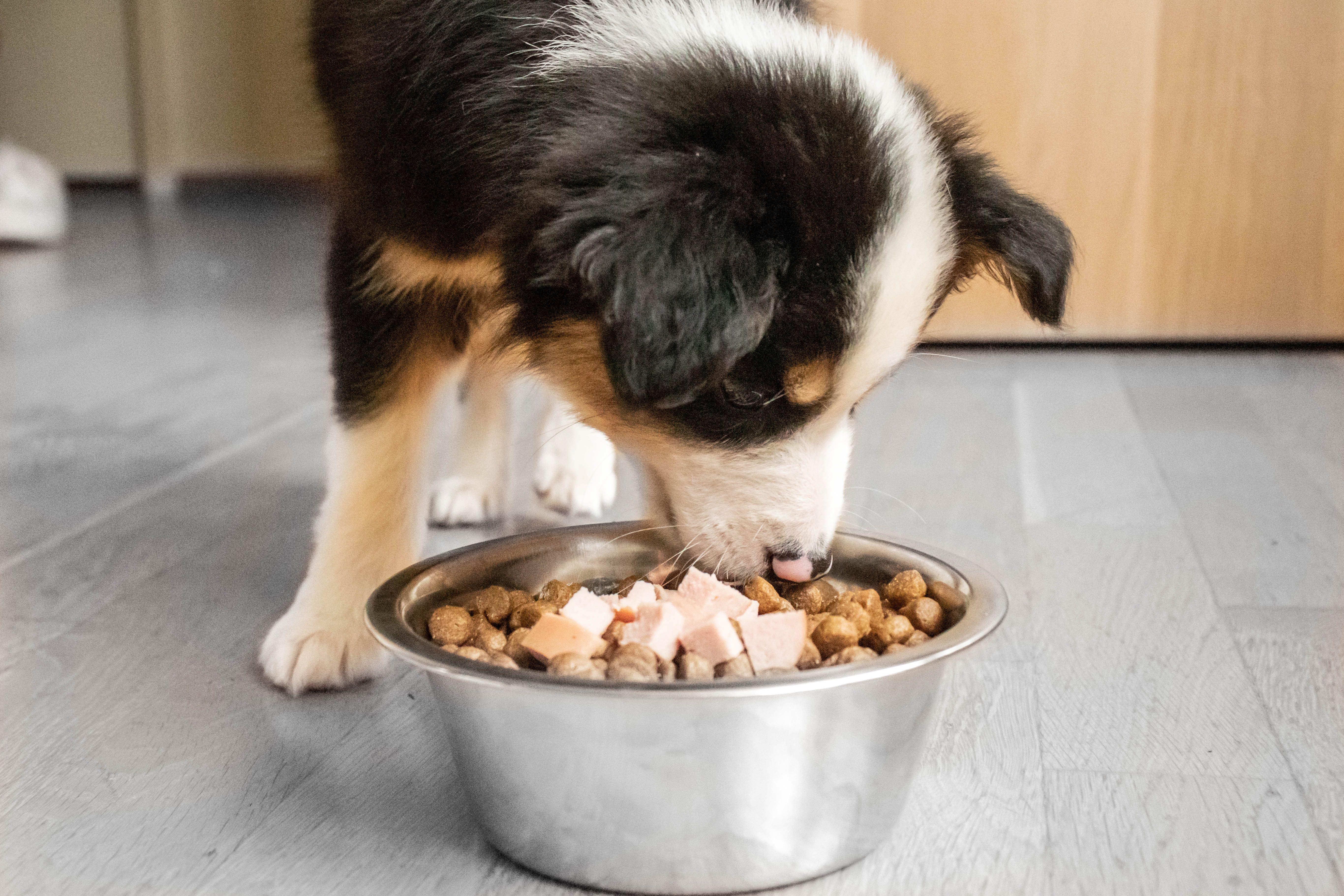
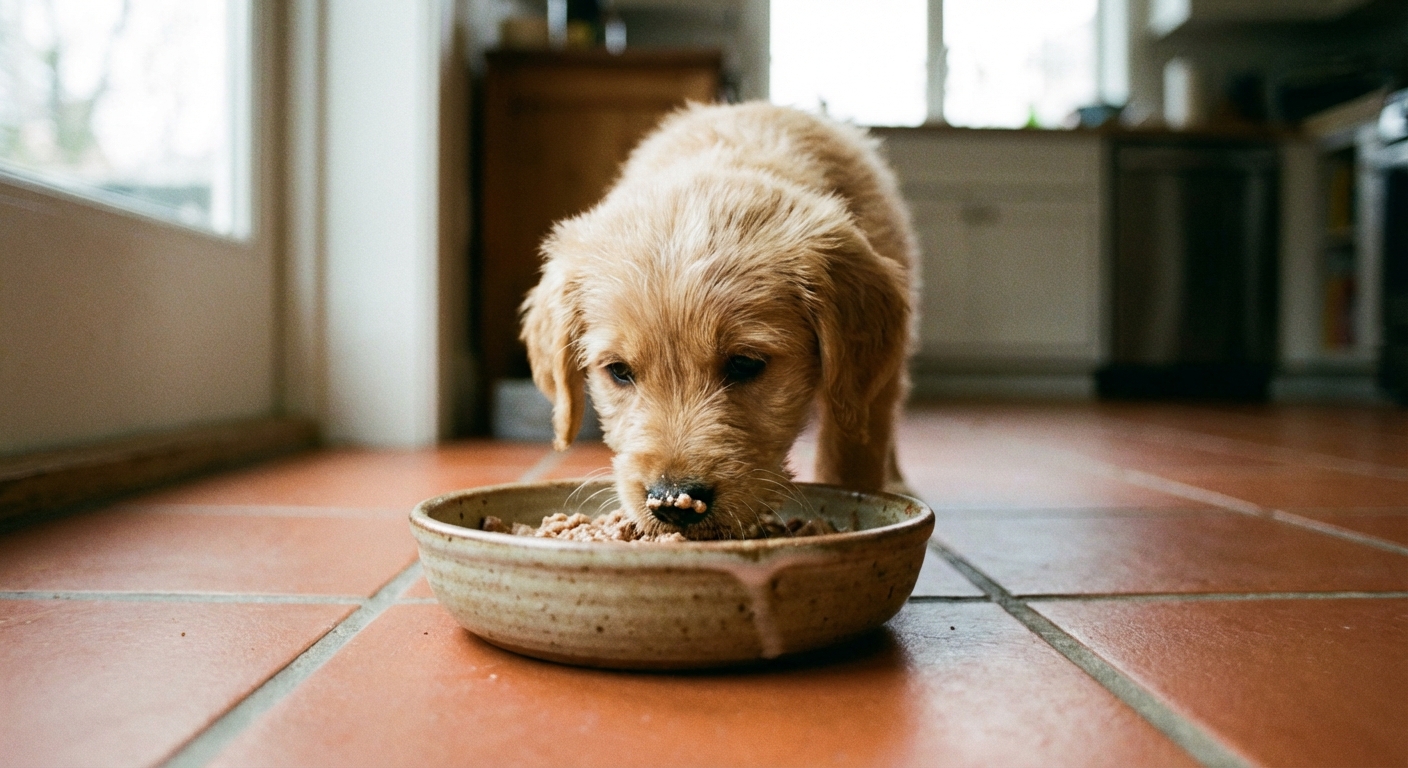
Wet food can be a great tool for picky eaters, and it adds moisture to the diet. Kibble can be easier to portion consistently, especially if you weigh it. The key is that you feed to total calories, not total volume.
Easy mixing ratios
- All dry: Use the chart above as your starting point.
- 75% dry, 25% wet (by calories): Feed about 3/4 of the kibble amount, then add wet food calories for the remaining 1/4.
- 50/50 (by calories): Feed about 1/2 of the kibble amount, then add wet food calories for the other half.
How to convert wet food to kibble cups: Look for calories per can or calories per cup on the label. If your kibble is 400 kcal/cup and the wet food is 200 kcal for the portion you plan to use, that wet portion replaces about 1/2 cup of kibble.
Storage and safety: Refrigerate opened wet food and follow the label for how long it stays fresh. Wash bowls daily, especially in warm weather.
The calorie method
If you want the most precise answer, use calories and your puppy’s weight, then compare it to the bag’s feeding guide. This is also the best way to reconcile differences between brands, treat-heavy training weeks, and mixed wet and dry feeding.
Step 1: Estimate RER
RER = 70 × (body weight in kg ^ 0.75)Step 2: Multiply for growth
Growth needs are a range, not a single magic number. These are typical clinical starting points that many veterinary teams use, and your veterinarian may adjust based on body condition, growth rate, breed, and neuter status. Large-breed puppies often do best on the lower end to keep growth controlled.
- Under 4 months: often 2.5 to 3 × RER
- 4 to 12 months: often 1.6 to 2.5 × RER (large and giant breeds commonly land closer to 1.6 to 2.0 × RER once they are past the fastest growth phase)
Also note: Energy needs often decrease after spay or neuter. If your puppy is recently altered, you may need to reduce calories and re-check body condition within a couple of weeks.
Quick spot-check examples
These examples are meant to show the charts are in the right ballpark for a kibble around 350 to 430 kcal/cup. Because foods and puppies vary, use them as a confidence check, not a perfect match. (All RER estimates below are rounded.)
- Small example (10 lb, about 3 months): 10 lb is 4.5 kg. RER ≈ 215 kcal/day. Many household puppies at this age land around 2.0 to 2.5 × RER or about 430 to 540 kcal/day. If kibble is 350 to 430 kcal/cup, that is roughly 1.0 to 1.5 cups/day, which overlaps the toy and small chart ranges for 10 lb depending on age and activity.
- Medium example (30 lb, about 5 months): 30 lb is 13.6 kg. RER ≈ 510 kcal/day. At 4 to 12 months, many puppies fall around 1.6 to 2.2 × RER or about 815 to 1120 kcal/day. With a 350 to 430 kcal/cup kibble, that is about 1.9 to 3.2 cups/day. This overlaps the medium chart for 30 lb at 3 to 6 months. If your kibble is higher-calorie (closer to 430), you will usually be toward the lower end. If your kibble is lower-calorie (closer to 350) or your puppy is extremely active, you may land higher. Use body condition to choose the right point in the range.
- Large example (50 lb, about 6 months): 50 lb is 22.7 kg. RER ≈ 725 kcal/day. At this stage, many large-breed puppies do well around 1.8 to 2.4 × RER (often closer to the lower end if you are keeping growth controlled), which is about 1300 to 1740 kcal/day. With a 350 to 430 kcal/cup kibble, that is roughly 3.0 to 5.0 cups/day. This overlaps the large chart for 50 lb once you are in the 6 to 12 month window. If your puppy is lean and very active or your kibble is closer to 350 kcal/cup, you may land toward the higher end. If your puppy is getting a little soft at the ribs, aim lower.
- Giant example (80 lb, about 5 months): 80 lb is 36.3 kg. RER ≈ 1040 kcal/day. Depending on growth stage and activity, a common real-world range is about 1.8 to 2.2 × RER or 1870 to 2290 kcal/day. With a 350 to 430 kcal/cup kibble, that is roughly 4.3 to 6.5 cups/day. This lines up with controlled-growth feeding targets for many giant-breed puppies. Use body condition and your veterinarian’s growth checks to guide you.
How to reconcile chart vs. calories: If the chart and calorie math do not match for your puppy, trust body condition trends over 2 to 3 weeks, then adjust by 5% to 10% at a time. Kibble calorie density, treat intake, and growth stage can shift the “right” cup amount, but for large and giant breeds, it is especially important to avoid pushing calories aggressively.
This method is especially helpful for puppies eating a mix of kibble, wet food, and treats, because it keeps you honest about total calories.
Signs you are overfeeding
- Rapid weight gain or a round belly that does not improve after your vet-directed parasite treatment is complete
- You cannot easily feel ribs, or there is no visible waist from above
- Stool becomes softer or bulkier than usual (this can also be caused by parasites, intolerance, or a sudden diet change)
- Your puppy seems uncomfortable after meals or less eager to play overall (noting that many pups naturally rest after eating)
- For large breeds: growing fast but looking chubby, which can stress joints
- Weight gain begins after spay or neuter without a change in routine (very common)
What to do: Reduce the daily amount by about 5% to 10% for 2 weeks, limit treats to 10% of daily calories, and re-check body condition.
Signs you are underfeeding
- Ribs, spine, or hip bones are prominent, or the puppy looks drawn in the face
- Low stamina, poor coat quality, or slow recovery after play
- Constant hunger that does not improve even with training enrichment
- Slow or stalled growth compared to littermates (keeping in mind some pups are naturally smaller)
What to do: Increase the daily amount by about 5% to 10% and re-check weight and stool quality in 10 to 14 days. If your puppy seems ravenous all the time, talk with your vet about intestinal parasites, diet quality, or other issues.
When to switch to adult food
The right time depends more on adult size than on age alone.
- Toy and small breeds: often transition around 9 to 12 months
- Medium breeds: often around 12 months
- Large breeds: often around 12 to 15 months
- Giant breeds: often around 15 to 24 months
How to switch: Transition gradually over 7 to 10 days, increasing the adult food while decreasing the puppy food. Go slower if your pup has a sensitive stomach.
Large-breed note: Many large-breed puppies do best staying on a large-breed puppy diet until they are ready for adult food, because those diets are formulated for controlled growth and appropriate mineral balance.
Common feeding questions
Do I free-feed my puppy?
In most homes, I recommend measured meals. It helps with potty training, prevents overeating, and makes it easier to spot appetite changes early.
How many treats can my puppy have?
A good rule is treats stay under 10% of daily calories. For tiny puppies, that can be shockingly few treats. Try using part of their kibble as training rewards.
What about toppers?
Toppers can help picky eaters, but keep them simple and consistent. If you add toppers, reduce the base food so total calories stay balanced.
Should I add supplements?
If you are feeding a complete and balanced puppy diet (AAFCO statement for growth), you usually do not need extra supplements. Extra calcium in particular can be harmful for large-breed puppies. When in doubt, ask your veterinarian.
Safety reminders
- Provide clean water at all times.
- Avoid toxic foods like grapes, raisins, onions, and xylitol.
- If your puppy is vomiting, has persistent diarrhea, seems lethargic, or is not gaining appropriately, call your vet.
- For deep-chested large breeds, ask your veterinarian about bloat risk and what feeding routine makes sense for your specific dog.
Your puppy’s feeding chart is a starting line, not a finish line. Watch the puppy in front of you, keep them lean, and adjust slowly. That is how you set up healthy growth for life.