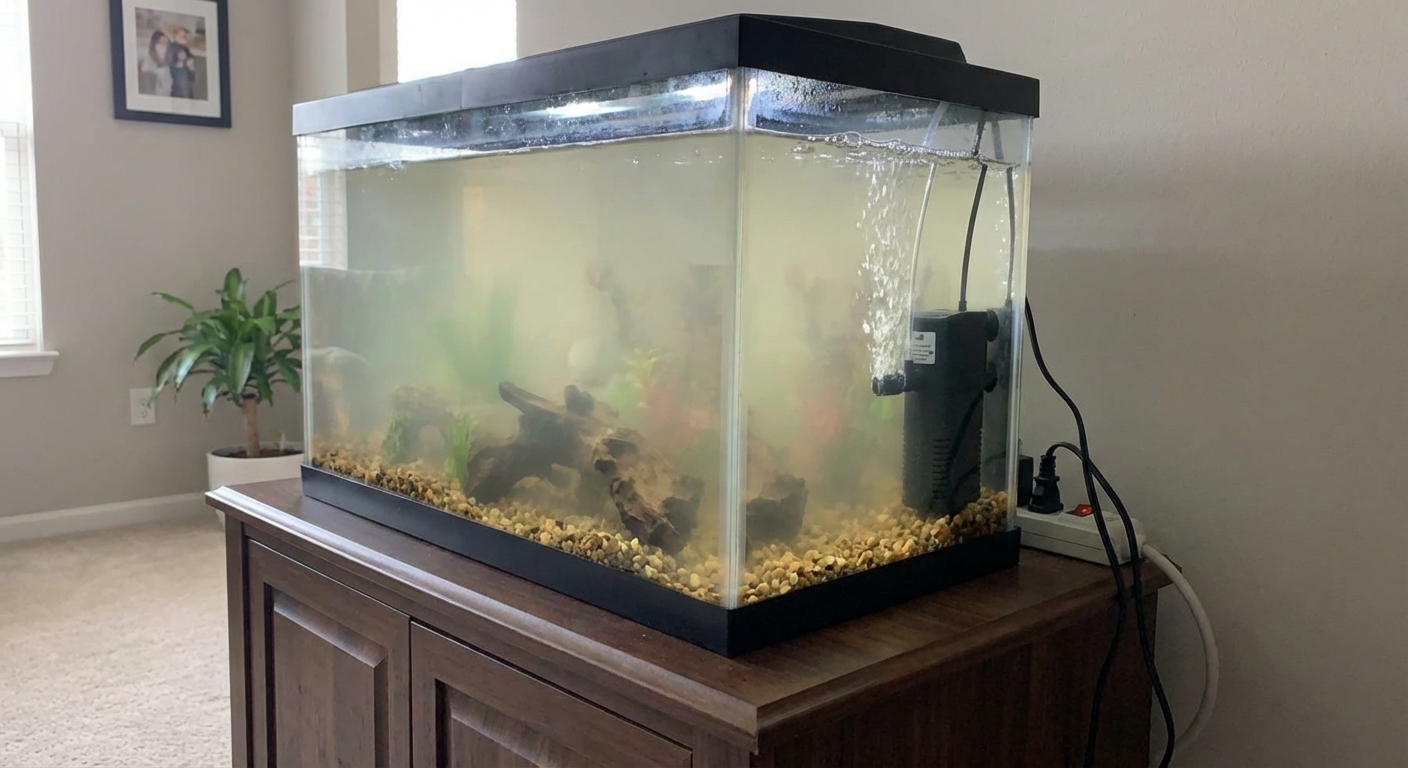
Cloudy aquarium water? Use color clues to find the cause, then test ammonia and nitrite, do safe water changes, boost filtration and aeration, and stop haze ...
Article
•
Designer Mixes
My Fish Tank Is Cloudy

Shari Shidate
Designer Mixes contributor
Cloudy aquarium water can feel discouraging, especially when you are doing everything “right.” The good news is that cloudiness is usually fixable once you know what kind of cloudiness you are seeing and what is causing it. In most cases, it is a temporary imbalance in filtration, bacteria, feeding, oxygen, or water chemistry.
Below is a comprehensive, beginner-friendly walkthrough to help you identify the cause quickly and clear your tank safely, without stressing your fish.
First, identify the type of cloudiness
Different cloudiness patterns point to different causes. Take a close look under bright room light. If you can, note when it started and what changed recently (new fish, new filter media, big cleaning, water change, new substrate).
White or milky haze
This is often a bacterial bloom, especially in new tanks or after a major change like deep-cleaning the filter, replacing too much filter media at once, or adding a lot of fish at once. However, white cloudiness can also be suspended substrate fines, microbubbles after a water change, or mineral precipitation. A couple quick checks below will help you narrow it down.
Green water
This is usually a bloom of free-floating algae. It is common when light is too strong or on too long, nutrients build up, or the tank gets direct sunlight.
Brown or yellow tint
This is often tannins from driftwood, leaves, or certain substrates. It is typically harmless. It can lower pH in some tanks, especially when the water has low KH (low buffering), but in well-buffered water the pH may not change much.
Cloudy after adding sand or gravel
This is usually dust or fine particles from substrate that was not rinsed enough. It typically clears with time and mechanical filtration.
Tiny “sparkles” or fizz after a water change
This is often microbubbles, not true cloudiness. It can happen after water changes, when a new filter is breaking in, or if a filter intake line is pulling in air. Microbubbles usually clear within a few hours to a day.
What is causing it (the mechanics)
This section explains what is happening behind the scenes biologically or chemically, based on the visual symptoms above.
1) Bacterial bloom in a new or disrupted tank
In a healthy aquarium, beneficial bacteria live on surfaces like your filter media, gravel, decor, and glass. They help process fish waste by converting ammonia into nitrite, then into nitrate. When that bacterial community is still developing, or gets knocked back, fast-growing bacteria can temporarily multiply in the water column and cause a white haze.
- Most common triggers: brand new setup, washing filter media in untreated tap water, replacing all media at once (especially cartridge-style media), a big overfeeding event, adding many fish quickly.
- Key clue: cloudiness appears suddenly and the tank is under a few months old, or you recently “reset” the filter.
2) Excess waste and organics
Uneaten food, decaying plant matter, and fish waste release tiny particles and dissolved organics that make the water look dull or hazy. This often goes hand in hand with higher nitrates and algae issues.
3) Algae bloom from light plus nutrients
Green water is not “dirty” in the usual sense. It is microscopic algae multiplying quickly. When light and available nutrients are consistently high, it can take over fast.
4) Hard water precipitation (mineral haze)
If you see a pale, chalky haze right after a water change or dosing, it may be minerals precipitating out, especially when mixing buffers, salts, or pH-altering products.
- Key clue: cloudiness appears immediately after dosing or a water change.
- Other signs: white residue on heater, glass, or filter parts; very high GH or KH; particles that settle over time.
Do this right away: quick safety check
When water turns cloudy, the biggest risk to fish is not the cloudiness itself. The risk is what might be happening alongside it, like rising ammonia or low oxygen.
Test these parameters today
- Ammonia (NH3/NH4+): should be 0 ppm
- Nitrite (NO2-): should be 0 ppm
- Nitrate (NO3-): aim under 20 to 40 ppm for many community tanks (lower for sensitive fish and invertebrates)
- pH: stable is more important than “perfect”
- Temperature: confirm heater accuracy if you use one
Watch fish behavior
If fish are gasping at the surface, acting lethargic, or clamping fins, treat it as urgent. Increase surface agitation right away and be ready for a partial water change.
If ammonia or nitrite is above 0
- Do a 30 to 50% water change with dechlorinator (match temperature as closely as you can).
- Increase aeration because ammonia and nitrite issues often come with low oxygen stress.
- Reduce feeding for a few days (small meals or skip a day).
- Re-test daily and repeat partial water changes as needed until ammonia and nitrite return to 0.
- Optional: an ammonia detoxifier can help in a pinch if used exactly per label, but it is not a substitute for water changes and restoring filtration.
Fix cloudy water by cause
If it is a bacterial bloom
- Be patient: many blooms clear in about 3 to 10 days once the tank stabilizes, but it can take longer in actively cycling tanks or heavily stocked tanks.
- Do not replace all filter media: that removes beneficial bacteria. This is especially important with hang-on-back cartridges. If you use cartridges, consider keeping long-term sponges or biomedia in the filter and only replacing disposable floss as needed.
- Rinse filter sponges or pads in tank water or dechlorinated water: avoid untreated tap water, which can harm beneficial bacteria if it contains chlorine or chloramine.
- Feed lightly for a few days: less food means less waste fueling the bloom.
- Optional support: adding bottled beneficial bacteria can help, but consistency and patience matter more than products.
Water changes? A modest change is fine if ammonia or nitrite is elevated. If parameters are safe, avoid doing huge back-to-back changes that keep the system from settling.
If it is green water (algae bloom)
- Reduce light: aim for 6 to 8 hours a day for most planted tanks, less for low-tech setups. Avoid direct sunlight on the glass.
- Pause or reduce fertilization: if you fertilize, scale back until the bloom resolves.
- Keep nutrients under control: avoid overfeeding, vacuum debris, and consider adding fast-growing plants.
- Water changes help, but do not rely on them alone: 25 to 40% weekly is a solid starting point for many tanks, but the bloom usually clears when the light schedule and nutrient inputs are corrected.
- Optional blackout: a 2 to 4 day blackout (tank lights off, minimize ambient light) can knock back free-floating algae. Make sure filtration and aeration run continuously.
Some aquarists use a UV sterilizer for stubborn green water. It can work very well, but it treats the symptom, so you still want to fix the light and nutrient imbalance.
If it is substrate dust or floating particles
- Let the filter run: mechanical filtration often clears this within 24 to 72 hours.
- Add fine filter floss: it can polish water quickly. Replace it as it clogs.
- Vacuum gently: avoid stirring the substrate too aggressively.
If it is tannins (brown tint)
- It is usually harmless: many fish, like bettas and tetras, do great in tannin-rich water.
- pH note: tannins may lower pH more noticeably in low-KH water. In hard, well-buffered water, the color may change while pH stays mostly stable.
- Clear it if you prefer: activated carbon or specific chemical media can remove tannins, and water changes will gradually lighten the color.
- Pre-soak driftwood: boiling or soaking helps reduce future leaching.
If it is microbubbles
- Give it time: microbubbles often clear on their own within hours.
- Check for air leaks: confirm the intake tube is fully submerged, connections are snug, and there are no cracks in airline or intake parts.
- Aim the output: adjust the filter output so it does not inject excessive air into the water.
If it is mineral precipitation
- Stop stacking additives: avoid mixing multiple buffers, salts, and pH-altering products at the same time unless you are following a specific recipe.
- Mix outside the tank when possible: dissolve powders fully in a bucket of dechlorinated water before adding.
- Run mechanical filtration: fine floss can help catch particles as they settle out.
What not to do
- Do not fully “sterilize” the tank: deep cleaning gravel, decor, and filter all at once can crash your beneficial bacteria.
- Do not overuse clarifiers: water clarifiers can clump particles, but they do not fix ammonia, overfeeding, or algae drivers. They can also clog filters if you do not maintain them.
- Do not chase pH: swinging pH is stressful. Stability is your friend.
- Do not add more fish to “balance things out”: that usually adds more waste and makes blooms worse.
A simple 7 day plan
If you are unsure of the exact cause, this gentle approach solves many situations without harming your cycle.
- Day 1: Test ammonia, nitrite, nitrate. If ammonia or nitrite is above 0, do a 30 to 50% water change with dechlorinator and increase aeration.
- Day 1 to 3: Feed half portions or skip one day of feeding. Keep filter running 24/7.
- Day 2 to 4: If flow is reduced, rinse filter sponge or pad in removed tank water or dechlorinated water. Add a small amount of fine floss if you have it.
- Day 4: Do a 25% water change and lightly vacuum visible debris.
- Day 5 to 7: Adjust lighting down to 6 to 8 hours if algae is suspected. Re-test parameters and watch fish closely.
If cloudiness is worsening and fish are stressed, treat it as a water quality emergency and test again immediately.
When to get help
Most cloudy water issues are husbandry-related, but you should get hands-on help if:
- Ammonia or nitrite will not return to 0 despite water changes and reduced feeding.
- Fish are gasping, flashing, or dying.
- You recently used a medication, pesticide, or cleaning product near the tank.
- The tank smells strongly foul or sulfur-like.
Prevention
- Cycle new tanks fully before adding a full stock of fish.
- Feed small amounts that are eaten quickly, and remove leftovers.
- Do weekly water changes in the 20 to 30% range for many tanks (adjust to your stocking and test results).
- Clean filters gently and never replace all media at once.
- Keep a consistent light schedule and avoid direct sun.
- Test regularly so you catch trends before the water turns cloudy.