Leash Reactivity in Dogs

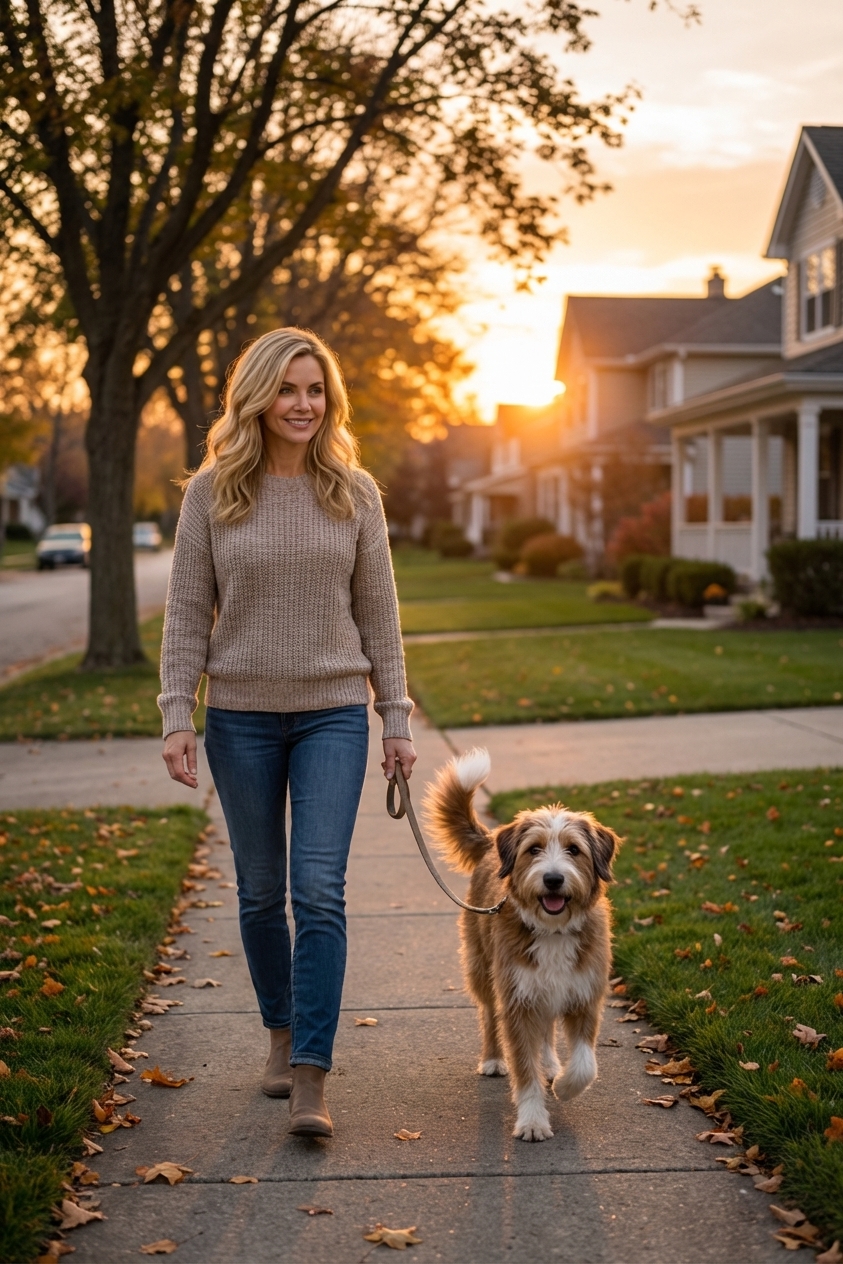
Leash reactivity can feel embarrassing and stressful. One second you are enjoying a walk, and the next your dog is barking, lunging, or spinning at the end of the leash because another dog, person, bike, or squirrel appeared. The good news is that reactivity is common, and with the right plan you can start improving your walks today.
I am Shari Shidate, a veterinary assistant in Frisco, Texas, and I want you to know this: reactive behavior is information, not a moral failing. Your dog is telling you they are over their comfort zone. Our job is to keep everyone safe while we teach calmer skills one walk at a time.
Quick note: This article is general training and safety guidance, not a medical or behavioral diagnosis. If you are worried about aggression risk, bites, or sudden behavior changes, please involve your veterinarian and a qualified behavior professional.
Reactivity vs. aggression
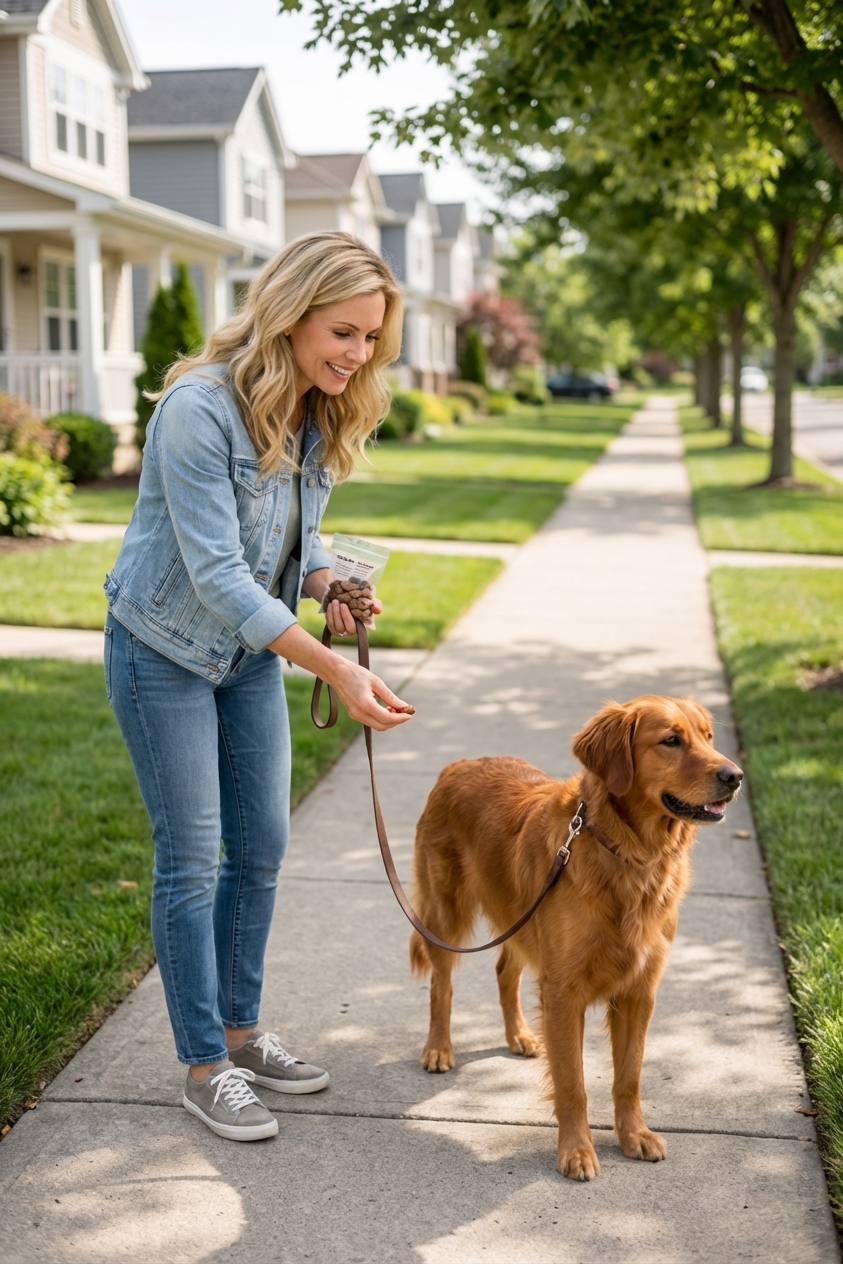
These words get mixed up a lot. They are not the same, even though they can look similar from the outside.
Leash reactivity
- What it looks like: barking, whining, lunging, staring, growling, jumping, spinning, or “melting down” on leash.
- What it usually means: big emotions like fear, frustration, excitement, or uncertainty.
- What often makes it worse: tight leashes, close distances, repeated surprises, and forced greetings.
Aggression
- What it is: a set of behaviors such as threats, snaps, lunges, and bites that often function to create distance or stop an interaction.
- Important note: reactive dogs can show aggressive behaviors if they are repeatedly pushed past their limits, especially if they feel trapped on leash.
Either way, your plan starts the same: create more space, prevent rehearsing the outburst, and teach new coping skills.
The key concept: threshold
Threshold distance is how close your dog can be to a trigger while still able to think, take treats, and respond to you. Past threshold, access to learned behaviors drops and the fight or flight response takes over, which makes learning much harder.
Here are common signs your dog is approaching threshold:
- Freezing or suddenly moving very slowly
- Hard staring or “locking on”
- Mouth closes, breathing changes
- Body weight shifts forward, leash tightens
- Ignoring treats they would normally love
Your training goal is simple: work under threshold. That usually means more distance than you think at first.
Walk setup: what to bring
- High-value treats: soft, smelly, and tiny. Think chicken, cheese, or store-bought training treats. Bring more than you think you need.
- A treat pouch: so your hands are fast and your timing is clean.
- A 6-foot leash: avoid retractable leashes for reactive training because they keep tension on the line and reduce control.
- Optional long line (10 to 15 feet): helpful for decompression sniffing in low-risk, open areas where it is legal and safe to use one.
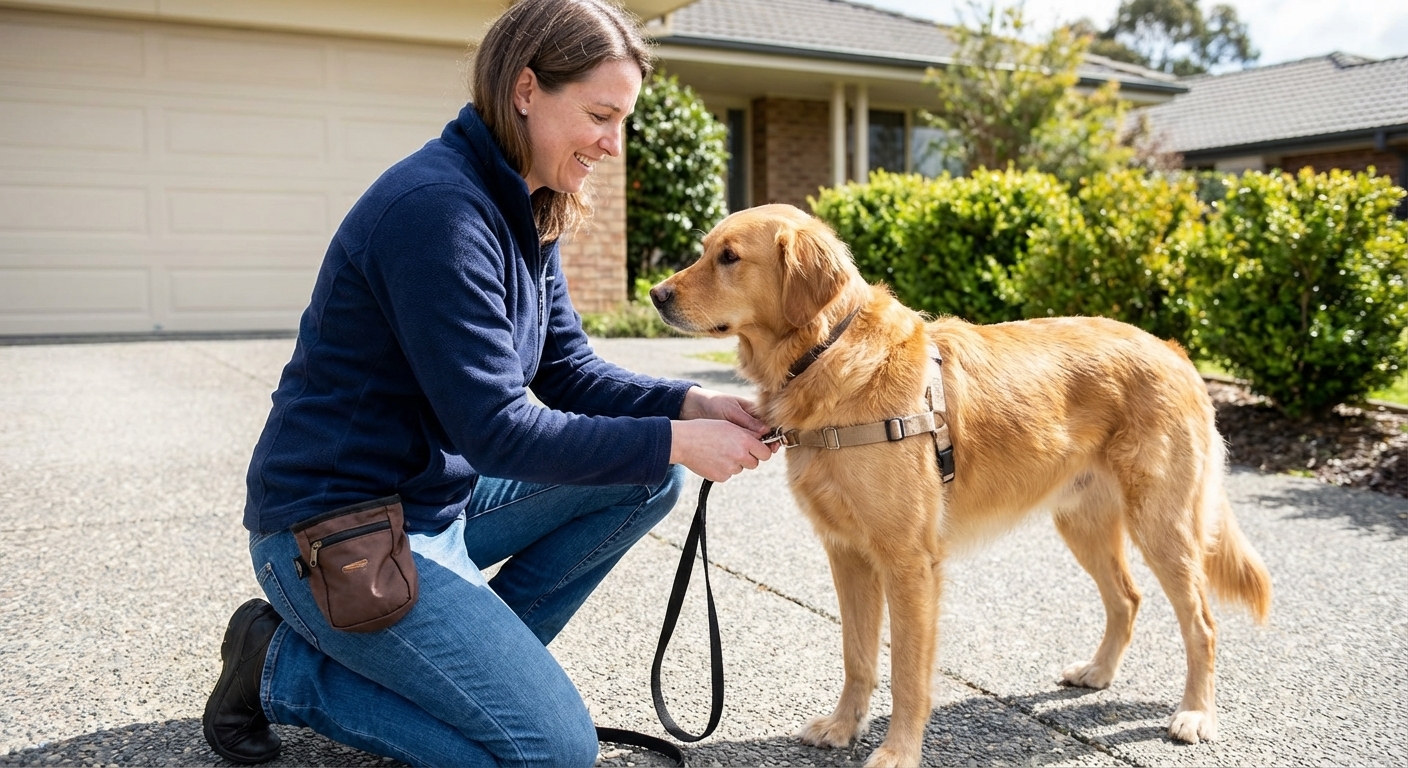
- Comfortable harness: ideally a Y-front style that does not restrict the shoulders. A front clip can help reduce pulling for some dogs.
- Optional safety backup: a second connection (leash to collar and harness) for dogs who can slip gear.
Equipment note: This plan is not built around punishment tools. Aversive methods like leash pops or shock can suppress behavior without changing the underlying emotion. They have also been associated with increased stress and fallout behaviors, including fear and defensive responses, in some dogs. If you have questions about gear, ask a certified professional who uses humane, evidence-based training.
The 15-minute calmer-walk plan
This is a practical plan you can use right away. Keep sessions short. You are building a habit, not winning a single walk.
Step 1: Pick the route
- Pick a time and place with fewer triggers, like quieter streets or wide open areas.
- Favor routes with escape options such as driveways, parking lots, or grassy setbacks where you can step away.
- During training, avoid crowded areas where you cannot create distance. Good leash control and space are part of responsible handling.
- If your neighborhood is busy, start with shorter walks and more enrichment at home.
Step 2: Start with decompression
For the first few minutes, let your dog sniff on a loose leash. Sniffing is calming and helps lower arousal. You can quietly feed a treat every so often when the leash stays loose.
Step 3: Find your working distance
When you spot a trigger, ask two questions:
- Can my dog take treats?
- Can my dog look away and reorient to me?
If the answer is no, you are too close. Create distance immediately.
Step 4: Use a treat-scatter
A treat-scatter is exactly what it sounds like. You toss several small treats on the ground near your feet so your dog can sniff and forage.
- It shifts your dog from staring to sniffing.
- It buys you a few seconds to assess and move away.
- It is easy, and it works best when done early, before the explosion.
How to do it: say a calm cue like “find it,” then drop or toss 5 to 10 tiny treats in the grass at your feet.
Step 5: Practice the U-turn
Your U-turn is your emergency exit and your daily skill builder.
- When to use it: when a trigger is approaching faster than you can handle, or your dog is starting to fixate.
- How to do it: say a cheerful cue like “this way,” turn your body smoothly, and feed treats as you walk away.
- Goal: leaving the situation becomes rewarding, not disappointing.
Practice U-turns when nothing is happening too, so the cue is strong when you need it.
Step 6: Watch and treat (Look at That)
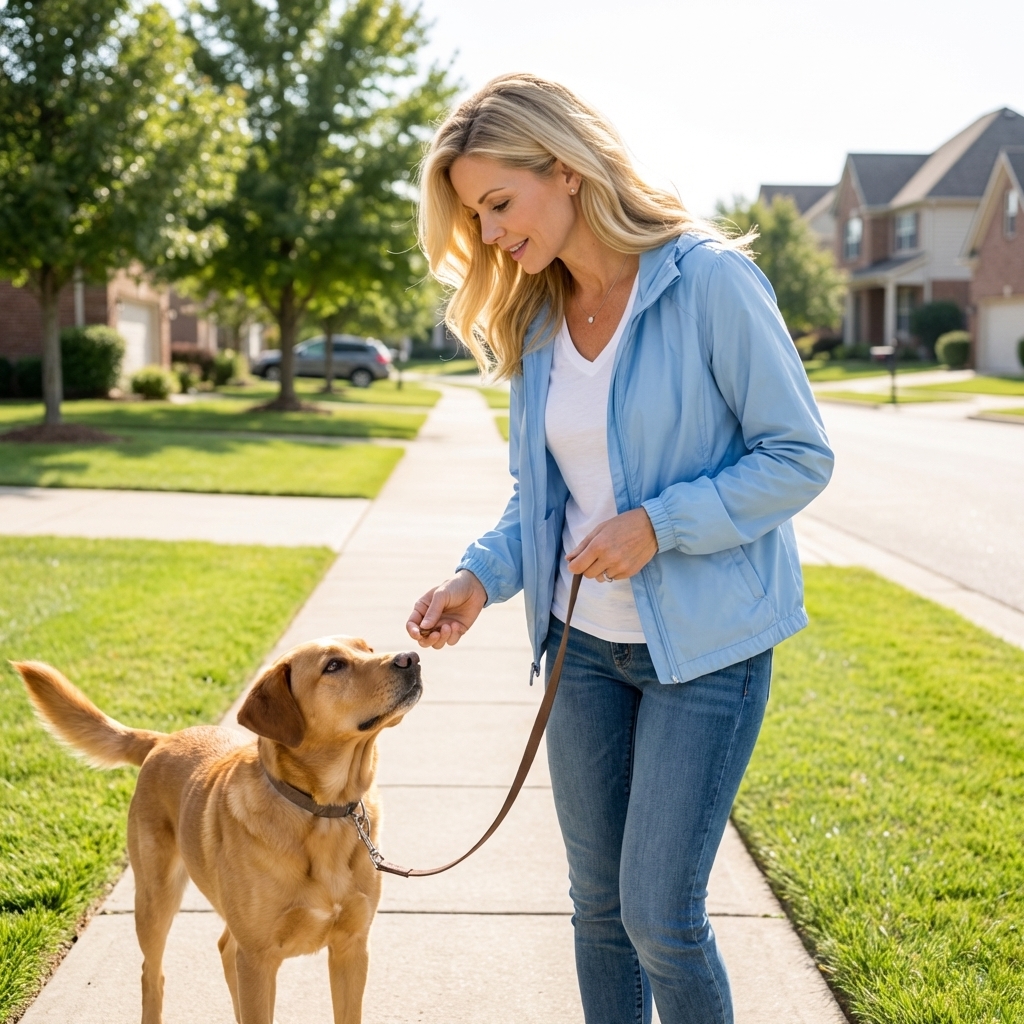
This is a simple counterconditioning pattern often called “watch and treat” or the “Look at That” game.
- Let your dog notice the trigger at a safe distance.
- Feed a treat, then feed another when your dog looks back to you. Over time, you are teaching: “I saw that, and good things happen.”
- If your dog stays under threshold, treat in a steady rhythm, such as every 1 to 3 seconds, while the trigger is in view.
- Stop feeding when the trigger is gone and move on.
During a full reaction
If your dog is already barking or lunging, training is mostly paused. Your priority is safety and distance.
- Do not drag your dog toward the trigger. Move away in the safest direction you can.
- Use your body as a block if appropriate, stepping between your dog and the trigger while you leave.
- Get behind a visual barrier like a parked car, hedge, or fence if available.
- Scatter treats once you have space. Some dogs will not eat until they are far enough away, so keep moving and try again when you see sniffing return.
After a blow-up, give your dog a break. Stress and adrenaline can remain elevated for hours, which is why one tough moment can make the rest of the walk harder.
If a loose dog approaches
This is one of the most stressful situations for reactive-dog families. Here are practical options that often help:
- Create distance fast: calmly U-turn, step behind a car, or move into a driveway or behind a gate if available.
- Toss treats away from you: throw a handful of treats toward the approaching dog to slow them down while you leave. You can also toss a treat-scatter for your own dog to keep them busy as you move away.
- Use a clear human request: “Please call your dog” or “My dog is not friendly” while you keep moving.
- Avoid leash tangles: keep your leash short enough for control but not tight, and focus on exiting rather than letting dogs meet.
Safety tool: muzzle training
If your dog has a bite history, has attempted to bite, or you are unsure about safety, ask a qualified trainer or veterinary behaviorist about muzzle training. A well-fitted basket muzzle, introduced slowly with treats, can be a humane management tool that protects everyone and can lower your stress during training.
Weekly progression
Consistency beats intensity. Here is a gentle structure that works for many families:
Days 1 to 3
- Choose low-trigger routes.
- Practice treat-scatter and U-turns even when calm.
- Track your dog’s working distance for common triggers.
Days 4 to 7
- Do short training walks with planned watch-and-treat moments at safe distances.
- End the walk before your dog is over-tired or over-stimulated.
Week 2 and beyond
- Reduce distance very slowly and only after multiple successful sessions with relaxed body language and quick recovery. For example, 3 to 5 walks in a row with no big reactions to that trigger at your current distance.
- If reactivity spikes, go back to more distance for a few sessions. That is not failure. That is smart training.
Mistakes that slow progress
- Walking too close, too soon: progress happens under threshold.
- Relying on “sit” as the only tool: some dogs cannot sit when stressed. Distance and sniffing are often more realistic.
- Waiting until the dog is exploding: early intervention is everything.
- Overexercising to “tire them out”: for some dogs, more adrenaline makes reactions bigger. Balance exercise with calming enrichment.
- Letting strangers or dogs approach: your dog does not owe anyone a greeting. Advocate politely and move away.
When to get professional help
Please reach out for support if any of the following are true:
- Your dog has bitten or attempted to bite
- Your dog cannot take treats outdoors at all, even at a distance
- Reactivity is escalating or spreading to more triggers
- You feel unsafe walking your dog
Look for a qualified, humane professional like a Certified Professional Dog Trainer (CPDT-KA), a Karen Pryor Academy (KPA) graduate, or a Fear Free certified trainer. For serious cases, a veterinary behaviorist (DACVB) can help, especially if anxiety medication might support learning.
Also consider a veterinary checkup if reactivity is new or sudden. Pain, sensory changes (including vision or hearing), and other medical contributors can make dogs more reactive. Endocrine issues can also play a role, so it is worth ruling out health factors with your veterinarian.
Next-walk checklist
- Treats ready, leash and harness comfortable
- Start with sniffing time
- Spot trigger, assess threshold
- Use treat-scatter early
- U-turn away before the meltdown
- Watch and treat at a safe distance
- End on a win, even if it is a short walk
Bottom line: calmer walks are built with space, timing, and repetition. Your dog is not giving you a hard time. They are having a hard time, and you can help.