
A practical, vet-assistant-backed guide to introducing a dog to a cat: home setup, scent swaps, gates and leashes, body language signs, and training to preve...
Article
•
Designer Mixes
Introducing Dogs and Cats at Home

Shari Shidate
Designer Mixes contributor
Bringing a dog and cat together can feel like a mystery, but it is really a process of planning, scent work, and short positive sessions. As a veterinary assistant in Frisco, Texas, I have seen the same pattern again and again: the “secret” is not forcing friendship. It is building safety first, then letting trust grow.
Whether you are adding a kitten to a home with a dog or adopting a dog into a home with a cat, the steps below help prevent chasing, stress-related litter box issues, and the kind of fear that can take months to unwind.
Note: This is general guidance. It is not a substitute for your veterinarian’s advice or a customized behavior plan.
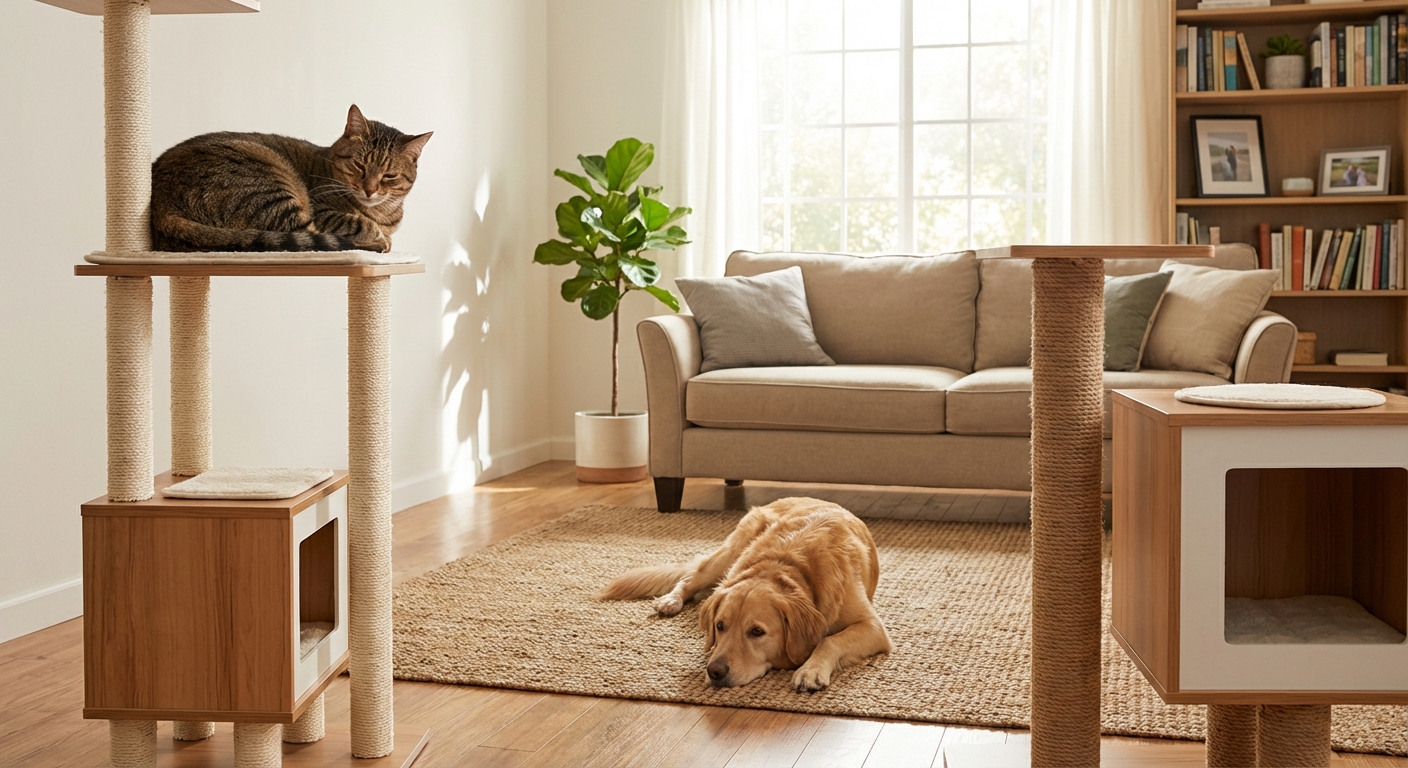
The goal: calm coexistence
Not every dog and cat will cuddle. A successful introduction often looks like this:
- The cat can eat, sleep, and use the litter box without being watched or chased.
- The dog can relax and respond to you even when the cat moves.
- Both animals show normal appetite, play, and restful sleep.
If you are new to this, “calm” for a dog usually means a loose body, soft eyes, sniffing the environment, taking treats, and being able to look away from the cat when you ask.
Friendship may happen later. Calm coexistence is the first win.
Before you start: set up for success
1) Give the cat an “always safe” zone
Cats cope best when they can control distance. Choose one room that is cat-only for the first several days at minimum (and longer if needed):
- Food and water
- Litter box (not next to food)
- Scratch pad or post
- Bed and hiding spot
- Vertical space like a shelf or cat tree

2) Use barriers and leashes, not “just see what happens”
Helpful tools:
- Baby gates (stacked or extra-tall if the dog can jump)
- Crate or exercise pen for the dog (only if crate-trained and calm)
- Leash and harness for controlled dog movement
- High-value treats for both pets
Barriers prevent rehearsal of chasing, and rehearsal is what turns interest into a habit.
3) Cover basic needs first
A hungry, under-exercised dog and a cornered cat are a recipe for chaos. Before any visual introduction:
- Give the dog a walk or play session.
- Give the cat quiet time to settle, explore, and eat.
- Confirm the cat is eating and using the litter box normally.
4) Cat-proof escape routes
Your cat should always have options. Before you do face-to-face sessions, set up the space so your cat can exit without getting trapped:
- Provide two escape routes when possible (like a doorway plus a vertical route).
- Avoid introductions in dead-end hallways or tight corners.
- Use a tall perch and keep pathways clear.
- Latch doors and block access to risky areas (stairs, narrow landings) during early sessions.
5) Household rules (especially with kids)
If children are in the home, make the rules simple and consistent:
- No chasing, grabbing, or forcing “meet and greet” moments.
- No carrying the cat to the dog.
- Adults handle leashes, gates, and treats.
Key principles that work
1) Scent first, face later
Dogs and cats learn a lot through scent. Start with scent swapping for a few days (often 1 to 3), but longer is fine if anyone seems unsure:
- Rub a clean sock or cloth on the dog’s cheeks and shoulders, then place it near the cat’s space (not right by the litter box).
- Do the same with the cat’s scent for the dog.
- Feed treats while they investigate the new scent so it predicts good things.
If either pet avoids the item or becomes tense, move it farther away and slow down.
2) Make sight predict good things
This is classic behavior science: counterconditioning. The moment they see each other, good stuff appears.
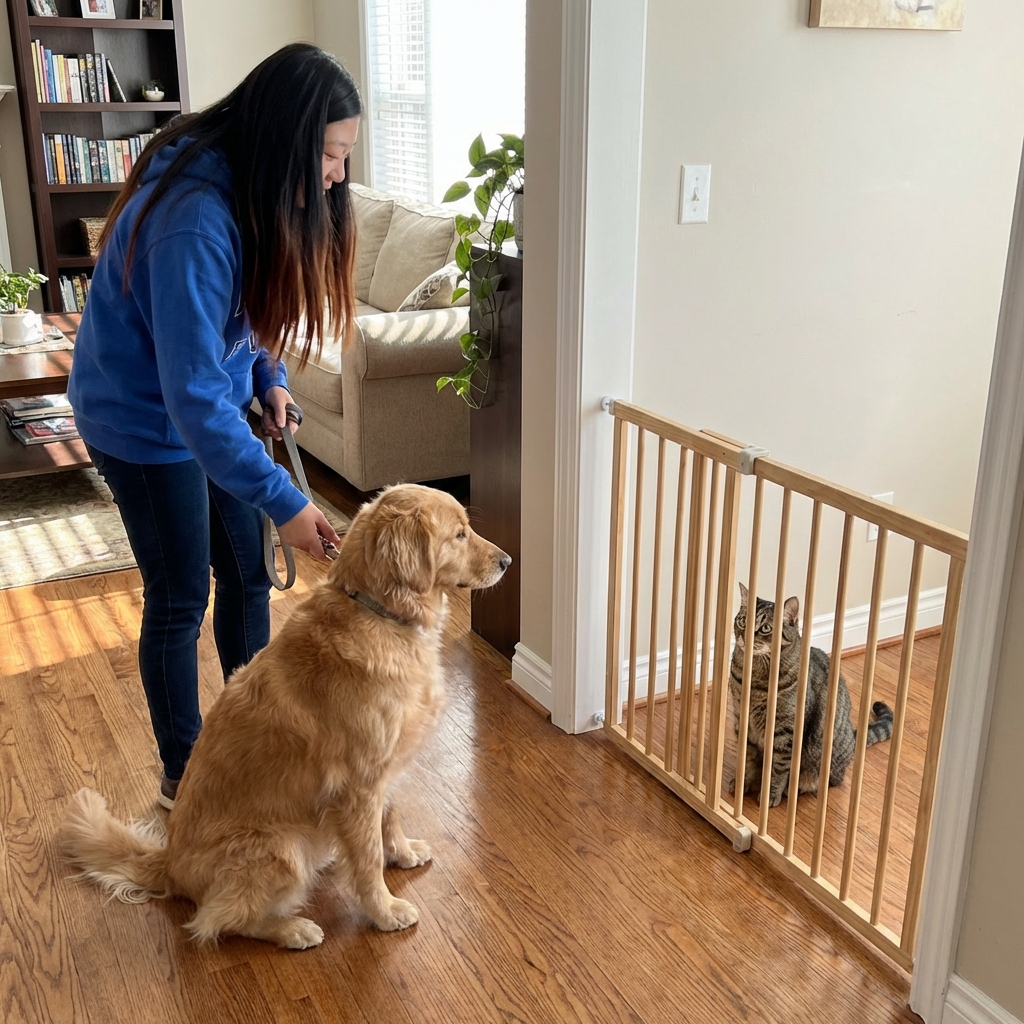
- Cat on one side of a baby gate, dog on leash on the other.
- Dog sees cat, you feed tiny treats one after another.
- Cat sees dog, offer a lickable treat or a special meal.
Keep sessions short, like 30 to 90 seconds at first. End while everyone is still doing well.
3) Teach the dog what to do instead of chasing
Chasing is self-rewarding for many dogs. Instead, train calm behaviors that pay well:
- Look at me: dog makes eye contact, treat.
- Leave it: dog disengages from the cat, treat.
- Go to mat: dog settles on a bed, treat.
Practice these skills without the cat present first. Then use them in low-intensity cat sessions.
4) Respect cat body language early
Cats often give quiet signals before they escalate. Watch for:
- Ears turned sideways or flat
- Tail flicking or thumping
- Crouching, freezing, or hiding
- Growling, hissing, swatting
If you see these, increase distance and end the session on a calmer note. For cats, confidence is built in tiny increments.
5) Use distance like a volume knob
If the dog is staring, whining, or pulling, the “volume” is too high. Create more space, use a barrier, or shorten the session. If both animals can eat treats and remain relaxed, you are in the right range.
A step-by-step plan
These timelines are common, not rules. Some pairs move faster. Many need longer in each phase, and that is normal.
Phase 1: Separate spaces (often Days 1 to 3+)
- Cat stays in the safe room with everything needed.
- Dog has normal routine, exercise, and enrichment.
- Scent swapping daily.
Phase 2: Visual intros with barriers (often Days 3 to 14+)
- Baby gate sessions 1 to 3 times per day.
- Dog on leash, calm, rewarded for disengaging.
- Cat has a high perch and an easy exit route.
Phase 3: Supervised time in the same space (often Weeks 2 to 6+)
- Start with the dog on a held leash or harness.
- Optional: Some trainers use a lightweight leash that the dog drags for quick control. If you choose this, do it only in a clutter-free area, with continuous adult supervision, and never near stairs, doorways, or furniture that can snag the leash.
- Keep sessions short and end before either pet is stressed.
- Increase time gradually only if calm behavior stays consistent.
Phase 4: Limited freedom (only after many calm sessions)
- Allow off-leash only if the dog reliably responds to cues and shows no stalking or fixation behavior.
- Maintain cat escape routes and dog-free cat zones long-term.
Many households stay in Phase 3 for a while, and that is okay. Slow is smooth, and smooth is fast.
Safety and red flags
Do not proceed if you see these
- Dog fixates, stalks, trembles, or lunges repeatedly
- Dog ignores food because the cat is “more important”
- Cat stops eating, hides all day, or has litter box accidents
- Any biting, grabbing, or cornering attempt
If any of these happen, pause introductions and consider working with a credentialed trainer or veterinary behavior professional. Credentials to look for include IAABC, CCPDT (CPDT-KA/CPDT-KSA), or KPA-CTP. A veterinary behaviorist is a board-certified specialist (DACVB). Also talk with your veterinarian if stress is affecting appetite, GI health, or urination.
Extra caution: high prey drive dogs
Some dogs have strong instincts to chase small animals. These dogs can still live safely with cats in many cases, but the introduction must be more structured and may require long-term management like gates, leash routines, and careful supervision.
Daily life tips
- Feed separately at first. Food guarding and curiosity can trigger conflict.
- Manage valuables early on (favorite beds, toys, chews, and even attention on the couch). Resource guarding is not only about food.
- Use puzzles and chew time for dogs during times when your cat is most active (often morning and evening).
- Add vertical space for cats in common areas so they can observe without feeling trapped.
- Keep nails trimmed for both pets. This helps reduce accidental injury and snagging during tense moments.
- Pheromone support may help as an add-on. Ask your vet about options like feline facial pheromone diffusers or sprays. Evidence is mixed, so think of it as support, not a solution.

Quick FAQ
How long does it take for a dog and cat to get along?
Some settle in within a week, many take a month, and a few need several months. The timeline depends on the dog’s impulse control and prey drive, the cat’s confidence, and how consistently you manage introductions.
Should I let my cat “teach the dog a lesson”?
No. A scared cat can injure a dog’s eyes, and a startled dog can react dangerously. Controlled sessions prevent setbacks and keep both pets safe.
Can I speed things up?
You can often make progress faster by doing more short, positive sessions instead of longer stressful ones. Quality beats duration every time.
The bottom line
Introducing dogs and cats is not about luck. It is about setting up the environment, using scent and distance, and rewarding calm behavior until it becomes the new normal. If you move slowly and protect your cat’s sense of safety, you give both animals the best chance to share a home peacefully.
If you want, tell me your dog’s breed, age, and behavior around squirrels or rabbits, and whether your cat is confident or shy. I can suggest a realistic starting plan for your specific mix.