Learn a realistic plan for helping dogs and cats coexist peacefully. Home setup, scent swaps, barrier sessions, controlled contact, and key cues like leave it.
Article
•
Designer Mixes
Introducing a Dog to a Cat

Shari Shidate
Designer Mixes contributor
As a veterinary assistant in Frisco, Texas, I have seen it go both ways: a dog and cat become instant nap buddies, or they spend weeks side-eyeing each other from opposite sides of a hallway. The good news is that most introductions can be managed safely with the right setup, a little patience, and realistic expectations.
This handbook walks you through how to introduce a dog to a cat step by step, what to watch for, and how to set your home up so both pets feel secure.
Before You Start
Know what makes it harder
Some pairings need more planning than others. A calm adult dog meeting a confident adult cat is usually easier than a high-energy adolescent dog meeting a shy cat. It is still doable, but the margin for error is smaller.
- Prey drive: Many dogs are wired to chase fast, small animals. That does not mean they are “bad,” but it does mean you need stronger management. Terriers and sighthounds, for example, are often more triggered by quick movement, but any dog can chase.
- Cat confidence: A cat who has never lived with dogs may bolt. Running can trigger chasing, even in friendly dogs.
- Pain or medical issues: Arthritis, dental pain, hyperthyroidism, and other conditions can make a pet more reactive.
Vet and safety basics
- Preventive care: Keep both pets current on flea and tick prevention and parasite control. Stress may lower immunity, and some cats can have stress-related flare-ups (like feline herpesvirus).
- Nail trims: Trim nails for both pets if possible. Cats will defend themselves, and scratches can happen even during “good” introductions.
- Microchip and ID: A stressed cat may slip out a door. Make sure identification is current.
Gather your supplies
- Sturdy baby gates: Ideally tall and secure. Hardware-mounted is safest for strong or determined dogs. If you use pressure-mounted, do not rely on it as your only barrier.
- A leash and secure harness for your dog
- High-value dog treats (soft, smelly, easy to swallow)
- Cat treats or wet food, plus a lickable treat if your cat likes it
- A blanket or towel for scent swapping
- A clicker (optional) for training
- A crate or exercise pen (optional, for management only, not punishment)
Non-negotiable safety rules
- Never allow chasing. Even “playful” chasing teaches the dog to practice the behavior and can terrify the cat.
- Never force contact. Do not hold the cat up to the dog or push either pet closer “to get it over with.”
- Never leave them loose together unsupervised until you have a long track record of calm, safe behavior.
- For higher-risk dogs: Ask your vet and a qualified trainer about muzzle training as an added safety layer during early sessions. Use a properly fitted basket muzzle and build it with positive reinforcement.
Home Setup
Think of your home like a two-lane road. You want each pet to have a safe route to food, water, rest, and the litter box without being cornered.
Cat-only room
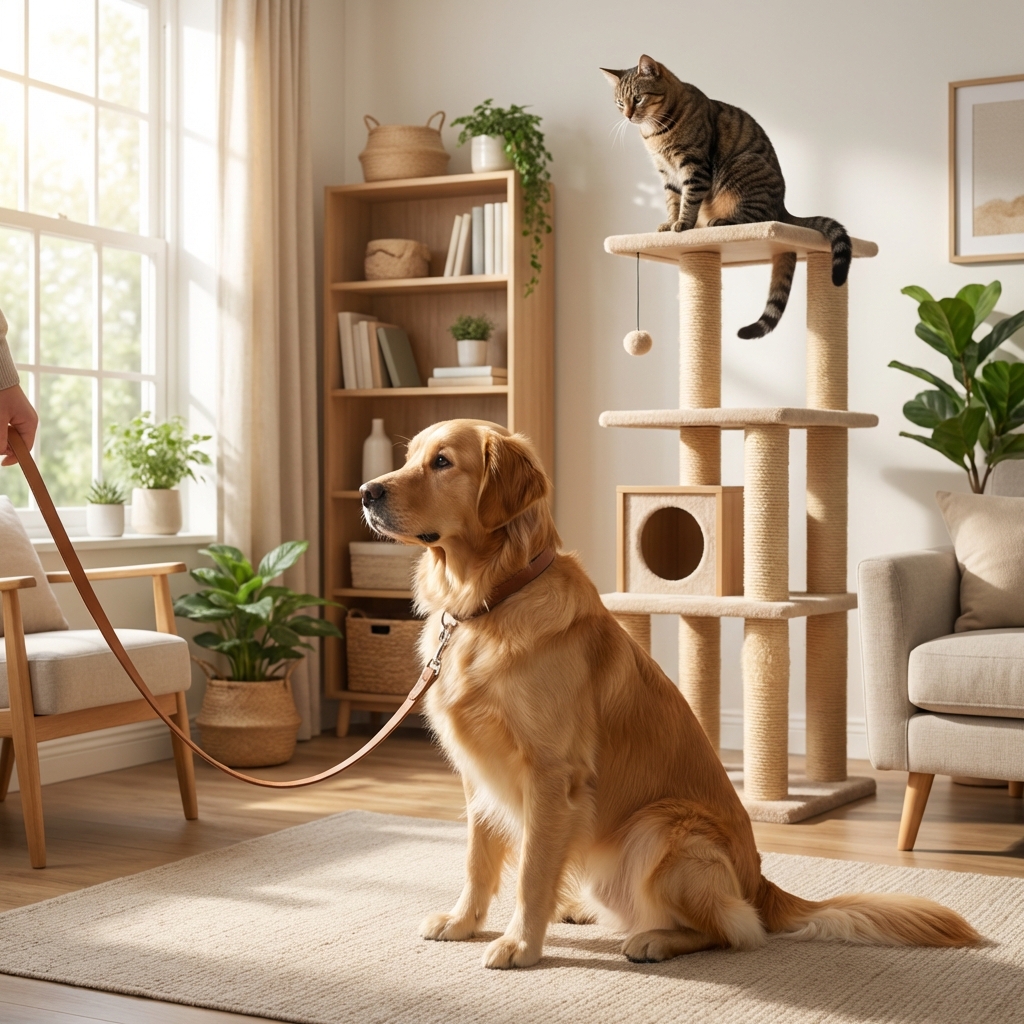
For the first several days, your cat should have a dog-free room with:
- Litter box (never place the litter box where the dog can access it)
- Food and water
- A cozy hiding option (covered bed, box, or under-bed access)
- Vertical space like a cat tree or shelves
This room helps your cat decompress and prevents forced interactions. Keep your cat’s routine as normal as possible (meals, playtime, and quiet naps).
Litter box basics
- A good rule is one box per cat, plus one extra, placed in quiet, easy-to-reach locations.
- Stress can cause litter box changes. If your cat is straining, peeing outside the box, or making frequent trips with little urine, treat it as urgent and call your veterinarian.
Dog boundaries
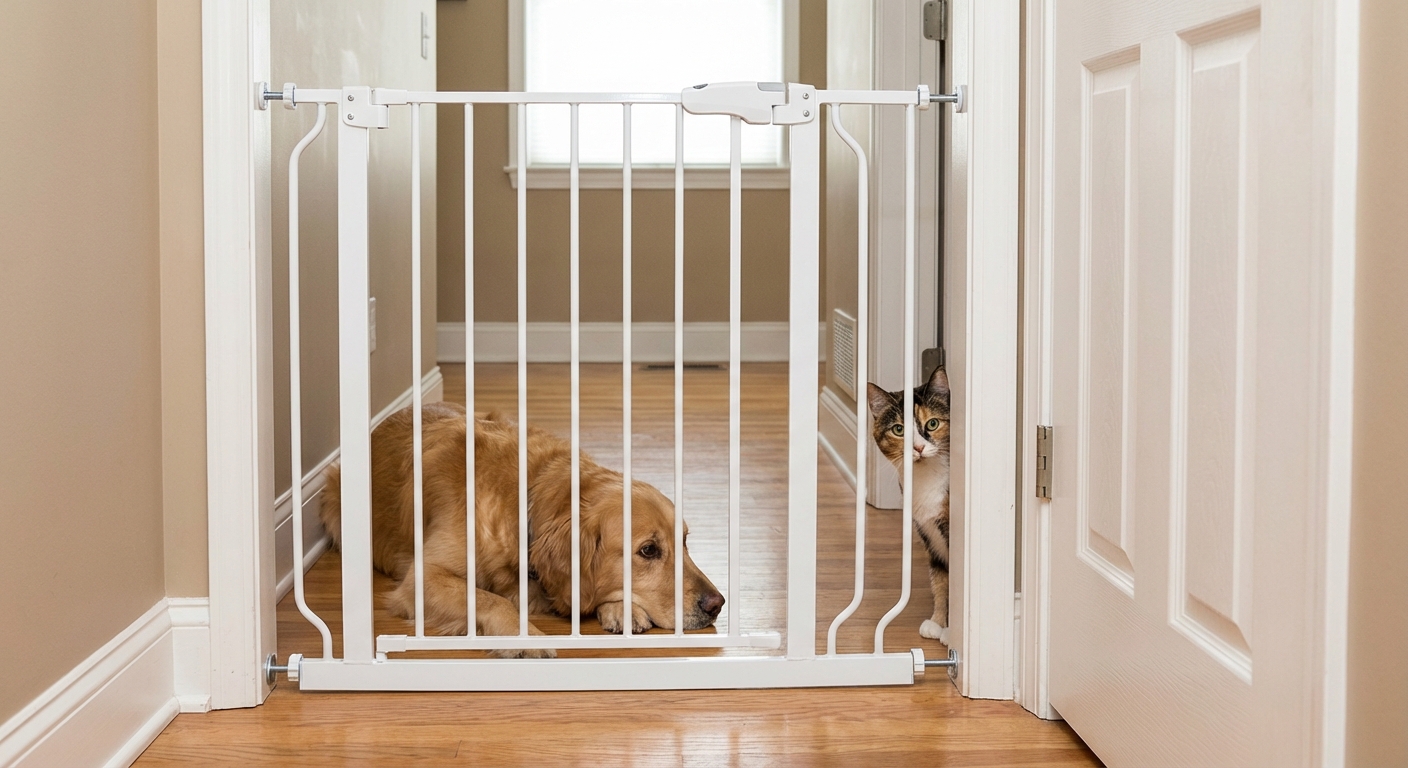
Plan where your dog will relax behind a gate. This is useful for meals, training sessions, and calm “parallel time” where your pets can see each other at a safe distance.
Manage resources
- Feed separately at first.
- Keep cat food up high or in the cat-only room.
- Use a covered trash can and store pet food securely. Food smells can cause guarding.
- Give the cat multiple exit routes in shared spaces.
Step-by-Step Plan
Use these timelines as examples, not deadlines. Some pets do great in days, many need weeks, and some need months. Let the more fearful pet set the pace.
Step 1: Scent first (a few days)
Animals learn a lot through smell. Before they meet face-to-face, swap scents to make the “new roommate” feel familiar.
- Rub a towel gently on your dog’s chest and shoulders, then place it near your cat’s resting area.
- Do the same with your cat and place it near your dog’s bed.
- Reward calm sniffing. If either pet shows stress, increase distance and try again later.
Step 2: Rotate spaces (same phase)
Let them experience each other’s normal sounds and scents without contact. A simple way is to rotate who gets access to common areas while the other is safely behind a door or gate.
- Dog gets living room time while the cat is in the cat-only room, then swap.
- Feed or give treats on opposite sides of a closed door to build a positive association.
- Keep it calm and predictable. You are aiming for “no big deal.”
Step 3: See each other through a barrier (several sessions)
Use a baby gate first. A door can be pushed open, even with a doorstop, so only use a door if it is securely blocked and you are right there supervising.
- Dog on leash, calm, and at a distance where they can notice the cat without fixating.
- Cat chooses whether to approach. Do not carry the cat toward the dog.
- Short sessions, 1 to 5 minutes, ending on a calm note.
- Reward your dog for looking at the cat and then looking back to you.
Step 4: Shared room on leash (only when Step 3 is calm)
This is the first time they are in the same room without a barrier. Keep it boring and structured.
- Dog on leash and harness.
- Cat has vertical escape and open routes out.
- Practice simple cues with your dog: “sit,” “down,” and “leave it.”
- End quickly. Multiple short sessions beat one long session.
Step 5: Gradual freedom with supervision
As your dog reliably stays calm and responds to cues, you can allow more movement while still supervising closely. Many households keep gates up long-term, and that is perfectly okay.
Body Language
Relaxed signs in dogs
- Loose body, soft mouth
- Sniffing the ground, disengaging easily
- Can look at the cat and then look away
- Responds to name and cues
Concern signs in dogs
- Stiff posture, weight forward
- Hard stare and locked focus
- Whining, trembling, or intense panting
- Lunging, barking, or ignoring treats
Relaxed signs in cats
- Normal blinking, grooming, casual movement
- Tail held neutrally or gently upright
- Approaches and retreats confidently
Concern signs in cats
- Hissing, growling, spitting
- Flattened ears, puffed tail
- Crouched body with a fixed stare
- Bolting and hiding for long periods
If either pet is frozen, fixated, or panicked, the session is too hard. Go back a step and make it easier.
Training That Helps
Teach “leave it” and “place”
A reliable leave it can stop a chase before it starts. A solid place (go to bed and settle) gives your dog an off-switch in the same room as the cat.
Reward calm
Many well-meaning people accidentally hype the dog up with excited voices during introductions. Keep your tone calm. Reward quiet behavior.
Give your dog outlets
Dogs who are under-exercised and under-enriched are more likely to fixate. Add:
- Sniff walks
- Food puzzles and lick mats
- Basic obedience games
- Tug and fetch (then a calm cooldown)

Common Problems
The dog chases the cat
Chasing is self-rewarding. The goal is to prevent practice while you build skills.
- Use gates and a leash indoors until calm is consistent.
- Increase cat vertical space and escape routes.
- Work at a distance where your dog can take treats and respond to cues.
- Practice “look at that” training: dog looks at cat, then you reward for turning back.
The cat swats the dog
Swatting is usually defensive. Your cat is saying, “You are too close.”
- Slow down the intro.
- Make sure the cat is not being blocked from exits.
- Reward the dog for giving space.
The dog is into the litter box
Litter box “snacking” is common and can be risky. It can cause GI upset, and it may expose your dog to pathogens or parasites if they are present.
- Place the litter box behind a gate with a cat door opening, or in a cat-only room.
- Use a top-entry box if your cat tolerates it.
Food and resource guarding
If your dog stiffens near food, toys, or even you when the cat approaches, take it seriously.
- Feed separately and pick up bowls.
- Keep high-value chews in a separate area.
- Get help early. Guarding is very treatable, but it is not something to ignore.
Special Situations
Puppy and adult cat
Puppies are bouncy and rude by cat standards. Use lots of management, short sessions, and frequent naps. Tired puppies make better roommates.
Adult dog and kitten
Kittens move fast and trigger prey drive. Extra caution is needed. Keep the dog on leash during early sessions and never allow rough play.
Senior pets
Senior dogs and cats may have less tolerance and more pain. Provide soft bedding, quiet zones, and slower introductions.
High prey drive dogs
Some dogs can learn to coexist safely, but not all can be trusted off-leash around cats. Management is not failure. It is responsible pet ownership.
How Long It Takes
Some pets do well in a few days, but many need weeks. Some need months, especially if your cat is shy, your dog is easily excited, or either pet has had a bad past experience.
- Early phase: Scent swaps, rotations, barrier sessions
- Middle phase: Leashed room sharing, training, gradual freedom
- Ongoing: Supervised coexisting, continuing boundaries as needed
If you see steady progress, you are on the right track.
When to Get Help
Please reach out to your veterinarian and a qualified positive-reinforcement professional if you notice:
- Repeated lunging, snapping, or attempts to bite
- The dog cannot disengage from staring at the cat
- The cat stops eating, hides constantly, or has litter box changes
- Any injury, even minor
Look for credentials like IAABC, CCPDT, or KPA, and avoid trainers who rely on intimidation or punishment around the cat. For severe aggression or complex cases, ask your vet about a board-certified veterinary behaviorist.
Early support prevents setbacks and keeps everyone safe.
Daily Checklist
- Cat has a dog-free room and vertical space
- Dog has had exercise and enrichment
- Litter box is inaccessible to the dog
- Introductions are short and controlled
- Reward calm behavior, end sessions before stress rises
- Supervise or separate, every time
With consistency, most dogs and cats learn an important life skill: how to share space peacefully. And once they do, it is genuinely one of the sweetest things to watch.