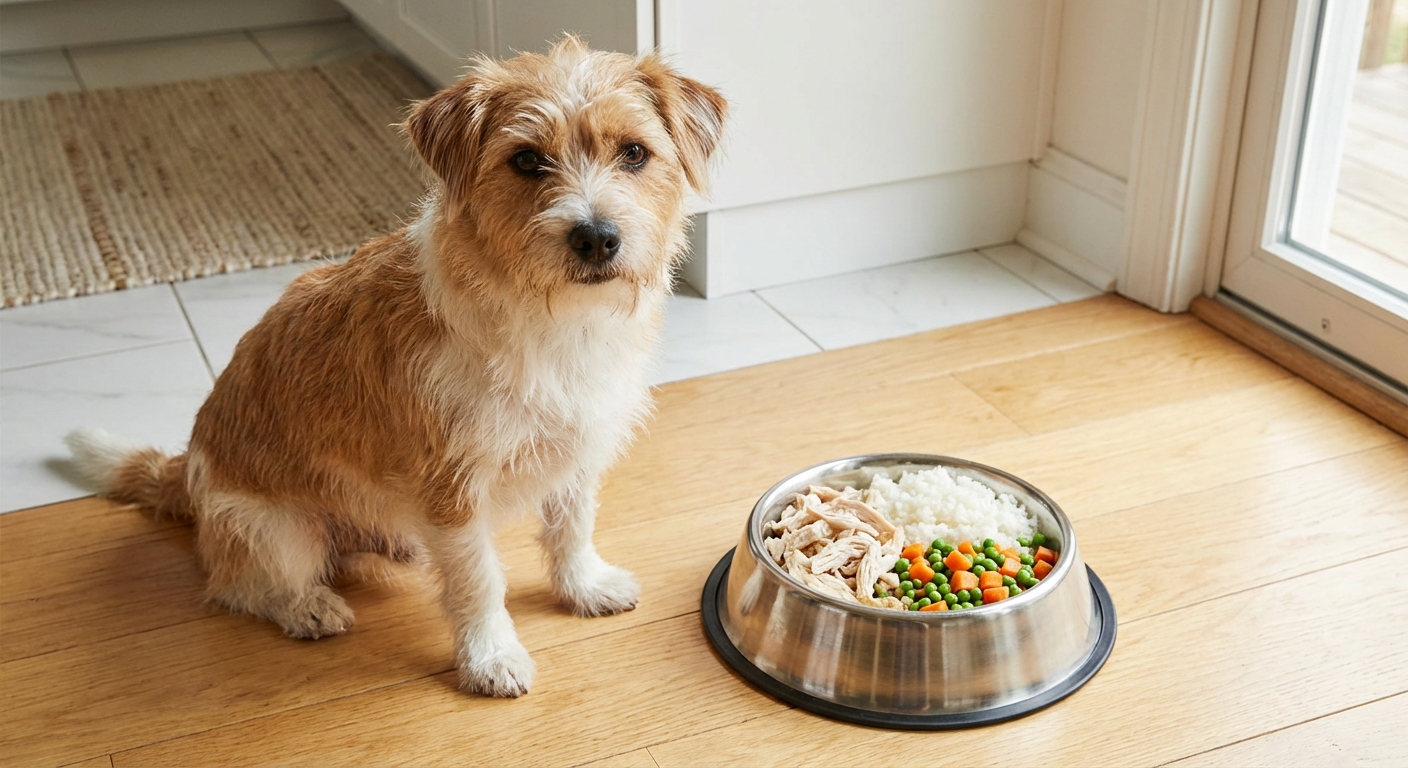
Start homemade dog food safely with this vet-informed starter plan. Learn what “vet approved” means, choose a balancer, follow a 14-day transition, and u...
Article
•
Designer Mixes
How to Train a Dog to Heel

Shari Shidate
Designer Mixes contributor
Heel is one of those skills that looks “fancy,” but it is really about safety and communication. A solid heel can make walks calmer, help reactive or excited dogs feel more secure, and give you a go-to behavior when you need your dog close, like passing another dog on a narrow trail.
As a veterinary assistant here in Frisco, Texas, I also love heel because it can prevent accidents. Fewer sudden lunges means fewer sore shoulders for you and less risk of your dog slipping a collar, stepping into the street, or tangling around someone’s legs.
What “heel” actually means
Heel means your dog walks close to your side (usually the left, but either side is fine) with their shoulder roughly aligned with your leg. The key detail is that your dog is choosing to stay there because it pays off, not because the leash is forcing it.
Heel is not the same as “loose leash walking.” Loose leash walking simply means no pulling and a relaxed leash, and your dog may be a bit ahead or sniffing within reason. Heel is a focused position used for short periods, like crossing a street, walking through a crowded area, or passing distractions.
Before you start: set yourself up for success
Pick a cue and a release word
- Cue: “Heel” (or “With me”).
- Release: “Free,” “Break,” or “Go sniff.”
That release word matters because it prevents frustration. Your dog learns: heel is a job I do briefly, and then I get my freedom back.
Use the right gear
- Comfortable harness or flat collar: Many dogs learn faster in a front-clip harness because it reduces pulling leverage.
- Standard leash: A 4 to 6 foot leash is ideal for training. Retractable leashes make heel training much harder.
- Treat pouch: Keep rewards easy to access so your timing stays sharp.
Choose high-value rewards
Use something your dog truly cares about: tiny pieces of chicken, turkey, cheese, freeze-dried liver, or a favorite toy for dogs who are more play-motivated. Keep pieces pea-sized so you can reward often without overfeeding.
Safety note: If your dog has pancreatitis history, food allergies, or a sensitive stomach, ask your veterinarian what treats are safest for training.
Step-by-step: teach heel from the ground up
Step 1: Teach the heel “zone” (stationary)
Start inside with minimal distractions.
- Stand still with your dog next to you.
- Hold a treat near your seam line (where your pants pocket would be).
- When your dog’s head comes into position, mark (say “Yes” or click) and reward.
- Repeat until your dog quickly swings into that spot.
If your dog is confused, make it easier by luring gently at first. Then fade the lure by moving your hand slightly up and rewarding from the other hand.
Step 2: Add one step
- Say “Heel.”
- Take one step forward.
- If your dog stays aligned with you, mark and reward at your side.
Do not worry about distance yet. One great step is better than ten messy ones.
Step 3: Build distance slowly
Increase from 1 step to 2, then 3, then 5. Reward frequently, especially early on. Many dogs need a reward every 1 to 3 steps at first. That is normal.
Step 4: Add turns and stops
Real-life walking includes a lot of direction changes, so teach them on purpose.
- Left turns: Often harder because you are turning into your dog on a standard left-side heel. Your dog is on the inside track and needs to slow down, pivot, or tuck in to avoid bumping you.
- Right turns: Often easier because you are turning away from your dog. Your dog is on the outside track and usually needs to speed up a bit to stay lined up at your side.
- About turns: A great tool to prevent pulling. Turn away from distractions and reward when your dog catches up in heel.
- Stops: Stop walking, wait for your dog to re-align, then reward.
Step 5: Add duration and variety
Once your dog can heel for 10 to 15 steps, start adding a little time too, like heeling for 5 to 10 seconds through a hallway or across a driveway. Then begin rewarding on a variable pattern. For example: reward after 3 steps, then 7, then 4. This keeps attention strong without needing constant treats forever.
A simple 5-minute heel session you can repeat daily
- Warm-up (1 minute): 5 to 10 rewards for finding heel position while you stand still.
- Easy reps (2 minutes): Short straight lines, reward every 1 to 3 steps.
- Skill builder (1 minute): Add 2 to 3 turns and 2 stops.
- Release (1 minute): Say “Free” and let your dog sniff or play. This makes the next session easier.
Keep sessions short enough that your dog ends excited, not tired or frustrated.
Common heel problems and how to fix them
Your dog forges ahead
- Reward closer to your leg: Deliver treats right where you want the head to be.
- Use quick about-turns: If your dog surges, calmly turn around. When they catch up in position, reward.
- Lower distractions: Practice indoors or in the driveway before hitting the busy sidewalk.
Your dog lags behind or sits
- Increase reward energy: Use a happy voice and treat rapidly for a few steps.
- Check comfort: If your dog is suddenly slow, consider nails, paw pads, joint discomfort, heat, or ill-fitting gear. A vet check is worthwhile if it persists.
Your dog is staring at the treat hand
This is common early on. Start moving the treat hand up toward your chest for a few steps, mark the moment your dog stays in position, then reward from your other hand. The goal is: follow your body, not the cookie.
Your dog only heels inside, not outside
That is not stubbornness. Outdoors has competing rewards: smells, squirrels, people, wind, and sounds. You will need to “re-teach” heel in new places with easier expectations.
- Practice in the backyard, then front yard, then quiet street, then parks.
- Increase treat value outdoors.
- Shorten the criteria. Go back to 1 to 3 steps and rebuild.
Proofing: making heel reliable in the real world
Once heel looks good in low-distraction areas, start proofing in small layers.
Add the 3 D’s carefully
- Distance: More steps between rewards.
- Duration: More time holding position, including stops.
- Distraction: New environments, people, dogs, and movement.
Only increase one at a time. If you increase all three at once, most dogs fall apart.
Use real-life rewards
Food is great, but life rewards are powerful too. Ask for 5 steps of heel, then say “Go sniff.” For many dogs, sniffing is the jackpot. This keeps heel strong without you feeling like a full-time snack dispenser.
Helpful tips for different dog personalities
Puppies
Keep it gentle and short. Puppies have limited focus and growing joints. Aim for micro-sessions and lots of praise. Think: “practice,” not “perfection.”
High-energy dogs
Try a short play burst first, then a 3 to 5 minute heel session, then another play break. Many energetic dogs learn best when they are not exploding with energy.
Shy or anxious dogs
Quiet praise, calm handling, and predictable patterns help. Avoid harsh corrections, which can make the environment feel unsafe and reduce learning.
When to get professional help
Consider a qualified positive-reinforcement trainer if:
- Your dog lunges, barks, or growls at dogs or people on walks.
- You are seeing fear behaviors like trembling, hiding, or refusing to move.
- Pulling is severe and you are worried about injury.
And always talk with your veterinarian if your dog’s walking behavior changes suddenly, especially if you notice limping, stiffness, panting more than usual, or reluctance to go on walks.
Bottom line
Heel is built in tiny wins: one good step, then two, then five. Keep your sessions short, reward the position you want, and remember that heel is a skill your dog needs to learn in many places, not just one.
With consistency and kindness, you will be amazed how quickly “chaotic walk” can turn into “we’ve got this.”