
A vet assistant’s guide to cat spay/neuter: what the surgeries involve, the best timing, proven health and behavior benefits, what happens on surgery day, ...
Article
•
Designer Mixes
How to Tell the Sex of a Kitten

Shari Shidate
Designer Mixes contributor
If you have a new kitten at home, it is completely normal to wonder, “Is this a boy or a girl?” The good news is that you can usually tell at home with a quick, gentle check. The key is to keep your kitten calm, use good lighting, and know exactly what you are looking for.
As a veterinary assistant, I want to reassure you that sexing kittens is a common task in clinics and shelters, but it is also easy to get wrong when kittens are tiny. If you are unsure after checking, your veterinarian can usually confirm quickly.

Before you start
Kittens are delicate, and the goal is a quick look, not a wrestling match. If your kitten squirms a lot, pause and try again later.
- Pick a warm, quiet spot. A bathroom with the door closed can work well.
- Use a soft towel. Place your kitten on it for traction and comfort.
- Wash your hands. Especially important if you have multiple pets at home.
- Have a light ready. A phone flashlight can help you see the spacing clearly.
- Be gentle with the tail. Do not force it upward. Many kittens will naturally lift their tail a little when relaxed.
Extra note for very young kittens: If your kitten is under about 3 to 4 weeks old, keep this check brief and make sure they stay warm. If they are with mom, minimize time away from her.
If your kitten seems to be in pain, reacts like it hurts when you handle them, has diarrhea stuck to the fur, or the area looks swollen or bleeding, skip the check and call your vet.
Distance and shape
You will be looking at two openings under the tail:
- Anus: the upper opening, closest to the tail.
- Genital opening: the lower opening, closer to the belly.
To determine sex, focus on two things:
- The distance between the anus and the genital opening
- The shape of the genital opening
Helpful cue: In females, the openings often look almost stacked. In males, there is usually a more noticeable gap.
Important: This should be a visual check only. Do not squeeze the belly or try to “pop” anything out.
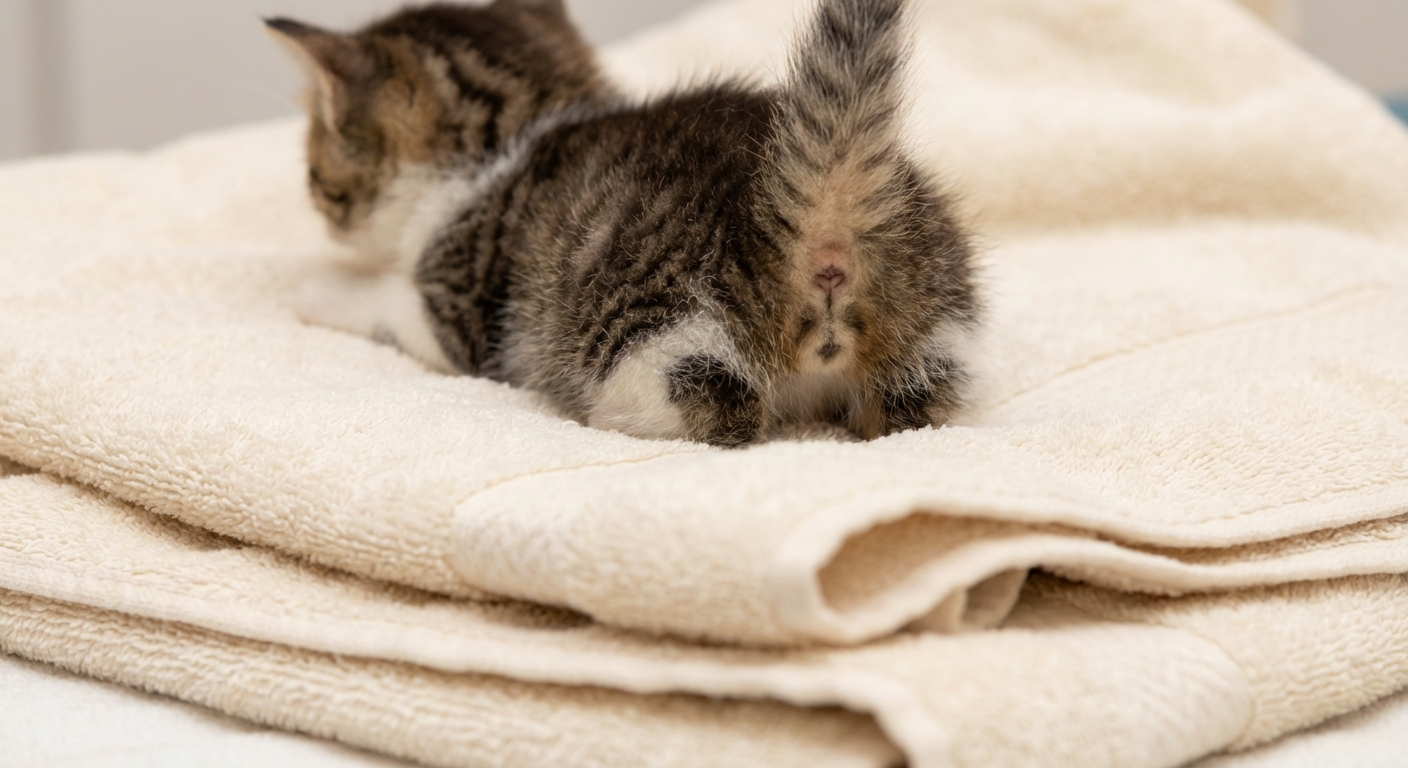
Female kitten: close, “i”
Female kittens typically have:
- Short distance between the anus and genital opening
- A vertical slit for the genital opening
Many people describe the overall appearance as a lowercase “i”: a dot (anus) with a short space and a line (vulva) below it.
Tip: On very young kittens, everything is tiny. If you are debating whether the lower opening looks like a slit or a small circle, pay extra attention to how close the two openings are.
Male kitten: farther, “:”
Male kittens typically have:
- Longer distance between the anus and genital opening
- A round opening for the genital opening
The overall look is often compared to a colon “:” because both openings look more circular and are spaced farther apart.
As male kittens grow, you may also notice a developing scrotal area between the anus and penis. In very young kittens, that area may look like a small, slightly raised patch rather than obvious testicles.
When can you tell?
You can sometimes make a good guess as early as 2 to 3 weeks, but for most beginners it becomes much more reliable a little later.
- 0 to 2 weeks: Often difficult, especially for beginners.
- 3 to 6 weeks: Usually easier to see distance and shape.
- 8+ weeks: Much easier. Males may show clearer development.
If your kitten is under 3 weeks old and you are not confident, it is okay to wait a bit. A wrong guess is very common at this stage.
If they are fluffy or wiggly
Long fur and constant motion can make it hard to see what you need. Here are a few tricks that help without stressing your kitten:
- Try after a meal or a play session. Kittens are often calmer when tired.
- Use the towel “burrito.” Wrap the kitten’s body loosely, leaving the rear exposed.
- Part the fur gently. Use clean fingers to separate the hair for a clearer view.
- Check your angle. A straight-on view under the tail, with good light, is usually the clearest.
- Take a quick photo. Sometimes a clear photo helps you evaluate the spacing after the moment is over.
Common mistakes
Relying on coat color
Coat color can hint sometimes, but it is not a reliable method for most kittens. The exception is that most calico and tortoiseshell cats are female due to genetics. Rare male calicos do occur, often due to an extra X chromosome, so confirm with an actual check.
Mistaking debris for anatomy
On tiny kittens, dried stool or a small scab can confuse the view. If the area is dirty, use a warm, damp cloth to clean gently, then re-check.
No reference point
If you have a whole litter, it is often easier to compare kittens to each other. Differences in spacing become more obvious.
When to ask your vet
Please reach out to your vet if:
- You cannot tell after a calm, well-lit check
- The kitten is under 3 weeks old and you need an answer for adoption paperwork
- You see swelling, discharge, redness, or signs of pain
- As your kitten grows, you have concerns about normal development before a spay or neuter appointment (for example, possible retained testicles)
Your veterinarian can confirm sex during a routine exam, and it is especially helpful to double-check before scheduling spay or neuter so everything is planned appropriately.
Gentle handling matters. If your kitten is stressed, stop and try again later. A calm kitten gives you the clearest answer.
Quick checklist
- Female: openings close together; lower opening looks like a vertical slit; “i” shape
- Male: openings farther apart; lower opening looks round; “:” shape
If you are still unsure, take a clear photo (safely and gently) and show it to your veterinarian or experienced shelter staff. They can confirm quickly and teach you what to look for next time.