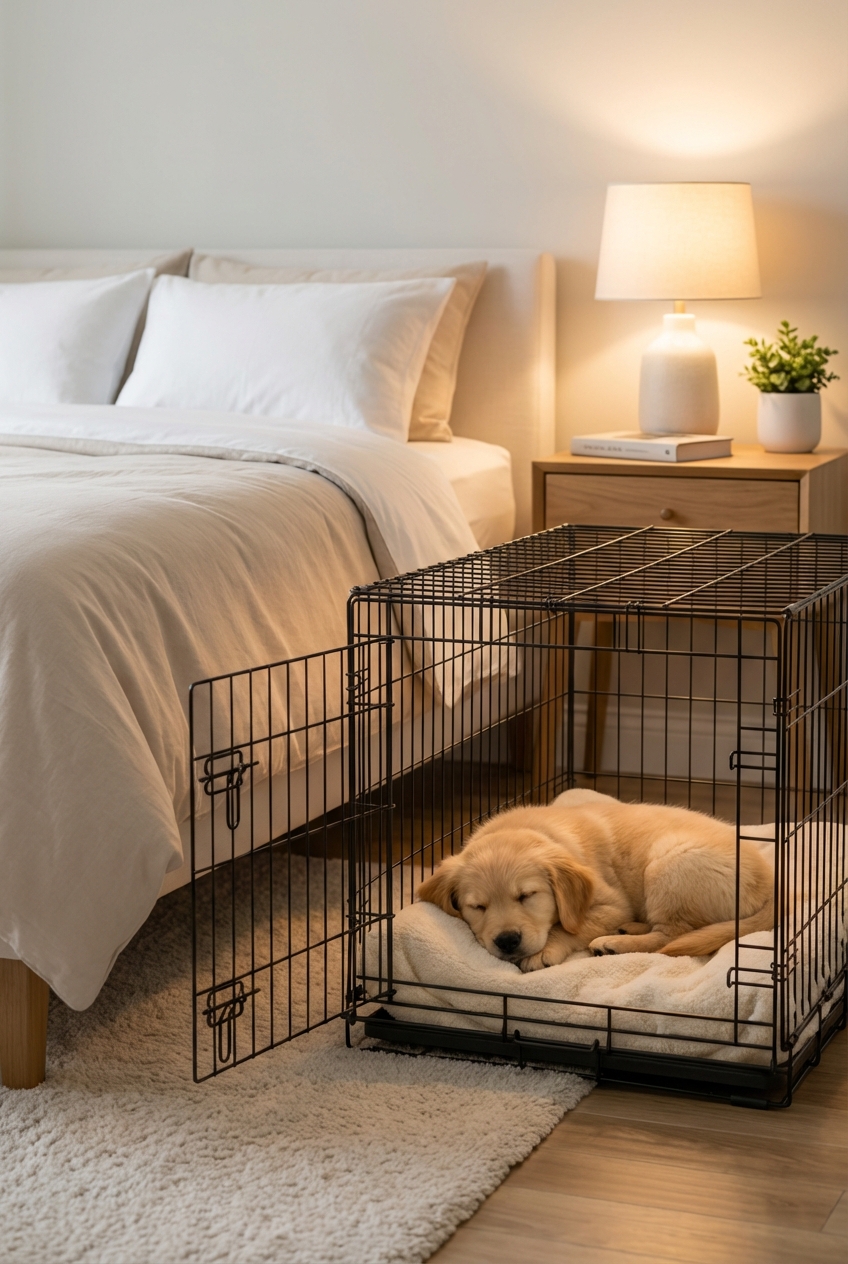
A step-by-step puppy crate training guide: choosing the right crate, building positive associations, first-week routines, nighttime potty breaks, and solutio...
Article
•
Designer Mixes
How to Size a Dog Crate

Shari Shidate
Designer Mixes contributor
Picking the right crate size is one of those small decisions that makes a big difference in your dog’s comfort, safety, and training success. Too small, and your pup can’t fully relax. Too large, and many dogs will treat one end like a bathroom, which can slow down house training.
As a veterinary assistant here in Frisco, Texas, I also see the physical side of this choice: a properly sized crate can help your dog maintain a more natural posture and settle more comfortably. Pair that with a sturdy, well-set-up crate, and you also lower the risk of injury from frantic escape attempts or a crate that is not secure.
What “right size” means
The best-fitting crate lets your dog:
- Stand up without their head or ears touching the top
- Turn around comfortably without bumping the sides
- Lie down fully stretched (or curled) in a natural position
- Sit upright without hunching
A good rule of thumb is “cozy, not cramped.” Crates are meant to feel like a safe den, but they still need to allow normal posture and movement.
How to measure your dog
You can get accurate measurements at home with a soft measuring tape, or even a string plus a ruler.
Step 1: Measure length
Measure from the tip of the nose to the base of the tail (where the tail meets the body, not the tip of the tail). Then add 2 to 4 inches for comfort.
Step 2: Measure height
Have your dog stand naturally. Measure from the floor to the top of the head (or to the tips of the ears if they stand upright). Then add 2 to 4 inches.
Step 3: Match to crate dimensions
Crate sizing is typically listed by length (for example, 30-inch, 36-inch, 42-inch). Use your dog’s length measurement as your anchor, then confirm the crate’s height is also sufficient.
Quick but important note: Many manufacturers list external crate dimensions. Always double-check the interior usable space, especially with plastic travel crates and heavy-duty crates where the walls take up more room.
Example
If your dog measures 22 inches from nose to tail base, adding 2 to 4 inches puts you at about 24 to 26 inches of interior length. That often points you toward a 24-inch crate or a small 30-inch crate, depending on your dog’s height and build.
Common crate sizes
Breed and weight are not perfect predictors, especially for mixed-breed dogs. A long-bodied dog might need a longer crate even if they are not heavy. Still, these ranges can help you narrow it down:
- 24 inch: many toy breeds and small puppies
- 30 inch: many small dogs and smaller medium mixes
- 36 inch: many medium dogs and mixes in the 30 to 55 lb range
- 42 inch: many larger dogs and taller mixes
- 48 inch: giant breeds or very tall, long dogs
My veterinary assistant tip: When you are stuck between two sizes, think about your goal. For house training, the smaller of the two (as long as your dog can stand, turn, and lie down comfortably) is often the better choice.
Puppies and planning ahead
Puppies grow fast. If you buy a crate that fits your puppy today, you may be replacing it soon.
Use a divider panel
If you expect your puppy to get much larger, choose a crate that will fit their adult size and use a divider to shrink the interior space while potty training. As your puppy grows, you slide the divider to give a little more room.
How big will my puppy get?
For mixed breeds, your best estimate usually comes from:
- Parents’ sizes (if known)
- Your veterinarian’s growth curve and physical exam
- Breed mix tendencies (for example, Poodles often add height and leg length)
If you are unsure, bring a photo and current weight to your veterinarian visit and ask for a realistic adult size range.
Common sizing mistakes
1) Buying based on weight only
Two dogs can weigh the same but have completely different body shapes. A long, lean dog may need a longer crate than a stockier dog at the same weight.
2) Choosing “extra large” for comfort
This is a well-meaning mistake. A crate that is too large can undermine potty training because your dog can sleep on one side and eliminate on the other.
3) Forgetting ear height
Pointy-eared pups need a little extra vertical space. If ears brush the top constantly, that crate is too short.
4) Not accounting for bedding
If you add a thick orthopedic mat, you reduce interior height. Measure with your dog standing naturally, then remember a bed can raise their body by 1 to 3 inches.
If your dog is between sizes
If your dog’s measurements put them right on the edge, use these tie-breakers:
- Potty training in progress? Choose the smaller size that still allows normal posture, or use a divider.
- Adult dog, fully house trained, crate is for relaxing? The larger option can be fine if it still feels den-like with a smart setup.
- Car travel crate? A little less extra space can mean less shifting in a sudden stop, but true travel safety depends on using a well-secured, ideally crash-tested crate or harness whenever possible.
If you go larger, make it feel secure: use a fitted crate cover (leaving airflow areas open) and place the bed to encourage sleeping, not pacing.
Special situations
Seniors and joint issues
Older dogs often do best with enough room to reposition easily, plus a supportive mat. If your senior struggles to turn around in a tight space, that is a sign to size up slightly.
Anxious dogs
Some anxious dogs do better in a slightly cozier space that feels more den-like. Others panic in confinement and need crate training done slowly with positive reinforcement. Sizing helps, but it is only one part of the plan.
Post-surgery or injury
After a procedure, your veterinarian may recommend “crate rest.” In those cases, the goal is often restricted movement for healing. Ask your veterinarian what size and setup they recommend for your dog’s specific condition.
Safety note: Never use a crate to force a dog through severe separation anxiety. If your dog is bending bars, chewing out, or injuring teeth or nails trying to escape, talk with your veterinarian or a qualified trainer. That is a medical and behavioral welfare issue, not a willpower issue.
Crate types matter
Crates with the same listed size can “feel” different inside depending on the style:
- Wire crates: great airflow and visibility, and they often come with divider panels.
- Plastic crates: more den-like for some dogs, but interior space can be smaller because of thicker walls. Always check interior dimensions.
- Soft-sided crates: lightweight for calm dogs, but not a good choice for strong chewers or dogs that try to escape.
Setup for good behavior
Once the crate is the right size, the setup does the rest of the work.
- Flooring: Use a washable mat or towel at first. Some puppies shred plush beds.
- Water: For longer crated periods, consider a crate-mounted water bowl to reduce spills.
- Chews: Offer veterinarian-approved, appropriately sized chews. Avoid anything that splinters.
- Location: Choose a low-traffic, calm spot where your dog can still feel included.
- Routine: Potty break before crating, and reward calm entry and calm exit.
Welfare reminder: Even a perfectly sized crate is not meant for all-day confinement. Build up crate time gradually, and make sure your dog gets enough exercise, training, and social time each day.
Quick checklist
- My dog can stand without head or ears touching the top.
- My dog can turn around easily.
- My dog can lie down fully stretched.
- I measured nose to tail base and added 2 to 4 inches.
- I measured floor to top of head or ears and added 2 to 4 inches.
- I checked interior usable dimensions, not just the label size.
- If my dog is a puppy, I have a divider or a plan for growth.
If you take just one thing from this: measure your dog’s body, not their breed label. Mixed-breed dogs are wonderfully unique, and crate sizing should be just as individualized.