
How to Read a Dog Food Label

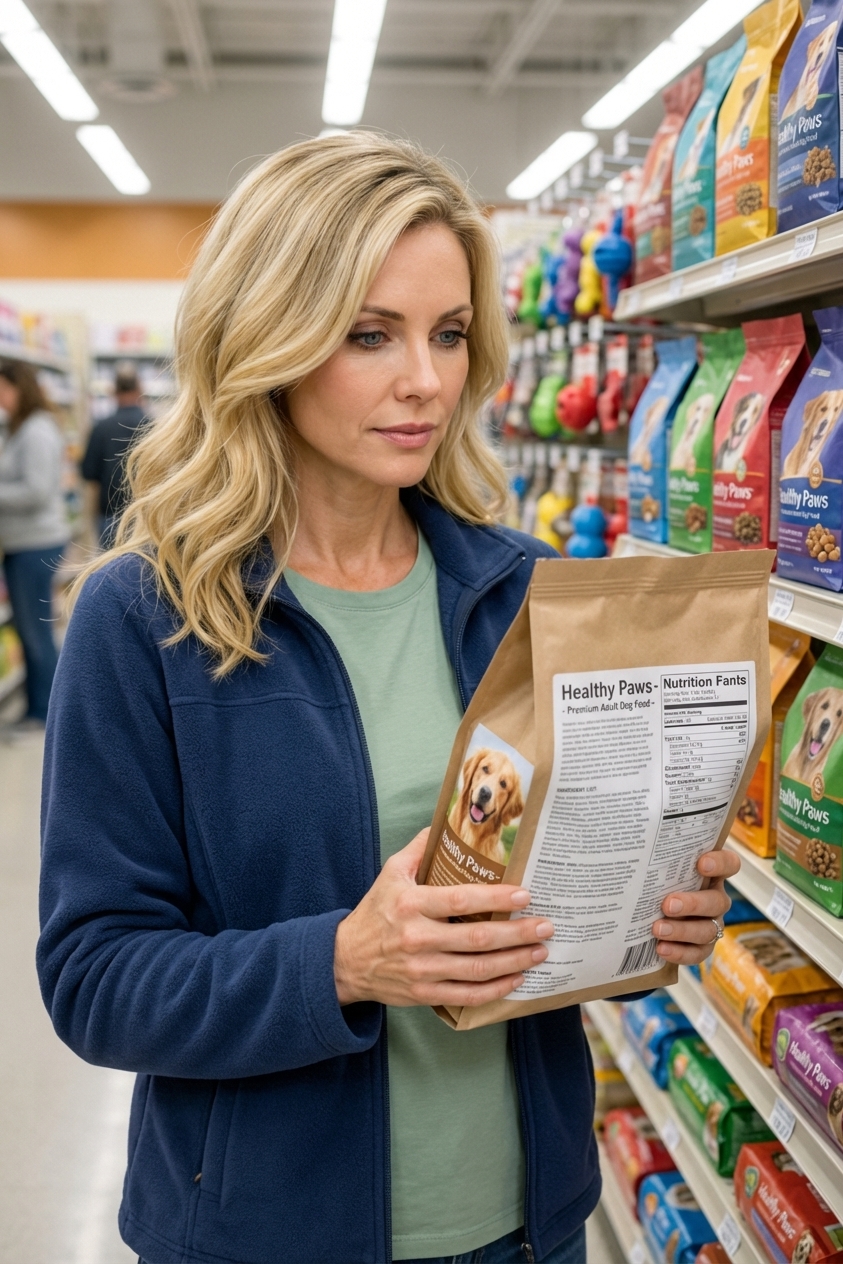
Standing in the pet food aisle can feel like taking a pop quiz you did not study for. “Real chicken!” “No fillers!” “Grain-free!” The front of the bag is designed to sell you a feeling, not teach you what is actually inside.
As a veterinary assistant here in Frisco, Texas, I have seen how much a dog’s day-to-day health can shift when we match the food to the dog in front of us. The good news is that you do not need a nutrition degree to read a label like a pro. You just need a few simple rules.
Start with the AAFCO statement
If you read only one part of a dog food label, make it the AAFCO nutritional adequacy statement. It is usually on the back or side panel and tells you whether the food is formulated to be complete and balanced for a specific life stage.
Quick shortcut: look for the words “complete and balanced” and confirm the life stage matches your dog.
What AAFCO is (and what it is not)
AAFCO is the Association of American Feed Control Officials. AAFCO does not “approve” dog foods. Instead, AAFCO publishes nutrient profiles and feeding trial protocols that manufacturers can use to support nutritional adequacy claims.
The most common AAFCO phrases
- “Complete and balanced for…” This is the big one. It should specify a life stage such as growth (puppies), adult maintenance, or all life stages.
- “Formulated to meet the nutritional levels established by the AAFCO Dog Food Nutrient Profiles…” This means the recipe was formulated on paper to meet nutrient targets.
- “Animal feeding tests using AAFCO procedures substantiate…” This means the food was tested in real feeding trials. It does not guarantee perfection, but it is meaningful.
- “For intermittent or supplemental feeding only” This is not a complete diet. It can be fine for toppers, treats, or limited use, but it should not be your dog’s main food.
Tip: “All life stages” sounds impressive, but it is not always ideal for every dog. It must meet higher nutrient requirements for growth and reproduction, which can be too rich for some adult dogs who gain weight easily.
Ingredients list: what it really tells you
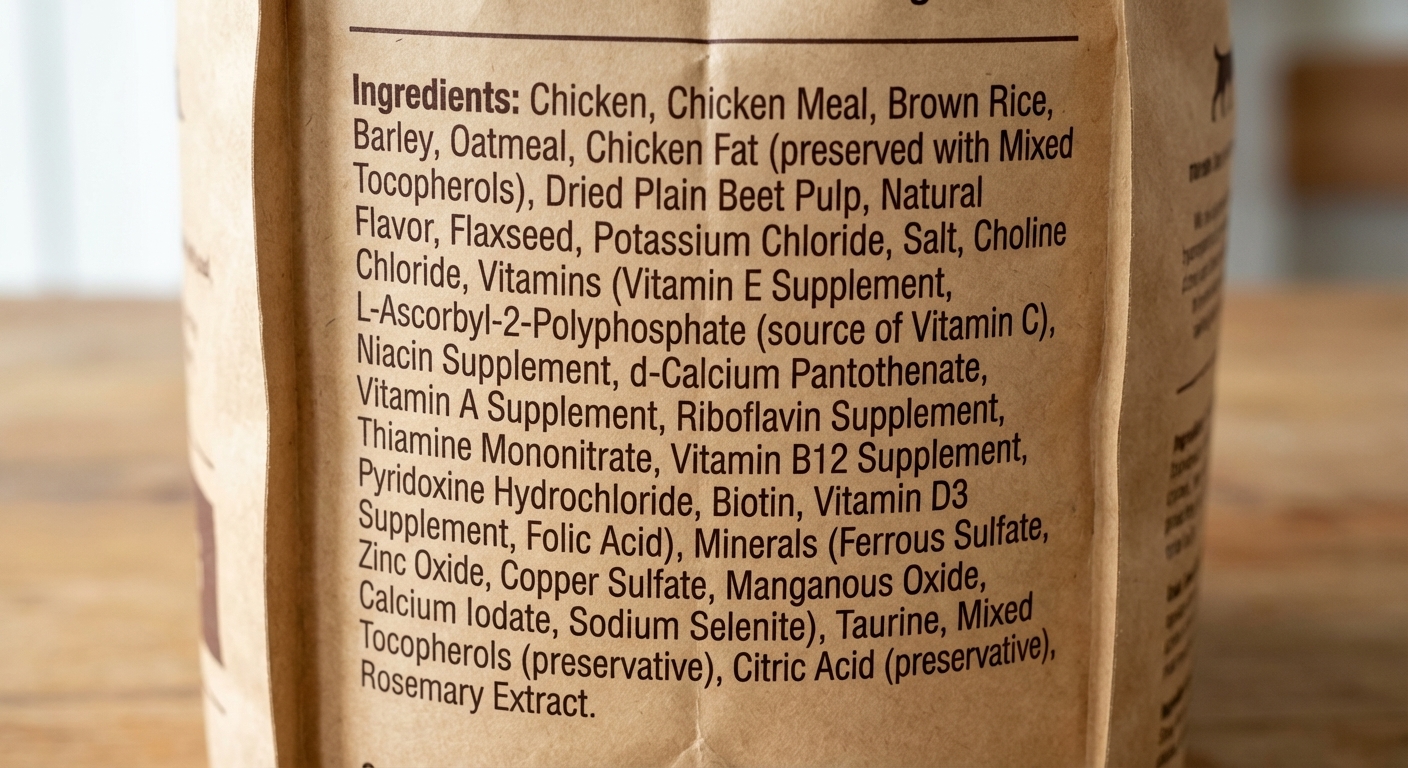
The ingredient list is required, but it is also the most misunderstood part of the label. Ingredients are typically listed by weight before processing. That detail matters a lot.
Ingredient order: why the first five matter
Because the list is in descending order by pre-processing weight, ingredients with high moisture (like fresh chicken) can appear higher than you might expect. After processing, their contribution to the final kibble may be smaller than the “first ingredient” headline implies.
That does not mean fresh meat is bad. It simply means you should not judge quality by “first ingredient” alone.
By-products vs meal: the plain-language version
- Meat (example: “chicken”): raw animal tissue with high water content.
- Meal (example: “chicken meal”): rendered, dried protein. Because water has been removed, it is typically more concentrated in protein than fresh meat. A named meal can be a solid ingredient.
- By-products (example: “chicken by-products” or “chicken by-product meal”): “By-products” can include nutrient-dense parts like organs. By-product meal is the rendered version. Under AAFCO-style definitions, by-products do not include things like feathers, hair, horns, or teeth (except unavoidable trace amounts). Quality can still vary by sourcing and processing.
What I look for: named animal sources (chicken, beef, salmon) rather than vague ones (meat, poultry, animal). Vague sources make it harder to evaluate consistency and can be a red flag for dogs with sensitivities.
“Splitting” ingredients: a common trick
Manufacturers can list similar ingredients separately to push them lower on the list, such as “peas,” “pea protein,” and “pea flour.” This does not automatically mean a food is bad, but it does mean you should scan the whole list and notice repeats.
Guaranteed Analysis: what those percentages mean
The Guaranteed Analysis (GA) lists minimums for protein and fat and maximums for fiber and moisture. This panel is helpful, but it does not show full nutrient completeness, ingredient quality, digestibility, or amino acid balance.
Practical takeaway: two foods can have similar GA protein, but perform very differently in the real world because digestibility and amino acid balance are not shown on the GA.
Why “as fed” can mislead
GA is reported “as fed,” meaning it includes moisture. Dry kibble might be 10% moisture, while canned food might be 78% moisture. Comparing the two without adjusting is like comparing grapes to raisins.
Quick dry matter comparison (simple method)
If you want to compare foods with different moisture levels, you can estimate on a dry matter basis:
Dry Matter % = (Nutrient % / (100 - Moisture %)) × 100
Example: A canned food with 8% protein and 78% moisture has 22% dry matter. 8 / 22 × 100 = about 36% protein on a dry matter basis.
Note: This helps you compare, but it still does not tell you amino acid quality, mineral balance, or whether the formula fits your dog’s needs.
Calories and “calorie math” that actually helps
Two foods can look similar on the front of the bag and have very different calorie density. Calories are usually listed as kcal per cup (dry food) or kcal per can (wet food). This matters for weight control more than most people realize.
Why kcal per cup is not a fair comparison
“A cup” is a volume measure, not a nutrition measure. Kibble shape and density vary. One brand’s cup can weigh more than another brand’s cup, which changes calories and nutrients dramatically.
If you want more precision, weigh your dog’s food in grams with a small kitchen scale and use the feeding guide as a starting point, then adjust based on body condition and your vet team’s guidance.
A more accurate way to compare: kcal per kilogram
Many labels include kcal/kg. This allows a more apples-to-apples comparison across foods. If you are monitoring weight, ask your vet team about your dog’s daily calorie target and choose a food that makes portioning realistic.
Helpful reality check: Treats count. Chews count. Table scraps count. Those “little extras” can quietly erase the benefit of a great food.

Life stage statements: match the food
A healthy adult dog does not have the same nutrient needs as a growing puppy or a senior with arthritis. Life stage is not marketing. It changes target levels for protein, fat, calcium, phosphorus, and more.
Common life stages you will see
- Growth (including growth of large-size dogs): pay special attention to calcium and phosphorus balance for large breed puppies.
- Adult maintenance: designed to support adult dogs without the higher growth demands.
- Gestation and lactation: higher energy and nutrient density.
- All life stages: meets growth standards, which can be unnecessary for some adult dogs.
If you are unsure, your veterinary team can help you pick a life stage based on your dog’s age, breed mix, body condition, and activity level.
Marketing words that do not guarantee quality
Some label words are regulated. Many are not. Here are a few that tend to confuse well-meaning dog parents.
“Natural”
In pet food, “natural” generally means the ingredients are not chemically synthetic (with some exceptions for added vitamins and minerals). Many people interpret it as “no artificial colors, flavors, or preservatives,” which can be part of it, but it still does not automatically mean the diet is ideal for your dog.
“Holistic”
This is not a tightly regulated term in pet food. It is a feel-good label, not a guarantee.
“Human-grade”
In pet food, “human-grade” has a specific meaning only when every ingredient and the final product are stored, handled, processed, and transported according to human food standards, typically in a human food facility. If you see this claim, look for clear documentation from the manufacturer explaining how they meet that standard.
“Vet recommended” or “vet approved”
This can mean anything from a formal partnership to a single veterinarian’s opinion. Look for transparency: who, what criteria, and whether there is published data.
“Grain-free”
Grain-free is not automatically healthier. Some dogs do great with grains, and some need specific diets for medical reasons.
Also, you may have heard about the ongoing diet-associated DCM (dilated cardiomyopathy) investigations. We do not have a single simple answer, but veterinary teams tend to be cautious with boutique or unusual formulations, especially those heavy in legumes, when there is no medical need. If your dog is on a grain-free food, ask your veterinarian whether it is truly needed and whether the formula is well-supported nutritionally.
WSAVA: quality beyond the bag
Label reading is powerful, but it does not answer the biggest behind-the-scenes questions: who formulated the diet, how it is tested, and what quality controls are in place.
Many veterinary teams also use the WSAVA (World Small Animal Veterinary Association) nutrition guidelines to evaluate brands. In plain language, these focus on accountability and transparency, such as:
- Does the company employ qualified nutrition experts (ideally including a board-certified veterinary nutritionist or PhD animal nutritionist)?
- Who actually formulates the diet and oversees quality control?
- Do they perform feeding trials or publish digestibility and nutrient data?
- Where is the food manufactured, and do they own the plant or closely control production?
- What is their process for recalls, batch tracking, and ingredient sourcing?
If a brand cannot or will not answer these questions clearly, that is useful information.
Red flags and green flags
Green flags
- A clear AAFCO statement that matches your dog’s life stage
- Named animal proteins (chicken, turkey, beef, salmon) rather than vague “meat” sources
- A company that answers WSAVA-style questions clearly and provides a full nutrient analysis upon request
- Reasonable calories for your dog’s needs and portions you can measure consistently
Red flags
- No AAFCO adequacy statement, or “intermittent or supplemental feeding” when you need a main diet
- Vague animal ingredients (“animal fat,” “meat meal”) especially for sensitive dogs
- Over-reliance on buzzwords with little transparency
- Frequent formula changes with no notice and no explanation
How to use label skills
Label reading is not about finding the “perfect” bag. It is about choosing a food that is complete and balanced, fits your dog’s life stage, and supports a healthy body condition.
If you are curious about homemade
I love seeing dog parents take an active role in nutrition. Homemade can be wonderful, but it needs to be balanced. The most common homemade mistake I see is a well-intentioned recipe that is low in calcium, missing key trace minerals, or not balanced over time.
If you want to explore homemade, here are safe stepping stones:
- Start as a topper: add a small amount of gently cooked whole food to a complete and balanced diet.
- Go slow: transition gradually over 10 to 14 days to avoid stomach upset.
- Balance matters: work with your veterinarian or a board-certified veterinary nutritionist for a full homemade plan, especially for puppies or dogs with medical needs.
The bottom line is this: the label helps you evaluate commercial food today, and it also teaches you what a balanced diet needs if you decide to cook at home tomorrow.

Quick label checklist (save this)
- Find the AAFCO statement and confirm it matches your dog’s life stage.
- Check calories (kcal/cup and ideally kcal/kg), then measure portions consistently (a scale is even better).
- Scan the first five ingredients, then look for repeats and vague sources.
- Use the Guaranteed Analysis to compare foods, and do dry matter math if moisture differs.
- Be skeptical of front-of-bag claims. Trust the nutrition facts, not the adjectives.
If you are still stuck after reading the bag, bring a photo of the label to your next appointment and ask your veterinary team to walk through it with you. A few minutes of label literacy can save you months of trial and error.