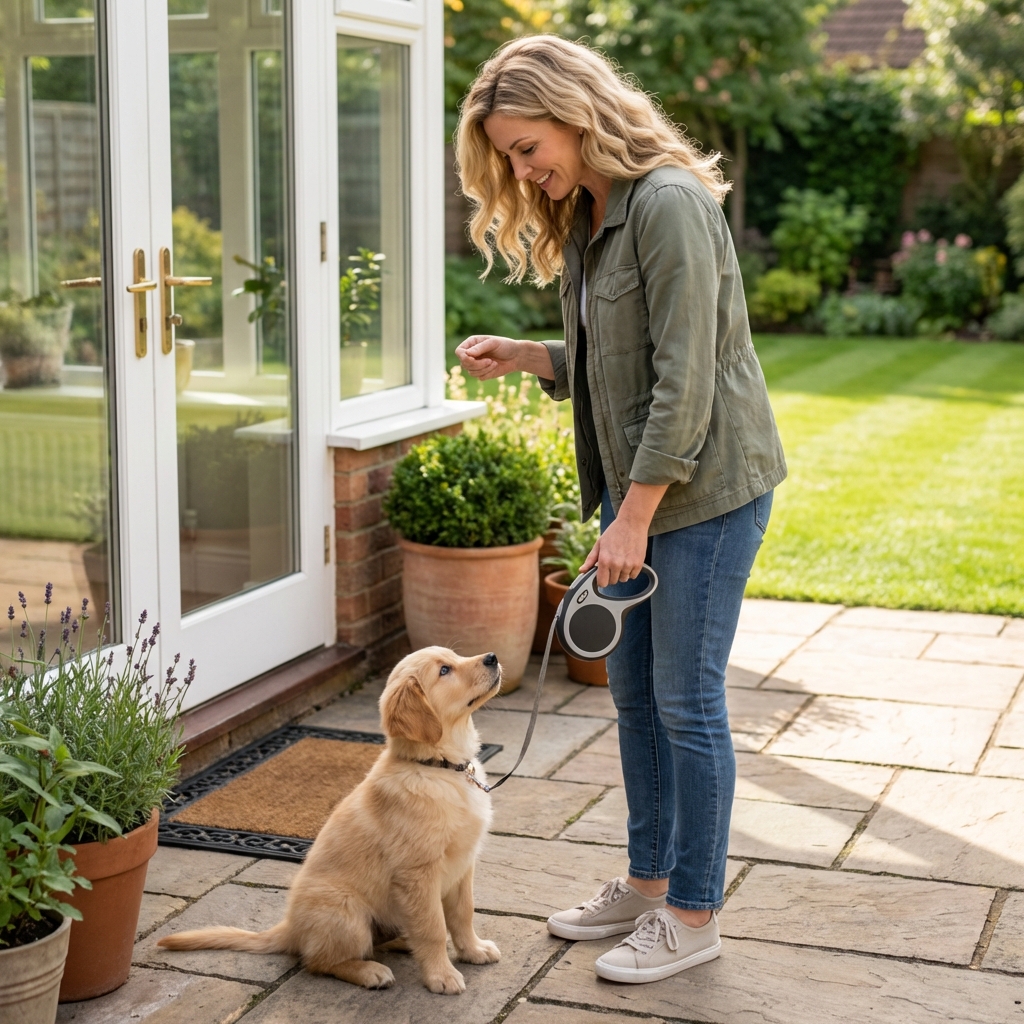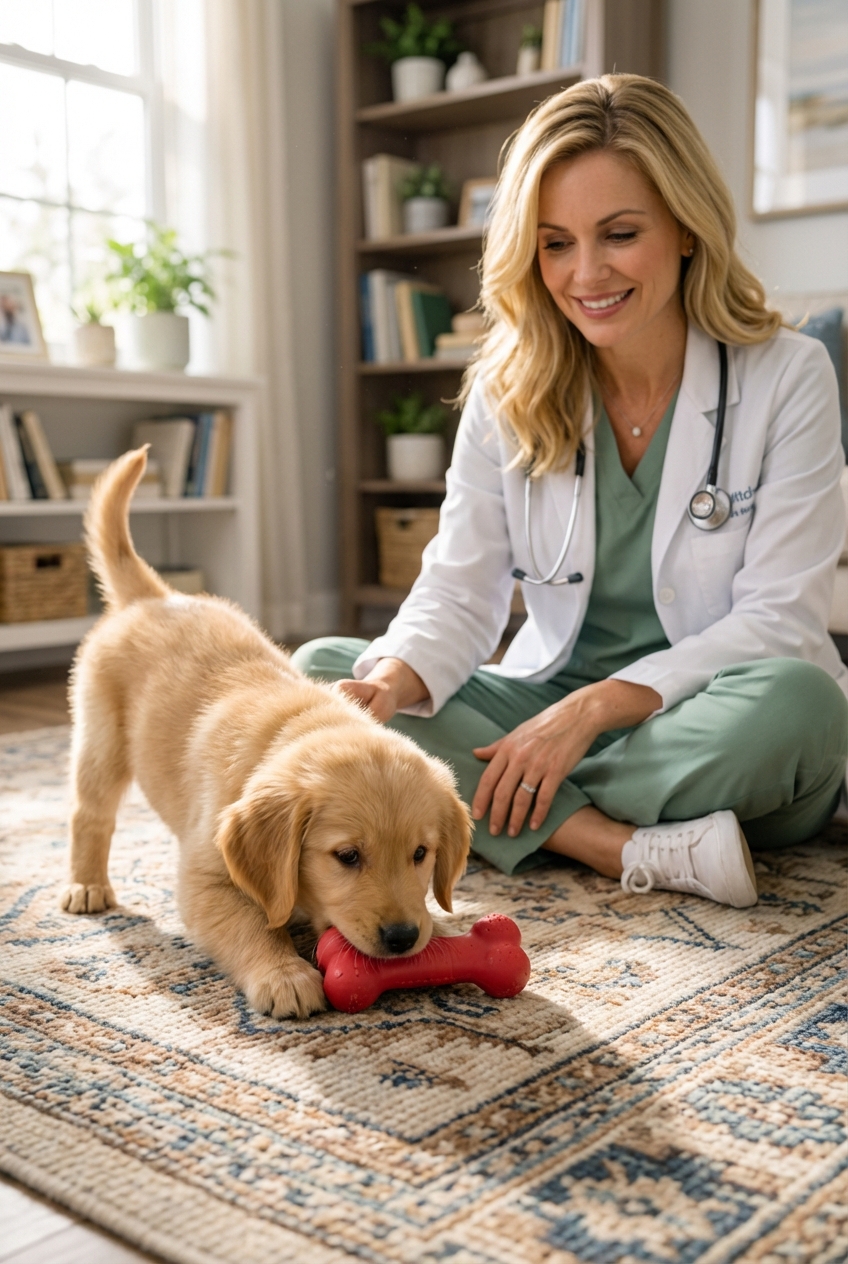
Puppy biting is usually normal. Learn why it happens and how to reduce it fast with redirects, reverse time-outs, calm breaks, naps, enrichment, and teething...
Article
•
Designer Mixes
How to Properly Discipline a Puppy

Shari Shidate
Designer Mixes contributor
Puppy discipline is not about being “tough.” It is about teaching your puppy what works in your home, what does not, and how to succeed with you. As a veterinary assistant working alongside veterinarians, I see this every day: the families who make the fastest progress are the ones who use clear routines, calm boundaries, and rewards that actually motivate their puppy.
In this overview, I’ll walk you through what effective discipline really looks like, what to avoid, and how to handle common challenges like biting, potty accidents, and jumping without damaging your puppy’s trust.
What discipline means
Proper discipline is simply teaching. Puppies are babies with sharp teeth and lots of opinions. They explore with their mouths, they repeat what pays off, and they struggle with impulse control.
The goal is to help your puppy learn:
- What to do instead of the behavior you do not want
- How to calm down when excited or frustrated
- How to communicate with you through cues like “sit,” “leave it,” and “drop it”
- How to live in a human home with predictable rules
When discipline is done well, you should see your puppy becoming more confident, not more fearful.
How puppies learn
Puppies learn through association. If jumping makes people talk, touch, or even push them away, many puppies interpret that as attention and will do it more. If chewing shoes feels good and relieves teething pain, it will be repeated. If peeing indoors happens when no one is watching, there is no learning moment at all.
That is why effective discipline relies on three evidence-based pillars:
- Management: prevent mistakes before they happen (baby gates, crates, leashes, keeping tempting items out of reach)
- Reinforcement: reward the behaviors you want repeated (treats, play, praise, access to the yard)
- Consistency: same rules, same timing, same response from everyone in the household
Once you understand these pillars, the rest becomes simpler: you will spend less time correcting and more time setting your puppy up to choose the right behavior.
What to avoid
Some methods can stop behavior in the moment, but they often create fear, anxiety, or even defensive aggression later. They also do not teach your puppy what you want instead.
Avoid these mistakes
- Hitting, alpha rolls, scruff shaking: increases stress and can damage trust
- Yelling: often excites puppies or teaches them to avoid you
- Rubbing a puppy’s nose in an accident: does not teach potty training and can create fear of you or the potty area
- Using a crate as punishment: the crate should feel safe, not scary
- Late corrections: timing matters. If you react after the moment has passed, your puppy may not connect the consequence to the behavior, and may learn the wrong association
If you are feeling overwhelmed, that is a sign you need a simpler plan, more management, and shorter training sessions. Not harsher discipline.
Interrupt, redirect, reward
This is the backbone of humane puppy discipline.
- Interrupt the unwanted behavior calmly (say your puppy’s name, make a gentle kissy sound, or say “uh-oh”). If your puppy is sound-sensitive, skip loud noises like clapping and keep your interrupter soft.
- Redirect your puppy to an appropriate behavior (chew toy, sit, go to mat, come to you)
- Reward the right choice immediately (treat within a second or so, praise, play)
Over time, your puppy learns a simple pattern: “When I do this, good things happen.” That is real discipline.
Common puppy problems
Mouthing and biting
Puppy biting is normal, and with consistent practice you can shape it significantly over time. Many puppies improve in noticeable steps as teething ends and impulse control develops.
- Keep chew options everywhere: rubber chew, rope toy, stuffed toy, frozen wet washcloth for teething
- When teeth touch skin: calmly stop interaction for 5 to 10 seconds, then offer a chew
- Teach “gentle”: reward soft mouth and licking, not grabbing
- Use short breaks if needed: a 20 to 60 second reset behind a baby gate can help an over-tired puppy calm down
If biting ramps up in the evening, that is often an overtired puppy. Add a nap schedule and you may see dramatic improvement.
Potty accidents
Accidents are information, not “misbehavior.” Most happen because the puppy had too much freedom too soon.
- Take out on a schedule: after waking, after eating, after play, and very frequently for young puppies (for many 8 to 12 week puppies, that can mean every 30 to 60 minutes when awake)
- Reward toileting outdoors: treat and praise immediately when they finish
- Supervise indoors: leash to you or use a playpen
- Clean correctly: use an enzymatic cleaner so the scent does not invite repeats
In-the-moment script: If you catch your puppy starting to pee or poop indoors, calmly interrupt (a gentle “oops”), scoop them up or leash them, and go straight outside. Reward when they finish outside. Then clean the indoor spot with enzymatic cleaner. No scolding.
If accidents are frequent, talk with your veterinarian. Urinary tract infections and intestinal parasites can look like “training issues.”
Jumping on people
Jumping is usually a friendly greeting. The fix is to remove the payoff and reward the alternative.
- Teach “sit for hello”: the moment your puppy sits, pet and praise
- Turn away if they jump: no hands, no eye contact, no talking until paws are on the floor
- Use management for guests: leash, baby gate, or a short “place” on a mat
Chewing furniture or shoes
Chewing is a need, especially during teething. Discipline here is mostly prevention.
- Limit access: close doors, use gates, keep shoes up
- Offer better chews: rotate toys to keep them novel
- Catch and swap: if they grab a shoe, trade for a treat and a chew toy
Barking for attention
Many puppies learn that barking makes humans react. Instead:
- Reward quiet: treat a second of silence, then build duration
- Meet needs first: potty break, exercise, enrichment, and rest
- Teach an “ask” behavior: sitting and making eye contact is a great replacement for barking
A simple daily routine
Puppies thrive on predictability. A good routine lowers stress and makes discipline feel easier.
A sample day
- Potty break right after waking
- Breakfast in a puzzle toy or snuffle mat
- 5 minute training: sit, down, touch, leave it
- Play with a toy, not hands
- Nap in crate or pen (most puppies need many naps)
- Potty break again after naps, meals, and play
- Exercise: a short, age-appropriate walk or backyard sniff session
- Gentle social time: brief, positive exposures to the world
Many “naughty” puppies are simply under-slept and over-stimulated. More naps can be a game changer.
Quick exercise note: More is not always better, especially for young puppies and large-breed puppies. Favor short sessions, sniffing, training games, and play on safe footing over long, forced walks.
Socialization, safely
Socialization is not about flooding your puppy with experiences. It is about pairing new sights, sounds, surfaces, people, and friendly dogs with good things like treats and play, at your puppy’s pace.
- Go slow: if your puppy tucks their tail, freezes, or tries to leave, add distance and make it easier
- Pair novelty with rewards: treat for calm observation, not just boldness
- Be health-smart: ask your veterinarian about safer places to socialize before your puppy is fully vaccinated, especially in high-risk areas
Tools that help
- Crate or playpen: management and safety (condition it with treats and naps so it stays a comfort zone)
- Baby gates: prevent rehearsing unwanted behaviors
- Treat pouch: having rewards on you improves timing
- Long line: helps with recall practice safely
- Chews: supports teething and reduces destructive chewing
Crate clarity: The crate should not be used to scare or isolate your puppy. It is fine to guide your puppy into a positively conditioned crate or pen for a calm, short management break when they are over-tired or making unsafe choices.
When to get help
Some situations need faster support, and there is no shame in that.
Contact your veterinarian and a qualified force-free trainer if you notice:
- Growling or snapping that escalates
- Guarding food, toys, or resting spaces
- Intense fear of people, dogs, or handling
- Sudden behavior changes, house-training regression, or signs of pain
Early help is usually easier, less expensive, and far less stressful for everyone.
Key takeaways
- Proper puppy discipline is calm teaching, not punishment.
- Prevent mistakes with management, then reward the behaviors you want.
- Use “interrupt, redirect, reward” for real-life moments.
- Most puppy problems improve with routine, naps, and consistency.
- If you see fear, aggression, or sudden changes, involve your veterinarian and a qualified trainer.
If you commit to small, consistent steps, you will be amazed how often your puppy starts choosing the right behaviors on their own. You are building a relationship that will last for years.
References (for further reading): American Veterinary Society of Animal Behavior (AVSAB) position statements on humane training and socialization; Fear Free guidance on low-stress handling and positive reinforcement.