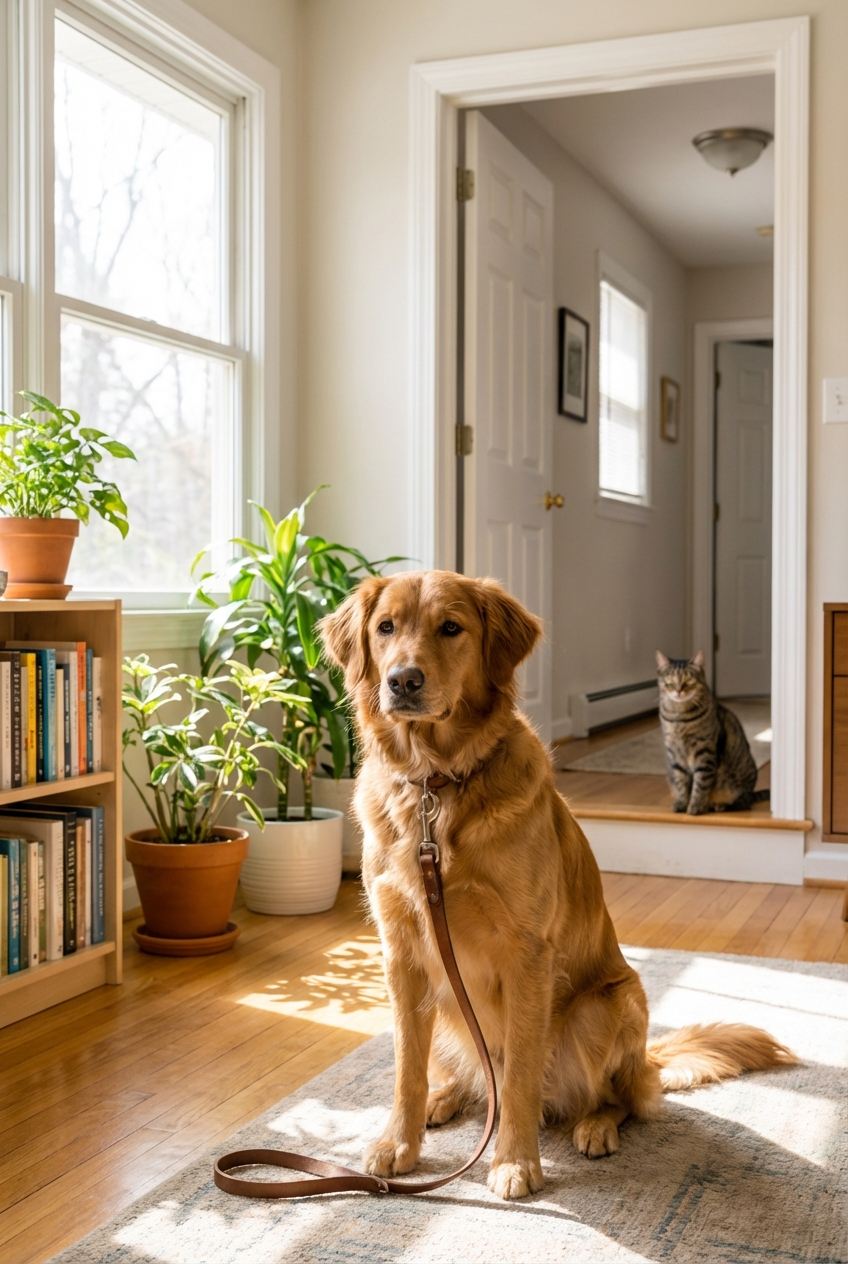
A vet-assistant guide to introducing cats and dogs using slow decompression, scent swapping, barrier sessions, and reward-based training. Includes safety che...
Article
•
Designer Mixes
How to Introduce a Cat to Dogs

Shari Shidate
Designer Mixes contributor
Bringing a cat into a dog household can absolutely work, but the goal is not a “cute first meeting.” The goal is safe, low-stress coexistence built over days to weeks (sometimes longer). As a veterinary assistant, I have seen introductions go beautifully when families slow down, manage the environment, and let both species communicate in the way they naturally do.
Quick note: This guide is general education, not a substitute for individualized veterinary or behavior advice. If you have safety concerns at any point, get help early.
This guide walks you through a step-by-step plan that protects your cat’s confidence and helps your dog learn calm, appropriate behavior.
Supplies checklist
- Barriers: solid door, tall baby gate (ideally two-gate setup), or a gate plus a closed door “airlock”
- Leash and harness for your dog
- Lightweight house line (short, light line used only with direct supervision)
- High-value treats for your dog and cat
- Cat safe room setup: litter box, food, water, bed, hiding spot, scratching post
- Vertical escape routes: cat tree, shelves, window perch
- Optional safety layer: properly fitted basket muzzle, conditioned positively for higher-risk dogs
Before you start
Know the risk factors
Some dog personalities and histories make introductions harder. If your dog has strong prey drive, a history of chasing small animals, or becomes intensely fixated on movement, be extra cautious and consider professional help early.
- Higher-risk dogs: dogs that lunge at squirrels or cats, dogs that cannot disengage when excited, dogs with a bite history. Some types, like sighthounds and many terriers, often have higher prey drive, but individuals vary.
- Higher-stress cats: cats that are fearful, under-socialized, or have previously been attacked.
- Puppies and adolescents: friendly is not the same as safe. Young dogs often struggle with impulse control, so management needs to be tighter.
- Kittens: kittens can be bold but physically fragile. Keep sessions even more controlled and never allow rough play.
Create a cat-only safe room
Your cat needs a space where no dog can follow. This is the cat’s home base for the first phase and a lifelong retreat afterward.
- Food, water, litter box (kept far from food), scratching post, bed, and hiding options
- Vertical space like a sturdy cat tree or shelves
- Use a solid door at first. A baby gate alone is not enough for many dogs.
Tip: Plug-in feline pheromone products may help some cats settle in, especially during the first week. Results vary by cat and by product, so treat this as a possible support, not a guarantee.
Make your living area cat-friendly
Even confident cats feel safer when they can move up and away from a dog.
- Add at least one tall cat tree in a common area
- Clear a route so the cat can leave without being cornered
- Use baby gates with small pet doors or install a cat door where possible
Multi-pet homes
- Multiple dogs: introduce the cat to one calm dog at a time. Do not do “group” introductions.
- Multiple cats: keep the new cat’s safe room protected. Let resident cats adjust with scent-first steps too.
Stop now red flags
Pause the introduction and increase separation if you see any of the following:
- The dog attempts to chase, stalk, corner, or grab
- The dog freezes and stares and cannot disengage, even for high-value treats
- The cat is panicking (bolting, crashing into windows/doors, screaming) or will not recover
- Any bite, near bite, or “close call”
If you hit these, slow down and consider professional support. Safety comes first.
Phase 1: Scent first
Dogs and cats learn a lot through scent. Start by letting them “meet” without seeing each other. This phase often takes several days, and for some pets it takes weeks. Rushing here increases risk later.
- Swap bedding between the cat room and the dog area.
- Gently rub each pet with a clean towel and place it near the other pet’s resting area.
- Offer treats on each side of the closed door only if both pets stay relaxed. If either pet is tense, increase distance and lower the intensity.
What you want to see: curious sniffing, relaxed posture, normal eating. If your dog is barking, scratching, or whining at the door, increase distance and slow down.
Phase 2: See each other safely
Once scent is boring, introduce short, controlled visual moments.
Set up the barrier
- Put your dog on a leash. Have a second adult ready if possible.
- Use a secure gate setup so no one can rush through. A tall gate is often best. For many homes, two gates spaced a few feet apart creates an “airlock” that prevents door-darting and nose-to-nose pressure.
- Avoid relying on a cracked door and a doorstop alone. Doors can shift and paws can hook openings.
Run the session
- Keep early sessions short, often 30 to 90 seconds.
- Reward your dog for calm behavior such as looking away, sitting, or sniffing the floor.
- End the session while both pets are still doing well.
Trainer skill that helps: Teach “look at me” and “leave it” away from the cat first, then use those cues during brief sightings.
Body language
Dog signs of calm: loose body, soft eyes, able to take treats, responds to cues, sniffs the floor, disengages from the cat.
Dog signs to pause: stiff posture, freezing, intense stare, whining that escalates, lunging, trembling, ignoring food.
Cat signs of calm: normal blinking, ears neutral, tail relaxed, approaches then retreats, eats treats.
Cat signs to pause: crouching low, puffed tail, growling or hissing with no recovery, ears pinned back, repeated gate swats, hiding and refusing food.
Important: Do not punish growling, hissing, or stiffening. Those are warnings. If you punish the warning, you can get a bite without any signal next time. Instead, add distance and make the setup easier.
Phase 3: Same room
This is the phase where families tend to move too fast. Keep it structured.
Set the room
- Dog on leash and ideally after exercise so energy is lower
- Cat has high perches and at least two exit routes
- Keep a portable gate or a blanket handy in case you need to calmly block visual contact
- For higher-risk dogs, consider a basket muzzle that has been conditioned with positive reinforcement. Never use a muzzle as a shortcut to skip steps.
Run the session
- Enter with the dog first, ask for a sit, reward.
- Let the cat choose whether to come in. Never carry a frightened cat toward a dog.
- Reward the dog for calm behavior and for choosing to look away.
- End the session early, before either pet escalates.
Rule of thumb: Many short sessions beat one long session. Think minutes, not hours, for the early stage.
Phase 4: Supervised freedom
Only move to this phase when your dog can consistently disengage from the cat and your cat is moving around the home with normal confidence.
- Consider switching from a leash to a lightweight house line so you can step on it if needed. Use it only under direct supervision.
- Remove snag hazards first (sharp table legs, cluttered furniture, anything the line can loop around). Never leave a dragging line on an unattended dog due to snagging and panic risk.
- Continue reinforcing calm choices with treats and praise.
- Keep gates and the cat’s safe room available.
Important: “They ignore each other” is a success. Best friends is optional.
Safety rules
- No chasing, ever. Even playful chasing can teach a dog that the cat is a fun moving target.
- No forced closeness. Do not hold the cat up to the dog for sniffing.
- Feed separately at first. Resource guarding can derail introductions quickly.
- Protect the litter box. Dogs often raid litter boxes. Use a cat door, gate, or elevated litter setup so the cat always has privacy.
- Supervision is non-negotiable. Until you are truly confident, separate them when you cannot supervise.
- Do not punish warnings. Growling, hissing, and swatting are communication. Adjust the environment and increase distance instead.
How long does it take?
Some pets settle in within a week or two. Others need a month or more. Your timeline depends on:
- Dog prey drive and impulse control
- Cat confidence and prior experiences
- Your consistency with barriers, rewards, and supervised sessions
If you feel stuck, it does not mean you failed. It usually means you need a slower pace, clearer management, or professional coaching.
Also true: a small number of pairings may never be safely cohabitable. Long-term management, strict separation, and protected zones can be the most humane choice.
Common problems
Dog is fixated and staring
- Increase distance immediately.
- Reward any glance away from the cat.
- Add barriers and shorten sessions.
- Practice “place” and relaxation away from the cat daily.
Cat hides and will not come out
- Go back to scent work and barrier-only visuals.
- Keep the dog away from the cat’s safe room door.
- Use interactive play like wand toys to rebuild confidence.
- Ask your veterinarian about anxiety support if the cat is not eating or using the litter box normally.
Dog barks at the gate
- End the session before barking escalates.
- Work under threshold: farther away, shorter sessions, calmer environment.
- Reward quiet behavior rather than punishing noise.
Cat swats the dog
A swat can be a normal boundary. Repeated swatting, hissing, or hiding usually means the cat is over threshold and the setup needs to be adjusted.
- Ensure the cat has high escape routes.
- Do not allow the dog to crowd the cat.
- Go back a phase if tension stays high.
- Remember the biggest risk is the dog escalating. Keep the dog leashed until calm is consistent.
When to call a professional
Please reach out for help sooner rather than later if you see any of the following:
- Dog lunging, snapping, or grabbing at the cat
- Cat not eating, hiding constantly, or having litter box accidents due to stress
- Dog cannot disengage even with high-value treats
- Any bite or close call
Look for a fear-free or positive reinforcement dog trainer, and for serious cases, a board-certified veterinary behaviorist.
A realistic goal
In the best introductions, both animals learn: “I am safe here.” Your cat learns they have control over their space, and your dog learns that calm behavior makes good things happen.
If you do one thing right, do this: protect your cat’s ability to escape and reward your dog for calm choices.
Go slowly, keep sessions positive, and remember that progress is not always linear. A calm household is the win.