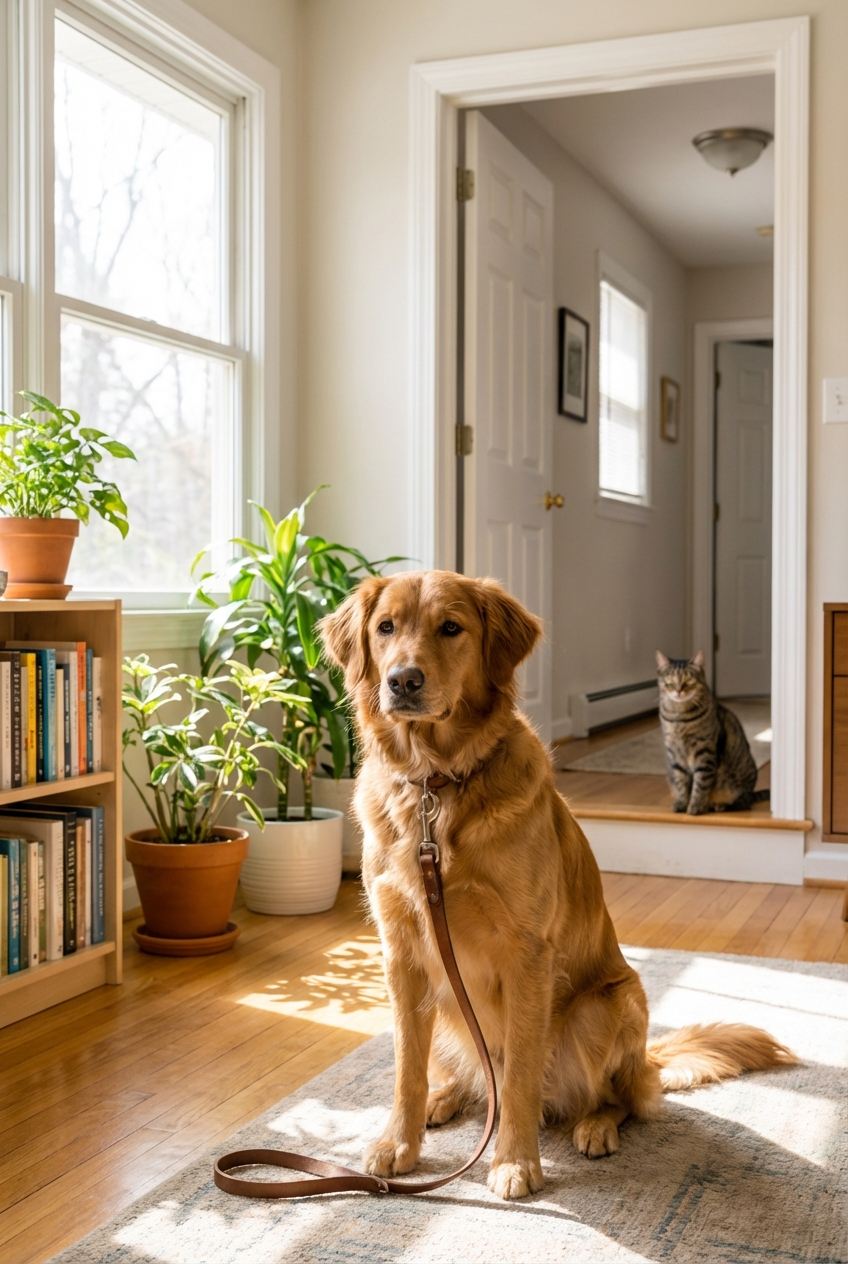
A practical, vet-assistant-backed guide to introducing a cat to dogs safely. Follow phased steps—scent first, barrier visuals, leashed sessions, supervised...
Article
•
Designer Mixes
How to Introduce a Cat to a Dog

Shari Shidate
Designer Mixes contributor
As a veterinary assistant here in Frisco, Texas, I can tell you this: most cat and dog introductions do not fail because the pets are “bad.” They fail because the process is rushed. The good news is that with a little planning and a lot of patience, you can help your cat feel safe and teach your dog calm, respectful behavior.
This guide walks you through a step-by-step, modern behavior approach based on gradual desensitization and counterconditioning, plus training tips that protect both pets and build trust over time.
Quick scope note: This is general education, not a substitute for individualized veterinary or behavior advice. If anyone feels unsafe, bring in your veterinarian and a qualified professional early.

Before you start: set realistic expectations
Some cat and dog pairs become best friends. Others simply learn peaceful coexistence. Your goal is safety first, then comfort, then relationship.
- Timeline: This often takes weeks. A common range is 2 to 8 weeks or longer, depending on your cat’s confidence, your dog’s drive, and how consistent your routine is.
- Progress is not linear: A great day can be followed by a stressful day. That is normal.
- Management is training: Gates, leashes, crates, and closed doors are not “cheating.” They prevent practicing chasing and fear responses.
Safety checklist
Know when to get professional help
If your dog has ever tried to injure a cat or any small animal, or if your cat is panicking, hiding nonstop, or not eating, do not “push through.” Partner with your veterinarian and a qualified trainer experienced in behavior modification (reward-based, least intrusive methods) or a veterinary behaviorist.
Call your vet urgently if: your cat is not eating for 24 hours (or is eating dramatically less), is repeatedly vomiting, seems painful, or is hiding and “shut down.” Cats can become seriously ill quickly when they do not eat (including risk of hepatic lipidosis in some cases).
Dog basics that make introductions smoother
- Reliable responses to sit, down, come, and leave it
- Comfort with a crate or relax on a mat
- Ability to take treats gently and recover from excitement
Cat basics that reduce fear
- A safe room with food, water, litter box, scratching post, bed, and hiding spots
- Vertical escape routes like a cat tree or shelves
- Predictable routines: meals, play, and quiet time
Important: Never allow a dog to corner a cat. Cats must always have a clear escape path.
Set up your home for success
Think of your home as zones, not a free-for-all.
- Cat-only zone: A room where the dog never enters. This lowers stress and protects litter box access.
- Visual barriers: Baby gates with a cat door, or gates plus a sheet temporarily if your dog fixates.
- Leash station: Keep a leash and treats near the introduction area so you are ready before excitement spikes.
- Feeding plan: Feed on opposite sides of a closed door or gate to create positive associations.
- Remove high-value items: During early stages, pick up bones, chews, favorite toys, and food bowls in shared spaces to reduce resource guarding risks.
Busy home tip: If you have kids, roommates, or frequent guests, plan your “zones” and rules in advance. Post a simple note by the cat room door (keep closed, no surprise entries) and use gates so no one accidentally creates a chase moment.

Step-by-step: the slow introduction plan
Step 1: Decompression (first 24 to 72 hours)
Bring your cat home to the safe room. Let your dog smell under the door, but do not allow rushing, pawing, or barking at the doorway.
- Reward your dog for relaxed behavior near the door.
- Play and cuddle with your cat in the safe room on their terms.
- Keep the household quiet and routine-based.
Step 2: Scent swapping (days 2 to 7)
Scent is powerful information for both species. Trade scents before face-to-face meetings.
- Rub a soft cloth on your cat’s cheeks and place it near your dog’s resting area (and vice versa).
- Swap bedding for short periods.
- Do short sessions and pair with treats or meals.
Step 3: Door feeding (several days)
Feed both pets on opposite sides of a closed door.
- Start far enough away that both will eat comfortably.
- Gradually move bowls closer over multiple meals.
- If either pet stops eating, back up and increase distance.
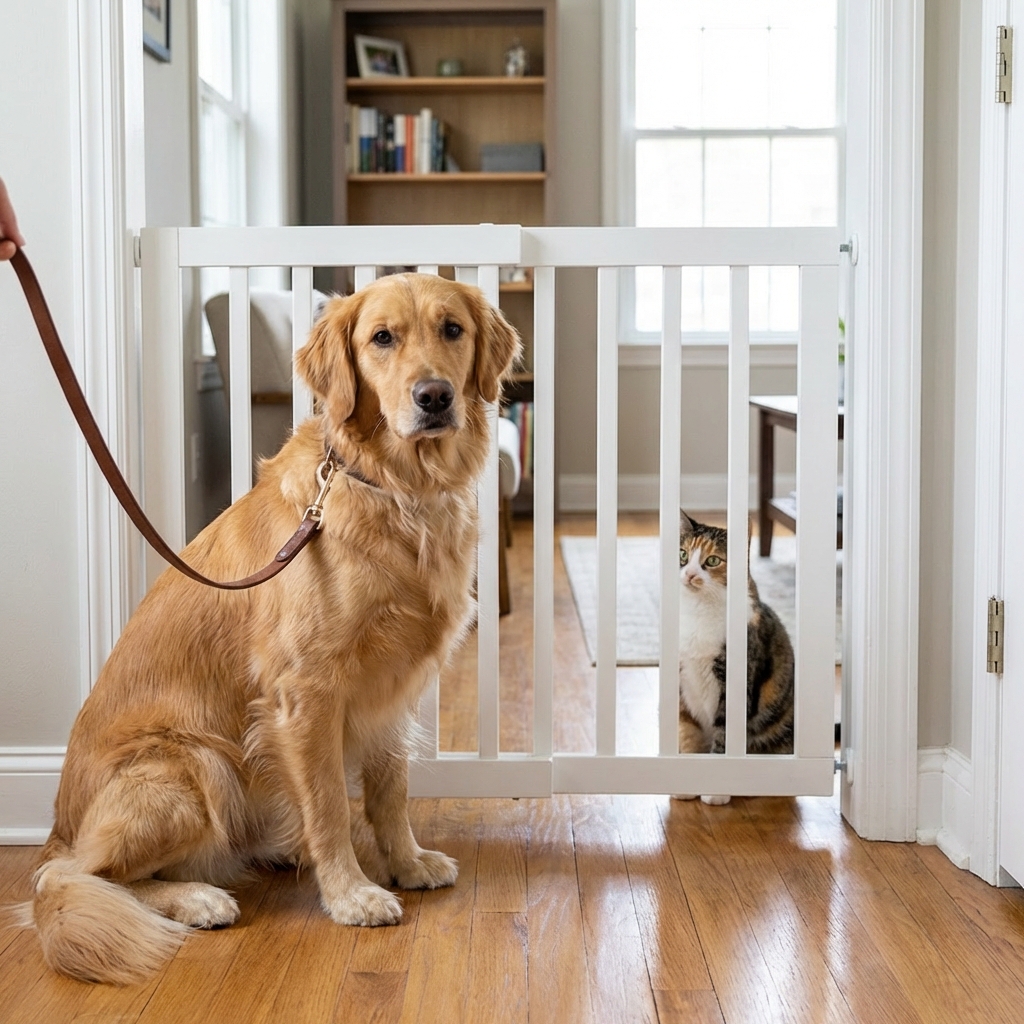
Step 4: First visual contact (through a barrier)
Use a sturdy baby gate or a door that is slightly open with a secure barrier in place (no gaps a dog can push through). Your dog should be on leash.
What “under threshold” means: your dog can notice the cat and still think, take treats, and respond to you. Your cat can observe without freezing, panicking, or escalating.
- Keep sessions 30 to 120 seconds at first.
- Reward your dog for looking at the cat and then looking back to you.
- End while everyone is still settled.
What relaxed looks like: soft body, loose tail, sniffing the floor, taking treats, disengaging easily.
What is too much: lunging, stiff posture, whining escalating to barking, trembling cat, flattened ears, growling, repeated swatting at the gate.
Step 5: Leashed indoor meetings (short and structured)
When barrier sessions are consistently relaxed, allow brief meetings in the same room.
- Dog on leash, ideally after a walk so energy is lower.
- Cat has access to vertical space and exits.
- Do not force the cat to approach. Let curiosity lead.
- Keep it short, then separate and give both a break.
Step 6: Supervised freedom (only after many relaxed reps)
Instead of a regular leash, use a lightweight indoor drag line (often called a house line). This gives you a safe way to interrupt without grabbing a collar.
- Safety note: Use a drag line designed for indoors and avoid handles or loops that can snag on furniture.
- Start with 5 to 10 minutes, then increase gradually.
- Continue rewarding relaxed, polite behavior.
- Separate when you cannot actively supervise.
Step 7: Long-term management (even after success)
Even friendly pairs can have moments. Keep the cat’s safe zone and vertical spaces permanently. Many homes do best with:
- Cat-only feeding and litter access
- Dog enrichment to reduce boredom (snuffle mats, training games)
- Daily play sessions for the cat to reduce zoomies and ambush behavior
Reality check: Many injuries happen in fast, unplanned moments (a door left open, a guest enters, a toy triggers chasing). Your barriers and routines are what prevent those moments from becoming emergencies.
Fast troubleshooting
- If your dog fixates or hard-stares: increase distance, add a visual blocker (sheet on the gate), switch to shorter sessions, and practice “Look at that” at an easier level.
- If your dog barks at the gate: end the session calmly, reset farther away next time, and reward quiet before you move closer.
- If your cat hisses or swats: that is information, not “bad behavior.” Give the cat more space, add more vertical options, and return to scent and barrier work for a few days.
- If either pet cannot eat or take treats during sessions: you are too close or going too long. Back up and shorten.
Dog training tips that matter most
Teach “Look at that” to reduce fixation
This is a simple pattern game: dog sees the cat, then earns a reward for reorienting to you.
- Start at a distance where your dog can stay relaxed.
- When your dog notices the cat, say “Yes” and give a treat.
- Repeat until your dog begins to glance at the cat and then look back to you automatically.
Over time, this replaces staring and stalking with a calmer habit.
Reinforce “Leave it” and “Come” like your safety depends on it
Because it does. Practice daily in low-distraction settings first, then gradually add distractions.
- Leave it: reward for disengaging from movement or temptation.
- Come: reward heavily, then release. Do not only call to end fun.
Build an off-switch with “Place” (relax on a mat)
Teach your dog to settle on a bed or mat while the cat moves around at a safe distance.
- Mark and reward when your dog lies down and relaxes.
- Feed treats slowly to encourage settling, not revving up.
- End before your dog gets restless.
Avoid punishment-based methods
Yelling, leash corrections, and “alpha” tactics can increase arousal and fear. That can make your dog more reactive and your cat less confident. Calm, reward-based training is safer and more effective for this scenario.
Cat support: confidence-building that helps the whole house
Create positive routines
- Play: 5 to 10 minutes of wand toy play once or twice daily
- Food puzzles: simple treat balls or hidden treats in the safe room
- Safe perches: the cat should be able to observe without being approached
Use calming tools when appropriate
Many cats benefit from pheromone diffusers in the safe room and shared spaces. Talk to your veterinarian if your cat is not eating, is overgrooming, or seems shut down, because stress can quickly lead to medical problems in cats.
Body language: what to watch for
Dog signs of rising risk
- Hard staring, stiff posture
- Slow stalking, freezing, then sudden lunging
- Whining that escalates, barking at the cat
- Mouth closed tight, weight shifted forward
Cat signs of fear or overload
- Crouching, hiding, flattened ears
- Puffed tail, hissing, growling
- Dilated pupils, rapid grooming, refusal to eat
- Swatting repeatedly when the dog is not approaching
If you see these signals, increase distance, shorten sessions, and return to barrier work. There is no shame in taking a step back.
Common mistakes (and what to do instead)
- Letting the dog chase “just once.” Chasing is self-rewarding and can become a habit. Use gates, drag lines, and structured practice.
- Forcing the cat to “face the dog.” This increases fear. Let the cat choose proximity.
- Going too long too fast. Short sessions keep everyone under threshold.
- Leaving them together unsupervised early. Most injuries and close calls happen in unplanned moments. Management prevents surprises.
- Ignoring medical factors. Pain, vision issues, or cognitive changes can change behavior quickly in both pets.
- Ignoring resource guarding. Feed separately, pick up bowls, and remove high-value chews and toys from shared spaces until you have a strong track record.
When the match is harder
Puppies
Puppies are bouncy and rude by cat standards. Use more management, more naps, and more structured training. A tethered puppy near you and a confident cat with vertical space can be a safe combo.
High prey drive dogs
Some dogs are genetically wired to chase. That does not automatically mean they cannot live with a cat, but you need stricter management, slower steps, and often professional guidance.
Muzzle training can be an added safety layer for some dogs when introduced correctly and humanely. Use a basket muzzle, condition it gradually with treats, and never use a muzzle as a shortcut to skip steps or force close contact.
Very shy or previously traumatized cats
Focus on the cat’s confidence first. Keep the cat’s world small and safe, expand gradually, and prioritize predictable routines. Your veterinarian can help you decide if short-term anti-anxiety medication could support the process.
A simple daily plan
- Morning: short dog walk, then brief barrier session with treats
- Midday: cat play session in safe room, dog enrichment (snuffle mat)
- Evening: door feeding or gate feeding, then “place” practice for the dog
- Night: separate sleeping spaces until you have weeks of relaxed interactions
Go slow enough that both pets can stay relaxed. Repetition builds trust, and trust is what creates a peaceful home.
Quick recap: non-negotiables
- Barriers and supervision prevent setbacks and injuries.
- Escape routes for the cat (vertical space, exits) are mandatory.
- Short sessions beat long, stressful ones.
- Reward disengagement (look away, return to you, settle).
- Separate when you cannot supervise, even after things improve.
References and further reading
- American Veterinary Society of Animal Behavior (AVSAB): Position statements and behavior resources
- American Animal Hospital Association (AAHA): Behavior management and preventive care guidelines
- International Association of Animal Behavior Consultants (IAABC): Finding a qualified behavior professional
- ASPCA: Dog and cat behavior and introduction guidance