Learn a proven, kind puppy house-training plan with a simple schedule, crate and supervision tips, a repeatable potty routine, cleaning methods, and nighttim...
Article
•
Designer Mixes
How to House Train a Puppy

Shari Shidate
Designer Mixes contributor
House training is one of the very first ways you build trust with your puppy. The goal is simple: help your pup learn where to go, when to go, and how to tell you they need a potty break. The secret is not harsh correction. It is consistency, the right setup, and plenty of praise.
As a veterinary assistant, I also want you to know this: potty accidents are usually a training issue, but sometimes they are a medical issue. We will cover both, so you can move forward with confidence.
Quick note: This is general guidance and not a substitute for veterinary care. If you are worried your puppy is sick or in pain, call your veterinarian.
House training facts every owner should know
- Puppies do not generalize well. Going potty outside at your house does not automatically mean they know to do it outside at grandma’s house. New places can require a mini refresh.
- Timing is everything. Puppies often need to go out after waking, after eating, after a big drink, after play, and after training sessions.
- Smell drives repeat behavior. If an area smells like urine, your puppy is more likely to use it again. Enzymatic cleaners matter.
- Freedom is earned. The more your puppy roams early on, the more chances they have to make mistakes.
- Punishment delays progress. Scolding after the fact teaches your puppy to hide accidents, not to stop having them.
Pick your potty plan
There is no one perfect method, but there are methods that are easier to be consistent with. Choose what fits your household and stick with it for several weeks.
Outdoor training (most common)
This is the classic approach: frequent trips outside, reward immediately, prevent accidents indoors.
Indoor option: pee pads or litter box
These can work for very small breeds, high-rise living, mobility limitations, or extreme weather. The main downside is that it can slow the switch to outside only if you eventually want that. If you use pads, place them in a consistent location and reward the same way you would outside.
Hybrid approach
Some families start with pads while vaccination is incomplete, then transition outdoors. If you do this, pick a clear transition window and gradually move the pad closer to the door, then outside.
If you are avoiding public areas due to parvovirus risk, ask your veterinarian what is appropriate in your region. In many cases, a private yard or other low-dog-traffic spot can be a safer outdoor potty option even before the full vaccine series is complete.
Set up your home for success
Crate training supports potty training
Most puppies prefer not to soil where they sleep, so a properly sized crate can speed up house training. The crate should be big enough for your puppy to stand, turn around, and lie down comfortably, but not so big they can potty in one corner and sleep in another.
That said, not every puppy has this instinct right away. Puppies from pet stores, puppies who were kept in small dirty spaces, and anxious pups may need extra patience and a tighter management plan.
Tethering works too
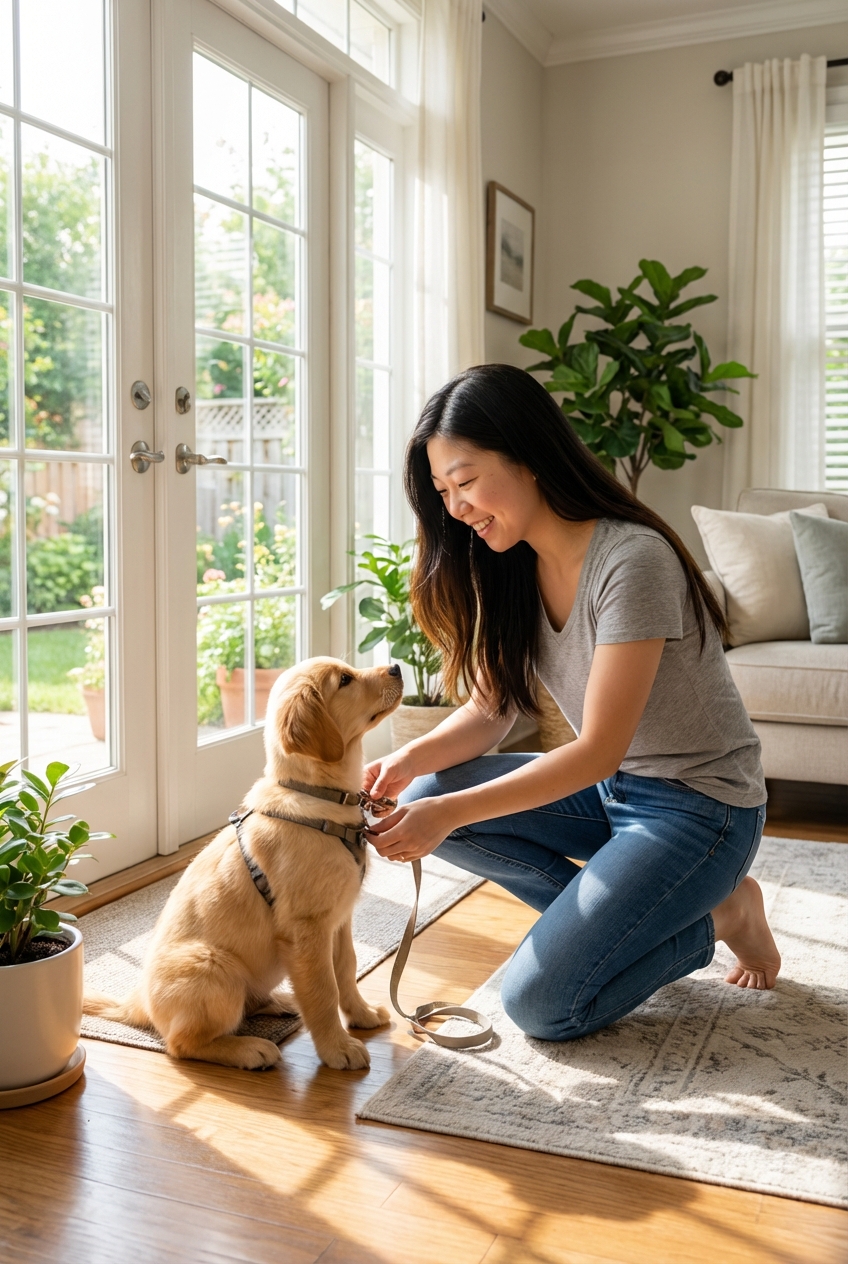
If a crate is not a good fit for your household (or your puppy needs a slower crate plan), try the “umbilical cord” method: keep your puppy on leash and attached to you indoors. It is a simple way to prevent sneaky accidents and catch potty cues early.
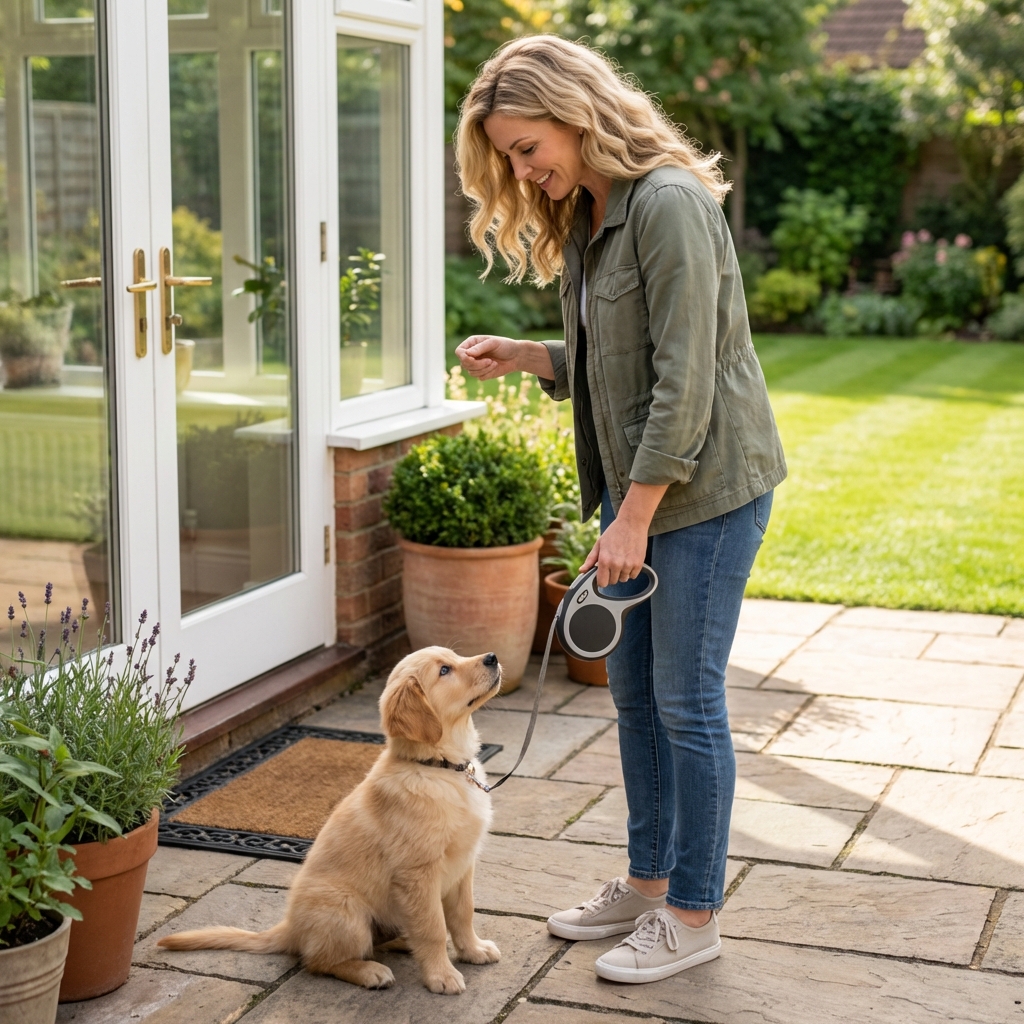
Use a leash even in the yard
For the first few weeks, take your puppy out on leash. This keeps them focused and helps you learn their potty cues like circling, sniffing, and suddenly wandering away from play.
Choose one potty spot
Bring your puppy to the same area each time. The familiar scent helps trigger the behavior you want.
A simple schedule
Puppies thrive with predictable routines. Here is a starter schedule you can adjust based on your puppy’s age and your workday. Younger puppies often need extra breaks between the times listed.
How often should a puppy go out?
- Immediately after waking up
- Within 5 to 30 minutes after meals
- After a big drink or lots of excitement
- After play or zoomies
- Before bed
- Overnight as needed for younger puppies
You may have heard the rule of thumb that puppies can hold it about one hour per month of age. Some puppies can, many cannot, and most need more frequent breaks when they are excited, active, or in a new environment. Also, there is no healthy “hold it all day” goal. Even many adult dogs max out around an 8 hour workday, and that is not a target for puppies.
Sample day (adjust to your life)
- 6:30 am: Wake up and straight outside
- 7:00 am: Breakfast, then potty break
- 9:00 am: Potty break
- 11:30 am: Potty break, lunch (if feeding 3 meals), potty break
- 2:00 pm: Potty break
- 5:30 pm: Potty break, dinner, potty break
- 8:00 pm: Potty break
- 10:00 pm: Final potty break and bedtime
Pee and poop basics
Many owners find poop trickier than pee because timing can be less predictable. A few helpful patterns:
- Many puppies poop 1 to 3 times per day, but it varies by diet, age, activity, and individual gut health.
- Poop often happens after meals, after waking, and during or right after active play.
- Soft stool or sudden urgency is not a training issue. It is a reason to tighten management and consider a veterinary check.
How to reward correctly
Your puppy needs to connect the dots: “I peed outside and good things happened.” That means timing your reward.
- Say nothing while they are going. Quiet and calm helps many puppies finish.
- Reward immediately when they finish, not when you get back inside.
- Use a happy marker word like Yes! and give a small treat, plus praise and a few seconds of sniff time.
- If your puppy is more toy-motivated, a quick game after potty can work too.
One of the fastest ways to speed up house training is to treat potty breaks like a training session: consistent cue, consistent location, immediate reward.
Accidents: what to do and what not to do
If you catch them in the act
- Stay calm.
- Interrupt gently with a neutral sound (like a quick clap or “oops”).
- Immediately take them outside to finish.
- Reward if they finish outdoors.
If you find it later
Do not scold. Your puppy will not understand why you are upset. Clean it thoroughly and tighten your routine.
Cleaning correctly
Use an enzymatic pet stain cleaner. Standard household cleaners may remove the stain for humans, but they often leave scent cues your puppy can still detect.
Common hiccups and fixes
My puppy will not potty outside
Some puppies get distracted, nervous, or just want to play. Try this simple plan:
- Go to your usual potty spot on leash and stand still.
- Wait about 5 minutes.
- If they do not go, bring them inside and either crate them or keep them tethered to you.
- Try again in 10 to 15 minutes.
This prevents the common pattern of “refused outside, came in, peed on the rug.”
My puppy pees right after coming inside
This usually means they did not fully empty, got distracted outside, or you stayed out just long enough for sniffing but not long enough for potty. Keep them on leash outside until they go, reward immediately, then give a short bonus minute for sniffing before heading in.
Crate training: the right way
Crates are not punishment. They are a safe, cozy den that helps prevent accidents and keeps puppies out of trouble when you cannot supervise.
- Feed a few meals in the crate with the door open at first.
- Use a comfortable mat or towel, unless your puppy tends to chew bedding.
- Give a safe chew or food puzzle for short crate sessions.
- Keep early sessions short, then build up gradually.
If your puppy is panicking in the crate, talk with your veterinarian or a qualified trainer. Some pups need a more gradual plan.
Common reasons training stalls
Not enough supervision
If your puppy is loose in the house, you should be able to see them. If you cannot actively watch, use the crate, tethering, or a small puppy-proofed area.
Too much indoor freedom too soon
Many puppies do best when they earn access room by room. Add space after a full week or two of success in the current space.
Inconsistent schedule
Random meal times and random potty breaks make it harder for your puppy’s body to develop a predictable routine.
Big life changes
Moving homes, new pets, new baby, travel, or even a new floor type can cause setbacks. That does not mean you failed. It means your puppy needs structure again.
When to suspect a medical issue
In the clinic, we always want to rule out health problems if potty training is not improving. Call your veterinarian if you notice any of the following:
- Frequent urination in tiny amounts
- Straining to urinate or vocalizing
- Blood in urine
- Sudden increase in thirst
- Accidents that start after your puppy was doing well
- Soft stool or diarrhea, especially with urgency
Urinary tract infections, intestinal parasites, and stress colitis can all look like “bad potty training” from the outside. Getting the right diagnosis is part of being an excellent pet parent.
Nighttime house training
Night accidents are common early on. Set your puppy up to succeed:
- Healthy puppies should have access to fresh water most of the day. If your veterinarian agrees, you can pick up the water bowl 1 to 2 hours before bed for very young puppies, but this is not a substitute for nighttime potty trips. Never restrict water if your puppy seems excessively thirsty or unwell.
- Do a calm final potty break right before bedtime.
- Keep the crate near your bed at first so you can hear restlessness.
- If your puppy wakes, go straight out and keep it boring. No play, no long cuddle session. Potty, praise, back to bed.
Cues and communication
Teach your puppy a consistent cue like Go potty. Say it once when they start to sniff and circle, then reward after they finish. Over time, the cue becomes very helpful for quick potty breaks before car rides or bedtime.
You can also teach a signal, like ringing a bell by the door, but only after your puppy understands the main routine. Otherwise, some pups learn “ring bell equals outside fun” and will ring it constantly.
Switching from pads to outside
If you used pads and want outside only, aim for a gradual transition over 1 to 3 weeks (faster for some pups, slower for others):
- Start taking your puppy outside on a schedule, even if pads are still available.
- Move the pad closer to the door every couple of days.
- Once your puppy is reliably heading to the door area, move the pad outside to your potty spot (or place a small pad outside temporarily).
- When outside successes are frequent, remove indoor pads so the message is clear.
Success looks like this: fewer indoor pad uses each week and more trips where your puppy goes promptly outside and earns a reward.
How long does it take?
Many puppies show major improvement in 2 to 4 weeks with a consistent plan, but reliably house trained often takes several months, especially in busy households. Small breeds can take longer because of smaller bladders and faster metabolisms.
If you are seeing fewer accidents week by week, you are on the right track.
Quick checklist for a smoother week
- Set meal times and stick to them
- Take your puppy out on a schedule and after key events
- Use a crate, tethering, or a small safe area when you cannot supervise
- Reward immediately after outdoor potty
- Clean accidents with an enzymatic cleaner
- Call your vet if symptoms suggest illness
References
- American Veterinary Society of Animal Behavior (AVSAB): Position statements and guidance on humane training and behavior
- American Kennel Club (AKC): Puppy house-training guidance and management basics