
Know the difference between choking and coughing, what to check first, how to remove visible objects safely, when to use abdominal thrusts or back blows, and...
Article
•
Designer Mixes
How to Help a Choking Dog

Shari Shidate
Designer Mixes contributor
Watching a dog choke is terrifying. I have seen it happen in clinic and at home, and the biggest lifesaver is having a simple plan you can follow even when you are scared. In this guide, I will walk you through how to tell choking from coughing, what to do right away, how to try safe removal, and when to get emergency help.
If your dog cannot breathe, cannot cough or vocalize, or their gums start turning pale, blue, or gray, treat it as an emergency and get help immediately.
Medical note: This is first-aid guidance, not a substitute for veterinary care. If you are unsure what you are seeing, call your veterinarian or an emergency hospital right away.
Choking vs. coughing
Dogs gag and cough for lots of reasons, including kennel cough, collapsing trachea, reverse sneezing, or irritation from pulling on a collar. True choking is about airflow being blocked or severely reduced.
Important: Noisy breathing (like a wheeze or harsh, high-pitched sound) can happen with partial choking, but it can also happen with other airway problems. The key question is: is your dog moving enough air?
Signs your dog may be choking
- Pawing at the mouth or face
- Sudden gagging or retching, especially right after chewing a treat or toy
- Wide-eyed panic, restlessness, or frantic behavior
- Drooling, foaming, or coughing that becomes weaker
- Struggling to inhale, or breathing that sounds harsh, tight, or high-pitched
- Silent attempt to cough or open-mouth breathing with little to no air movement
- Gums or tongue turning pale, bluish, or gray
Signs it may be coughing, not choking
- Honking cough, but your dog can still inhale and exhale
- Your dog can bark between coughs
- Your dog can swallow normally
- Episodes come and go without a clear trigger like a chew
If you are not sure, it is safer to treat it like an emergency and call your vet or an ER clinic while you assess your dog. This is especially true for flat-faced breeds (like bulldogs and pugs) and dogs with known airway disease, since respiratory distress can look a lot like choking.
What to do first
In a choking emergency, you do not have time to guess. Here is the order I recommend.
- Stay as calm as you can. Your dog may bite out of panic, even if they are normally gentle.
- Call for help. If someone is with you, have them call your veterinarian or the nearest emergency hospital and start driving preparations.
- Check for airflow. Put your hand in front of their nose and watch the chest for movement.
- If your dog is coughing strongly, let them cough. Strong coughing is a good sign because it means air is moving and your dog may clear it on their own.
- If your dog cannot breathe or the cough is silent or weak, act immediately. Look in the mouth if it is safe to do so.
Decision line: Blue or gray gums, collapse, or little to no airflow means go now. Call the ER and start transport while you do first aid if you can do so safely.
What not to do
- Do not do a blind finger sweep. It can push the object deeper.
- Do not offer food or water during active choking.
- Do not delay leaving for the ER if your dog is in severe distress, even if you are still trying to help at home.
Check the mouth safely
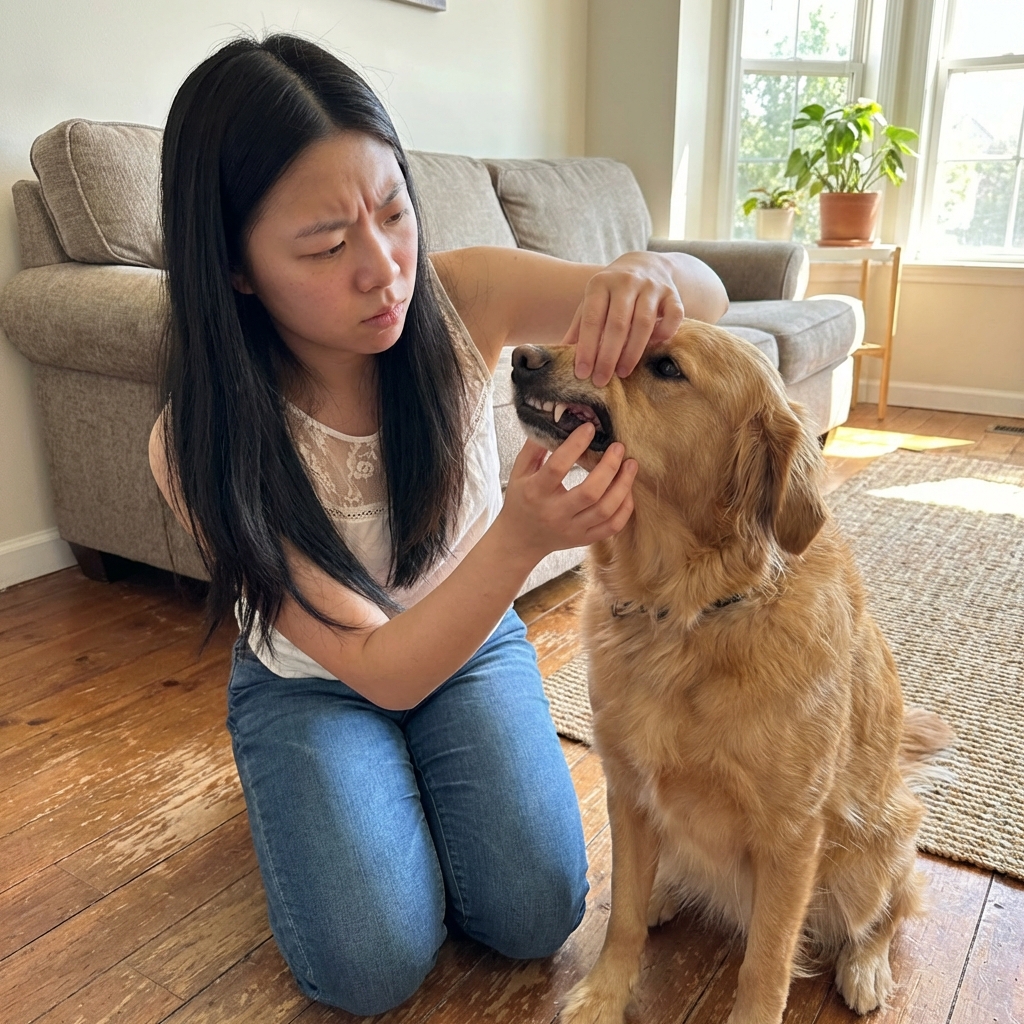
Only do a mouth check if your dog is not breathing well or cannot cough or vocalize, and you can do it without getting bitten.
- Approach from the side, not directly face-to-face.
- Gently open the mouth and look for an obvious object (bone shard, rawhide chunk, toy piece).
- Only remove what you can clearly see and easily grasp. Use your fingers like a pincer or use tweezers if they are right there.
- Do not sweep blindly with your fingers. A blind sweep can push the object deeper and make the blockage worse.
Heimlich for dogs
If your dog is not getting air and you cannot remove the object quickly, abdominal thrusts (Heimlich-style) can help force air up and out, potentially dislodging the blockage. Technique depends on your dog’s size and position.
Safety note: Thrusts can cause injury (including bruising, rib injury, or abdominal trauma). Use them when you strongly suspect a true obstruction with poor or no airflow, and keep moving toward emergency care.
Small dogs
- Hold your dog with their back against your chest (if possible).
- Make a fist and place it just below the rib cage (the soft area of the abdomen).
- Give quick, firm inward and upward thrusts, like a “J” motion, about 3 to 5 times.
- Check the mouth after a set of thrusts, and remove the object if visible.
Medium and large dogs
- Stand or kneel behind your dog.
- Wrap your arms around the belly, just behind the ribs.
- Make a fist and place it in the soft area under the rib cage.
- Pull inward and upward in quick thrusts, 3 to 5 times.
- Recheck the mouth and repeat if needed while someone prepares to leave for the ER.
Dog on their side
- Place one hand on the back for support.
- With the other hand, press firmly into the abdomen just behind the rib cage, pushing inward and upward.
- Do 3 to 5 compressions, then recheck the mouth.
Important: Even if the object comes out and your dog seems fine, contact a veterinarian. Choking can cause throat trauma, and aspiration (inhaling saliva, food, or vomit into the lungs) can show up later.
If your dog passes out
If your dog collapses or becomes unresponsive, this is a true emergency.
- Call an emergency veterinary hospital and start transport as soon as someone can drive safely.
- Lay your dog on their side on a firm surface.
- Check breathing. Watch the chest and feel for airflow at the nose.
- Open the mouth and look for an object you can clearly remove. Again, do not do a blind finger sweep.
- If your dog is not breathing and you are trained, begin pet CPR and continue until you reach veterinary care or your dog resumes breathing.
Many communities offer pet first aid classes and CPR training. Taking one before an emergency happens is one of the best gifts you can give your dog.
When to see a vet after
Even after the crisis passes, your dog may need an exam. Go in urgently if you notice:
- Persistent coughing or gagging
- Noisy breathing or wheezing
- Drooling, repeated swallowing, or refusing food
- Vomiting, lethargy, or weakness
- Fever, rapid breathing, or worsening cough later that day or the next day (possible aspiration pneumonia)
- Bleeding from the mouth
Common hazards
Prevention is not about fear, it is about setting your dog up for success.
High-risk items
- Large chunks of rawhide or similar compressed chews
- Cooked bones that splinter (especially poultry bones)
- Small balls or toys that fit fully in the mouth
- Chew toys that break into pieces
- Dental chews that are too small for your dog’s size
- Human foods that are sticky or large (chunks of meat, marshmallows, nut butter clumps)
Simple safety habits
- Match chews to your dog’s size and chewing style. Power chewers need sturdier options.
- Supervise chew time, especially with new products.
- Use the “trading” skill (swap for a treat) instead of prying items from the mouth.
- Slow fast eaters with a slow feeder bowl or food puzzle.
- Keep kids’ toys, socks, and trash secured. Many airway emergencies start as a swallowed household item.
Quick takeaways
- If your dog is coughing strongly, let them cough and watch closely.
- If your dog cannot breathe or is making silent coughs, check the mouth only if safe and only remove what you can clearly grasp.
- Use abdominal thrusts (Heimlich-style) based on your dog’s size if airflow is blocked.
- After any choking event, talk to a veterinarian. Airway irritation and aspiration can show up later.
Your dog does not need you to be perfect in a crisis. They need you to be prepared. Consider saving the nearest emergency vet number in your phone today, and take a pet first aid class when you can.