A vet assistant’s complete guide to giving dogs tablets, capsules, and liquids safely. Learn pill-in-food tricks, direct pilling, pill poppers, and when to...
Article
•
Designer Mixes
How to Give a Dog Liquid Medicine

Shari Shidate
Designer Mixes contributor
Giving a dog liquid medicine can feel like wrestling an octopus, especially if your pup has had a bad experience before. The good news is that most dogs can learn to tolerate it (and many learn to accept it calmly) when you use the right technique, the right timing, and a calm, confident approach.
As a veterinary assistant, I want you to know two things right up front: you are not failing if your dog resists, and you do not have to force it down the throat to be successful. Let’s walk through safe, evidence-based ways to get that dose in with less stress for both of you.
Quick note: This article is general guidance and does not replace your veterinarian’s instructions. Always follow your prescription label for dosing and timing.
Before you start
Liquid medications are often dosed very precisely. A tiny difference can matter, especially for small dogs.
- Confirm the medication name and concentration. Many liquids come in different strengths.
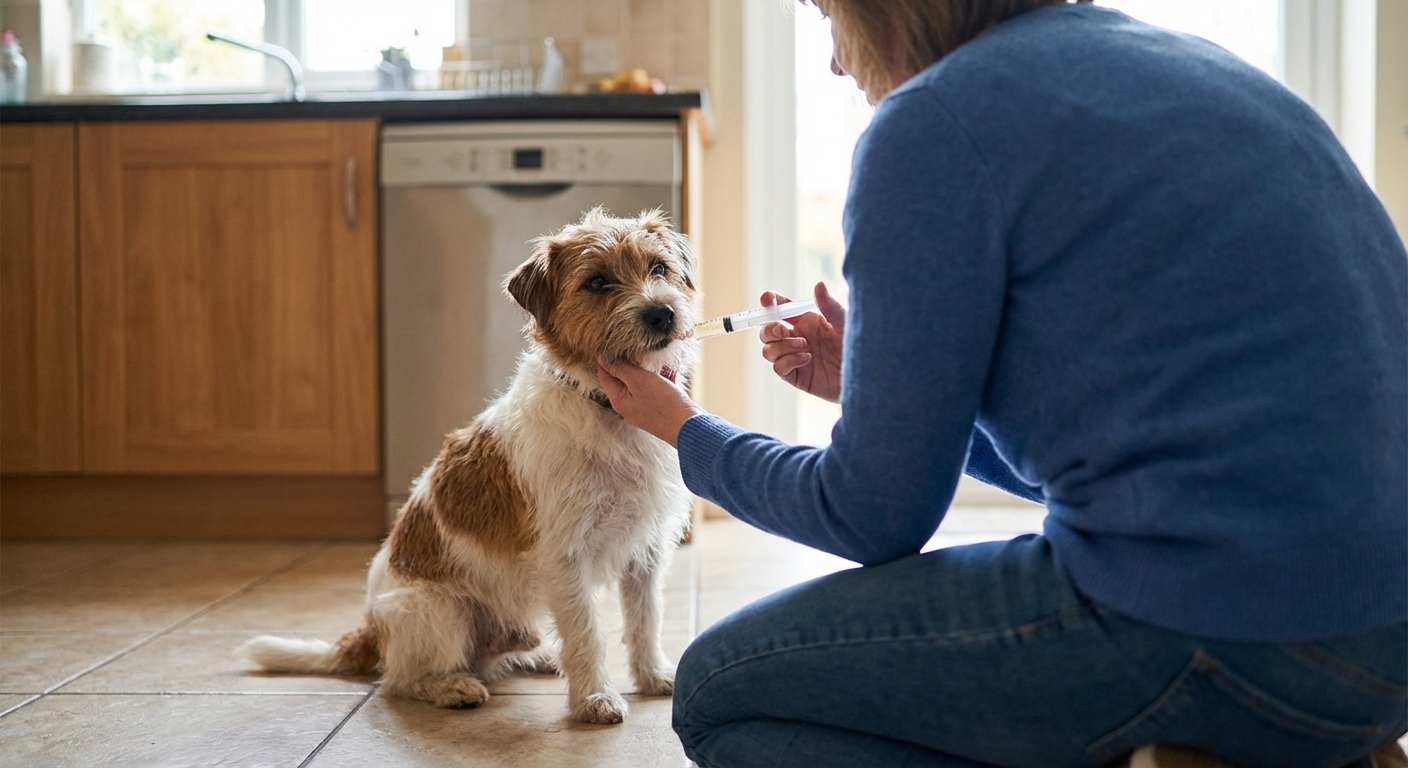
- Measure with an oral dosing syringe marked in mL. Kitchen spoons are not accurate enough.
- Never use a needle. Use an oral syringe only.
- Check storage instructions. Some liquids must be refrigerated or shaken well.
- Follow food instructions exactly. Some meds are easier on the stomach with food, while others are prescribed on an empty stomach.
- Verify the “finish all medication” rule. Antibiotics often need the full course, even if your dog seems better.
If anything on the label does not match what your veterinarian told you, call your clinic before giving the next dose.
What you need
- Oral dosing syringe (usually 1 mL to 10 mL)
- A towel or small blanket (for wiggly pups)
- High-value treat options (tiny pieces)
- A small bowl of water or a lick of something tasty (if allowed)
- Good lighting so you can see the syringe markings clearly
Optional but helpful: Ask your pharmacy about a bottle adapter (syringe stopper) so you can draw up the exact dose with fewer spills.
Safest method
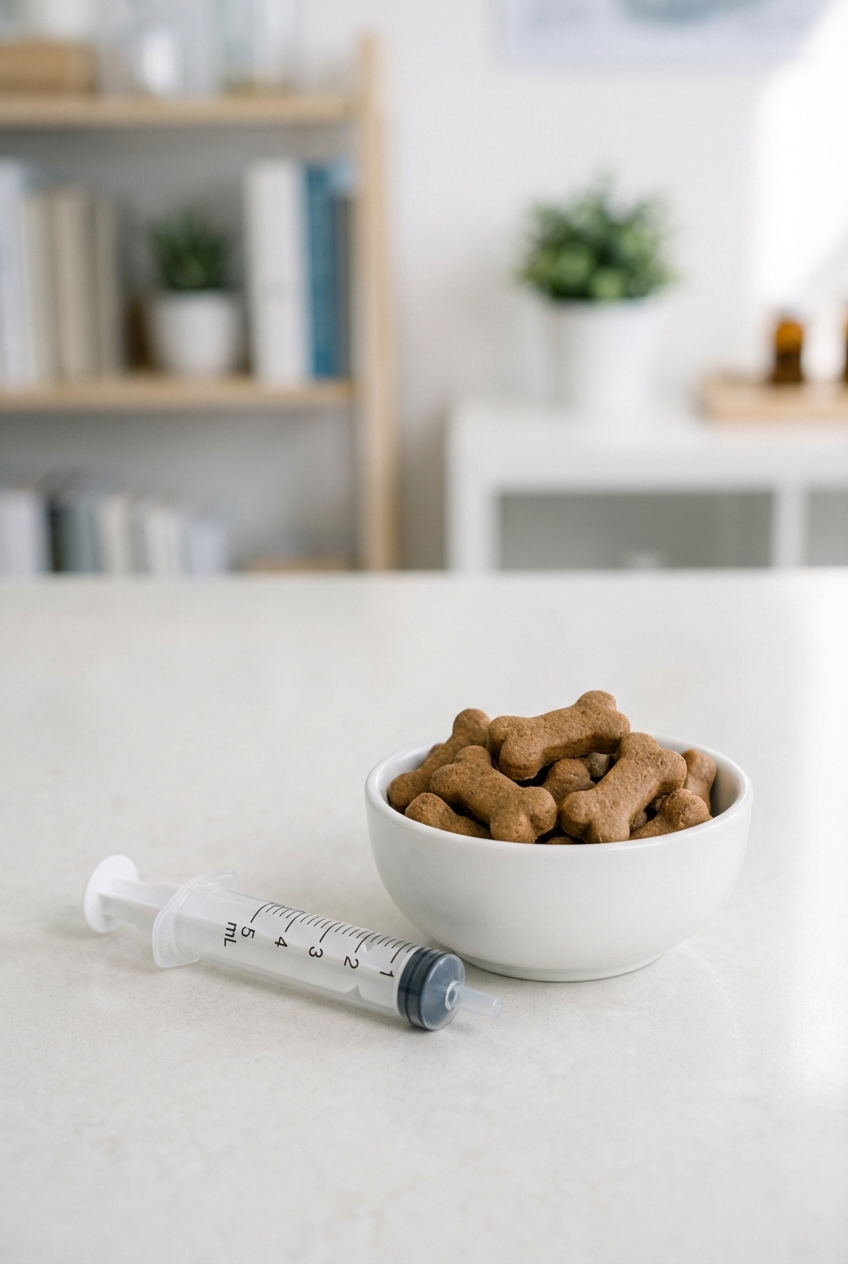
This is the method we teach most often in clinic because it reduces gagging and lowers the risk of aspiration (liquid going into the airway).
Step-by-step
- Stay calm and upbeat. Dogs read our nervous energy fast.
- Position your dog. Many dogs do best sitting with their back against your legs, or on a non-slip rug.
- Hold the muzzle gently. You do not need to pry the mouth open. Do not clamp the mouth shut.
- Insert the syringe at the side. Aim for the space behind the canine tooth, between the cheek and teeth (the cheek pocket).
- Give small, gentle pushes. Aim the liquid along the inside of the cheek, not straight back. Pause between small amounts so your dog can swallow.
- Keep the head level. Do not tilt the head way up. A neutral position is safer.
- Follow with praise and a reward. Even if it was messy, celebrate the win.
Why the cheek pocket works: It encourages natural swallowing and avoids triggering the gag reflex that can happen when liquid hits the back of the throat too quickly.
Safety stop: If your dog is panicking, struggling hard, or you are worried about a bite, stop and call your veterinarian for safer options. Forcing it can increase stress and injury risk.
If your dog fights the syringe
Tiny dose practice
If your dog is already stressed, practice when you do not have to medicate. For a few days, do this once or twice daily:
- Show the syringe (empty or with a tiny bit of dog-safe broth if your vet allows).
- Touch it gently to the side of the mouth.
- Reward immediately.
This creates a pattern: syringe equals treat, not struggle.
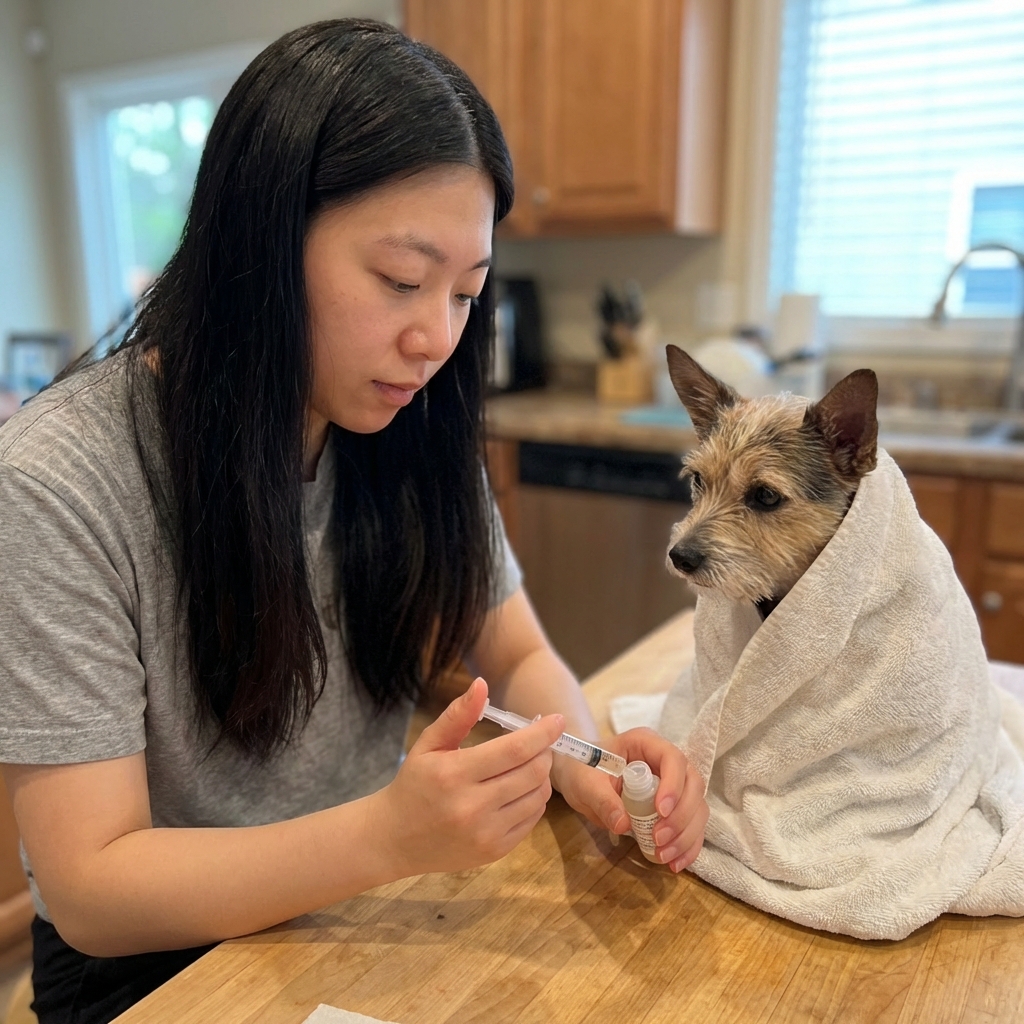
Towel wrap
For small dogs, wrapping can prevent flailing and help you give medication more gently.
- Place your dog on a towel.
- Wrap snugly around the body, leaving the head out.
- Keep it firm but not tight around the chest.
Pick the right time
A slightly hungry dog may be more cooperative, especially if you can pair the medication with a special reward afterward. If the medication must be given with food, do it right before the meal so the food becomes the “chaser.”
Mixing with food
Sometimes yes, sometimes no. This depends on the medication, the dose accuracy needed, and whether your dog will reliably finish the entire portion.
Ask first if
- The medication label says “give on an empty stomach” or has special instructions.
- Your dog is on a restricted diet (kidney disease, pancreatitis, allergies).
- The medication tastes very bitter and may cause food aversion.
If you are cleared to mix it
- Use a tiny amount of a high-value food so your dog finishes it all (a spoonful, not a full bowl).
- Choose something that will not upset sensitive stomachs, like a small amount of canned food or plain cooked chicken if your dog tolerates it.
- Watch to confirm the entire portion is eaten before offering the rest of the meal.
Tip: If your dog refuses the medicated food once, do not keep offering bigger and bigger portions. That is how picky habits and food aversions start.
Common mistakes
- Mistake: Pushing the full dose fast.
Instead: Give small, gentle pushes with swallow pauses. - Mistake: Tilting the head far back.
Instead: Keep the head level to reduce aspiration risk. - Mistake: Holding the mouth open and aiming straight down the throat.
Instead: Aim into the cheek pocket. - Mistake: Chasing your dog around the house.
Instead: Use a calm, consistent “med station” with a non-slip surface and rewards. - Mistake: Blowing air or “shooting” medicine to force a swallow.
Instead: Slow delivery into the cheek pocket, then pause and let your dog swallow naturally. - Mistake: Skipping doses because it is hard.
Instead: Call your vet for alternatives (flavored liquid, different concentration, tablets, or other options when appropriate). In some cases and for certain medications, your veterinarian may discuss other formulations, but suitability is medication-specific.
If your dog spits it out
This is incredibly common. Don’t panic, and do not automatically re-dose.
Do this first
- Estimate what was actually lost. A little drool looks like a lot of medicine.
- Check for foaming. Some drugs taste bitter and cause foamy saliva even when the dose was swallowed.
- Call your veterinarian if you believe a significant portion was spit out, especially with antibiotics, heart meds, seizure meds, or pain meds.
Re-dosing without guidance can lead to accidental overdosing.
If you miss a dose
Give the missed dose only if your veterinarian or pharmacist advises it is safe based on the medication and timing. In general, do not double up unless you are specifically told to. When in doubt, call your clinic for instructions.
Call the vet now
Liquid meds should not cause severe distress. Contact your vet or an emergency clinic if you see:
- Coughing, choking, noisy breathing, or repeated gagging after dosing
- Vomiting that prevents keeping medication down
- Hives, facial swelling, sudden itching, or collapse
- Extreme lethargy or agitation after a new medication
- Bloody diarrhea or black, tarry stool
Important: If you think your dog inhaled medication into the airway, prompt veterinary guidance matters. Aspiration can lead to pneumonia.
Quick troubleshooting
Wiggly puppy
- Use the towel wrap.
- Give tiny amounts.
- Reward often and keep sessions short.
Anxious rescue
- Practice syringe training with no medication.
- Use a quiet room and slow breathing.
- Ask your vet about flavored compounds if the taste is a trigger.
Strong, big dog
- Position with their rear in a corner or against a wall so they cannot back away.
- Have a second person calmly steady the shoulders if needed.
- Keep your hands safe. No fingers between teeth.
A gentle routine
Dogs thrive on predictability. Try this simple routine:
- Go to the same spot each time.
- Ask for an easy behavior like “sit.”
- Give the medication using the cheek pocket method.
- Immediately follow with a high-value reward and affection.
- End the interaction. No lingering or repeated mouth handling.
Most dogs do better when medication time is fast, calm, and consistent. You’re aiming for “no big deal,” not perfection.