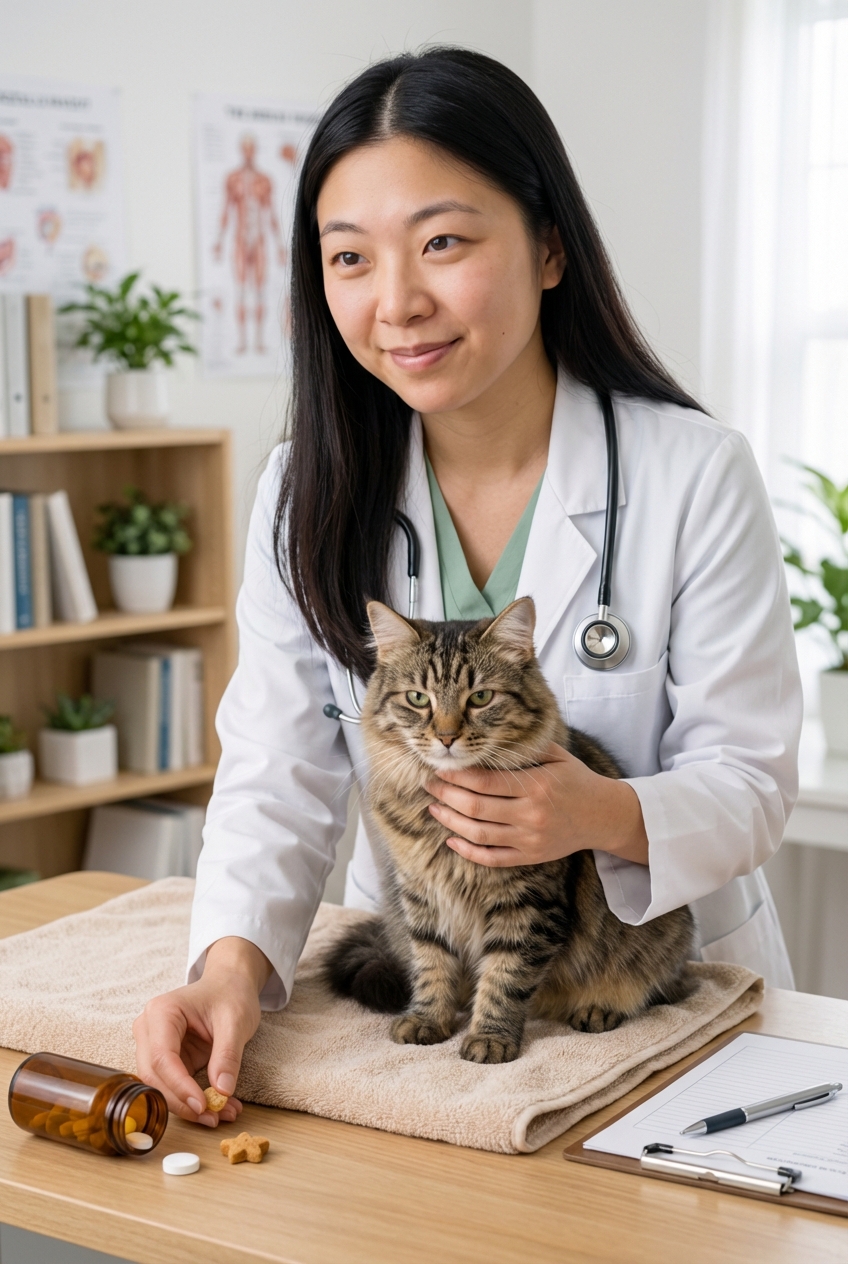
I am Shari Shidate, a veterinary assistant in Frisco, Texas, and if there is one thing I have learned at work and at home, it is this: cats do not “cooperate” with medicine. We set them up for success with good positioning, small amounts at a time, and a calm plan.
This guide walks you through the syringe-in-the-cheek method, a simple towel wrap, what to do about bitter liquids that make cats foam, and how to handle it if part of the dose ends up on your shirt instead of in your cat.
Before you start: set yourself up for a smooth dose
A little prep prevents most of the wrestling. Here is what I recommend:
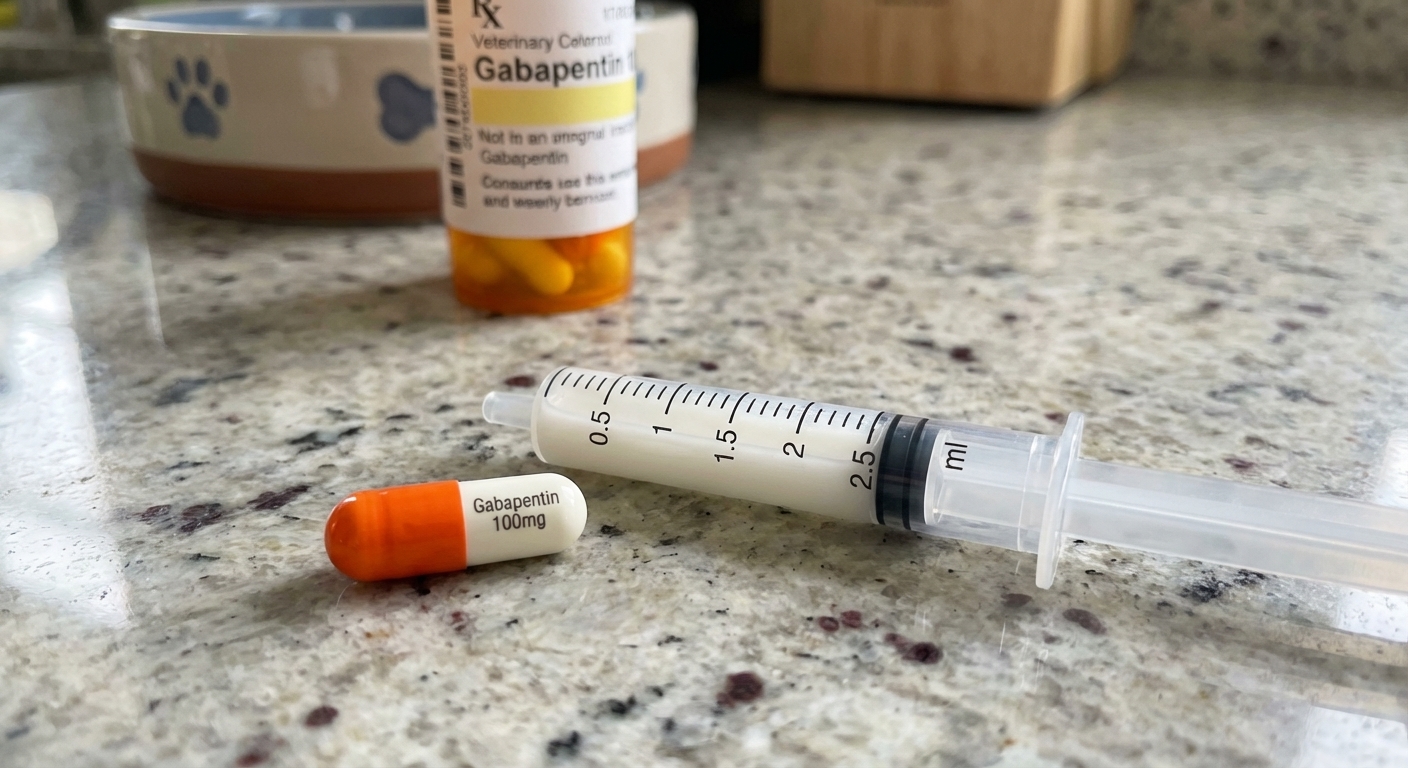
- Read the label and confirm the dose in mL (not teaspoons).
- Check the concentration if it is listed (for example, mg/mL) so you know you have the right bottle and strength.
- Use the dosing syringe your pharmacy or vet provided. Kitchen spoons are inaccurate.
- Measure at eye level, draw up to the correct mL line, and tap out air bubbles so you are giving the amount you think you are.
- Shake if instructed. Many liquid suspensions must be shaken to mix evenly.
- If the label allows, take the chill off by warming the filled syringe in your hands for a minute or two. Do not microwave or heat medication unless your veterinarian or pharmacist specifically tells you to.
- Choose a quiet, small room with the door closed. A bathroom works well.
- Have a towel and a tissue ready for drool or foaming.
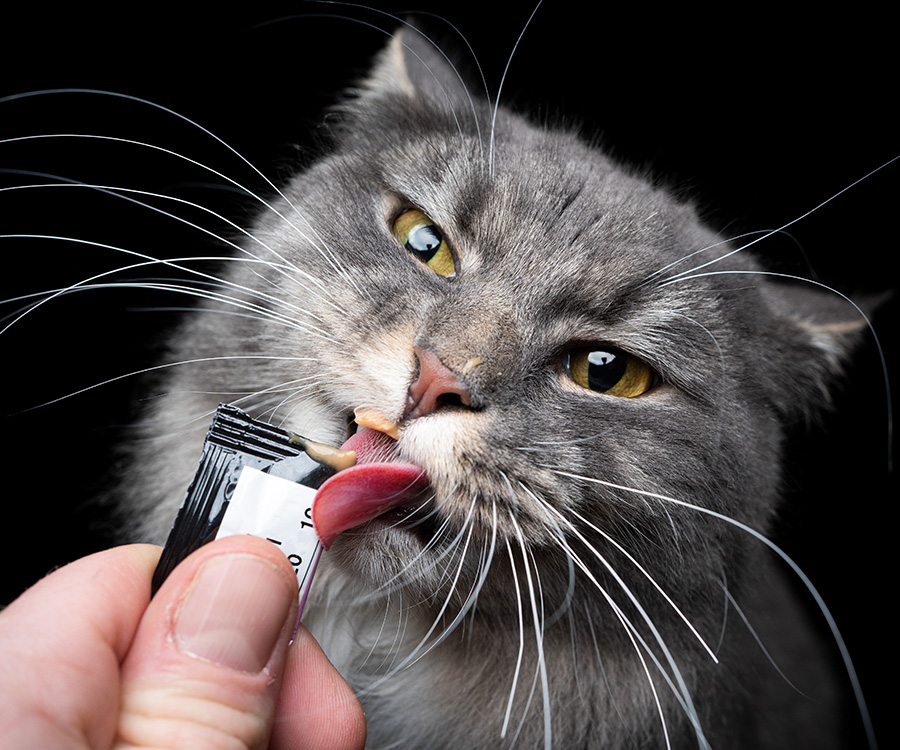
- Plan a tiny reward for after, like a squeeze-up treat (like Churu) or a favorite chin scratch, as long as your veterinarian has not restricted food.
If your cat is hard to handle or you are worried about getting bitten, call your veterinary clinic. It is completely normal to need help, and there are alternatives like different flavors, different concentrations, or in some cases a different form of the medication.
If you have a second person available, use them. One person can calmly hold and steady the head and shoulders while the other focuses on dosing. It is often safer and faster for everyone.
The syringe-in-the-cheek method (step by step)
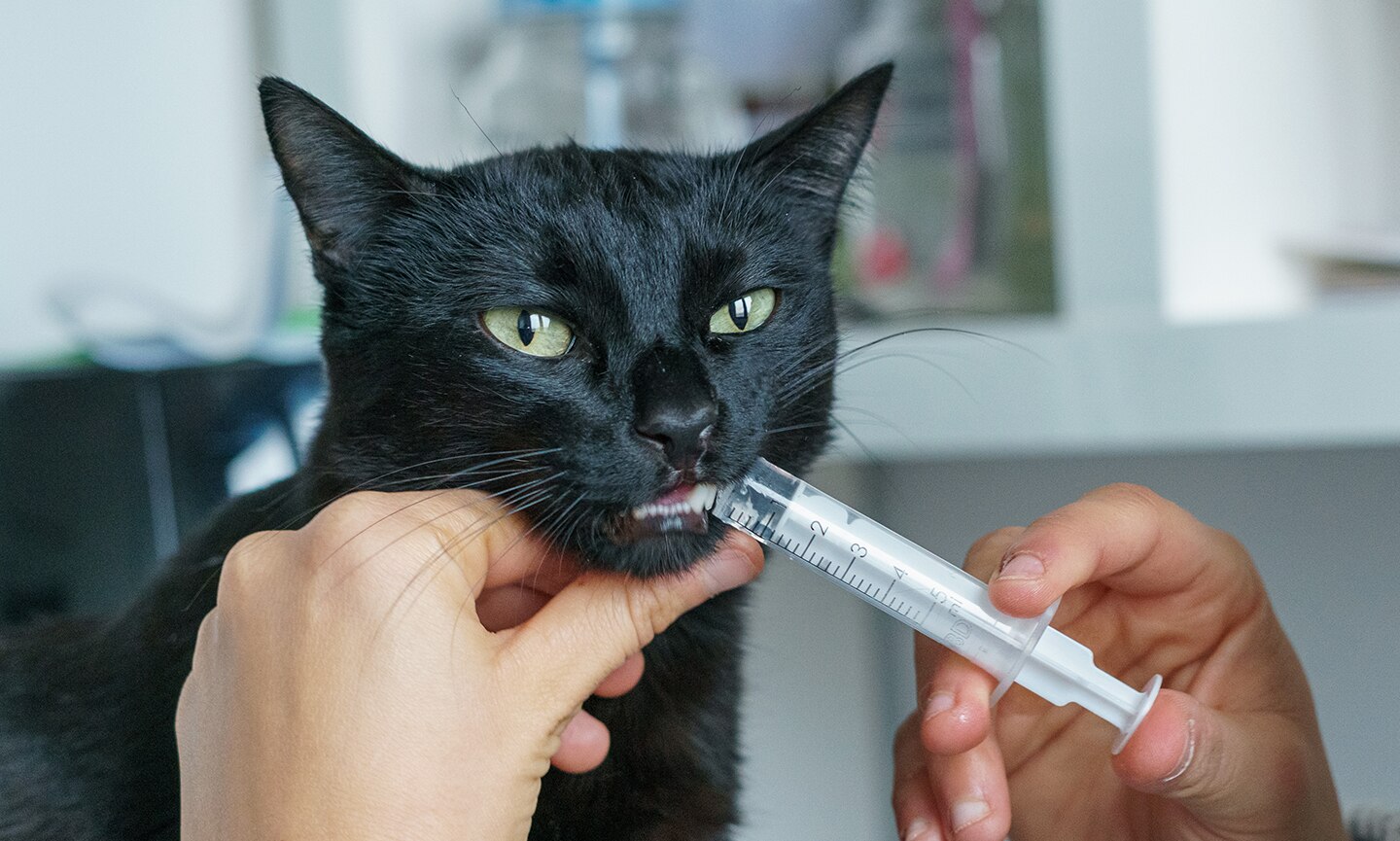
This is the most reliable technique for cats because it aims the liquid into the “cheek pocket” instead of shooting it straight to the back of the throat.
1) Position your cat safely
Place your cat on a non-slip surface, with their body facing away from you. I like to stand slightly behind them and to the side, so I am not directly in front of the “escape route.” If your cat backs up, your body blocks the retreat without pinning them. Keep your movements slow and steady.
2) Hold the head gently, not tightly
Rest your non-dominant hand over the top of your cat’s head, with your thumb and fingers behind the cheekbones. You are guiding, not squeezing. Avoid tipping the head back or pointing the nose up. That is one of the easiest ways for liquid to go the wrong way.
3) Insert the syringe into the side of the mouth
Slide the tip of the syringe into the corner of the mouth, aiming toward the cheek pocket on the side. Many cats have a small gap behind the canine teeth that makes this easier. You do not need to pry the mouth open wide.
Important: Keep your fingers away from the teeth as much as you can, and do not force the syringe in if your cat is clamping down.
4) Give tiny amounts, slowly
Depress the plunger in small squirts, giving your cat time to swallow between each one. Slow is safer. Rushing is when most cats spit, drool, or aspirate.
If your cat bites down hard, do not force the plunger. Pause, let them relax their jaw, and try again from the corner of the mouth. Forcing it can break the syringe tip and can also get you bitten.
5) Watch for swallowing
Look for a swallow, lip lick, or tongue movement before continuing. If your cat is holding their breath, growling, or struggling hard, pause and let them reset.
6) Keep the chin level
Try to keep the head in a normal, level position. Aim into the cheek pocket and resist the urge to “shoot it to the back.” If you go slowly, swallowing usually happens naturally.
Safety note: If your cat coughs, gags repeatedly, has noisy breathing, or seems distressed during dosing, stop and call your vet. Liquid accidentally entering the airway can be serious.
The towel wrap (when you need a little extra control)
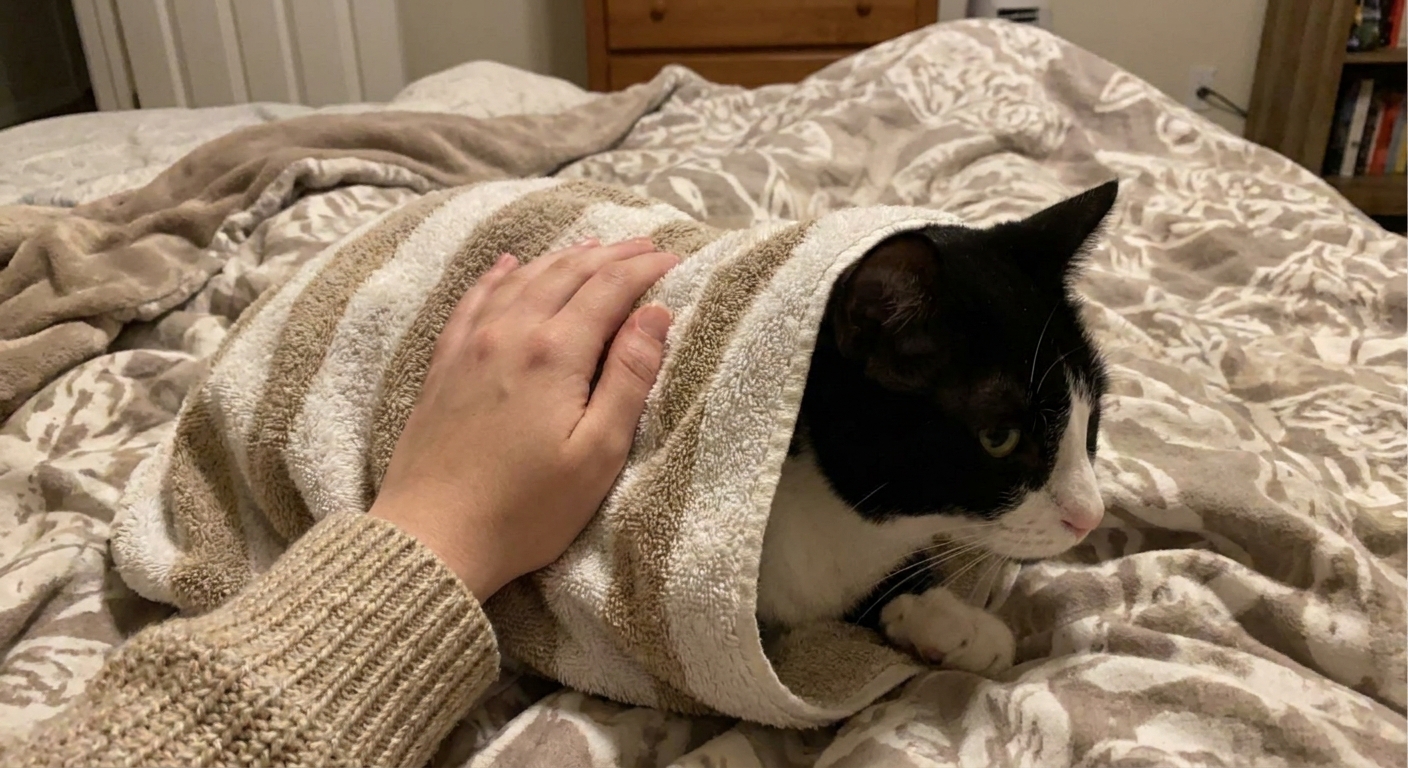
Some cats do best with a “purrito” towel wrap, especially if they swipe, back up fast, or twist away mid-dose.
How to do a simple cat towel wrap
- Lay a towel flat on a bed or counter.
- Place your cat in the middle, lengthwise, with their head near one short end.
- Fold one side of the towel snugly over the body and tuck it under the cat.
- Fold the other side over, creating a secure wrap with only the head out.
- Keep the wrap snug enough to control paws but not so tight that breathing is restricted.
This helps protect you from scratches and helps your cat feel contained, which can actually lower panic for some cats. I avoid forceful restraint when possible. If you feel like you have to “wrestle,” that is your cue to call your clinic and ask for a hands-on demonstration or a different plan.
Why bitter liquid medicine makes cats foam
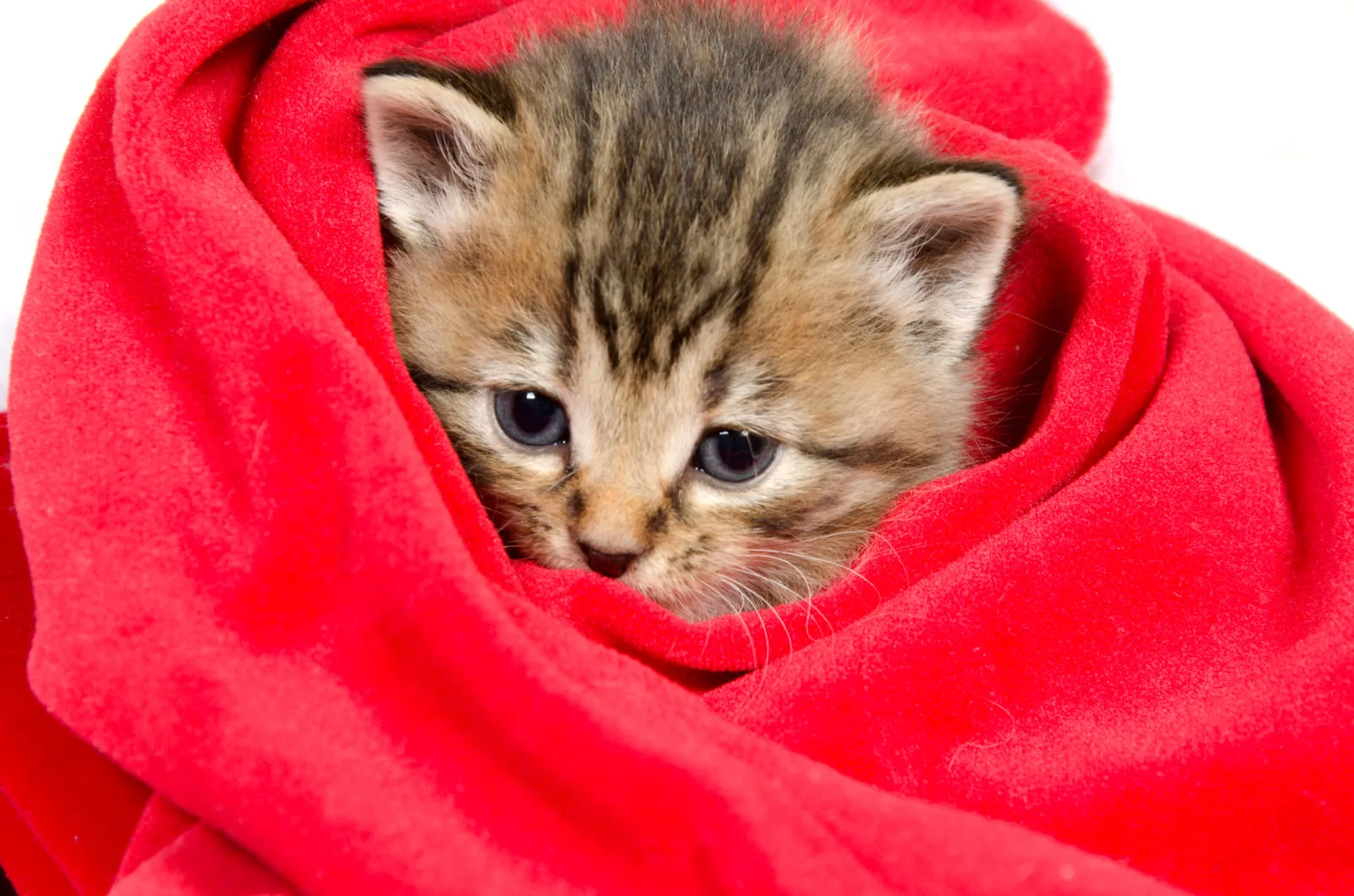
If you give a dose and your cat suddenly starts drooling or producing white, foamy saliva, it is scary, but it is often a normal reaction to bitter-tasting medication.
This is called hypersalivation (also known as ptyalism). It is a protective response to a bad taste, and it is common with many antibiotics and other bitter liquids.
What to do if your cat foams
- Do not give more medicine right away.
- Stay calm and let your cat drool it out.
- If your vet says it is allowed, offer a small sip of water or a tiny lick of something palatable to help clear the taste. Do not try to pour water into the mouth of a stressed cat.
- Wipe the chin with a soft tissue or damp cloth.
Call your veterinarian urgently if you see signs of an allergic reaction such as facial swelling, hives, severe vomiting, collapse, or trouble breathing. Foaming alone, especially right after dosing, is usually taste-driven, not an allergy, but I always want owners to know the difference.
What if my cat spits out the dose?
This happens a lot, even when you do everything right. The key is to respond safely, not automatically.
Step 1: Do not immediately re-dose
Unless your veterinarian has specifically told you to re-dose if spillage occurs, do not give a second full dose. With some medications, doubling can be dangerous.
Step 2: Estimate how much was lost
Ask yourself:
- Did most of it dribble out right away?
- Did your cat swallow several small squirts before the head shake?
- Is the liquid mostly on the lips and chin, or is it truly expelled?
If you are unsure, it is safest to call your vet or pharmacist and explain what happened. They can advise whether to wait until the next scheduled dose, give a partial amount, or adjust timing.
Step 3: Clean up and give your cat a minute
Wipe away medication from the fur so your cat does not ingest an unknown amount later while grooming. Then take a short break. A 5 to 10 minute reset can make the second attempt far more successful.
Step 4: Improve technique for the next try
- Go slower.
- Aim the syringe more into the cheek pocket, not straight across the tongue.
- Give smaller micro-squirts.
- Use the towel wrap if paws are involved.
Can I mix liquid medicine into food?
Sometimes yes, sometimes absolutely not. The biggest issues are:
- Accuracy: If you mix medicine into a full meal and your cat eats only half, you cannot know the dose they actually got.
- Food aversion: Cats can form a strong negative association with a food after a bad taste. One “medicated dinner” can ruin a favorite food for months.
- Absorption: Some medications must be given on an empty stomach, while others should be given with food. This is medication-specific.
Practical rule I use
Do not mix medicine into a full meal unless your veterinarian or pharmacist has told you it is okay. If your vet approves mixing, ask if you should use a small snack portion instead of a whole meal so you can confirm your cat finished it.
Also ask your vet whether the medication can be mixed with a small amount of strong-flavored cat treat, and whether the medicine is safe to combine with that food type. Some drugs interact with certain foods, and some require exact timing with meals.
Tips that make liquid dosing easier
- Ask about flavoring: Many pharmacies can compound certain medications into chicken, tuna, or other cat-friendly flavors.
- Ask about a smaller volume: Some meds can be made more concentrated, meaning less liquid to give. Not always possible, but worth asking.
- Stay consistent with timing: Give doses at the same times each day to maintain steady levels in the body.
- Follow with something pleasant: A tiny treat or favorite attention helps your cat recover emotionally, and it helps you, too.
- Protect the relationship: If your cat starts hiding when you approach, separate “cuddle time” from “medicine time” during the day so every interaction is not stressful.
When to call your veterinarian
Please reach out to your vet promptly if:
- Your cat cannot be safely handled without risk of bites or serious stress.
- Your cat vomits every time you medicate.
- You suspect your cat aspirated liquid, especially with coughing, wheezing, or labored breathing.
- You missed a dose and do not know whether to catch up.
- Your cat seems worse after starting the medication, or you notice facial swelling, hives, severe lethargy, or collapse.
Your clinic can often adjust the plan. In veterinary medicine, the “best” medication is the one your cat can actually take safely and consistently.
Quick checklist
- Confirm the dose in mL and measure carefully at eye level.
- Use the syringe-in-the-cheek method, not straight back.
- Keep the head level and go slow, allowing swallowing.
- Use a towel wrap if paws and twisting are a problem.
- Foaming is often a bitter taste response. Stay calm and do not automatically re-dose.
- If the dose is spit out, do not double dose without veterinary guidance.
- Do not mix meds into a full meal unless your veterinarian or pharmacist confirms it is appropriate.