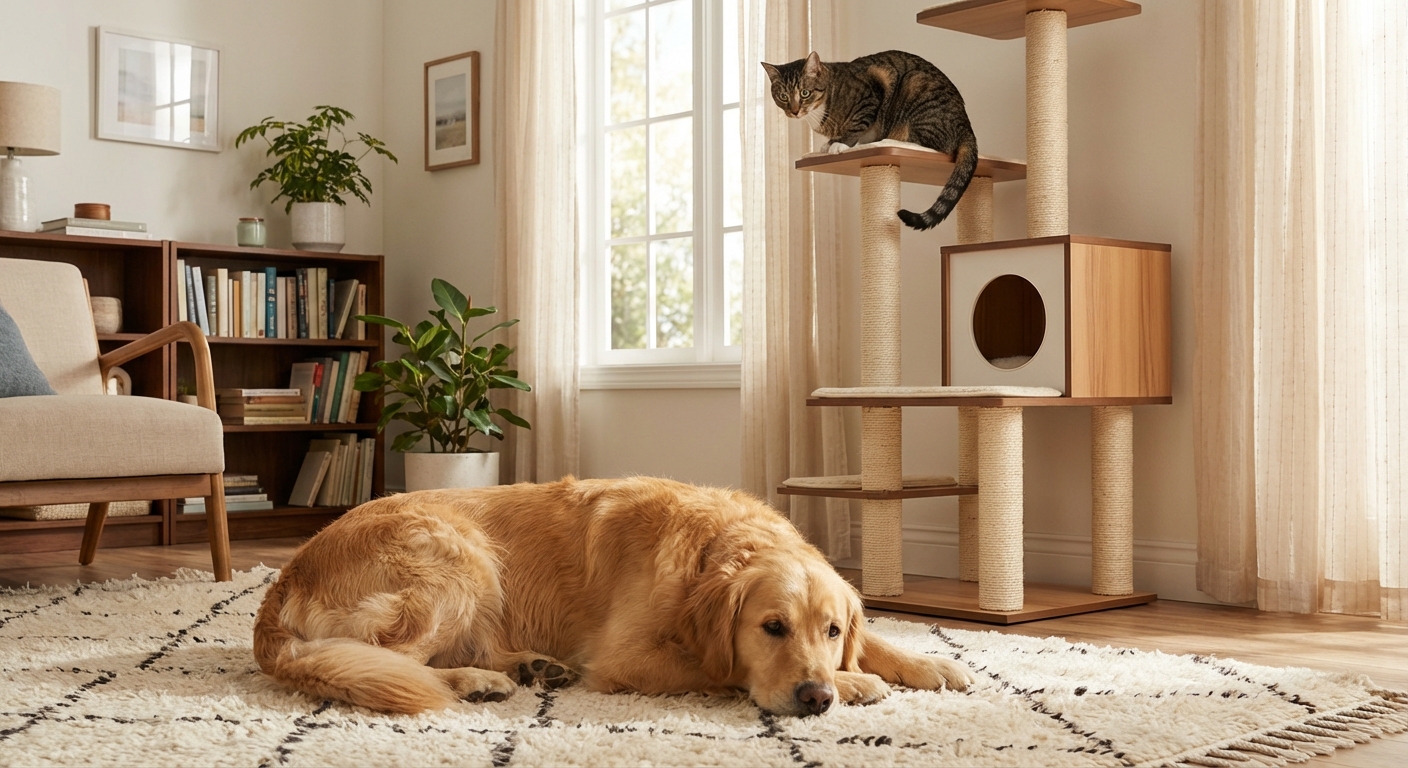
Learn a realistic plan for helping dogs and cats coexist peacefully. Home setup, scent swaps, barrier sessions, controlled contact, and key cues like leave it.
Article
•
Designer Mixes
How to Get a Dog and Cat to Get Along

Shari Shidate
Designer Mixes contributor
Living with both a dog and a cat can be genuinely peaceful, but it rarely happens by luck. The best results come from a thoughtful setup, slow introductions, and reading each pet’s body language before things escalate. As a veterinary assistant, I’ve seen many "they’ll work it out" situations turn into long-term fear, chasing, and stress. The good news is that most dog and cat households can improve a lot with a simple behavior plan you can follow at home.
Scope note: This guide covers typical introductions and common challenges. If you are dealing with serious aggression, repeated attacks, or a dog that cannot disengage from stalking, get professional help right away.
Start with safety and realistic expectations
Some pets become best friends. Many become respectful roommates. Both outcomes are a win if everyone feels safe.
When to slow down or get help
- Your dog has a strong prey drive (stiff body, intense staring, trembling with excitement or arousal, lunging, whining when the cat moves).
- Your cat is highly fearful (hiding constantly, not eating, dilated pupils, growling or swatting whenever the dog appears).
- There has been a bite, a serious scratch, or repeated cornering.
- Either pet has medical issues that make stress risky (urinary issues in cats, senior pets, chronic pain).
If you’re seeing these, you can still make progress, but it’s worth involving your veterinarian and a qualified trainer or veterinary behaviorist early. Safety first is not “overreacting.” It is prevention.
If your dog’s risk level is high, ask a qualified professional about basket muzzle training using positive reinforcement. A properly fitted basket muzzle can add a layer of safety during training, but it is not a substitute for supervision and management.
Set up your home before they meet
Environment is half the battle. A smart setup reduces conflict without you saying a word.
Create a cat-only safe zone
- Use a bedroom, office, or large bathroom with the cat’s food, water, litter box, scratching post, and bed.
- Add vertical space: a cat tree, shelves, or a cleared bookcase section.
- Use a baby gate with a small cat door, a gate the cat can jump over but the dog cannot, or a secured screen plus gate for safe visual access.
Litter box note: During introductions, a protected cat-only litter box is ideal. Long term, many cats prefer litter boxes in socially important, easy-to-reach areas, so aim for locations that feel “normal” to your cat while still being dog-proof.
Manage the dog’s movement
- Have a leash, treat pouch, and crate or exercise pen ready.
- Practice calm skills ahead of time: sit, down, stay, leave it, and go to mat.
- Remove chase triggers at first, like high-energy games in the same hallway where the cat needs to pass.
Protect key resources
Resource stress is common and fixable. Feed pets separately, keep litter boxes inaccessible to dogs, and give the cat escape routes so the dog cannot block doorways.
Understand their body language
You do not need to be an expert to catch early warning signs. Look for patterns, not just single moments.
Green lights
- Dog: soft eyes, loose body, sniffing then looking away, responding to your voice, able to eat treats.
- Cat: normal walking, grooming, sitting with tail relaxed, choosing to observe from a perch, able to eat.
Yellow lights
- Dog: staring, body stiffening, whining, leaning forward, ignoring treats.
- Cat: crouching, tail flicking hard, ears turning sideways, hiding but peeking.
Red lights
- Dog: lunging, barking explosively, snapping, trying to chase, shaking with excitement.
- Cat: hissing, swatting repeatedly, puffed tail, attempting to bolt with no escape route.
Yellow and red lights mean you need more distance, more barriers, and slower steps.
The introduction plan
Think of introductions as a series of short, successful sessions, not one big “meeting.” Your goal is for each pet to learn: When the other animal appears, good things happen, and I stay safe.
Step 1: Scent first
This often starts with a few days, but take longer if either pet is stressed.
- Swap bedding or gently rub each pet with a clean cloth and place it near the other’s space.
- Feed tasty meals or treats on opposite sides of a closed door.
- Do not rush if either pet refuses food. That is a stress signal.
Step 2: Visual with a barrier
This can take days to weeks or longer, depending on the pets.
- Use a baby gate, a secured screen door, or a double-barrier setup if needed.
- Keep the dog on leash at a distance where the dog can stay loose and take treats.
- Reward calm behavior: looking at the cat, then looking back at you.
Step 3: Controlled room sessions
- Cat should have a clear escape route and a vertical option.
- Dog stays on leash, ideally practicing “go to mat.”
- Keep sessions short and successful. Start with 1 to 5 minutes for very reactive pets, then build toward 5 to 10 minutes as both relax.
Step 4: Supervised free time
Only move to this step when calm is consistent.
- If you need a line attached, use a lightweight drag line (not a looped leash that can snag on furniture).
- Continue rewarding calm behavior and redirect the dog early.
- Do not allow the dog to chase, even “playfully.” Chasing teaches chasing.
Step 5: Gradual normal life
As trust builds, you can increase time together in shared spaces. Many families still choose to separate pets when no one is home, and that is a responsible choice, not a failure.
Stop chasing safely
If your dog starts to fixate or chase, you want to interrupt the behavior safely and then teach an alternative.
Do
- Create distance immediately: calmly guide the dog away with the leash.
- Reward the moment your dog disengages from the cat (even a quick glance away).
- Use management: baby gates, pens, leash, and structured routines.
- Increase exercise and enrichment for the dog so the cat is not the most exciting thing in the house.
Do not
- Yell or punish. It often increases arousal and can make the cat more scary or more “interesting.”
- Hold the cat in your arms to “show the dog.” This can make the cat feel trapped and can lead to scratches or a lunge.
- Assume a wagging tail means friendly. Many dogs wag when excited, overstimulated, or on the verge of chasing.
A helpful cue to teach is leave it (disengage from the cat) followed by go to mat (settle on a bed). These give your dog a job that is incompatible with stalking.
Support your cat’s confidence
Cats cope best when they have control over their space. Confidence reduces defensive behavior like hissing and swatting.
- Vertical territory: cat tree, shelves, window perch.
- Dog-proof litter boxes: dogs commonly raid litter, which stresses cats and can contribute to house-soiling.
- Predictable routines: feeding times, play sessions, quiet rest.
- Interactive play once or twice daily: wand toy sessions help reduce anxiety and redirect energy.
If your cat stops eating, starts hiding constantly, or develops litter box issues, talk with your veterinarian promptly. Stress is associated with problems like feline idiopathic cystitis (FLUTD signs), overgrooming, and GI upset in some cats, so it is worth addressing early.
Common mistakes
- Moving too fast: one scary chase can set you back weeks.
- Unsupervised time too early: many incidents happen when owners assume it is “fine now.”
- No safe cat zone: cats need an area where the dog simply cannot follow.
- Expecting the cat to “correct” the dog: some cats will swat, but this can escalate conflict and increase prey behavior in the dog.
- Forgetting pain and health: a dog with joint pain may be grumpy; a cat with arthritis may feel threatened and lash out. Behavior changes deserve a veterinary check.
FAQs
How long does it take?
It varies widely. Some pets settle in within a couple of weeks. Others need a few months (or longer) of gradual work. Focus on progress: less staring, more calm, and the ability to share space safely.
Does age matter?
Yes. Puppies often need extra impulse-control practice because they are bouncy and invasive. Kittens can be fearless in ways that trigger chasing. Adult cats and senior pets may need slower pacing and more protected rest areas.
Do breed and history matter?
They can. Many terriers, sighthounds, and dogs with a strong chase history may need more management and a longer training plan. That said, individual personality matters more than labels, so watch the dog in front of you.
Can I make them friends?
You can create the conditions for friendship: safety, calm routines, and positive associations. But your main goal should be respectful coexistence. Friendship is a bonus.
Should I use treats?
Yes, when used correctly. Treats help change emotional responses. Reward calm behavior, not chasing or barking. If your dog will not take treats, you are too close or the dog is too overstimulated.
Do pheromone products help?
Some households find them helpful as part of a bigger plan, especially for anxious cats. They are not magic, but they can support relaxation when paired with management and training.
A simple daily routine
If you want a straightforward plan, try this for 10 to 14 days and adjust based on stress signals.
- Morning: dog walk or play, then calm time on a mat while the cat has free access to the home (or a safe zone if needed).
- Midday: short barrier session with treats on both sides if both pets are relaxed.
- Evening: interactive cat play session, then a controlled room session with the dog on leash practicing “leave it” and “go to mat.”
- Night: separate sleeping areas until you have weeks of calm, chase-free behavior.
Slow is fast here. A calm month beats a chaotic weekend every time.