
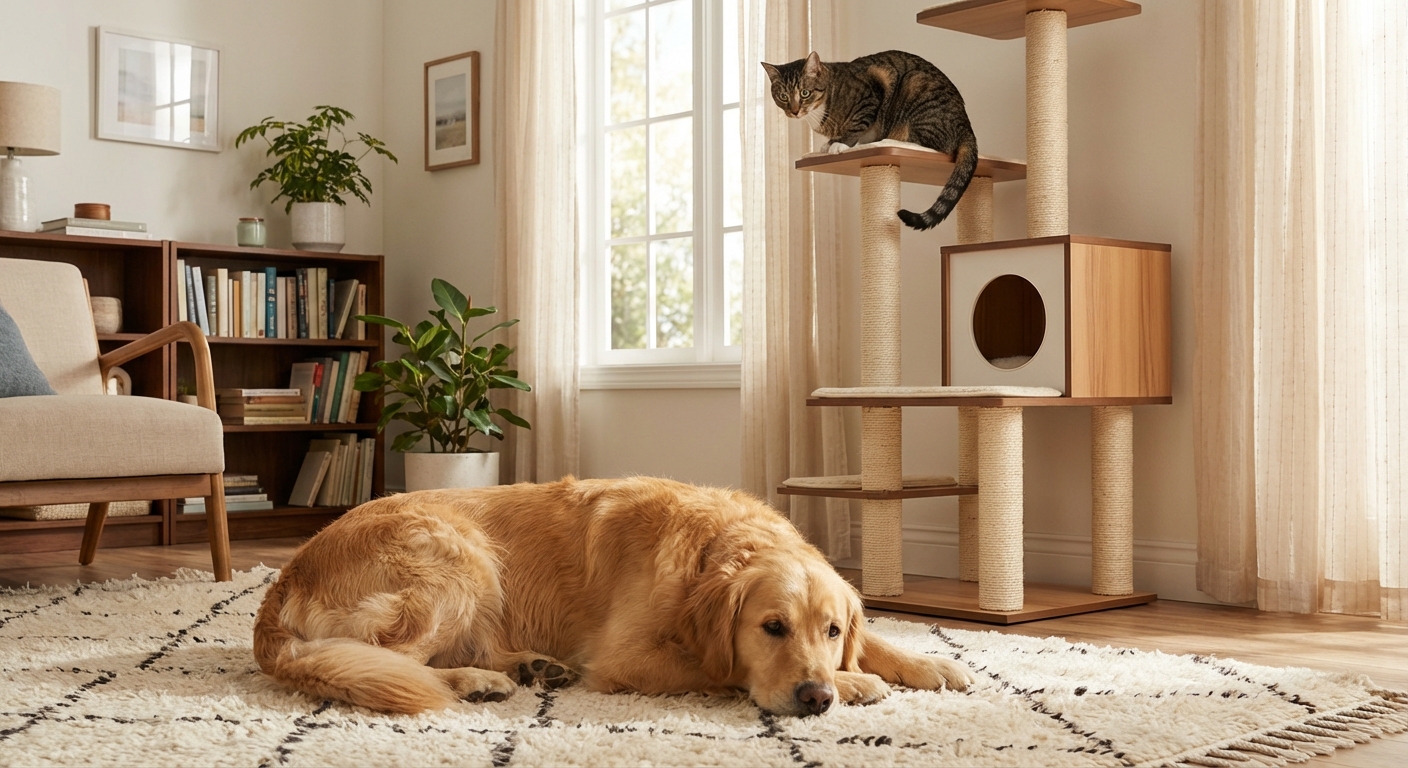
A vet-assistant guide to introducing cats and dogs using slow decompression, scent swapping, barrier sessions, and reward-based training. Includes safety che...
Article
•
Designer Mixes
How to Get a Cat and Dog to Get Along

Shari Shidate
Designer Mixes contributor
As a veterinary assistant here in Frisco, Texas, I have seen this go two ways. Sometimes the cat and dog become best buddies. Other times, they learn to peacefully ignore each other, which is also a huge win. The key is not forcing friendship. It is building safety, predictable routines, and positive associations so both pets can relax.
Below is a step-by-step plan you can follow, plus the most common roadblocks and what to do about them.
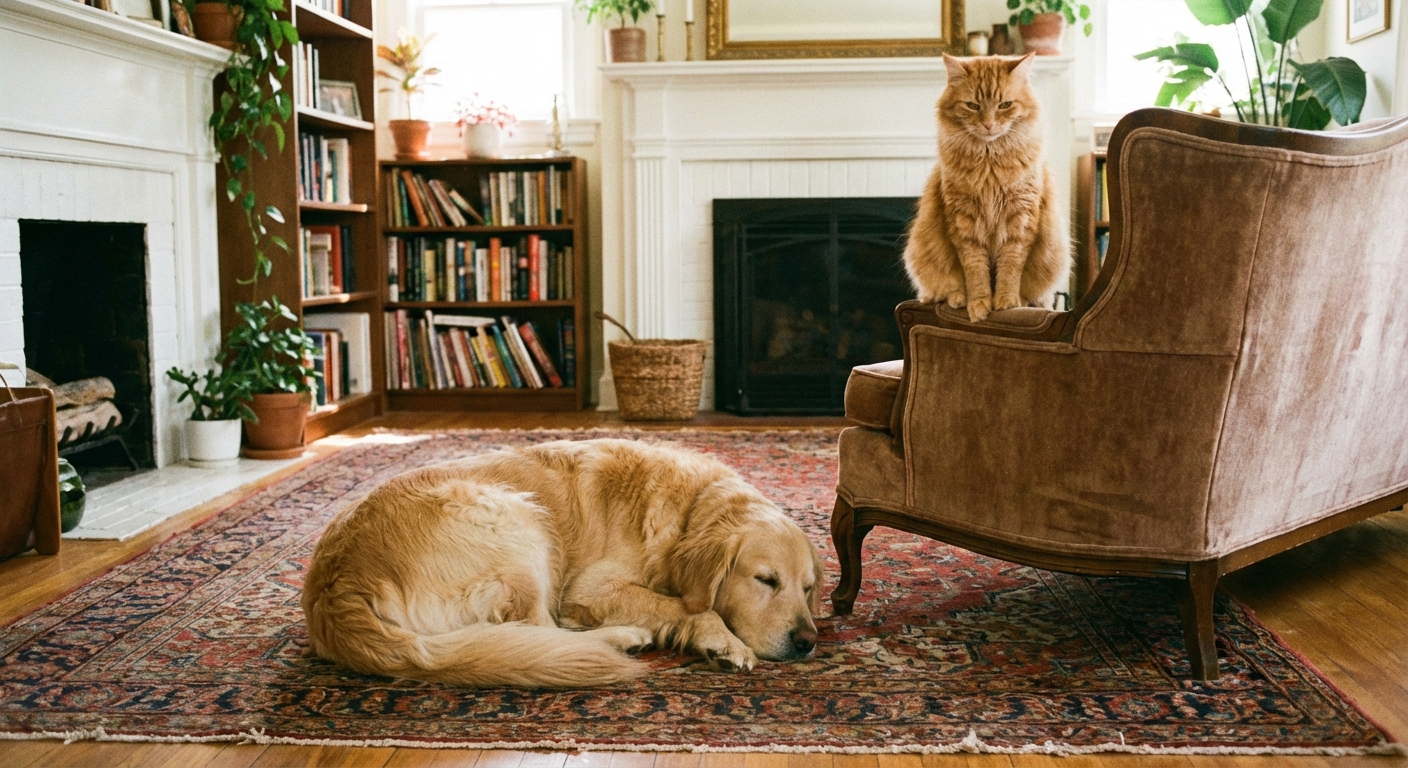
At a glance
- Do: Use barriers, leashes, and rewards. Give the cat vertical escapes and dog-free essentials. Move forward only when both pets are consistently relaxed.
- Do not: Force face-to-face contact, punish growling or hissing, or allow chasing to happen “just once.”
- When in doubt: Separate and reset. Safety comes first.
What is really happening
Dogs and cats speak different body languages. Dogs often want to investigate with their nose and eyes, sometimes with bouncy movement. Many cats read that as threatening. Meanwhile, cats may freeze, stare, or swat, which can trigger a dog to chase. That chase is not always aggression, but regardless of the motivation (play, prey drive, or overexcitement), it is a serious safety risk and it can escalate. It also tends to get reinforced because chasing is naturally rewarding for many dogs.
Green flags
- Loose, relaxed body language from both pets
- The dog can look away from the cat when asked
- The cat is eating, grooming, or exploring normally
- Both can share space with a barrier without intense staring
Red flags
- Dog: stiff posture, stalking, fixed stare, whining, lunging, snapping
- Cat: puffed fur, flattened ears, growling, repeated hissing, swatting, hiding all day
- Either pet cannot eat or settle because the other is nearby
Set up your home
Management is not failure. It is what keeps everyone safe while you teach new habits.
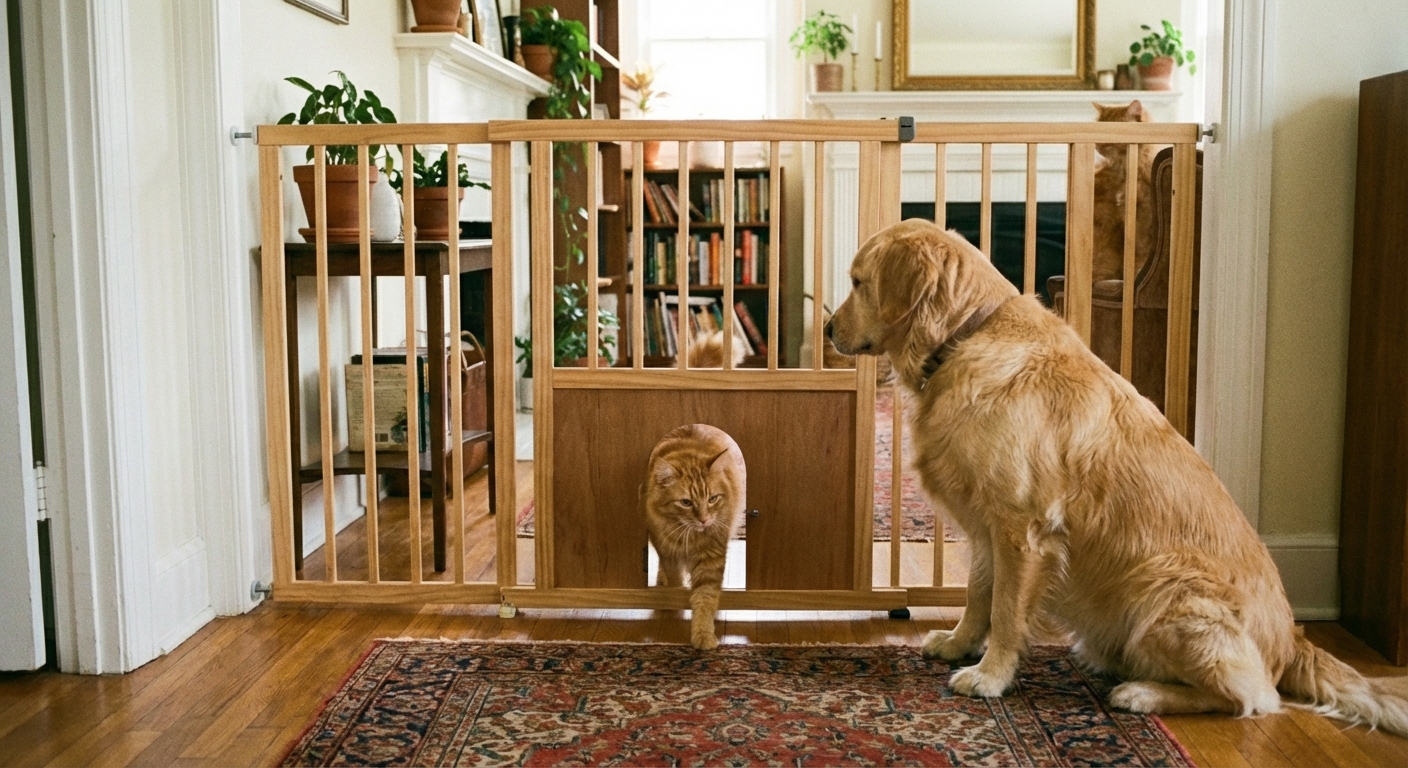
- Create cat-only zones: Use a purpose-built pet gate with a cat pass-through, a tall gate the cat can jump, or a closed room the dog cannot access. If you DIY anything, make sure there are no sharp edges, snag points, or gaps a paw can get stuck in, and mount it securely so a dog cannot push it over.
- Add vertical escapes: Cat trees, shelves, or a cleared bookcase level give the cat control and confidence.
- Protect the litter box: Place it in a dog-free area. Many cats stop using the box if they feel watched or ambushed. As a general rule, aim for one box per cat plus one extra.
- Feed separately: Separate spaces reduce resource guarding and prevent the dog from stealing cat food.
- Use the right gear: A leash and harness for the dog indoors during training sessions, plus gates or an exercise pen for separation.
- Optional supports: A feline pheromone diffuser (like Feliway) can help some cats feel more settled during the transition.
Step-by-step plan
Timelines vary a lot. Some pairs progress in days, many take weeks, and some need long-term management. Only move to the next step when both pets are consistently relaxed at the current step.
Step 1: Scent first (a few days to a week, or longer)
Start with smell, not face-to-face. Swap bedding, rub each pet with a soft towel and place it near the other, and allow them to sniff under the door. Pair these scent moments with something good like treats, play, or meals.
- Feed each pet on their side of a closed door, starting far away and gradually moving closer over sessions.
- If either pet stops eating, backs away, growls, or fixates, increase distance.
Step 2: See each other safely (several sessions)
Use a securely latched baby gate, a screen door, or an exercise pen so they can see each other without contact. Keep sessions short and calm.
- Dog on leash. Reward for looking at the cat and then looking back at you.
- Cat gets high-value treats or a favorite wand toy on their side of the barrier.
- End the session while things are going well, not after a blow-up.
Step 3: Share a room (start small)
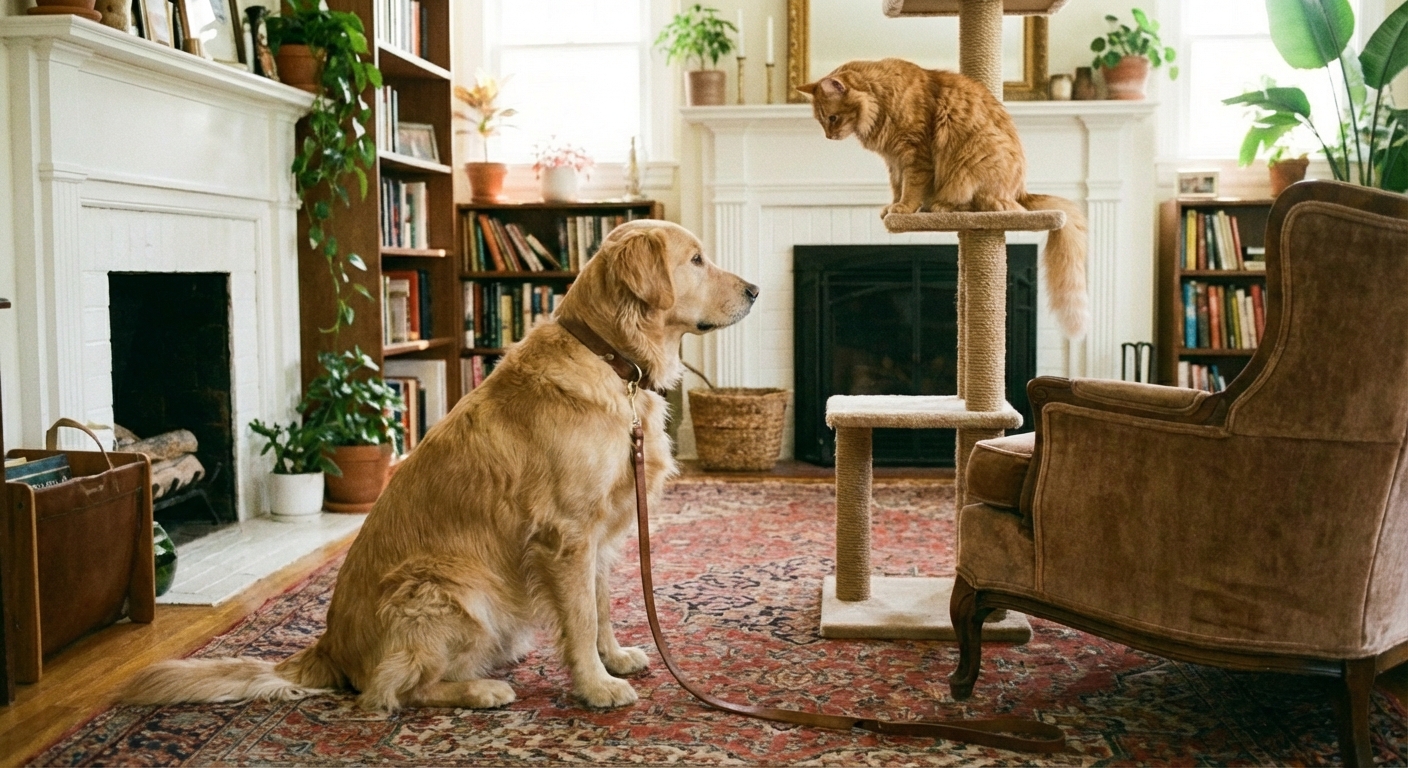
Move into the same room with the dog on leash. Start with very short sessions, even 1 to 2 minutes if that is where your pets can succeed, and build up gradually. Let the cat choose distance. Do not allow the dog to rush the cat.
- Practice simple cues: sit, down, touch, leave it.
- Reward calm behavior generously. Calm should pay well.
- If the cat approaches, keep the dog still and relaxed. If the dog gets overly excited, calmly increase distance and reset.
Step 4: Supervised freedom (only after consistent calm)
When the dog can reliably disengage from the cat and respond to cues, you can start short off-leash sessions in a controlled space. Keep your management tools available.
- Do not leave them alone together yet.
- Keep high-value chews, toys, and food picked up at first to reduce tension.
- If there is any chasing, pinning, cornering, or intense staring, go back to Step 2 or Step 3 right away.
Step 5: Normal life (weeks, not days)
Many households need a few weeks to a few months for true comfort, especially with a young dog or a shy cat. Keep routines predictable and keep giving the cat safe escapes. In North Texas summers, indoor enrichment matters even more, because everyone is stuck inside together. Plan on extra sniff games, puzzle feeders, and play sessions.
Training that helps most
Teach the dog to disengage
Every time your dog notices the cat, mark and reward when they look away or look at you. You are teaching, “Seeing the cat means good things happen, and I stay settled.”
- Look at that: reward the dog for calmly noticing the cat from a safe distance.
- Leave it: start with treats in your hand, then apply around the cat only when the cue is solid.
- Place: train a mat or bed as a relaxing station when the cat is present.
Build the cat’s confidence
Confidence reduces running, and less running reduces chasing. Give your cat predictable hiding spots, vertical space, and daily interactive play.
- Use wand toys to let the cat “hunt” safely away from the dog.
- Offer treats when the dog is calm in the same area, at a distance the cat chooses.
Common problems
The dog keeps chasing
Chasing is self-reinforcing. Each chase makes the next one more likely.
- Go back to leashed sessions and barriers so the dog cannot practice chasing.
- Increase exercise and enrichment for the dog: sniff walks, food puzzles, training games.
- Work on impulse control daily. Short sessions are better than one long session.
The cat keeps swatting or hissing
Hissing is communication, not “bad attitude.” Your cat is saying, “I need space.” Do not punish it. Punishment tends to increase fear.
- Increase distance and give the cat higher escape routes.
- Stop all dog approach behavior. Reward the dog for staying still and settled.
- Make sure the cat is not being blocked from food, water, and the litter box.
The dog is obsessed, even when separated
Constant staring at the gate, whining, or pacing can mean the dog is over threshold.
- Cover part of the gate for visual breaks.
- Use shorter sessions, greater distance, and better rewards.
- Ask your veterinarian about support if anxiety is a factor.
Things are fine, then tension spikes at night
High-energy moments are when things can go wrong.
- Separate during dog zoomies or wild play.
- Leash the dog in the evening if that is a common trigger time.
- Schedule calmer enrichment: licking mats, chew time, quiet training.
Extra notes
High prey drive dogs
Some dogs have a strong prey drive and may never be safe with cats, even with training. In those cases, management may need to be lifelong, and safety tools like secure barriers and strict separation become the plan, not a temporary step.
Kitten vs. adult cat
Kittens can be more flexible, but they also dart and sprint, which can trigger chasing. Older cats may be less tolerant and need more time and more escape routes. Size and age mismatches matter, so go slower than you think you need to.
When to get help
Some situations need professional guidance, and that is completely normal.
- The dog has a history of high prey drive, has injured small animals, or cannot disengage from the cat.
- The cat is not eating, is hiding constantly, or stops using the litter box.
- There is any bite, claw injury, or repeated near-misses.
Look for a qualified force-free trainer or a board-certified veterinary behaviorist. Avoid punishment-based methods. They often increase fear and can make aggression more likely.
Quick medical note: If behavior changes suddenly, or if you see litter box issues, appetite changes, or new aggression, check in with your veterinarian. Pain and illness can look like “bad behavior,” and it is important to rule that out.
A realistic goal
The goal is not instant cuddling. The goal is safety and calm coexistence. Many cat and dog pairs eventually choose to hang out together once they have had enough neutral, predictable interactions.
Go slow, manage the environment, and reward the behaviors you want. Calm is a skill you can teach.
If you ever feel unsure, separate and reset. If you stick with the steps above and keep sessions positive, you are giving both pets the best possible chance to feel secure and at home with each other.