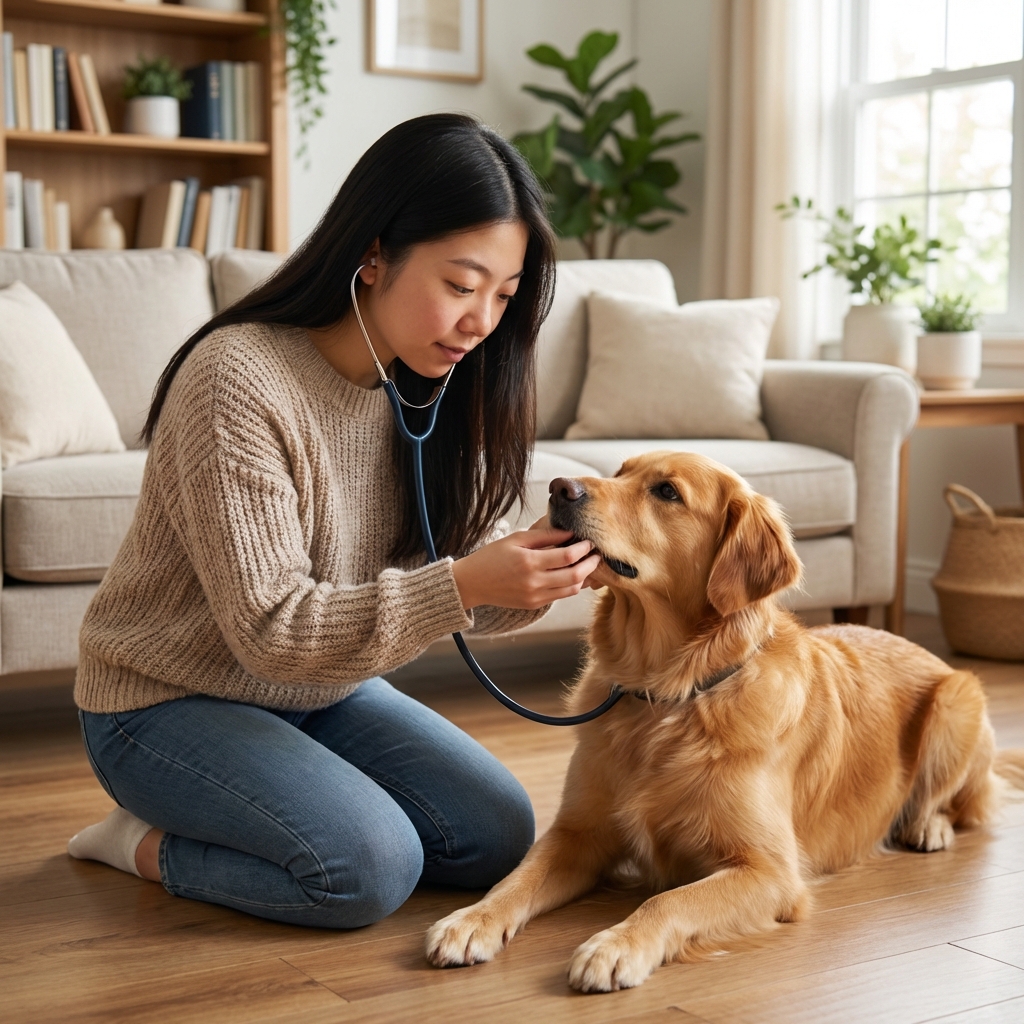
Recognize true choking vs. reverse sneeze, safely check the mouth, and use back blows or Heimlich by dog size. Includes what not to do and when to go to the ER.
Article
•
Designer Mixes
How to Do the Heimlich on a Dog

Shari Shidate
Designer Mixes contributor
Choking is one of those emergencies that feels like it happens in slow motion. One second your dog is chewing a treat, the next they are panicking, silent, and struggling to breathe. As a veterinary assistant, I can tell you this with confidence: knowing what to do in the first minute can make a life-saving difference.
This guide walks you through how to recognize choking, what to do first, when to try thrusts, and how to do them as safely as possible for different sizes of dogs. If you are ever unsure, it is always safest to treat it as an emergency and get veterinary help right away.
Note: This is general first aid information and is not a substitute for veterinary care or hands-on training. If your dog is in distress, contact a veterinarian or emergency hospital immediately.
First: Is it really choking?
Not every coughing or gagging episode is true choking. Dogs can cough from kennel cough, reverse sneezing, collapsing trachea, heart disease, or irritation from pulling on a collar.
Choking means something is blocking the airway. It can be partial (some air still moves) or complete (little to no air moves). Partial obstructions can worsen quickly, so take any sudden breathing crisis seriously.
Signs your dog may be choking
- Silent distress: panicked, open-mouth effort, but unable to bark or cough effectively
- Pawing at the mouth or frantic rubbing of the face on the ground
- Gagging, retching, or repeated attempts to swallow
- Difficulty breathing, including harsh, high-pitched breathing, wheezing, or raspy noises
- Blue or gray gums (a late, very serious sign)
- Sudden collapse
If your dog is coughing forcefully
If your dog can still cough hard and pull in air, let them keep coughing if possible. Coughing is the body’s best tool to expel an object. Do not do thrusts if your dog is breathing and coughing effectively, because it may worsen the situation or cause injury.
If your dog cannot breathe, cannot cough effectively, is turning blue, or collapses, treat it as a life-threatening emergency and act immediately.
Call for help while you act
If another person is present, have them call your veterinarian or the nearest emergency animal hospital while you start first aid. If you are alone, do a quick mouth check and a few attempts to clear the airway, then go immediately to the ER.
Do not delay transport if you cannot clear the airway quickly. A good rule is to try a couple of short cycles (about 30 to 60 seconds total), then leave for the ER while continuing to monitor your dog.
Even if you successfully dislodge the object, your dog should still be examined. Choking can cause throat trauma, aspiration pneumonia, or hidden injury.
Quick mouth check: only if it is safe
Before you do any thrusts, do a fast, safe check of the mouth.
How to check
- Keep your dog as calm as possible. A choking dog may bite out of panic.
- Open the mouth and look. If you can see an object clearly and it is easy to grasp, remove it carefully.
- Only sweep with a finger if you can see the item and you are sure you can hook it out.
Important safety note
Do not blindly sweep the mouth. You can push the obstruction deeper and make the blockage worse.
What not to do
- Do not give food or water to “wash it down.”
- Do not put tools in the mouth (tweezers, chopsticks) unless you can clearly see and securely grab the object.
- Do not waste time on home remedies. If breathing is compromised, treat it like the emergency it is.
- Do not keep repeating attempts for many minutes at home. If you are not getting results quickly, go to the ER.
How to do thrusts (by size)
The goal is to create a quick burst of pressure to force air up and out, hopefully pushing the object out with it. Techniques vary slightly between training organizations, so if you take a certified pet first aid course, follow the method you were taught.
For small dogs: back blows + chest thrusts
For small dogs, chest thrusts are often safer than abdominal thrusts.
- Position your dog with the head slightly lowered if you can do so safely. Gravity can help. You can hold them against your chest with their head angled down, or place them on their side with the head a bit lower than the body.
- Give 5 firm back blows between the shoulder blades with the heel of your hand.
- Then do 5 chest thrusts: place two fingers or the heel of your hand on the front of the chest over the breastbone (sternum) and push in quick, firm compressions.
- Open the mouth and look between cycles. Remove the item only if you can see and grasp it easily.
For medium and large dogs: abdominal thrusts (standing)
- Stand behind your dog (or kneel behind them if needed).
- Wrap your arms around their belly.
- Make a fist and place it just behind the ribcage in the soft part of the abdomen.
- Grasp your fist with your other hand.
- Thrust inward and upward in a quick motion, like a “J” shape. Do 3 to 5 thrusts.
- Stop to check breathing and do a quick mouth look. Repeat if needed, but do not delay getting to the ER if it is not working quickly.
For large dogs that are down (lying on their side)
If your dog collapses or cannot stand:
- Lay your dog on their side.
- Place one hand on top of the other on the abdomen just behind the ribcage.
- Push firmly inward and slightly upward in quick thrusts.
- Check breathing and do a quick mouth look between attempts.
If your dog becomes unconscious
If your dog is not responsive, treat this as a CPR-level emergency and get to an emergency veterinary hospital immediately.
What to do
- Call an ER (or have someone call) and prepare to leave.
- Open the mouth and look. Remove a visible object only if you can clearly see it and grasp it.
- Start chest compressions if your dog is not breathing normally. Compressions can help move air and sometimes help dislodge an obstruction.
- After a short set of compressions, recheck the mouth for an object you can remove.
- Only attempt rescue breaths if the airway is open and air goes in. If you meet resistance and the chest does not rise, focus on compressions and rapid transport.
If you have never been trained in pet CPR, I strongly recommend taking a certified pet first aid class. Practice and confidence matter when seconds count.
After the object comes out
It is common for dogs to seem “fine” right after, but problems can show up later.
Go to the vet urgently if you notice:
- Coughing that continues or worsens
- Labored breathing
- Drooling, repeated swallowing, or gagging
- Blood-tinged saliva
- Low energy, fever, or poor appetite over the next several days
Your vet may recommend an exam of the throat, chest x-rays, or monitoring for aspiration pneumonia depending on what happened and what was stuck.
Helpful transport tips
- Keep your dog as calm and still as possible.
- Do not offer food, treats, or water on the way.
- If you know what they choked on, bring the packaging or a matching item (for example, the same chew) so the vet can better assess risks.
Common choking hazards
Prevention is truly the easiest “first aid.” Many choking emergencies involve everyday items.
Frequent hazards
- Large chunks of treats or meat
- Chews that get soft and slippery (rawhides, some dental chews)
- Bones that splinter
- Small balls or toys that can fit fully in the mouth
- Corncobs, sticks, socks, and kids’ toys
Simple prevention tips
- Choose chews that are appropriate for your dog’s size and chewing style.
- Supervise high-value chews and remove small end pieces.
- Use puzzle feeders or slow feeders for dogs that inhale food.
- Keep laundry, trash, and small toys secured.
- If your dog is a known “gulp-er,” ask your vet which chew types are safest.
When in doubt, go now
If your dog cannot breathe normally, has blue gums, collapses, or you cannot dislodge the object quickly, get to an emergency veterinary clinic immediately. Call on the way so the team can be ready at the door.
And please do not feel guilty if this ever happens. Dogs are curious, enthusiastic eaters, and choking can happen even to the most careful families. The best thing you can do is learn the steps now, keep calm, and act quickly.
Quick checklist
- Is your dog truly choking (cannot breathe, cannot cough effectively, or worsening distress)?
- Call a vet or ER if someone can, or call as you head out if you are alone.
- Quick mouth look: remove only if you can see and grasp it.
- Small dog: head slightly lowered if possible, then 5 back blows + 5 chest thrusts over the sternum.
- Medium or large dog: 3 to 5 abdominal thrusts just behind the ribs.
- Recheck breathing and do a quick mouth look between cycles.
- If not improving within about 30 to 60 seconds, go to the ER immediately.
- Even if successful, see a vet as soon as possible.