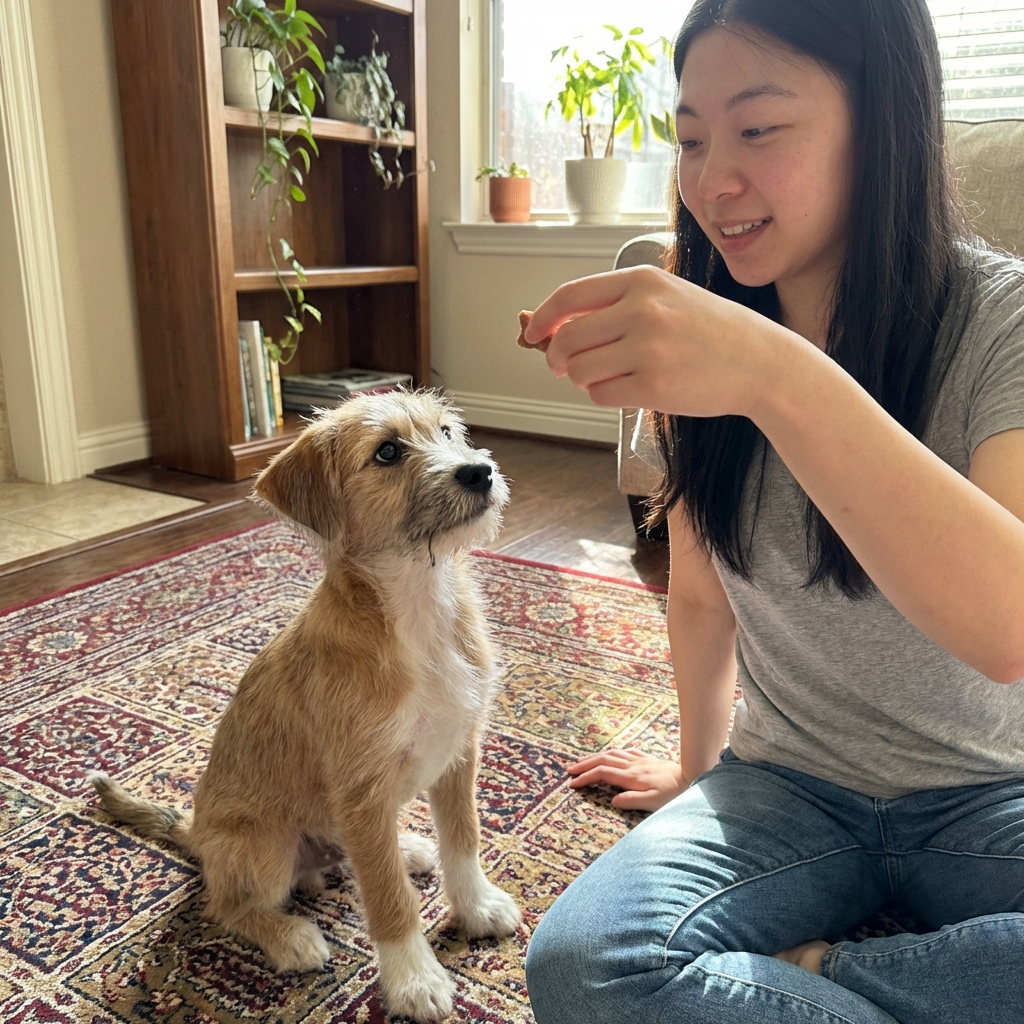
A kind, step-by-step clicker training guide for dogs. Learn how to charge the clicker, nail timing, teach sit, touch and mat settle, and tackle jumping, pull...
Article
•
Designer Mixes
How to Clicker Train a Puppy

Shari Shidate
Designer Mixes contributor
Why clicker training works
Clicker training is a simple, practical way to teach puppies using positive reinforcement (a basic part of operant conditioning). The click is a consistent sound that tells your puppy, “Yes, that exact behavior earns a reward.” Because the click is fast and precise, it can help puppies learn more quickly than relying on praise alone, which often comes a second too late.
As a veterinary assistant, I love clicker training because it is gentle, clear, and it builds trust. It can also support calmer vet visits over time when you pair it with gradual handling practice and cooperative care (think: rewarding tiny steps toward nail trims, exams, and gentle restraint).
Quick note: This is general training guidance. If you are dealing with fear, guarding, or aggression, loop in your veterinarian and a qualified force-free trainer so you can get a plan that fits your puppy.
Clicker basics
The click is a promise
Think of the click as a “marker.” The moment you click, you are promising a reward is coming. That promise is what makes the click powerful, so try not to click unless you can deliver a treat right after.
Timing matters most
You do not need perfect technique. You do need good timing. Click the instant your puppy does the behavior you want, then give the treat.
Short sessions win
Puppies learn best in tiny bursts. Aim for 1 to 3 minutes at a time, a few times a day. End on a success before your puppy gets wiggly or distracted.
What you need
- A clicker (any simple button clicker works)
- Soft, pea-sized treats your puppy can chew quickly
- A treat pouch (optional, but it helps your timing)
- A quiet space with minimal distractions
- A leash for safety if your puppy tends to wander
If your puppy is not treat-motivated yet, try higher-value options like tiny bits of cooked chicken, turkey, or freeze-dried single-ingredient treats. Some puppies also work for toys, but food is usually easiest for beginners.
If your puppy is noise-sensitive: muffle the clicker by clicking it in your pocket or behind your back, or switch to a verbal marker like “yes.” The goal is clarity, not volume.
Treats and calories: keep treats tiny (pea-sized or smaller) and adjust meals if training treats add up. Many puppies can use part of their daily kibble as training rewards.
Step 1: Charge the clicker
This is the foundation. You are teaching your puppy that click equals reward.
- Click once.
- Immediately give a treat.
- Repeat 10 to 20 times.
Keep reps moving with a short pause (about 1 to 2 seconds) between them. Stop if your puppy wanders off, seems stressed, or loses interest. You can always do another mini session later.
Do not ask for any behavior yet. You are simply building the association. When your puppy hears the click and quickly looks for the treat, you are ready to train.
Step 2: Teach 5 skills
These are practical life skills that set your puppy up for success at home and in public.
1) Name game
Say your puppy’s name once. When they look at you, click and treat. This becomes your most useful tool for focus.
2) Sit
Hold a treat to your puppy’s nose and slowly lift it back over their head. As the bottom hits the floor, click and treat. After a few reps, add the cue “sit” right before you lure.
Tip: deliver the treat where you want your puppy’s head to be next. For sit, that often means right in front of them, not way up in the air, so they stay balanced and calm.
3) Touch
Hold out your open palm near your puppy’s nose. When they investigate and boop it, click and treat. “Touch” helps with recalls, leash walking, and redirecting excitement.
4) Come
Start indoors. Crouch down, say “come,” and encourage your puppy in a happy voice. Click when your puppy gets to you (or is very close), then treat. Make “come” feel like a party, not the end of fun.
Tip: when your puppy arrives, feed a few tiny treats in a row and gently hold their collar for one second while you treat. This helps teach that being caught is still a good deal.
5) Settle on a mat
Toss a treat on a bed or mat. When your puppy steps onto it, click and treat. Over time, reward for sitting, then lying down, then relaxing. This skill is gold for busy households.
Make skills real: once your puppy can do a skill in the living room, practice in a new room, then the hallway, then the yard. Keep it easy at first and lower your expectations when you change locations. That is how dogs learn to generalize skills.
Fade treats and the clicker
Clicker training does not mean you will treat forever for every single cue. The goal is to build the behavior, then maintain it with smarter reinforcement.
Do not rush the marker
Many people keep the click (or a “yes” marker) longer than they keep constant treats. The marker stays useful for precision, even when food becomes less frequent.
Use a variable schedule
Once your puppy understands a cue, begin rewarding unpredictably. For example, treat after the first sit, then after the third, then after the second. Variable reinforcement can help maintain behavior strength over time.
Use real-life rewards
Many puppies love rewards like going outside, greeting a friend, sniffing a bush, or chasing a toy. You can mark the behavior and then reward with one of those sometimes, especially for leash skills.
What trainers agree on
- Positive reinforcement builds behavior by increasing the chance your puppy will repeat what worked.
- Markers improve clarity because they pinpoint the exact moment your puppy got it right.
- Punishment can create fallout like fear, avoidance, or defensive behavior, especially in sensitive puppies.
- Early training supports socialization because your puppy learns coping skills and focus in new environments.
If you are ever unsure, a force-free trainer can help you tailor techniques to your puppy’s age, breed mix, and personality.
Common mistakes
Clicking too late
Fix: Practice without the puppy. Watch your puppy do something simple like looking at you, then click instantly. Your timing will improve fast.
Clicking to get attention
Fix: The click is not a “come here” button. Use your puppy’s name or a kissy noise to get attention, then click the behavior you want.
Repeating cues
Fix: Say a cue once. If your puppy does not respond, reset and make it easier. Repeating teaches puppies they can ignore you the first few times.
Training when overtired
Fix: If your puppy gets nippy or zoomy, it is often nap time, not training time. Keep sessions short and pair training with rest.
Real life problems
Mouthing and biting
Reward calm choices. Click when your puppy chooses a toy, or when their mouth is off your skin during play. If teeth touch skin, calmly pause play for a moment, then redirect to a chew or toy. Click and reward the chew behavior.
Tip: Many puppies need more appropriate outlets than we think. Add extra chew time, food puzzles, and short tug sessions (with rules) so their mouth has a job.
Jumping on people
Click and treat for four paws on the floor. If your puppy jumps, remove attention briefly, then reward the moment they are grounded again.
Leash pulling
Click for walking near you, even for one step at first. You can also click for checking in with eye contact. Start in low-distraction areas so your puppy can succeed.
Tip: deliver the treat right by your leg (where you want your puppy to be). Placement is a quiet way to teach position.
7-day starter plan
- Day 1: Charge the clicker, 2 to 3 mini sessions
- Day 2: Name game and sit
- Day 3: Touch and sit in a new room
- Day 4: Come indoors, short distances
- Day 5: Mat training, reward stepping on and sitting
- Day 6: Combine skills: name, touch, sit, come
- Day 7: Light distractions: backyard or porch, keep it easy
Consistency beats intensity. A few minutes daily is plenty to see progress.
Safety and support
If your puppy shows growling, snapping, stiff body posture, or fear around handling, food, or people, please reach out to your veterinarian and a qualified positive-reinforcement trainer. Early support can make a lifelong difference.
Also talk with your vet about training-friendly treats if your puppy has a sensitive stomach, is on a prescription diet, or is gaining weight too quickly. You can often use part of their daily kibble allowance as training rewards.
The goal is not a “perfect” puppy. The goal is a confident, safe puppy who understands how to succeed in your home.