A practical, reward-based guide to reduce barking by identifying the cause, managing triggers, teaching “quiet,” fixing door and demand barking, and usin...
Article
•
Designer Mixes
How to Break a Dog From Barking

Shari Shidate
Designer Mixes contributor
Barking is normal dog communication. It can also become a habit that wears everyone out, especially in close neighborhoods or apartments. The good news is that many barking problems improve with the same three ingredients: meeting your dog’s needs, identifying the trigger, and teaching a clear alternative behavior that pays better than barking. Some cases (like separation anxiety, compulsive behaviors, or advanced senior cognitive changes) may need a more specialized plan and sometimes medication support through your veterinarian.
As a veterinary assistant in Frisco, Texas, I always like to start with a simple reminder: if barking is new, suddenly worse, or paired with other changes (sleep, appetite, mobility, potty habits), it is worth checking in with your veterinarian first. Pain, anxiety, cognitive changes in seniors, and even hearing or vision loss can all change how and when a dog vocalizes.
Why dogs bark
Barking is not one behavior. It is several behaviors that sound similar. The reason behind the bark determines the best training plan.
- Alert barking: “Something is out there!” Common with doorbells, delivery trucks, and people outside the window.
- Demand barking: “Do this for me.” Often aimed at food, play, attention, or going outside.
- Fear or anxiety barking: “I’m not okay.” Often paired with tucked tail, pacing, hiding, or trembling.
- Frustration barking: “I want that and I can’t get it.” Common on leash or behind fences.
- Boredom barking: “I need something to do.” Often happens at predictable times, like when the household is busy.
One quick clue: if your dog stops barking the moment they get what they want (treat, toy, attention), demand barking is likely in the mix.
Safety note: If barking escalates with distance closing, stiffness, hard staring, growling, lunging, snapping, or you feel unsafe, avoid close interactions and prioritize management and professional support sooner rather than later.
Health and lifestyle
Training works best when your dog’s body and brain are set up to succeed. Before you focus on cues, take an honest look at the basics.
Rule out medical causes
- Sudden barking at night or “nothing” can sometimes be linked to pain, itchiness, hearing changes, or senior cognitive changes.
- Increased reactivity can show up when a dog is uncomfortable (ear infections, dental pain, arthritis).
If you notice limping, head shaking, new sensitivity to touch, or sudden clinginess, schedule a vet visit.
Meet daily needs
- Exercise: Most dogs need both physical movement and sniffing time. A “sniff walk” often helps many dogs settle more than a quick potty break.
- Mental enrichment: Food puzzles, scatter feeding, training games, and lick mats help drain stress.
- Sleep: Overtired dogs can be surprisingly noisy. Many adult dogs often sleep around 12 to 14 hours per day (including naps), but it varies by age, breed, and health. Puppies and seniors usually need more.
Management first
Each rehearsal strengthens the habit. Management is not “giving up.” It is the fastest way to create breathing room while training takes hold.
Quick management wins
- Block the view: Use window film, curtains, or baby gates to prevent fence and window barking.
- White noise: A fan or sound machine can reduce hallway and neighborhood triggers.
- Leash and distance: If your dog barks at dogs or people on walks, increase distance immediately. Distance is powerful.
- Predictable routine: Many dogs bark less when they can anticipate meals, walks, and rest.
If your dog charges the front door when the bell rings, consider a temporary plan: keep a leash near the door, use a gate, and deliver treats away from the entry while you work on training.
Two key skills
You do not need a complicated program to see progress. These two skills are grounded in reward-based training principles like differential reinforcement, stationing, and calm pattern-building.
Skill 1: Quiet
Many people try to teach “Quiet” by waiting for barking, then scolding. That usually adds stress and can make barking worse. Instead, we teach that silence makes good things happen.
- Wait for a moment of silence (even one second).
- Say “Quiet” in a calm voice.
- Immediately mark it (a cheerful “Yes” works) and give a small treat.
- Gradually build from 1 second of silence to 2, then 3, and so on.
Tip: keep treats in a jar near the main barking zone (front window, back door). Timing matters. Also, avoid repeating “Quiet, quiet, quiet” while your dog is actively barking. You do not want the cue to turn into background noise or accidentally become part of the barking routine.
Skill 2: Go to mat
A mat behavior is one of my favorite “barking breakers” because it replaces chaos with a predictable routine.
- Place a bed or bathmat a few feet from the trigger (not right at the door or window).
- When your dog steps on it, mark and reward.
- Add the cue “Mat” or “Place” once they are moving to it reliably.
- Reward for staying on the mat calmly.
Fix the trigger
Doorbell and visitors
Door barking is usually alert plus excitement. Your goal is not a silent dog forever. Your goal is a quick alert, then a trained routine.
- Practice without visitors: Play a doorbell sound at a very low volume, treat for calm, then gradually increase volume over days.
- Run a routine: bell rings → dog goes to mat → a rapid stream of small treats on the mat.
- Use a barrier: A baby gate keeps everyone safe and prevents jumping rehearsals.
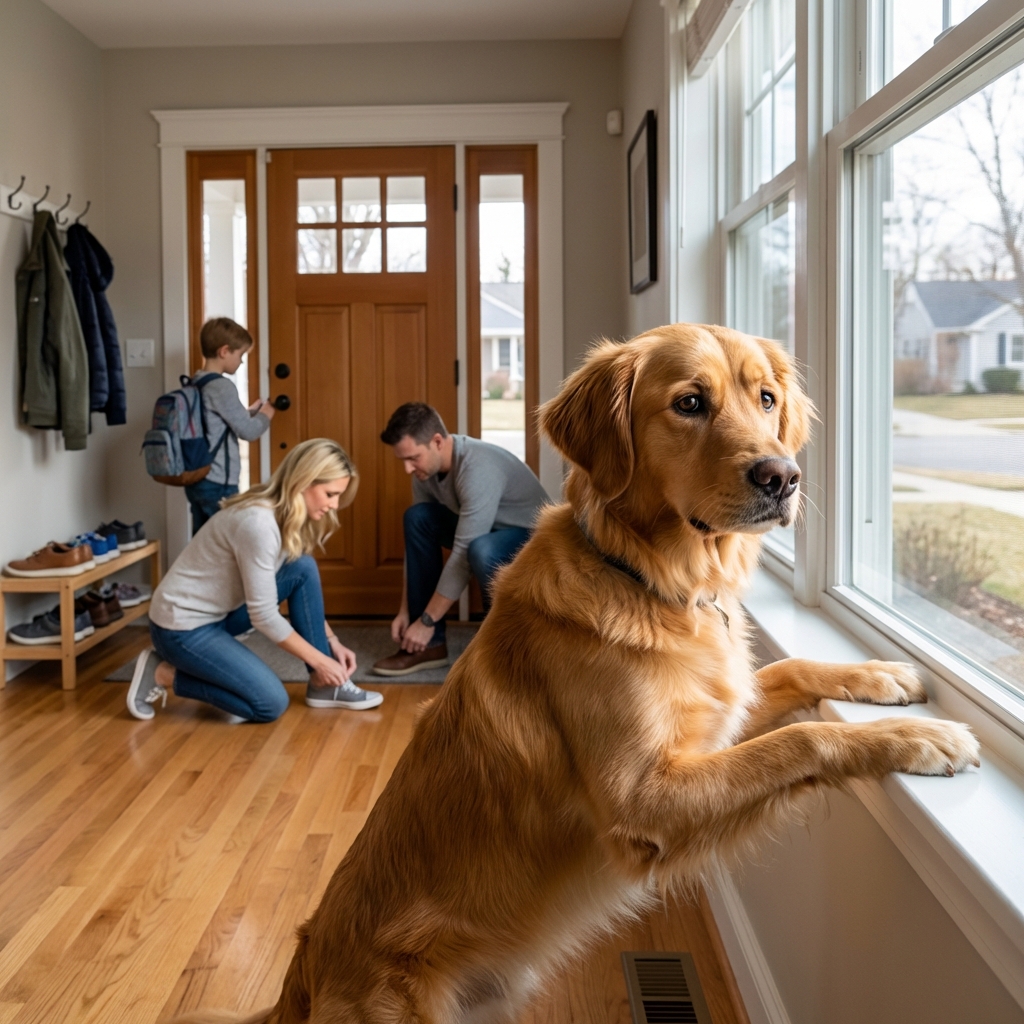
Window barking
Window barking is often self-rewarding because the person or dog outside eventually leaves. Your dog thinks the barking worked.
- Block visual access for a couple of weeks while you build new habits.
- Teach “Look at that”: when your dog notices the trigger, say “Yes” and treat before barking starts. Then guide them to a calmer spot.
- Reward checking in with you, not pressing the glass.
Leash barking
Many dogs bark on leash from fear or frustration. Punishment can intensify it. Instead, increase distance and change the emotional response.
- At the moment your dog notices the trigger, feed a high-value treat (chicken, cheese, freeze-dried liver).
- Keep moving in an arc, not straight toward the trigger.
- Stop sessions before your dog is overwhelmed. Several short, successful walks beat one long meltdown walk.
Demand barking
This is the most common accidental training mistake: barking works, so barking grows.
- Do not reward the bark: no eye contact, no talking, no touching.
- Reward the alternative: the instant your dog is quiet, sitting, or on their mat, pay them with attention or the toy.
- Teach a polite ask: “Sit” or “touch” becomes the request instead of barking.
Barking when alone
If the barking or howling happens only when your dog is alone (or as you are leaving), separation anxiety could be part of the picture. This is not stubbornness, and “cry it out” can make it worse.
- Common signs: pacing, drooling, panting, attempts to escape, destruction around doors or windows, accidents despite being house-trained.
- First steps: record a short video to confirm the pattern, avoid long alone stretches when possible, and start gradual alone-time training below your dog’s panic point.
- Get help early: a trainer experienced in separation anxiety and your veterinarian can make a huge difference.
Multi-dog barking
In multi-dog homes, barking can be contagious. If one dog starts, the others pile on.
- Use gates or separate spaces during peak trigger times to prevent group rehearsals.
- Reinforce the first dog who stays quiet (or goes to their mat) before the “group bark” starts.
- Consider staggered routines, like separate enrichment activities, so everyone is not escalating at once.
What not to do
When you are tired and the barking is constant, it is tempting to grab a quick fix. Many “quick” methods create more fear, more arousal, and more barking over time.
- Avoid yelling: many dogs interpret it as joining the noise.
- Avoid punishment collars: they can increase anxiety and can suppress warning signals without changing the underlying emotion.
- Avoid chasing your dog away from the window: it can become a fun game or increase arousal.
Instead, focus on distance, calm routines, and rewarding the behavior you want repeated. Quiet behavior is a skill, and skills improve with practice.
7-day reset
If you are feeling overwhelmed, start here. Keep it small and doable.
- Day 1: Identify the top 2 barking triggers and block at least one (curtains, gate, white noise).
- Day 2: Add two enrichment activities (sniff walk, food puzzle, scatter feed).
- Day 3: Begin capturing quiet for 1 to 2 seconds, 10 reps total.
- Day 4: Introduce “Go to Mat” for 2 minutes total practice.
- Day 5: Pair one trigger at low intensity with treats (door sound, window trigger at distance).
- Day 6: Practice the mat routine with the trigger slightly stronger.
- Day 7: Review progress and adjust. If your dog is going over threshold (too stressed to eat treats, unable to respond, barking is nonstop or escalating), reduce difficulty and increase distance.
Progress often looks like shorter barking bouts, faster recovery, and more moments where your dog can notice a trigger and then choose you.
How long does it take? Many families see small improvements in days and more reliable change in a few weeks. More complex cases can take longer, and that is normal.
When to get help
If your dog’s barking is paired with growling, snapping, lunging, panic, destruction when alone, or you feel unsafe managing the situation, get expert help.
- Look for a credentialed, rewards-based trainer or a veterinary behaviorist.
- Credentials to look for can include CPDT-KA, CPDT-KSA, KPA, IAABC, or DACVB.
- Ask what methods they use. Choose professionals who focus on behavior change, not intimidation.
If separation anxiety is a possibility, early intervention matters a lot. It is a treatable condition, and you do not have to white-knuckle it alone.