Hands-off slow cooker dog food for busy owners: 3 easy recipes (chicken/rice, turkey/sweet potato, beef/pumpkin) plus calcium guidance, safe ingredients, por...
Article
•
Designer Mixes
How to Add Calcium to Homemade Dog Food

Shari Shidate
Designer Mixes contributor
When you start making homemade dog food, one nutrient deserves extra attention right away: calcium. I see well-meaning pet parents do everything right with protein and veggies, then accidentally miss calcium and throw off the calcium to phosphorus balance. Over time, that imbalance can stress bones, teeth, muscles, and even the nervous system.
The good news is that adding calcium is usually simple once you know which sources are safe, how to use them, and when you should ask your veterinarian for help.

Why calcium matters so much
Calcium is not just a “bone mineral.” Dogs use calcium every day for:
- Bone and tooth strength, especially for puppies and seniors
- Muscle contraction, including the heart
- Nerve signaling
- Blood clotting
In homemade diets, the most common issue is not “too little protein” or “not enough vegetables.” It is too little calcium compared to phosphorus.
Why? Most meats are high in phosphorus and relatively low in calcium. In nature, wild canines consuming whole prey may also consume calcium-rich bone. In a kitchen bowl, we have to recreate that balance safely, ideally with a formulated recipe.
Calcium to phosphorus in plain English
Dogs need both calcium and phosphorus, but they need them in the right relationship. Targets vary by life stage and the guideline you are using (for example, AAFCO or NRC). A commonly cited adult dog target falls in the neighborhood of about 1:1 to 2:1, and many formulators aim roughly 1.2:1 to 1.4:1 for adult maintenance.
If you are feeding a homemade diet that is mostly meat and rice with a few veggies, the ratio often skews too high in phosphorus. That can be risky over time, especially for:
- Puppies (rapid growth)
- Pregnant or nursing dogs
- Senior dogs with bone or mobility concerns
- Dogs on long-term homemade diets without a formulated recipe
If you only remember one thing, make it this: meat-heavy homemade diets usually need a consistent calcium source.
Best calcium sources
Below are the most common evidence-based options used in balanced homemade feeding. The “best” choice depends on what you already feed, your dog’s size, and whether your dog has any medical conditions.
1) Ground eggshell powder
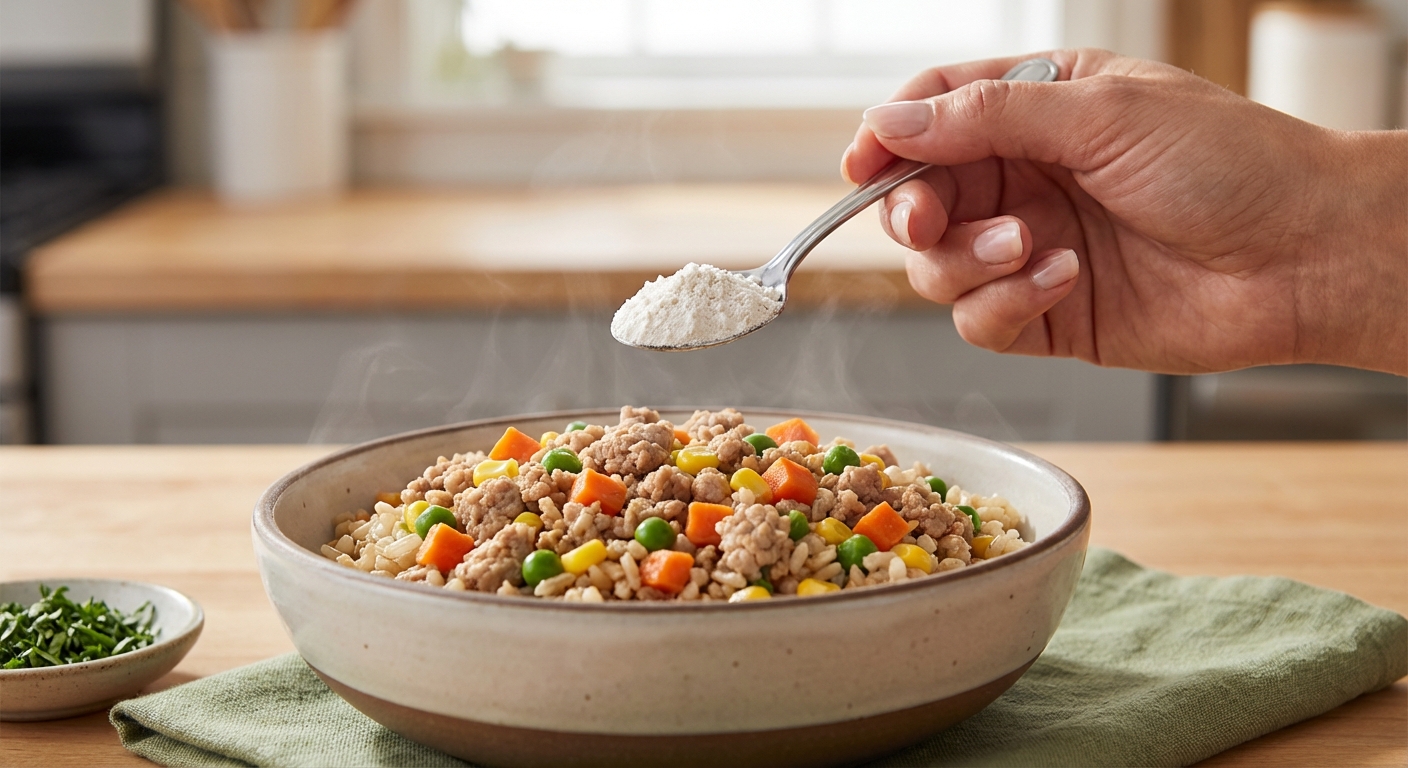
Eggshell is one of the most practical calcium options for many families. It is inexpensive, easy to store, and provides calcium with very little phosphorus.
- How to use: Use plain shells only (no seasoning, coatings, or membrane treatments). Rinse well, then dry completely. Many people bake the shells briefly at low heat to dry them and reduce surface bacteria. Once fully dry, grind into a very fine powder (a coffee grinder works well). Store dry in a sealed container.
- Tip: Finer powder mixes better and is less likely to be left at the bottom of the bowl.
General dosing guideline: Volume measures are not perfectly precise because grind and packing density vary. As a rough reference, 1/2 teaspoon of finely ground eggshell powder often lands around 900 to 1,000 mg of calcium, and 1 teaspoon is often around 1,800 to 2,000 mg. Consider weighing your powder for more consistent dosing if you use it daily.
2) Calcium carbonate (pet supplement or plain powder)
Calcium carbonate is a common calcium supplement used in balanced recipes. If you choose this route, pick a reputable brand with clear labeling and ideally third-party testing.
- Pros: Consistent calcium content, easy dosing
- Watch-outs: Do not use products that combine calcium with extra ingredients your dog may not need, unless your veterinarian recommends it. Also note that calcium carbonate can interfere with the absorption of certain medications and minerals. If your dog takes thyroid medication, some antibiotics, iron, or other long-term meds, ask your veterinarian about spacing doses.
3) Bone meal (use carefully)
Bone meal can work for homemade feeding, but it is not always my first choice because quality control matters. Bone meal contains both calcium and phosphorus, and some products can vary widely.
- Pros: Mimics “bone” nutrients more closely than eggshell alone
- Watch-outs: Choose a pet-specific product that addresses sourcing and testing for contaminants.
4) Raw meaty bones (only with professional guidance)
This is a hot topic, and I want to be careful and respectful of different viewpoints. Bones can provide natural calcium, but they also carry real risks including tooth fractures, gastrointestinal obstruction, and perforation. Because of those risks, many veterinarians recommend avoiding feeding bones, especially cooked bones which can splinter.
If you are committed to a raw diet approach, the safest plan is to work with a veterinary nutrition professional who can help you balance the diet and reduce risk based on your dog’s chewing style and health history.
5) Dairy and fish options (helpful, but rarely enough on their own)
Some foods contain calcium and can support a balanced diet, but they often do not provide enough calcium by themselves to fix a meat-heavy recipe.
- Plain yogurt or kefir: Can add calcium and probiotics, but may not be tolerated by dogs sensitive to dairy.
- Goat milk: Some dogs tolerate it better than cow’s milk, but it can still trigger loose stool in lactose-sensitive dogs. It is not a primary calcium tool for balancing a full diet.
- Canned salmon or sardines with bones: Calcium-rich and nutrient-dense, but you still need to account for calories, sodium, and overall balance.

How much calcium to add
This is the part where I like to slow everyone down and get practical.
The most accurate answer comes from a complete recipe formulated to meet AAFCO or NRC nutrient guidelines for your dog’s life stage, using the exact ingredients and amounts you feed.
A helpful general approach if you are doing “homemade plus” and rotating ingredients is to:
- Use a consistent calcium source (like eggshell powder or calcium carbonate)
- Follow a veterinary-formulated recipe when possible
- Re-check calcium if you change proteins, add organ meats, or increase fish
A rough starting point
Some home-feeding frameworks use a rough interim ballpark of about 800 to 1,000 mg of calcium per pound of finished food for adult maintenance. This can shift quite a bit depending on fat content, water content, and overall caloric density, since calcium needs track more reliably with calories (mg per 1,000 kcal) than with food weight. Use this only as a temporary training-wheel estimate, not a long-term formulation method.
Mini example
Let’s say you make a one-pound batch of cooked, meat-forward food (for example: ground turkey plus rice and vegetables) and you are using finely ground eggshell as your calcium source. If your eggshell powder is roughly 1,800 to 2,000 mg calcium per teaspoon, you might start in the neighborhood of about 1/2 teaspoon per pound of food to land near that 900 to 1,000 mg range. Then you adjust based on the actual recipe, your dog’s life stage, and (ideally) a formulated nutrient analysis.
If you want, you can ask your veterinarian for a referral to a board-certified veterinary nutritionist (DACVN in the U.S.) who can create a recipe tailored to your dog.
One more important note: Calcium is a big piece of the homemade puzzle, but it is not the only one. Many homemade diets also fall short on vitamin D, iodine, zinc, copper, and essential fatty acids unless the recipe is intentionally complete.
Common mistakes to avoid
Relying on meat alone
Chicken, turkey, beef, and organ meats are not meaningful calcium sources for balancing a homemade diet. They are valuable, but they tend to drive phosphorus up. Add calcium on purpose.
Using cooked bones
Cooked bones can splinter and are a major choking and perforation hazard. If you are using bones at all, discuss it with your veterinarian first.
Assuming “a little dairy” balances the bowl
Yogurt is wonderful for some dogs, but it is usually not enough to correct the calcium to phosphorus ratio in a meat-forward meal.
Over-supplementing
Too much calcium can be harmful, especially for growing puppies. More is not better here. Aim for balanced.
Not adjusting for life stage and health
Puppies, pregnant dogs, and dogs with kidney disease, bladder stone history, hypercalcemia, or certain endocrine conditions need extra care with minerals. Homemade is absolutely possible, but it should be guided.
Quick checklist
- Is this a complete recipe? If not, keep homemade as a portion of the diet until you have a balanced plan.
- Where is the calcium coming from today? Eggshell powder, calcium carbonate, fish with bones, or a formulated supplement.
- Did I change the protein or add organ meat? If yes, re-check the calcium plan.
- Is my dog a puppy, senior, or medically complex? If yes, talk to your veterinarian before making major shifts.
If you are transitioning from kibble, go slowly and watch stool quality, energy, and weight. Small improvements, done consistently, really do add up.
When to talk to your vet
Please reach out to your veterinarian or a veterinary nutritionist if your dog:
- Is a puppy or a large-breed puppy
- Is pregnant or nursing
- Has kidney disease, pancreatitis, a history of urinary stones, or known mineral abnormalities
- Has ongoing diarrhea, constipation, or unexplained weight loss
- Is on long-term medications where minerals may affect absorption
- Is on a long-term homemade diet and has never had the recipe evaluated
Homemade feeding can be incredibly nourishing, but mineral balance is not the place to guess.