
A vet assistant’s age-by-age guide to kitten feeding frequency: newborn to 12 months. Includes sample schedules, wet vs. dry tips, portion guidance, and re...
Article
•
Designer Mixes
How Old Is My Kitten?

Shari Shidate
Designer Mixes contributor
As a veterinary assistant here in Frisco, Texas, one of the most common questions I hear from new kitten parents is, “How old do you think my kitten is?” It matters more than people realize. Age helps you choose the right food, plan vaccines and deworming, schedule spay or neuter, and understand what behaviors are normal.
The good news is that you can get a surprisingly accurate estimate at home using a few practical clues: teeth, eyes, ears, weight, mobility, and behavior. If your kitten is a rescue or found outdoors, think of this as your best starting estimate until your veterinarian confirms it.
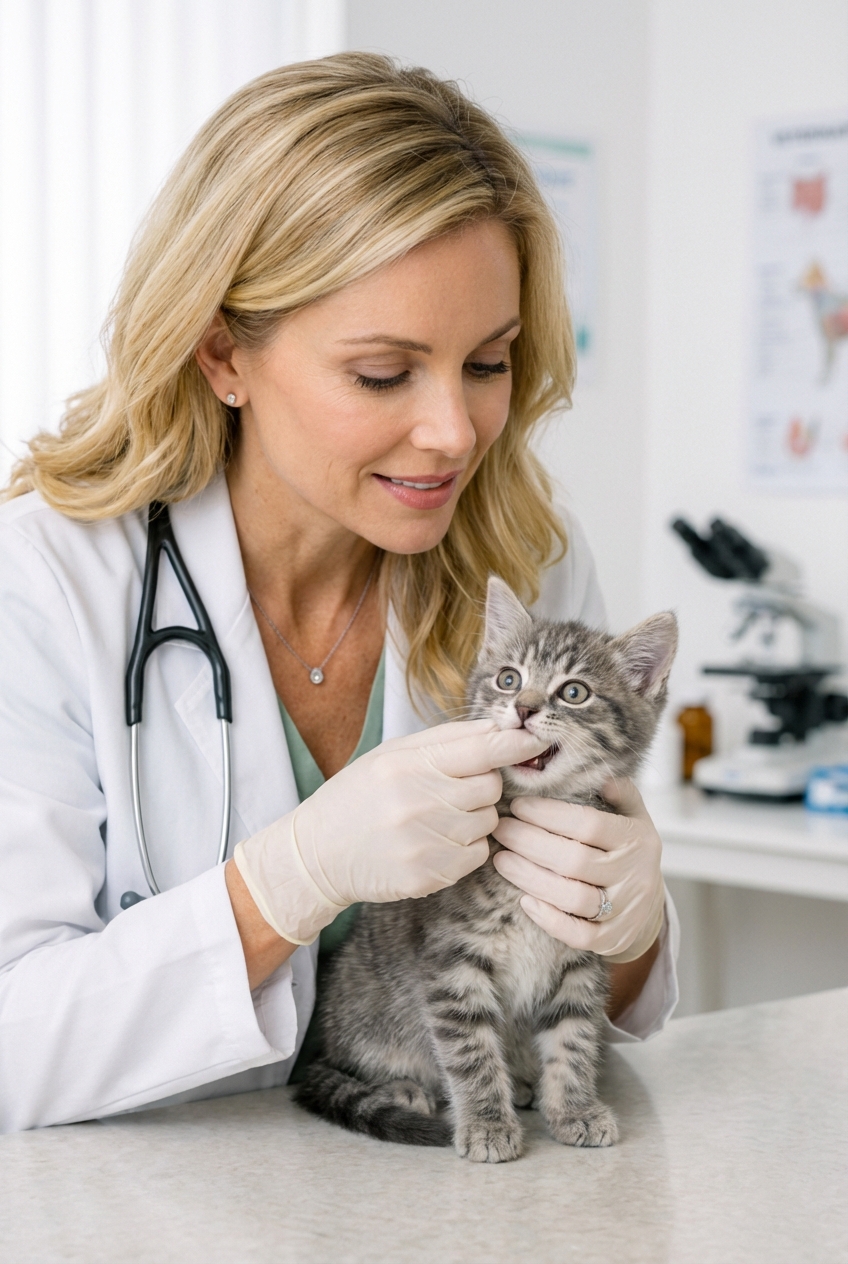
Fast age estimate
If you want the fastest answer, start here. Look at teeth first, then use weight and behavior to confirm.
- 0 to 1 week: Eyes closed, ears folded, wobbly, relies fully on warmth and milk. Umbilical stump may still be attached.
- 1 to 2 weeks: Eyes starting to open, ears still low, crawling more than walking.
- 2 to 3 weeks: Eyes open, ears lifting, first baby teeth may start to erupt, beginning to toddle.
- 3 to 4 weeks: More stable walking, playing begins, baby teeth coming in, may start lapping.
- 4 to 6 weeks: Many baby teeth present, active play, learning litter box habits, weaning begins but is often not complete yet.
- 6 to 8 weeks: Full set of baby teeth, running and pouncing, typically ready for first vaccines. Many kittens are fully weaned by the end of this window.
- 8 to 12 weeks: Very playful, coordinated, baby teeth intact, appetite strong and consistent.
- 3 to 6 months: Adult teeth begin replacing baby teeth (often incisors first), growth is rapid.
- 6 to 8 months: Most adult teeth in, approaching the “teen cat” phase.
Teeth
Teeth are usually the best way to estimate age, especially under 6 months. If your kitten allows it, gently lift the lip and look at the front teeth and the longer canine teeth. Do not force the mouth open if your kitten is struggling.
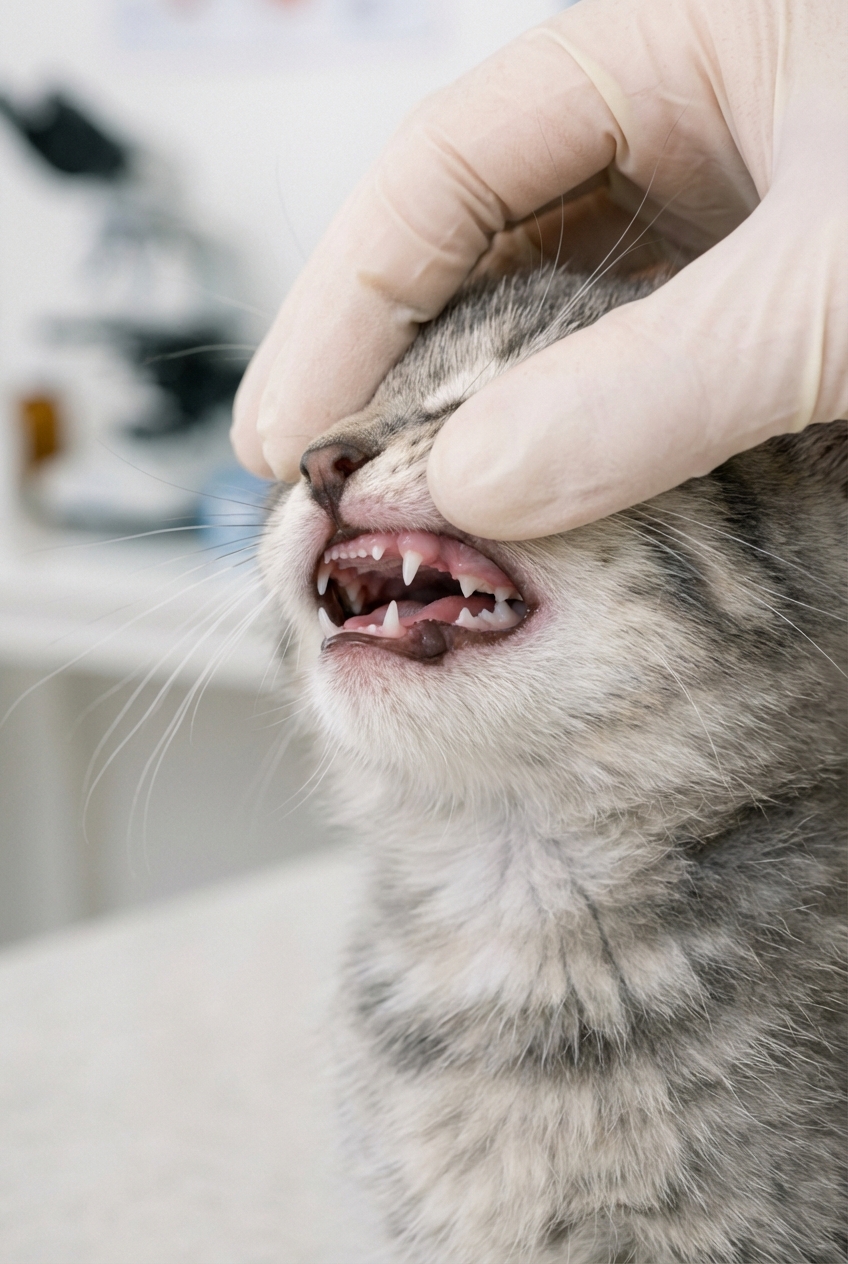
Teeth timeline
- No teeth: typically before about 2 to 3 weeks
- Baby incisors (tiny front teeth) erupt: around 2 to 3 weeks
- Baby canines (fangs) erupt: around 3 to 4 weeks
- Baby premolars erupt: around 4 to 6 weeks
- Full set of baby teeth (26 teeth): around 6 to 8 weeks
- Adult incisors start replacing baby teeth: around 3 to 4 months
- Adult canines appear: around 4 to 5 months
- Adult premolars come in: around 4 to 6 months
- Adult molars come in: often closer to 5 to 7 months
- Full set of adult teeth (30 teeth): around 6 to 8 months
Baby vs adult teeth
Baby teeth are very small, thin, and needle-sharp. Adult teeth look larger and thicker. During the teething months (around 3 to 6 months), you may see doubled teeth, a baby tooth still present while the adult tooth is erupting nearby. This is fairly common, but if a baby canine does not fall out, your veterinarian may recommend removal to prevent crowding.
Eyes and ears
Eyes and ears change quickly in the first month, so they can be a strong clue when you are dealing with a very young kitten.
Eyes
- Eyes closed: usually under about 7 to 10 days
- Eyes opening: often 1 to 2 weeks (may open unevenly)
- Blue or grayish eye color: common in young kittens, with adult eye color often beginning to shift around 6 to 7 weeks and continuing for months
If there is eye crusting, swelling, or persistent discharge, schedule a vet visit promptly. Upper respiratory infections are common in rescued kittens and can worsen fast without treatment.
Ears
- Ears folded close to the head: newborn to about 1 week
- Ears starting to stand up: around 2 to 3 weeks
- Ears upright and responsive: often by 3 to 4 weeks
Weight
Weight is a great cross-check alongside teeth. Many kittens gain roughly 10 to 15 grams per day early on when healthy and well-fed. In clinic, we often use a simple rule of thumb: about 1 pound per month until around 5 to 6 months, though individuals vary and body condition matters more than the exact number.

Typical weights
- 1 week: 150 to 250 g (5 to 9 oz)
- 2 weeks: 250 to 350 g (9 to 12 oz)
- 3 weeks: 350 to 450 g (12 to 16 oz)
- 4 weeks: 450 to 550 g (16 to 19 oz)
- 6 weeks: 650 to 900 g (1.4 to 2.0 lb)
- 8 weeks: 900 to 1,100 g (2.0 to 2.4 lb)
- 12 weeks: 1.4 to 1.8 kg (3.0 to 4.0 lb)
Important: Undernourished kittens may weigh much less than expected for their age. Overfed kittens or larger-breed cats may weigh more. If your kitten seems too thin, has a pot-belly, diarrhea, or low energy, it is time to get a fecal test and a full exam.
Movement and behavior
Developmental milestones can help you estimate age, especially if you are not getting a good look at teeth.
Milestones
- 0 to 2 weeks: mostly sleeping, rooting for milk, limited mobility
- 2 to 3 weeks: shaky standing, first steps, starting to groom
- 3 to 4 weeks: walking better, early play, may start using a shallow litter tray
- 4 to 6 weeks: confident walking, climbing, playful wrestling, learning bite inhibition
- 6 to 8 weeks: high-energy play, pouncing, social learning, more independence
- 8 to 12 weeks: very interactive, improved coordination, strong curiosity
If your kitten is extremely tiny but also very coordinated and bold, that often points to a small-bodied kitten around 7 to 10 weeks rather than a much younger baby.
What to do next
Once you have an age range, you can make safer choices right away.
Under 4 weeks
- Warmth first: Kittens cannot regulate body temperature well. Use a safe heat source with room to crawl away.
- Feeding: They typically need kitten milk replacer, not cow’s milk.
- Bathroom help: Very young kittens often need gentle stimulation to urinate and defecate.
- Hydration check: Dry or tacky gums, sunken eyes, or low energy can mean dehydration. Young kittens can decline quickly, so call a vet right away if you are unsure.
- Vet check: ASAP if found outdoors, especially for dehydration, fleas, and respiratory issues.
4 to 8 weeks
- Weaning: Many kittens start weaning around 4 weeks, but some are not fully weaned until 6 to 8 weeks. Begin with wet kitten food mixed into a slurry, then gradually thicken.
- Litter training: Use a low-entry box and non-clumping litter for younger kittens.
- Parasite control: Deworming and flea control should be guided by a veterinarian because age and weight determine what is safe.
- Flea products: Avoid over-the-counter flea treatments unless your vet specifically approves them for your kitten’s age and weight. This is a common (and risky) mistake with found kittens.
8 weeks or older
- Vaccines: Many kittens start core vaccines around 6 to 8 weeks, then get boosters every 3 to 4 weeks until about 16 weeks, depending on your vet’s protocol.
- Rabies: Timing varies by state and local law and your veterinarian’s protocol (often around 12 to 16 weeks in the U.S.).
- Nutrition: Feed a complete, balanced kitten diet for growth.
- Spay or neuter planning: Many clinics schedule this around 4 to 6 months, though timing can vary.
When to see a vet
Home estimates are helpful, but a veterinary exam can catch details that change the timeline, especially for rescued kittens. A vet team may use teeth, body condition, muscle development, and overall growth patterns to give a more confident range.
Make an appointment soon if you notice
- Labored breathing, frequent sneezing, or thick eye or nose discharge
- Diarrhea, vomiting, or failure to gain weight
- Fleas on a very young kitten (this can cause dangerous anemia)
- Lethargy, weakness, or a kitten that feels cool to the touch
- A swollen belly with poor body condition (possible parasites)
Common questions
My kitten has blue eyes. Is it very young?
Not always, but it can be a clue. Many kittens have blue or grayish eyes early on. Eye color often begins shifting around 6 to 7 weeks, but some cats keep blue eyes as adults, especially colorpoint breeds and mixes.
My kitten is chewing everything. Is that teething?
It might be. Teething commonly ramps up between 3 and 6 months when adult teeth are coming in. Offer safe chew options, keep string and hair ties out of reach, and let your veterinarian know if gums look very inflamed or if your kitten stops eating.
Can I tell age by size alone?
Size helps, but it is not reliable by itself. Nutrition, parasites, and genetics can make a kitten look younger or older than they truly are. Teeth plus weight usually gives a better estimate.
Takeaway
If you are trying to figure out your kitten’s age today, start with teeth, then confirm with weight and developmental milestones. If anything feels off or your kitten was found outdoors, a veterinary visit is the quickest way to get a solid estimate and a safe care plan. You are doing the right thing by asking, because age-appropriate care is one of the best gifts you can give a growing kitten.