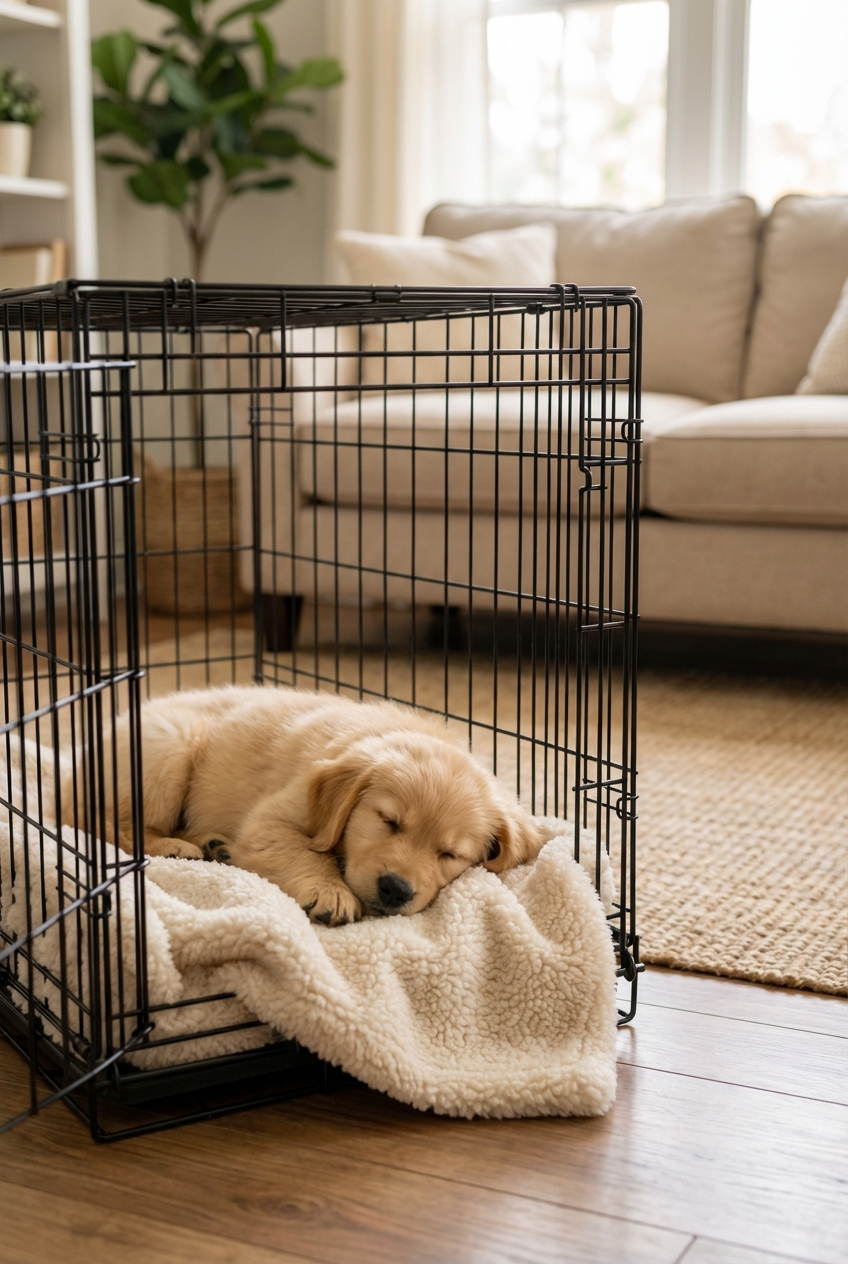
A step-by-step puppy crate training guide: choosing the right crate, building positive associations, first-week routines, nighttime potty breaks, and solutio...
Article
•
Designer Mixes
How Long Can a Puppy Stay in a Crate?

Shari Shidate
Designer Mixes contributor
Crate training can be a humane, confidence-building tool when it is used correctly. As a veterinary assistant here in Frisco, Texas, I have seen crates help puppies settle, sleep better, and learn housetraining faster. I have also seen well-meaning owners accidentally ask for too much crate time too soon, which can lead to stress, accidents, and setbacks.
This quick guide will help you choose crate time limits that are safe, realistic, and puppy-friendly.
Quick answer: crate time by age
A common rule of thumb is that many puppies may manage holding their bladder for about one hour per month of age, sometimes with one extra hour. This is a flexible guideline, not a promise. Small breeds, shy pups, and puppies with tummy trouble often need more frequent breaks. Also, awake and active puppies usually need to potty sooner than sleeping puppies.
Important: The list below is about time between potty breaks (a single stretch). It is not meant to suggest that a puppy should spend most of the day crated.
Here is a practical starting point for the maximum time in the crate without a potty break when your puppy is awake, calm, and not right after eating, drinking, or intense play.
- 8 to 10 weeks: 30 to 60 minutes
- 10 to 12 weeks: 1 to 2 hours
- 3 months: up to 3 hours
- 4 months: up to 4 hours
- 5 months: up to 5 hours
- 6 months: up to 6 hours
- 7 to 8 months: up to 7 to 8 hours as an occasional upper limit (many still do better with a midday break, and it is not an ideal daily routine)
Overnight: Many puppies can sleep longer than they can hold it during the day, especially if they are calm, the room is quiet, and their last potty break is right before bed. Very young puppies often still need at least one nighttime potty trip.
What changes the right crate time?
Crate time is not just about age. It is about biology, routine, and how your puppy feels in that moment.
1) Size and breed
Tiny puppies usually have smaller bladders and may need more frequent potty breaks. Some larger-breed puppies can go a bit longer, but they can still have accidents if they are stressed or excited.
2) Schedule and timing
Most puppies need to potty:
- Right after waking up
- After eating or drinking
- After playtime or training
- After a big exciting event, like visitors arriving
3) Diet, hydration, and digestion
New foods, rich treats, or a sudden diet change can trigger soft stools and urgent potty needs. If your puppy is having diarrhea, shorten crate time and talk with your veterinarian if symptoms persist or your pup seems unwell.
4) Crate comfort and training level
A puppy who is gradually trained to enjoy the crate can settle for longer. A puppy who feels isolated or frightened may vocalize, drool, or have stress accidents even if they physically could have held it.
5) Special situations
Some puppies need shorter limits because of factors like a suspected UTI, GI upset, medications that increase thirst or urination, very small toy breeds, or confinement anxiety in rescue pups. When in doubt, choose more frequent breaks and ask your veterinarian or a qualified trainer for an individualized plan.
Healthy crate use: a daily rhythm
Crates work best when they are part of a predictable routine. Think of the crate as your puppy’s safe bedroom, not a place they get sent when life gets busy.
A gentle pattern that works for many puppies
- Potty right before crating
- Short crate rest with a safe chew or stuffed food toy (only if appropriate and safe for your puppy)
- Potty again after coming out
- Play, training, and cuddles
- Nap (many puppies need a lot of sleep)
Puppies commonly do best with several short crate sessions rather than one long stretch.
Total daily crate time
The time between potty breaks is only one part of the picture. Even if your puppy can technically hold it, long daily crating can be hard on their body and mind. Puppies need movement, social time, training, and supervised exploration for healthy development.
If you find yourself relying on the crate as default parking for most of the day, consider adding a midday break, an exercise pen, a puppy-proof room, or help from a sitter or walker.
When crating is too long
Your puppy cannot tell you, “I need a break,” in words, but they will tell you with behavior. Here are red flags that crate time is too long or training is moving too fast:
- Frequent accidents in the crate
- Panic barking that escalates, not short protest whining
- Drooling, panting, or frantic scratching at the crate
- Trying to bite the bars or escape
- Refusing to enter the crate even with treats
If you are seeing these signs, shorten the duration, increase potty breaks, and go back to easier steps in crate training. If you suspect separation anxiety or intense distress, involve your veterinarian and consider working with a qualified trainer.
Safe setup: what goes in the crate?
A well-set crate helps your puppy relax and reduces accidents.
- Correct size: enough room to stand up, turn around, and lie down comfortably. Too large can encourage peeing in one corner.
- Comfort: a washable mat or towel. Some puppies chew bedding, so safety comes first.
- Water: for longer crating, especially in warm homes. For short sessions, many pups do fine with water offered before and after. If your puppy has frequent accidents or a medical issue, ask your veterinarian what is best for your situation.
- Safe enrichment: a veterinarian and owner-approved chew or stuffed toy for calm pups. Avoid high-risk items unattended, and supervise until you know what your puppy can handle safely to reduce choking or obstruction risk.
- Temperature: keep the crate in a cool, well-ventilated area away from direct sun, hot garages, or stuffy rooms. Overheating is a real risk.
Skip: collars or tags in the crate, which can snag.
Workdays: a reality check
Many families need to leave the house for 6 to 9 hours. For most young puppies, that is too long to crate without help. Even older puppies who can hold it may do better emotionally and physically with a break.
Here are kinder options:
- Midday potty break: a trusted neighbor, friend, or professional pet sitter
- Dog walker: choose one who will do a potty trip and a little calm time, not just a quick in and out
- Puppy-safe confinement area: an exercise pen or gated puppy-proof room with a potty pad option, if you are pad training
- Doggy daycare: best for older puppies who are healthy, enjoy groups, and are up to date on vaccines per your veterinarian and accepted by the facility (requirements vary)
As a general welfare guideline, long daily crating without breaks can be hard on a puppy’s body and mind, even if they can technically “hold it.”
Night crating
Nighttime can be the easiest time to crate because puppies sleep deeply. To make nights smoother:
- Offer a potty break right before bed
- Keep the crate near your bed for the first weeks if possible
- If your puppy wakes and cries, take them out calmly for a quick potty, then back to the crate
- Keep lights low and play minimal
Most puppies grow out of nighttime potty trips as their bladder capacity increases and their routine stabilizes.
Frequently asked questions
Can a puppy be in a crate while I run errands?
Yes, if you keep it within the age-appropriate time between potty breaks and your puppy has had a potty break first. For very young puppies, errands may need to be short or split up.
Should I ignore crying in the crate?
Some whining during early training is normal. But persistent, escalating crying may mean your puppy needs to potty, is frightened, or you moved too fast. Always rule out potty needs first, then continue training in smaller steps.
Is it okay if my puppy has an accident in the crate?
Accidents happen. Clean thoroughly with an enzymatic cleaner and adjust the plan. Usually it means the time was too long, the crate was too big, or the schedule needs a tweak.
My practical bottom line
A crate should help your puppy feel safe, not trapped. When you match time in the crate to your puppy’s age, routine, and comfort level, you support housetraining, sleep, and emotional security all at once.
If you want the simplest next step, do this today: potty before crating, keep the session short, and potty immediately after. Then repeat. Consistency is what makes crate training low-stress and effective.
Veterinary note: These are general guidelines, and individual puppies vary. If your puppy is having frequent accidents despite reasonable breaks, seems painful when urinating, has diarrhea, or is unusually lethargic, check in with your veterinarian. Medical issues can look like “training problems.”