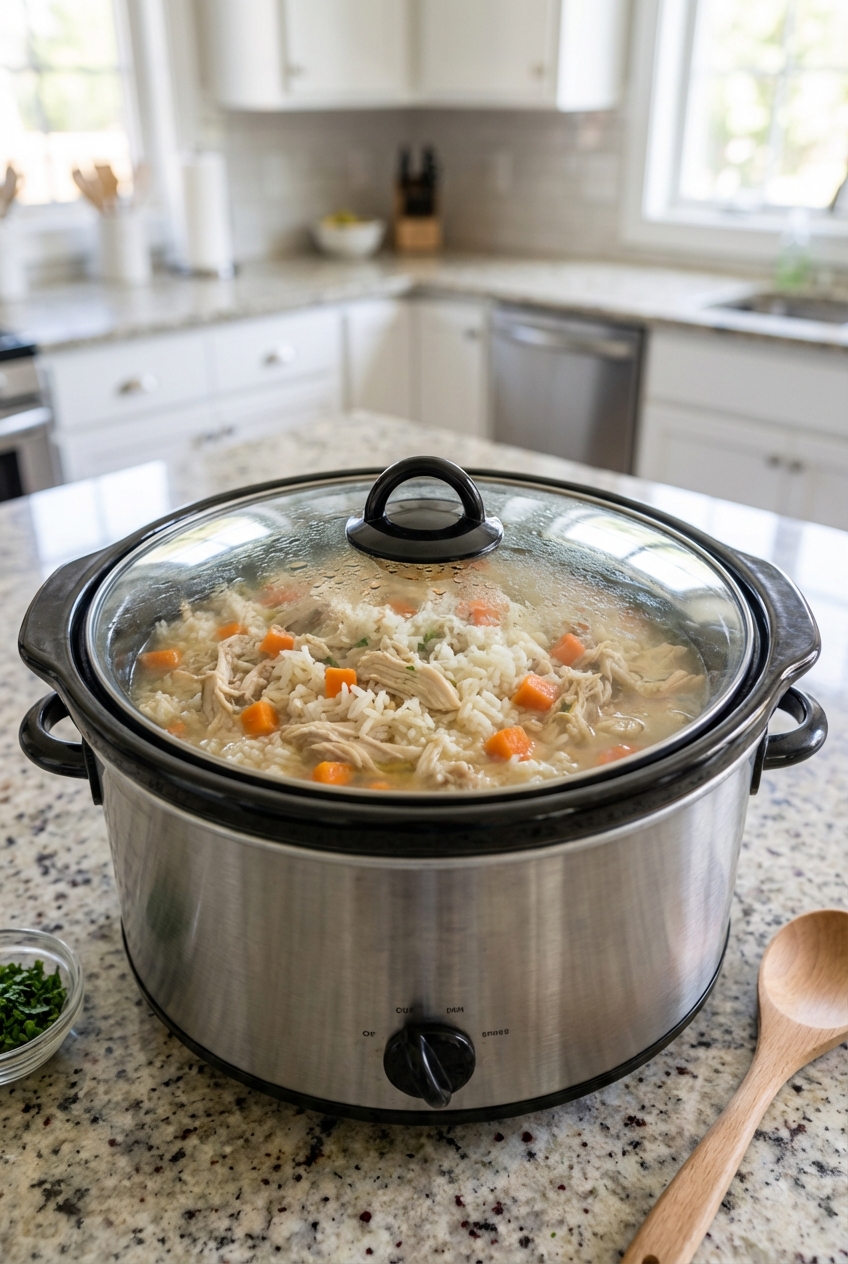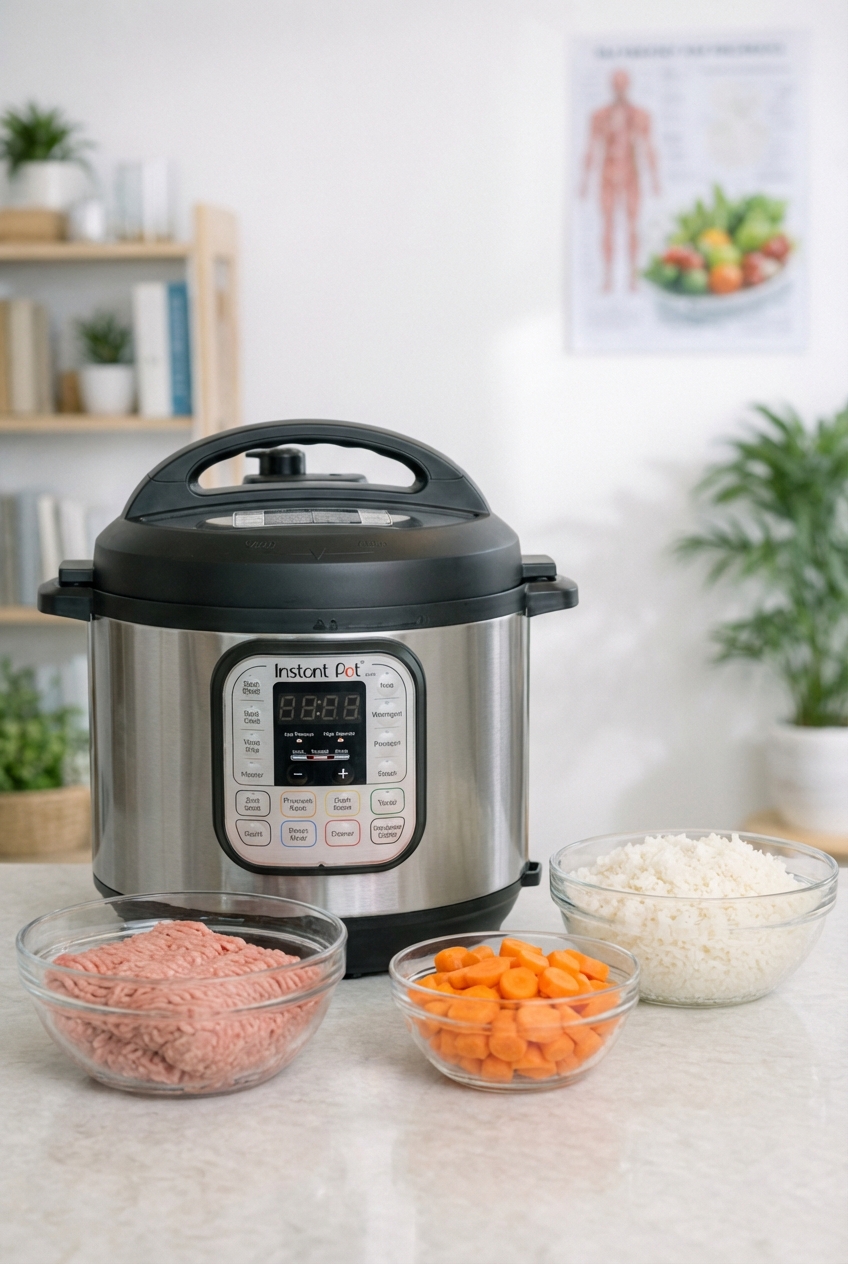
Busy schedule? Cook real dog food in your Instant Pot with a simple turkey, rice, and veggie batch. Get meal-prep, storage, feeding tips, and how to keep hom...
Article
•
Designer Mixes
Homemade Dog Food Ratios and Recipe Templates

Shari Shidate
Designer Mixes contributor
If you have ever looked at a bag of kibble and thought, “I have no idea what half of these ingredients even are,” you are not alone. The good news is that homemade dog food does not have to be complicated to be nourishing. When you understand a few simple building blocks, you can create consistent meals from real, grocery-store ingredients and rotate ingredients for variety.
As a veterinary assistant here in Frisco, Texas, I love when families feel empowered to feed their dogs well. The key is doing it in a way that supports long-term health, not just a one-off “healthy bowl” that accidentally misses important nutrients.

Start with a practical cooked-food ratio
For most healthy adult dogs, a practical starting point for cooked homemade meals is a more moderate split than many raw-feeding frameworks:
- 40 to 50% protein (meat, fish, or eggs)
- 25 to 40% carbs (rice, oats, quinoa, potato, etc.)
- 10 to 20% vegetables (lightly cooked and chopped or pureed)
- 5 to 10% boosters (healthy fats and targeted add-ins)
Quick clarity: These are rough by-ingredient proportions to help you build a bowl, not a calorie-based formulation. Water content varies a lot (especially with cooked carbs), so these percentages can look “right” and still be very different in calories and nutrients.
This framework can help keep calories steadier, support stool quality, and can help reduce the risk of overly phosphorus-heavy meals that sometimes happen when bowls are very meat-forward. It is still not a substitute for a therapeutic diet and it is not ideal for puppies, pregnant dogs, or dogs with certain medical conditions.
Important note: Percentages should be treated as a starting framework, not a guarantee of a complete diet. For long-term feeding, most dogs will need a comprehensive vitamin and mineral plan, not just “good ingredients.”
Common gaps in homemade diets
1) Calcium: the most common issue
Meat is naturally high in phosphorus and low in calcium. If you feed meat without a calcium plan, the calcium-to-phosphorus balance can drift in an unhealthy direction over time.
Practical calcium options many owners use:
- Ground eggshell powder (from clean, baked, finely ground shells)
- Veterinary-formulated calcium supplement designed for homemade diets
Quick clarity: eggshell provides calcium, but it does not fill the other common micronutrient gaps (like iodine, zinc, copper, manganese, and vitamins D and E). Think of eggshell as “calcium only,” not a complete balancer.
Because calcium needs vary by recipe and by dog size, the most evidence-based approach is to use a veterinary nutrition calculator or a board-certified veterinary nutritionist, especially if you want to feed homemade long-term.
2) Omega-3 fats: small amount, big payoff
Omega-3 fatty acids (especially EPA and DHA) support skin, coat, joints, and inflammation balance. Many homemade diets are omega-3 light unless you include fatty fish or a fish oil supplement.
- Easy food approach: sardines or salmon (cooked, unseasoned, and preferably low-sodium)
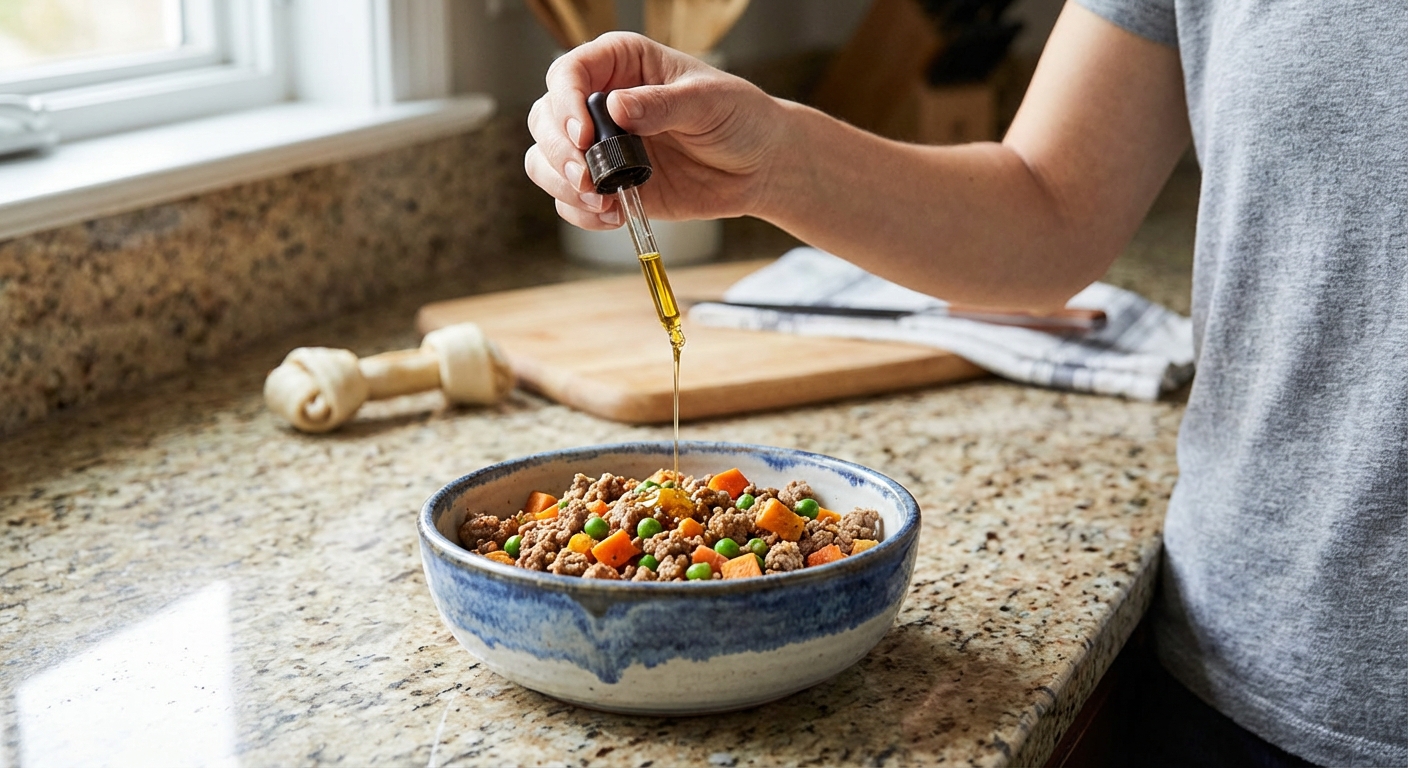
- Supplement approach: a quality fish oil stored away from heat and light
Dose matters: omega-3s add calories and can cause loose stool in some dogs if you start too high. Ask your vet for an EPA plus DHA target for your dog, especially if you are using fish oil daily.
3) Trace minerals and vitamins: the hidden long-term problem
This is the part most loving owners do not realize at first: even well-intentioned home-cooked meals often come up short on key micronutrients like zinc, copper, iodine, manganese, and vitamins like D and E unless a complete supplement is used.
If you are feeding homemade as a long-term main diet, talk with your veterinarian about a complete canine vitamin and mineral supplement formulated specifically to balance home-cooked recipes. In plain terms, you want something designed to help bring a recipe up to recognized canine nutrient targets (often based on AAFCO or NRC profiles) when used as directed. This is different from a generic human multivitamin and different from calcium alone.
What counts as protein, veggie, carb, and booster?
Proteins
- Chicken, turkey, lean beef, pork
- Salmon, sardines (watch bones and sodium, choose simple preparations)
- Eggs (excellent whole food protein)
- Organ meats in small amounts (like liver) for micronutrients
Tip: Rotate proteins when you can. Variety helps broaden nutrients and may reduce repeated exposure to any one protein, but it is not a guarantee against sensitivities.
Vegetables
Dogs do best with vegetables that are lightly cooked and then chopped or pureed. This makes the nutrients more available and easier to digest.
- Great staples: carrots, green beans, zucchini, spinach, broccoli, cauliflower
- Helpful add-ins: small amounts of pumpkin for stool support
- Go slow with: cruciferous veggies if your dog is gassy (broccoli, cabbage)
Carbs
Healthy carbs can make meals more affordable, support energy needs, and add fiber. Despite trendy messaging, grains are not automatically “bad.”
- Brown or white rice, oats, quinoa, barley
- Sweet potato or baked potato (plain)
Boosters
- Healthy fats: fish oil, small amounts of olive oil
- Gut support: plain kefir or yogurt if tolerated
- Flavor and hydration: unsalted or low-sodium bone broth or meat broth
- Balancing support: a vet-recommended vitamin and mineral supplement for home-cooked diets (especially for long-term feeding)
Fat note: Oils and fatty meats can add up quickly. If your dog has a pancreatitis history or does poorly with rich foods, keep fat modest and check with your vet before adding oils or higher-fat proteins.
Three base recipe templates
These are simple “plug and play” base templates to help you get started with cooked meals. They are not complete and balanced on their own for long-term feeding. To make a home-cooked diet complete, you typically need:
- a calcium plan
- omega-3 support
- a complete canine vitamin and mineral supplement (for trace minerals and vitamins like D and E)
For long-term feeding, especially for small dogs or dogs with health conditions, consider having your recipe reviewed by your veterinarian or a board-certified veterinary nutritionist (DACVIM Nutrition).
Template 1: Turkey, rice, and veggie bowl
- Protein: cooked ground turkey
- Carb: cooked rice
- Vegetables: steamed carrots and green beans, chopped
- Boosters: fish oil and a splash of unsalted or low-sodium broth
Template 2: Beef, quinoa, and greens
- Protein: cooked lean ground beef (drain excess fat if needed)
- Carb: cooked quinoa
- Vegetables: lightly cooked spinach, finely chopped
- Boosters: plain kefir if tolerated
Template 3: Salmon, sweet potato, and pumpkin mix
- Protein: cooked salmon (plain, no seasoning)
- Carb: cooked sweet potato
- Vegetables: pumpkin mixed with a lower-fiber veggie (for example zucchini or green beans)
- Boosters: a small spoon of yogurt if tolerated or a drizzle of olive oil
Pumpkin note: Pumpkin can be wonderful for some dogs, but too much can loosen stools. If your dog is sensitive, keep pumpkin to a smaller portion of the veggie blend and use another vegetable for the rest.
How much should you feed?
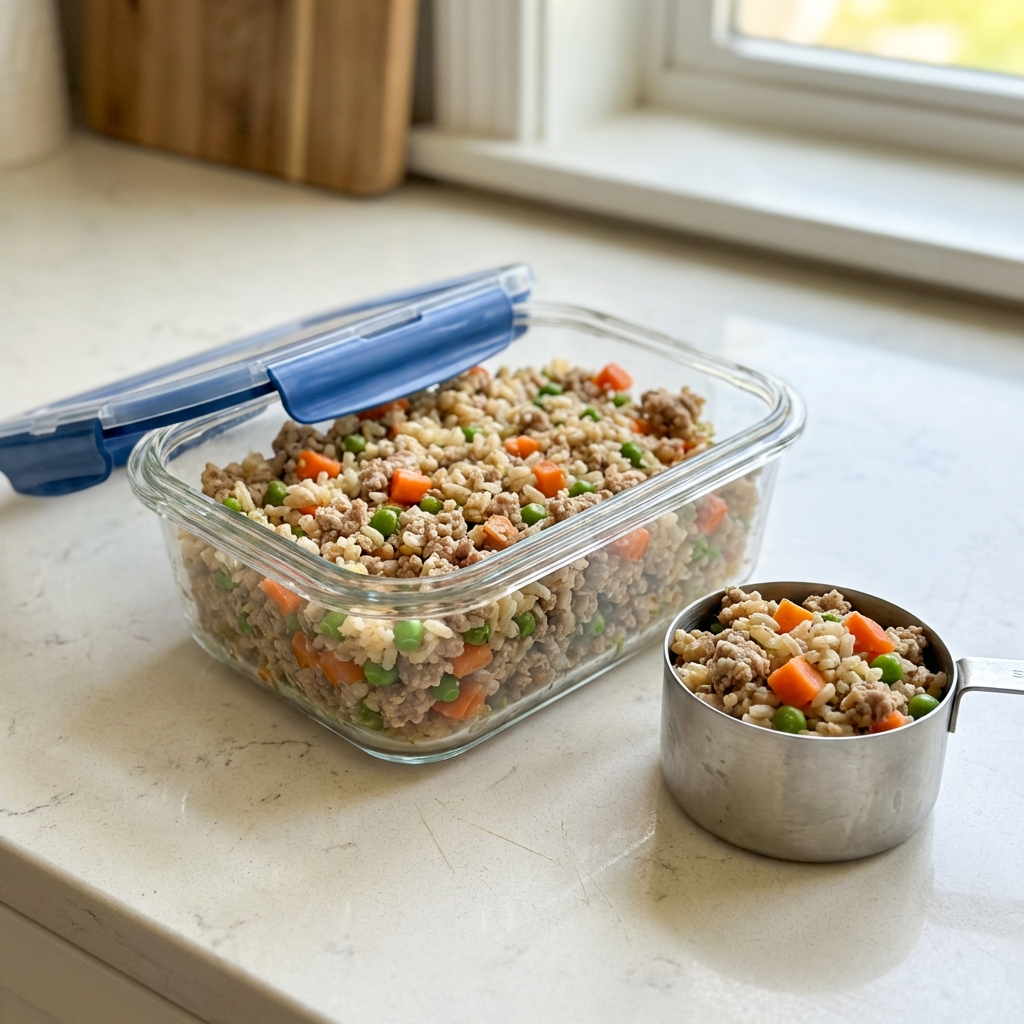
Portion needs depend on your dog’s weight, age, activity level, and whether they need to gain or lose weight. With cooked food, volume can be misleading because water content varies a lot (think: cooked rice versus dense meat).
My favorite starting point: ask your vet for your dog’s daily calorie target and then portion your recipe to match. Calories, not bowl volume, determine portions.
If you want a simple at-home approach, start with a measured amount and adjust every 2 to 4 weeks based on body condition and stool quality.
If you see “feed 2% to 3% of body weight,” know that this rule of thumb is most often used in raw feeding and does not translate cleanly to cooked diets.
Weighing matters: If you are tracking ratios, decide whether you are measuring ingredients cooked or raw and be consistent. Cooked weights change dramatically (especially carbs) and will affect both calories and nutrients.
Action step: Take a “before” photo from above and from the side. Re-check every 2 to 4 weeks. You want a visible waist and ribs that are easy to feel but not sharply protruding.
Transition slowly
Even healthy food can cause tummy upset if you switch too fast. A gentle transition usually works best:
- Days 1 to 3: 25% homemade, 75% current food
- Days 4 to 6: 50% homemade, 50% current food
- Days 7 to 9: 75% homemade, 25% current food
- Days 10 to 14: 100% homemade (if your dog is doing well)
Watch stool consistency, itching, ear debris, and energy. Those little clues can help you fine-tune ingredients.
Safety notes
- Avoid toxic foods: onions, garlic, grapes/raisins, xylitol, macadamia nuts, alcohol, cooked bones.
- Keep seasoning simple: avoid onion and garlic powders, avoid seasoning blends, skip salty sauces, keep meals plain.
- Watch sodium: choose unsalted or low-sodium broths, and keep canned fish low-sodium.
- Food safety matters: refrigerate promptly, freeze extra portions, wash prep surfaces.
- Puppies need different formulas: growth requires precise mineral balance, especially calcium and phosphorus.
If your dog has pancreatitis history, kidney disease, urinary stones, allergies, or is on prescription food, please talk with your vet before changing anything. Homemade can still work, but the recipe needs to be tailored.
Make it doable
The best homemade diet is the one you can stick with consistently. Here are a few “busy week” tricks that I see work well:
- Cook in batches twice a week and freeze single-meal portions.
- Keep a rotation list of 3 proteins, 3 veggies, and 2 carbs to simplify shopping.
- Stay flexible: even 50/50 homemade plus a quality commercial food can be a meaningful step.
Good food supports good energy. And good energy is often the first thing families notice when a dog finally starts eating meals that truly nourish them.