Puppies need precise nutrition for healthy growth. Learn the non-negotiables—calcium/phosphorus, protein, DHA, calories—plus safe homemade bowl tips and ...
Article
•
Designer Mixes
Homemade Dog Food for Puppies Growth Guide

Shari Shidate
Designer Mixes contributor
Puppies grow fast, and their nutrition has a bigger job than an adult dog’s diet. They are building bone, muscle, brain tissue, and a healthy immune system all at once. Homemade puppy food can be a wonderful option, but it has to be done with intention because “close enough” can lead to long-term issues, especially in large-breed puppies.
As a veterinary assistant here in Frisco, Texas, I love seeing families take a proactive approach to nutrition. This guide will help you understand what growing puppies truly need, how to build balanced homemade meals, and how to transition safely.

Before you start
A quick checklist can prevent a lot of stress later.
- Schedule a puppy visit to confirm weight trends, discuss expected adult size, and ask about any breed-specific growth risks.
- Check parasite status (fecal test and deworming plan). Parasites can mimic “food intolerance” with loose stool and poor growth.
- Know your growth category. “Large-breed” usually means an expected adult weight of 50 pounds or more (giant-breed is often 90 pounds or more).
- Pick your safety path for nutritional completeness:
- A recipe formulated for growth by a board-certified veterinary nutritionist (DACVN or ECVCN).
- A commercial base mix labeled for growth that you add meat to, following the label exactly.
- A high-quality puppy food as the main diet, with small fresh toppers for variety.
Why puppy nutrition is different
Puppies generally need more nutrient-dense food than adults. They often need more calories per pound of body weight and more protein per pound than adult dogs, but it varies with age, size, and activity. The biggest difference is that puppies have a narrow margin for error with calcium and phosphorus. Too little can impair bone development, but too much can be just as risky, particularly for large and giant breeds.
Homemade diets can support healthy growth, but they must be complete and balanced for growth, not just “healthy ingredients.”
What balanced for growth means
For puppies, balance is not just about protein plus veggies. It means your recipe consistently provides:
- Enough energy to support growth without promoting excess weight gain
- High-quality protein with essential amino acids
- Essential fatty acids (especially DHA and EPA) for brain and vision development
- Correct calcium and phosphorus levels and ratio to support skeletal growth
- Key micronutrients like zinc, iodine, copper, selenium, vitamins A, D, E, and B-complex
For puppies, the calcium question is the one I want you to take the most seriously. Bone development is not the place for guesswork.
If you are trying to confirm whether a product is appropriate, look for language like “complete and balanced” and “for growth” or “including growth of large-size dogs” (common wording on AAFCO-based statements in the US). If you are in Europe or following European guidance, look for diets formulated to FEDIAF growth standards.
Large-breed puppy basics
Large-breed puppies do best with controlled calories and a carefully managed mineral profile. In practice, the most common problems I see are:
- Excess calories driving rapid growth and extra weight
- Incorrect calcium-to-phosphorus balance from meat-heavy recipes without proper supplementation
- Oversupplementing calcium “just to be safe,” which can backfire in large-breed puppies
Slow, steady growth is the goal.
Puppy growth targets
1) Steady growth wins
A lean puppy is a healthier puppy. Rapid weight gain can increase orthopedic risk, especially in large-breed mixes. You should be able to feel ribs easily with light pressure, and your puppy should have a visible waist when viewed from above.
2) Use body condition
Feeding amounts vary widely based on breed mix, activity, and age. Instead of locking into a single number, reassess every 1 to 2 weeks:
- If ribs are hard to feel and your puppy is getting “round,” reduce portions by about 10% and recheck in a week.
- If ribs and hip points are prominent, increase calories and speak with your veterinarian to rule out parasites or malabsorption.
3) Meal frequency
- 8 to 12 weeks: often 4 meals per day
- 3 to 6 months: often 3 meals per day
- 6 to 12 months: many puppies do well with 2 meals per day, but some, especially larger breeds, do better staying at 3 meals longer
Building blocks
Protein
Choose a primary protein your puppy tolerates well, then rotate over time for nutrient variety. Great options include:
- Chicken or turkey (thigh meat is often more flavorful and energy-dense than breast)
- Beef
- Pork
- Sardines or salmon (cooked, deboned)
- Eggs (fully cooked)
Organ meats can be nutrient-rich, but puppies are sensitive to excess vitamin A. Keep organ meat carefully portioned and use a formulated recipe if organs are included.
Fats and omega-3s
Puppies need fat for energy and development. DHA is especially important during growth. Consider:
- Fish oil that provides EPA and DHA (a common, evidence-supported choice)
- Fatty fish meals 1 to 2 times per week
- Small amounts of olive oil or other fats if your vet-approved recipe includes them
Supplement note: Fish oil should be dose-based. Too much can cause diarrhea, add unnecessary calories, and can be risky for dogs prone to pancreatitis. If you are unsure, ask your veterinarian for a target dose based on your puppy’s weight and diet.
Carbs and fiber
Many puppies do well with gentle carbs for energy and stool quality. Options include:
- Cooked rice
- Oats
- Sweet potato
- Quinoa
If your puppy has soft stool, it is often better to adjust the recipe slowly than to keep changing ingredients every day.
Vegetables
Veggies provide fiber and phytonutrients. Light cooking, steaming, or pureeing can improve digestibility by breaking down plant cell walls. Great starter veggies include:
- Carrots
- Zucchini
- Green beans
- Spinach or kale in small amounts
- Pumpkin (plain) for stool support

Calcium and phosphorus
Here is the simplest, safest rule for homemade puppy food:
If you are not following a recipe formulated for growth, do not try to “wing it” with calcium.
Puppies need an appropriate calcium intake and an appropriate calcium-to-phosphorus balance. Muscle meats are high in phosphorus and low in calcium, so simply adding meat and rice can create a serious imbalance.
Common calcium sources people reach for include ground eggshell powder or a veterinary calcium supplement, but the dose must match the recipe, your puppy’s size, and the rest of the ingredients. Large-breed puppies are especially vulnerable to problems from excess calcium, excess calories, and an incorrect calcium-to-phosphorus setup.
Also remember this: calcium is not the only concern. Homemade diets can fall short on iodine, zinc, copper, selenium, vitamin D, and more. Vitamin D is one nutrient you do not want to improvise because both too little and too much can cause serious harm.
If you want to do homemade correctly, I recommend one of these approaches:
- Use a veterinary nutritionist-formulated recipe for your puppy’s expected adult weight.
- Use a growth-labeled base mix designed for adding fresh meat, then follow the label exactly. A “base mix” is a vitamin and mineral blend meant to be combined with specified amounts of meat (and sometimes oil). The key is that it is intended to make the final diet nutritionally complete for puppies, not just adults.
- Feed a quality puppy food as the primary diet while adding small amounts of fresh “toppers” for variety.
Transitioning to homemade
Puppies have sensitive digestive systems. Go slow and be consistent.
- Days 1 to 3: 25% new food, 75% current food
- Days 4 to 6: 50% new food, 50% current food
- Days 7 to 9: 75% new food, 25% current food
- Days 10 to 14: 100% new food
If you see vomiting, significant diarrhea, mucus, or your puppy becomes lethargic, pause the transition and call your veterinarian. Parasites and dietary changes can look similar in the early stages.
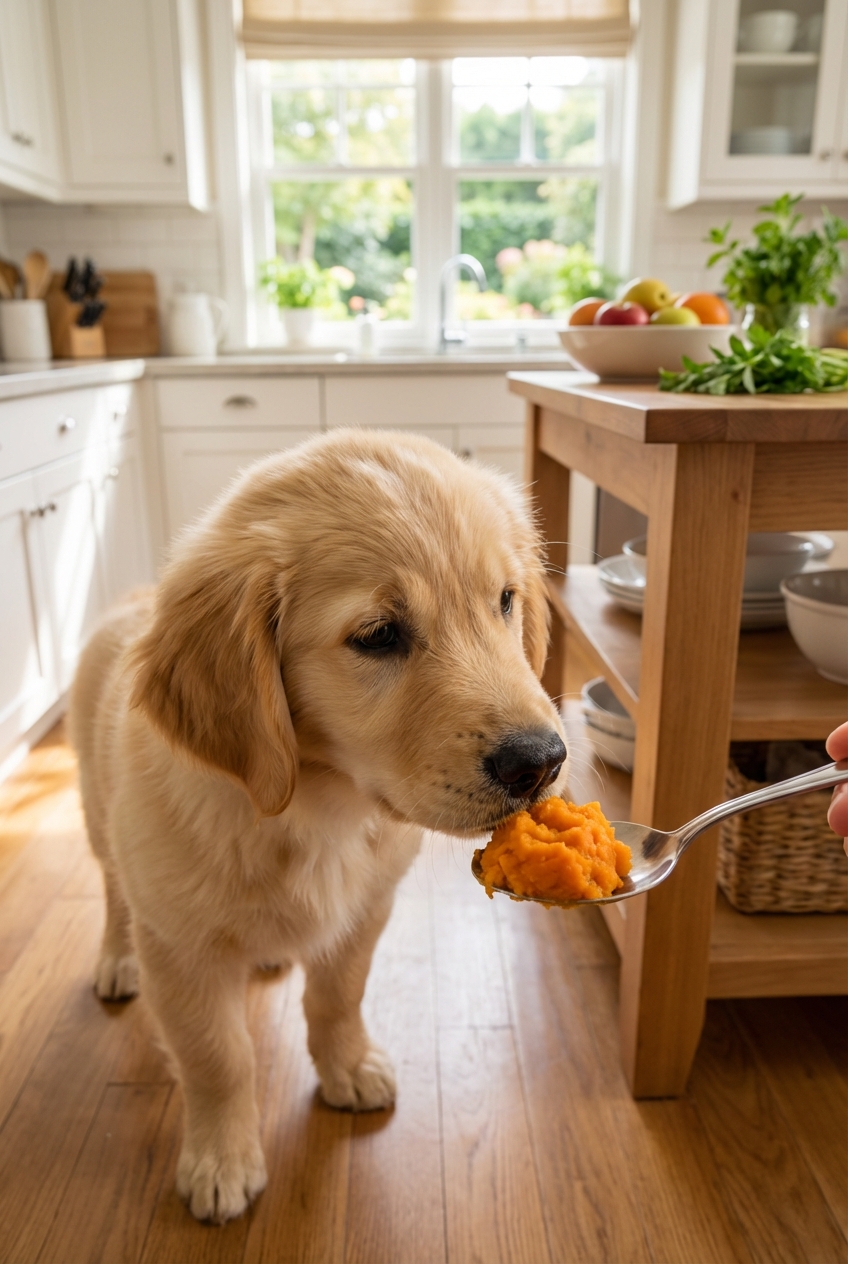
Starter toppers
These are gentle examples of what fresh foods can look like as toppers or as part of a vet-approved plan. On their own, they are not nutritionally complete for puppy growth because they do not include a properly calculated vitamin and mineral profile.
Simple topper
- Cooked ground turkey
- Steamed carrots (mashed)
- A spoonful of cooked rice
Omega-3 boost (occasionally)
- Cooked salmon or sardines (carefully deboned)
- Cooked sweet potato
- Steamed green beans
Foods to avoid
Some foods are unsafe for dogs, even in small amounts. Keep these out of puppy meals and out of reach:
- Onion, garlic, chives, and leeks
- Grapes and raisins
- Xylitol (common in sugar-free gum, candy, and some peanut butters)
- Chocolate and caffeine
- Macadamia nuts
- Alcohol and raw bread dough
Bone warning: Avoid cooked bones. They can splinter and cause choking or intestinal injury. If you use any chews, choose veterinarian-recommended options that match your puppy’s size and chewing style.
Food safety and prep
- Cook proteins fully to reduce pathogen risk, especially in homes with kids, seniors, or immunocompromised family members.
- Batch cook 1 to 2 times per week, portion into containers, and freeze what you will not use promptly.
- Refrigerator storage: use cooked homemade food within 2 to 3 days.
- Freeze extras for freshness and convenience.
- Thaw in the refrigerator, not on the counter.
- Reheat safely if you choose to warm food: warm it gently and stir well to avoid hot spots. Serve lukewarm, not hot.
- Keep notes on ingredients, stool quality, itching, ear debris, and gas. Patterns show up fast in puppies.
When to call your vet
Please reach out promptly if you notice any of the following during growth:
- Limping, difficulty standing, or bunny-hopping gait
- Persistent diarrhea, especially with blood or black stools
- Poor growth, dull coat, or low energy
- Frequent ear infections, itchy skin, or recurrent paw licking (could be food sensitivity, but also environmental allergies)
- Rapid weight gain in a large-breed puppy
Homemade feeding is not all or nothing. Even adding a small amount of fresh, whole foods can be a positive step as long as your puppy’s core diet is nutritionally complete for growth.