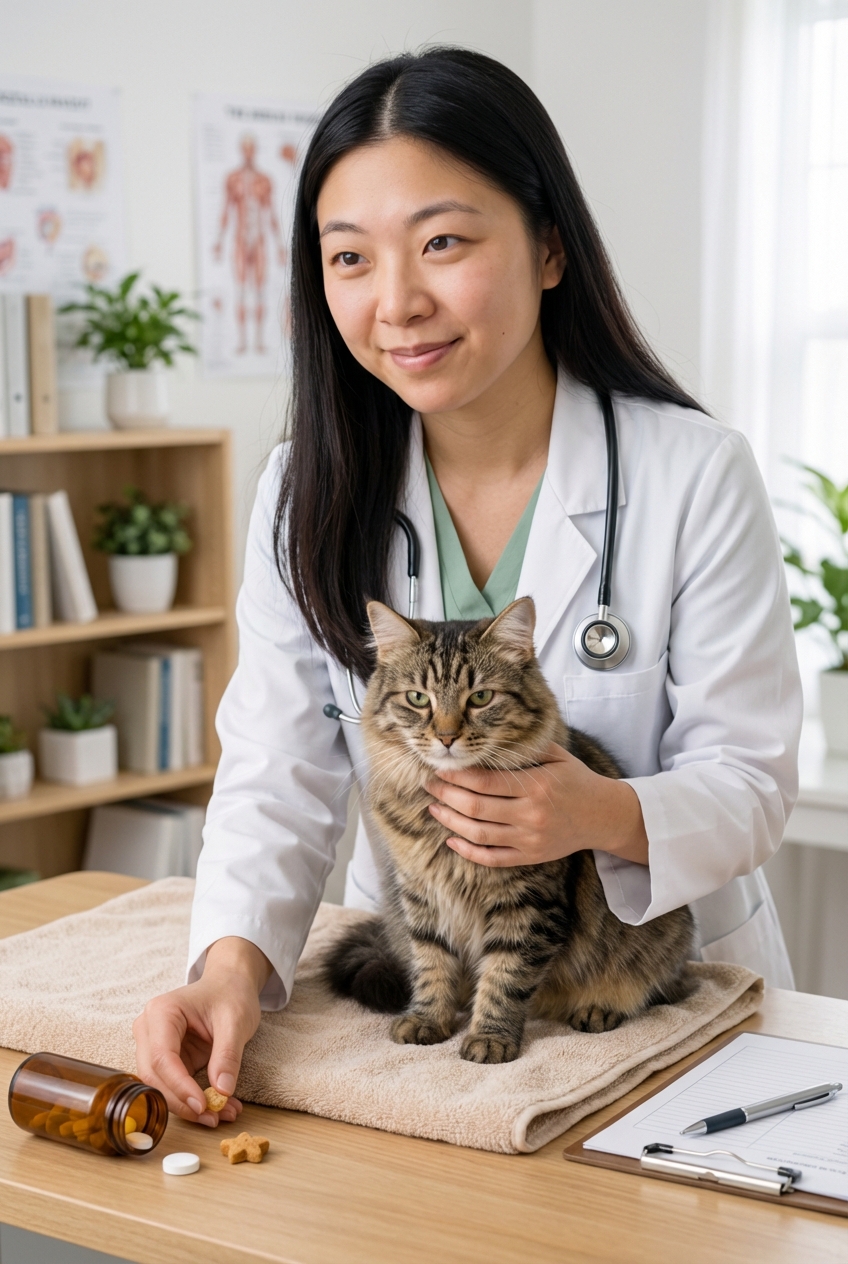
Step-by-step, vet-approved ways to give your cat a pill: hide it in food, use a pill popper, or pill by hand. Includes towel wrap tips, aftercare, and proble...
Article
•
Designer Mixes
Giving Pills to Cats

Shari Shidate
Designer Mixes contributor
Giving a cat a pill can feel like a tiny wrestling match you did not sign up for. I get it. As a veterinary assistant, I have seen how quickly a well-meaning attempt can turn into stress for both the cat and the human. The good news is that with the right technique and a calm plan, most cats can learn to tolerate medication, and some will even take it like pros.
This guide walks you through safe, vet-aligned ways to give pills, how to train the behavior over time, and what to do if your cat fights it. Always follow your veterinarian’s instructions on dosing and whether a pill can be crushed, split, or opened, because some medications must stay intact.
Before you start
Medication check
- Double-check the dose and how often to give it.
- Confirm food instructions. Some medications are easier on the stomach with food, while others work best on an empty stomach.
- Do not crush or open capsules unless your veterinarian says it is safe. Extended-release pills, enteric-coated tablets, and very bitter medications can cause problems if altered.
- Ask about alternatives if pilling is truly not working. Some medications can be prescribed as flavored liquids, compounded treats, transdermal gels in certain cases, or long-acting injections.
Set up your station
Preparation makes everything smoother and safer. Gather your supplies first so you are not chasing a cat with a pill in your hand. Wash your hands before and after, and keep all medications stored securely out of reach of pets and children.
- The pill or capsule
- 2 to 3 high-value treats or a spoonful of wet food
- A towel for a gentle wrap if needed
- A small syringe of water or a little wet food (only if your vet says it is okay) to help swallowing
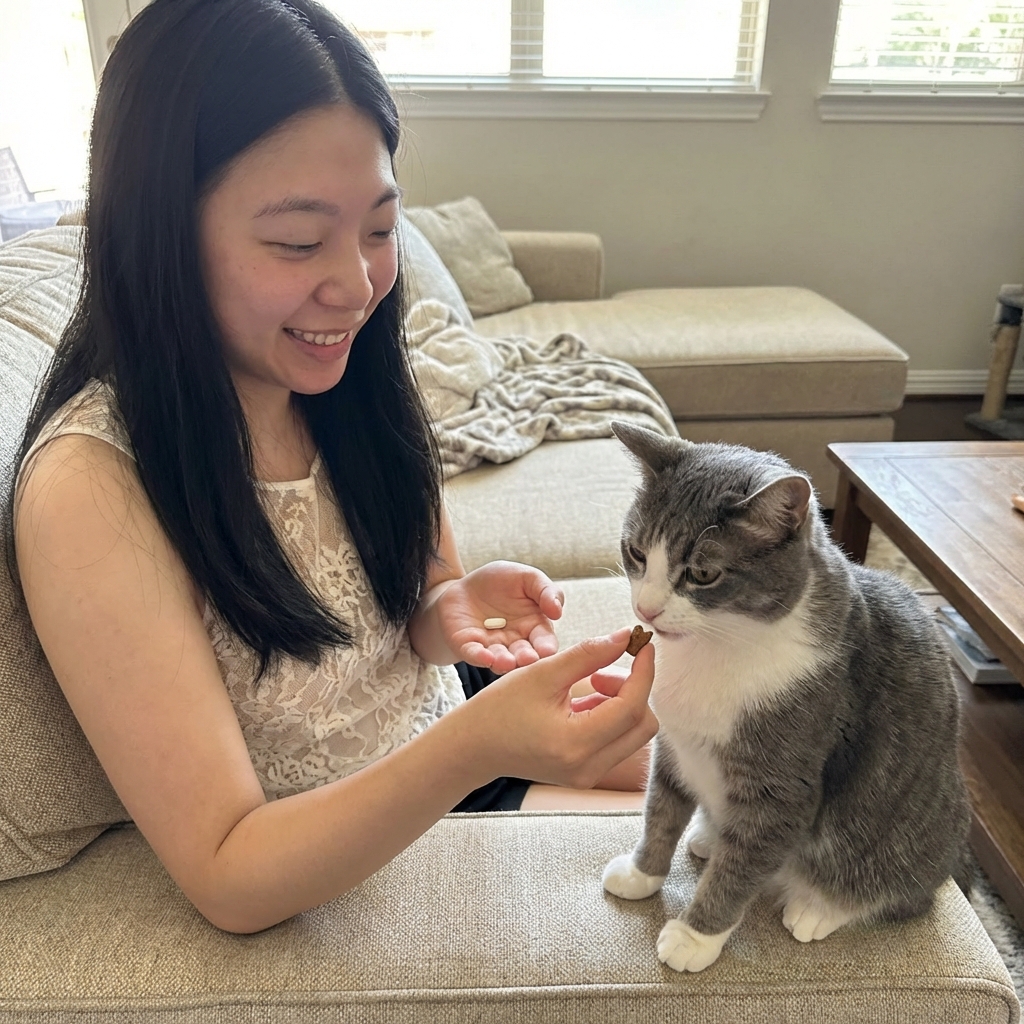
- Pill pocket or a small soft treat (optional)
- Pill splitter if you have been instructed to split doses
When to pause and get help
Do not push through a situation that is unsafe. If you think you might be bitten or scratched, or your cat is panicking, stop and contact your veterinary team. They can show you technique, provide a safer plan, or prescribe a different formulation.
Start with low stress
Begin with the gentlest approach your cat will accept. If you jump straight to force, many cats learn to fear the whole routine.
Method 1: Hide it in food
This works best for cats who are food-motivated and not suspicious. The trick is to prevent the “I found the pill” experience.
- Use a tiny portion of strong-smelling wet food, like fish-based varieties.
- Make a 3-bite sequence: first bite is plain, second bite has the pill hidden, third bite is plain again.
- Keep portions small so your cat does not chew too carefully.
- Watch to confirm swallowing. Some cats spit the pill out later, very casually, in another room.
Method 2: Pill pockets
Pill pockets can be wonderful, but cats are honest critics.
- Use just enough pocket to cover the pill, then seal it fully so there is no bitter taste.
- Offer a plain pocket piece first to build trust.
- If your cat starts refusing, rotate flavors or take a break and try a different method.
Method 3: Direct pill
If food tricks fail, direct pilling can be quick and kind when done correctly. The goal is a calm, efficient motion, not a struggle.
- Position your cat on a stable surface with good lighting. Many cats do better on a counter or table.
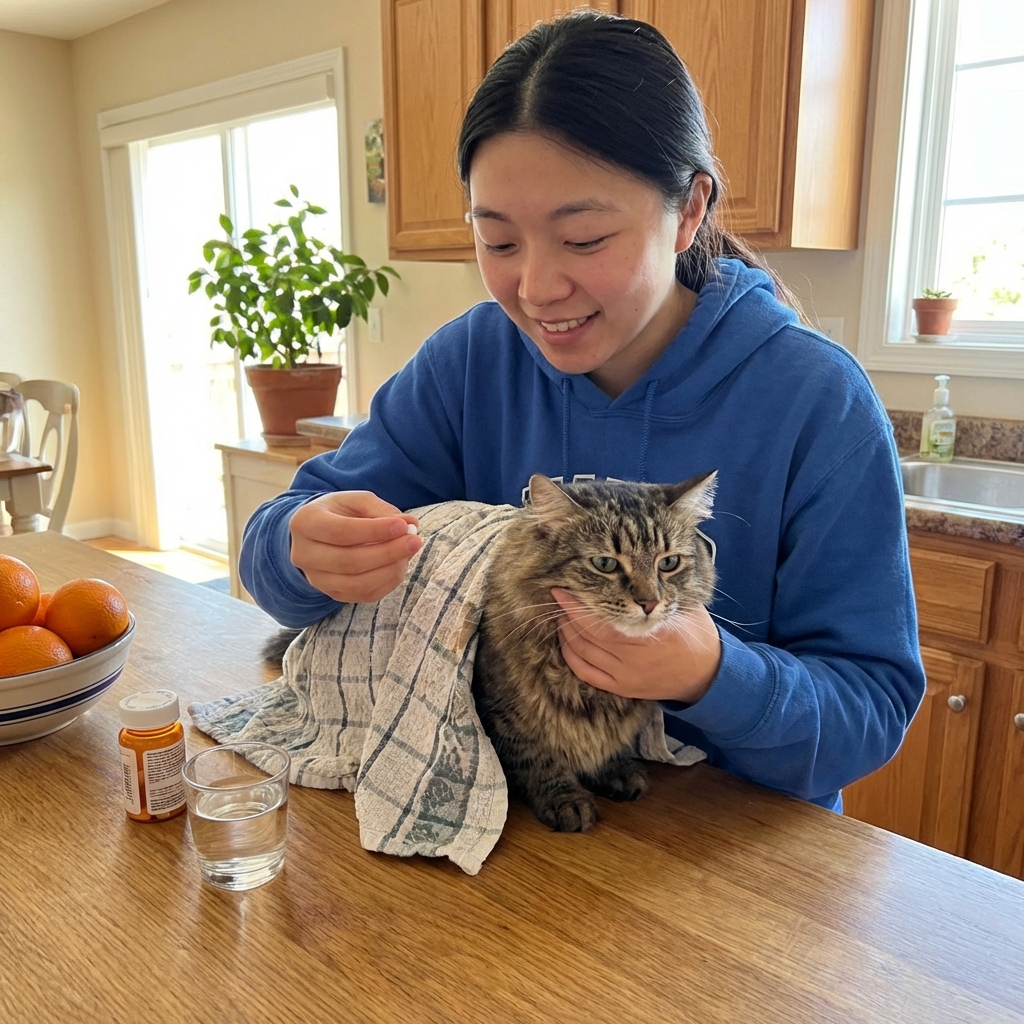
- Use a towel wrap if needed: place the cat on the towel and wrap snugly around the body, leaving the head out. This prevents scratching and reduces panic.
- Hold the head gently: place your non-dominant hand over the top of the head, thumb and fingers behind the cheekbones.
- Tilt the nose slightly up. Do not crank the neck back. Just a small tilt is enough.
- Open the lower jaw with your dominant hand by using a finger to drop the jaw at the front.
- Place the pill as far back on the tongue as you safely can, ideally past the “hump” of the tongue.
- Close the mouth and hold it closed for 1 to 2 seconds. A gentle throat stroke can help trigger a swallow.
- Give a “chaser” if appropriate: offer a small amount of wet food, a treat, or a small syringe of water if your veterinarian has said it is safe for that medication. This helps the pill go all the way down and can reduce the risk of irritation from dry pilling.
Method 4: Pill popper
A pill popper can protect your fingers and place the pill farther back, which often improves success. Ask your veterinary team to demonstrate the correct angle and depth so you avoid poking the back of the throat.
Optional: Gel caps
For very bitter tablets, some people use empty gelatin capsules (gel caps) to mask the taste. This can be helpful, but confirm with your veterinarian that the medication can be placed in a capsule and ask what size is appropriate for your cat.
Training tips
Even if your cat needs medication right now, you can still build cooperation over time. The goal is to teach, “Handling predicts rewards.”
Practice off days
- Touch the cheeks, lift the lips, reward.
- Briefly hold the head, reward.
- Touch the mouth corner, reward.
- Gently wrap in a towel for 3 seconds, reward, then release.
Use tiny steps
Keep sessions under one minute. End on success. If your cat pulls away or tenses, you have moved too fast. Go back one step and reward there.
Calm is contagious. Your job is to be boring, steady, and quick, then pay your cat generously for cooperating.
Safety and comfort
Protect the airway
- Never force water down a cat’s throat.
- Do not tilt the head straight back aggressively.
- If your cat coughs hard, gags repeatedly, or seems distressed, stop and let them reset.
Prevent irritation
Some pills can irritate the esophagus if they lodge, especially when given “dry.” Many veterinarians recommend following certain pills with a small amount of water or wet food, but it depends on the medication. Ask your vet what is appropriate for your specific prescription.
When it is a no-go
Call your veterinarian promptly if you notice:
- Drooling and pawing at the mouth for more than a minute or two
- Repeated vomiting after dosing
- Wheezing, trouble breathing, or collapse
- Swelling of the face or hives
- Not eating for about 24 hours (or sooner for high-risk cats, including overweight cats)
Common challenges
“My cat foams at the mouth”
This is often a reaction to a bitter taste, not necessarily an allergy. Many cat medications are extremely bitter. Try a pill pocket, ask about a coating option like a gel cap, or ask your vet if compounding is an option.
“My cat hides when I grab the bottle”
- Change the routine: medicate in a different room or at a different time.
- Do a few “fake outs”: pick up the bottle, give a treat, and put it away. Store it securely when you are done.
- Do not chase. Calmly confine your cat to a small room first, then proceed.
“My cat bites”
Stop and switch strategies. Use a towel wrap, a pill popper, or ask your vet about another formulation. A fearful, biting cat is telling you they are over their stress threshold.
“I’m not sure it went down”
- Look for lip-licking and a swallow.
- Check the front of the mouth quickly for a “cheek stash.”
- Offer a treat or a lick of wet food, which encourages swallowing.
Special situations
Kittens
Kittens are wiggly and tiny, so precision matters. Many kitten medications are prescribed as liquids for a reason. If you have a pill for a kitten, confirm with your vet that it is the correct form and dosage, and ask for a demonstration.
Senior cats
Older cats may have dental pain, arthritis, or nausea that makes pilling harder. A gentle towel wrap and a food chaser often help. Also ask your vet if nausea control or pain management is needed.
Multiple medications
Do not assume you can combine pills in one treat or give them all at once. Some medications interact, some need food or an empty stomach, and some are more likely to cause nausea when paired. Ask your vet for a schedule that is realistic for your household.
A simple routine
If you want a straightforward plan, here is one I often recommend for families who are feeling overwhelmed:
- Prepare everything first (pill, treats, towel).
- Bring your cat to a quiet room and close the door.
- Offer a small treat to start on a positive note.
- Give the pill using your chosen method quickly and gently.
- Immediately offer a favorite reward (and a chaser if appropriate), then a calm release.
- Give yourself credit. This is a skill, not a personality test.