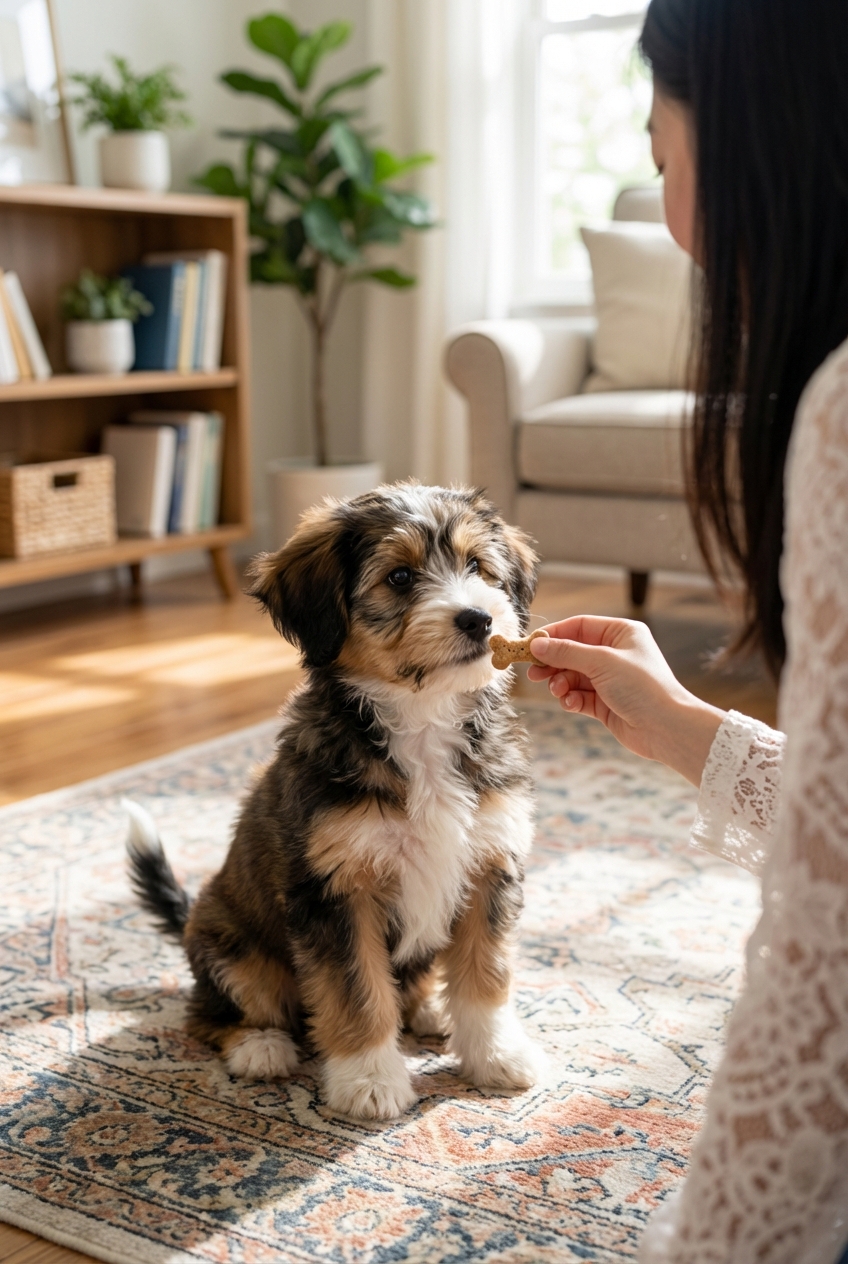
Master clicker training with clear, humane steps: charge the clicker, improve timing, place rewards correctly, teach sit/name/touch, try shaping, fade the cl...
Article
•
Designer Mixes
Fun Training With a Dog Clicker Answers

Shari Shidate
Designer Mixes contributor
Clicker training is one of my favorite ways to teach dogs because it is clear, kind, and truly fun. The click is a consistent sound that tells your dog, “Yes, that exact behavior is what earned you something good.” That tiny moment of clarity helps dogs learn faster with less frustration. If you have ever wondered, “Am I doing this right?” you are in the perfect place.
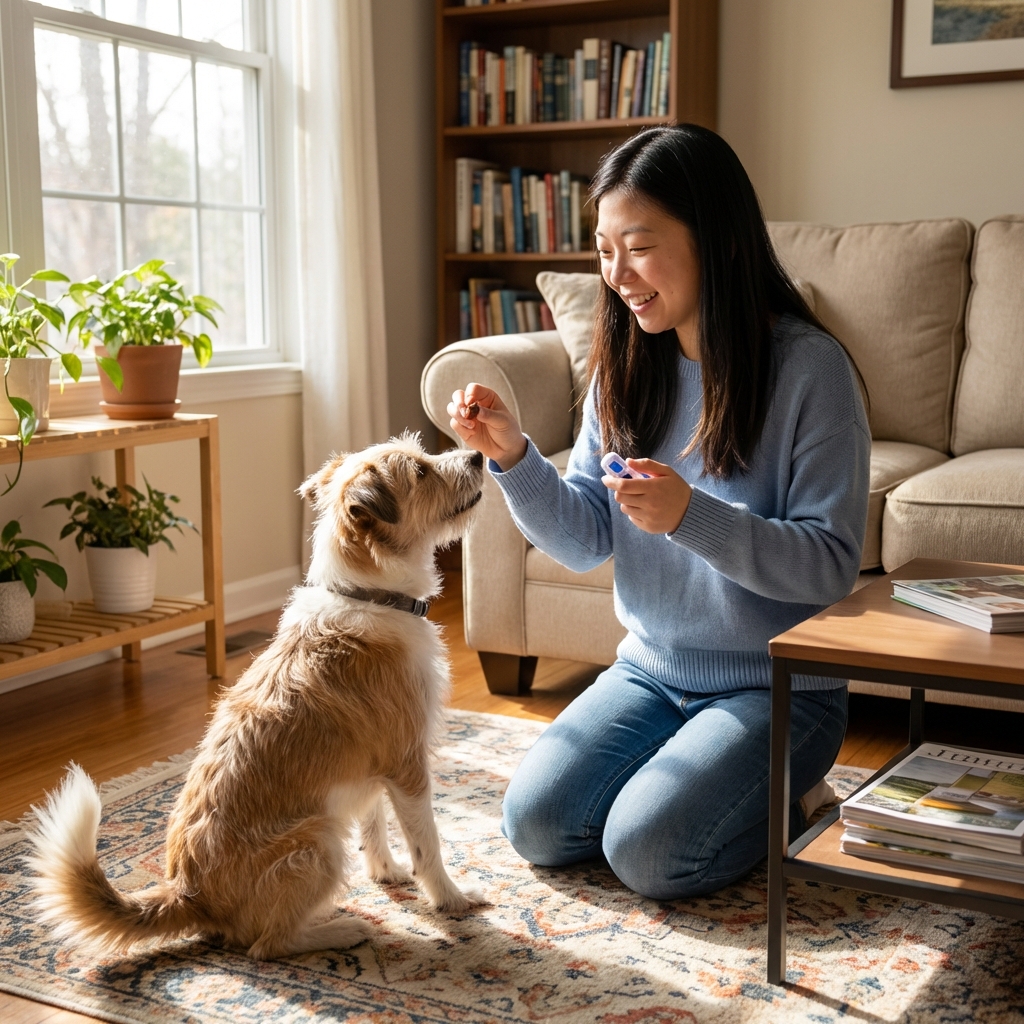
Below are the most common “fun training with a dog clicker” questions I hear in real life, along with practical, reward-based answers you can use today.
What is a clicker?
A clicker is a small handheld device that makes a consistent clicking sound. In training terms, it becomes a marker, meaning it tells your dog, “Yes, that is it.”
The click itself is not the primary reward. It is information that predicts reinforcement. The reward is what comes next, usually a treat, toy, or access to something your dog wants.
Does it work for every dog?
For most dogs, yes, especially food-motivated dogs, sensitive dogs, and dogs who get stressed by lots of verbal feedback. I have seen clickers work beautifully for puppies, senior dogs, shy rescues, and high-energy mixes.
That said, there are a few cases where you may need to adapt:
- Noise-sensitive dogs: Use a quieter clicker, click in your pocket, or switch to a verbal marker like “yes.”
- Dogs who are not into treats: Use higher-value food, toys, or real-life rewards like going outside or sniffing.
- Very distracted environments: Start at home first, then increase difficulty gradually.
How do I charge the clicker?
Charging the clicker means teaching your dog that click = reward. This is classical conditioning, the same learning process behind dogs getting excited when they hear the treat bag.
Simple charging session
- Stand or sit with your dog in a quiet room.
- Click once, then immediately give a treat.
- Repeat 10 to 20 times.
- Take a break, then do another short session later.
You will know it is working when your dog hears the click and quickly looks for the treat.
Clicker mechanics
Good timing is easier when your hands are set up well.
- Hold the clicker in one hand and treats in the other (or use a treat pouch).
- Click first, then reach for the treat. Try not to show the treat as a lure unless you are intentionally teaching that way.
- Deliver the treat where you want your dog to be next (for example, at your side for leash skills, or on the mat for relaxing).
When do I click?
Click at the exact moment your dog does the behavior you want to reinforce. Timing matters more than you think.
A helpful way to think about it is: the click is a snapshot. You are marking the instant you want more of.
Examples:
- Dog’s bottom touches the floor in a sit: click, then treat.
- Dog makes eye contact: click, then treat.
- Dog steps onto the mat: click, then treat.
Then treat after the click. The treat can come a second later, but the click should happen right on target.
Do I click and treat every time?
In the beginning, yes. Especially while your dog is learning what a cue means or learning a brand-new skill. This is called a continuous reinforcement schedule, and it builds strong understanding.
Once the behavior is reliable, you can slowly switch to rewarding unpredictably. That is called variable reinforcement, and it can help maintain behaviors long-term. Many trainers still use a mix: high rates of reinforcement for new skills, hard environments, or big distractions, and more variety when the skill is truly solid. Just do not rush this part. Dogs need clarity before they can handle “sometimes.”
What treats work best?
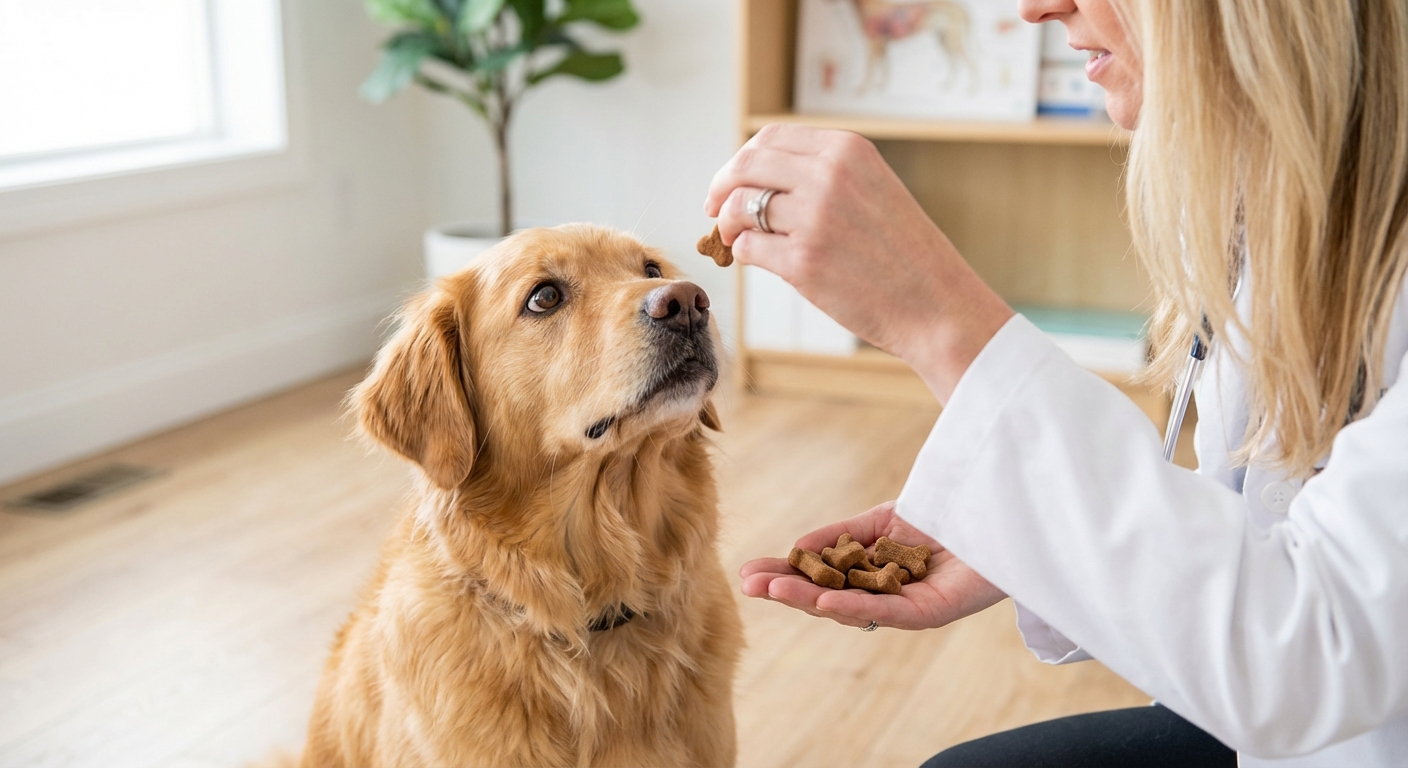
Use small, soft, high-value treats so your dog can eat quickly and stay focused. Think pea-sized or smaller for most dogs.
Great options
- Boiled chicken or turkey pieces
- Freeze-dried single-ingredient treats
- Soft training treats broken into tiny bits
- Cheese or hot dog in very small amounts for high distraction situations
If your dog has a sensitive stomach, start simple and keep sessions short. For many dogs, using part of their daily kibble as training rewards can also work, as long as motivation stays high.
Quick health note: rich treats (like cheese and hot dog) can be high in fat and sodium. Keep portions tiny, reduce meal portions if needed, and skip them if your dog has medical diet restrictions.
How long should sessions be?
Short is powerful. I recommend 1 to 5 minutes per session, especially for puppies or easily overstimulated dogs. End while your dog still wants more. That is how you keep it fun.
A good goal is several tiny sessions per day instead of one long session.
Is it only for tricks?
Not at all. Clicker training is amazing for real-life skills, including polite greetings, leash walking, and calm behavior in the home.
Everyday behaviors worth clicking
- Choosing to look at you instead of barking at the window
- Keeping four paws on the floor when guests arrive
- Walking next to you for a few steps on leash
- Going to a mat and relaxing
- Offering a sit before the door opens
Jumping and mouthing
Yes, a clicker can help, as long as you give your dog a clear alternative behavior to earn clicks. Jumping and mouthing are often attention-seeking or overstimulation behaviors. With puppies, some mouthing is also normal developmental behavior, so think “teach and redirect,” not “punish.”
Try this instead
- Wait for four paws on the floor, click, treat.
- Click for a sit before you pet or greet.
- If mouthing happens during play, pause the game briefly, then click and resume play when your dog offers a calmer behavior (like sitting, or grabbing a toy).
If jumping and mouthing are intense, combine training with management: use a leash indoors for greetings, provide enrichment, and make sure your dog is getting enough rest.
Leash pulling
Yes, and it can be surprisingly effective. The key is to click for what you want, not just react to what you do not want.
A simple loose-leash plan
- Start in a low-distraction area.
- Click and treat for your dog being near your side with a loose leash.
- Take one step, click when the leash is loose, treat.
- Gradually increase to two steps, then three, before clicking.
If your dog pulls, stop moving and wait for slack. Then click the moment the leash loosens and reward. Consistency matters.
What if I click wrong?
It happens to everyone. If you click accidentally, still give a treat. This keeps the clicker consistent and meaningful. Then reset and try again.
To improve timing, practice without your dog first. Toss a ball in the air and click when it hits the ground, or click when a second hand hits a certain number on a clock. Little drills like that can sharpen your skills quickly.
How do I add a cue?
Teach the behavior first, then name it. Once your dog is reliably offering the behavior, say the cue one time, pause for a brief beat, and when your dog does it, click and treat.
If you repeat the cue over and over, dogs learn that “sit sit sit” is the real command. One cue, then help the dog succeed.
Do I need the clicker forever?
No. Many people use the clicker heavily for learning new skills, then fade it out once a behavior is fluent.
- For well-known behaviors, you can switch to a verbal marker like “yes.”
- You can also keep the clicker as a “precision tool” for new tricks, shaping, or tricky training goals.
- Even if you stop clicking, keep reinforcing. Good behaviors stay strong when they still pay off in real life.
Clicker training and boundaries
Reward-based training is not the same as “no boundaries.” It works best when you also prevent your dog from practicing unwanted behaviors. That can look like baby gates, crates, leashes indoors for greetings, covering windows, or setting up the environment so your dog can succeed while they learn.
Positive reinforcement
Clicker training is a tool commonly used within positive reinforcement training. The click marks the behavior, and then you reinforce it by giving something your dog values.
Many studies suggest reward-based training methods are associated with lower stress and better welfare outcomes than harsh or punitive methods. In a veterinary setting, we also see that fear-free handling and reward-based training can make routine care and grooming much easier.
Research notes
- AVSAB (American Veterinary Society of Animal Behavior) position statements support reward-based training and caution against aversive methods.
- Hiby, Rooney, and Bradshaw (2004) reported associations between punitive approaches and increased behavior problems, while reward-based approaches were linked with better outcomes.
Fun clicker games
If training feels like homework, it will feel like homework to your dog too. These quick games keep learning light while building real skills.
1) Look at me
- Wait quietly.
- When your dog makes eye contact: click, treat.
- Repeat for 1 to 2 minutes.
2) Find the treat
- Toss a treat a few feet away.
- When your dog turns back to you after eating it: click, treat near you.
- This builds engagement and helps with recall foundations.
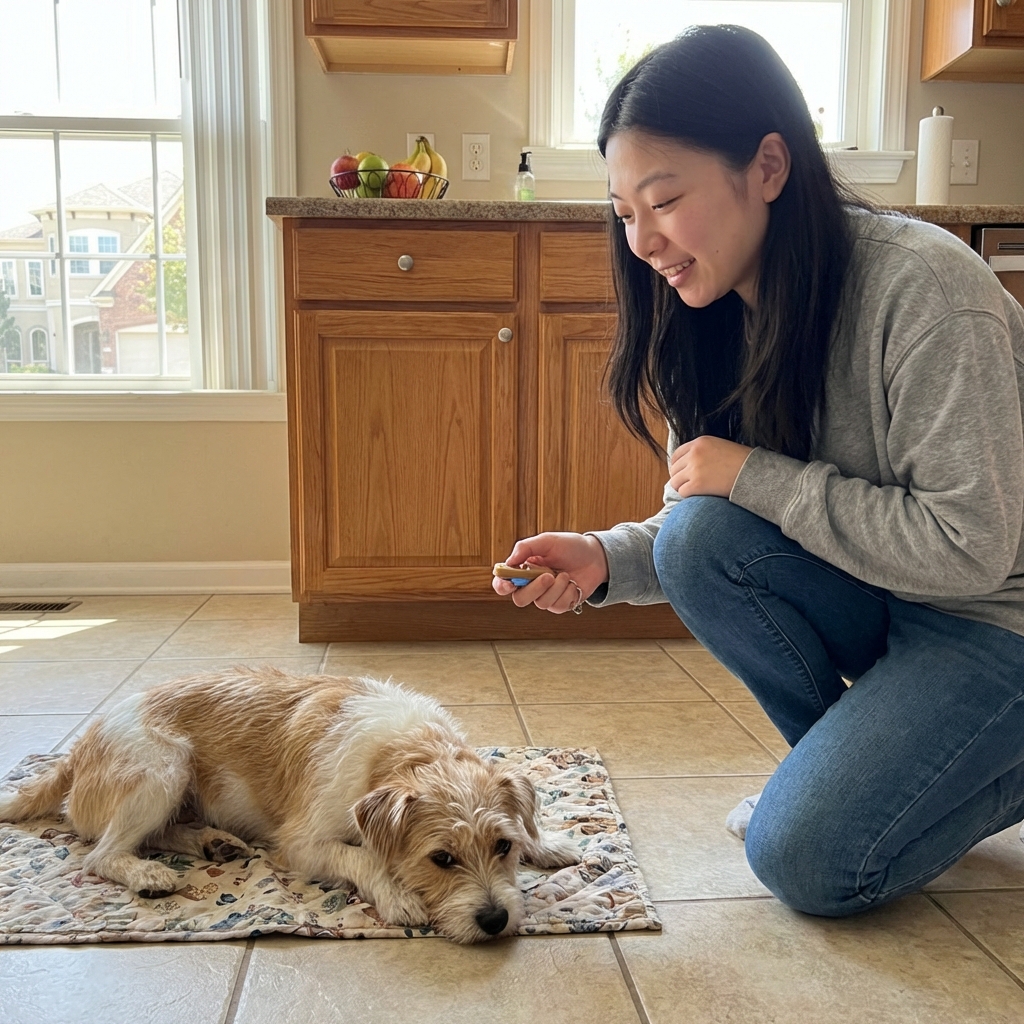
3) Go to mat
- Place a mat on the floor.
- Click when your dog steps on it, then treat on the mat.
- Work up to sitting, then relaxing on the mat.
Troubleshooting
- My dog is scared of the click. Muffle it in your pocket, switch to a quieter clicker, or use a gentle verbal marker like “yes.”
- My dog is getting too excited and nippy. Use calmer treat delivery, take breaks, and reward calm behaviors like sitting or going to a mat.
- My dog stops listening when treats come out. Keep treats out of sight (pouch or pocket), click first, then deliver the treat. Start in an easier environment and keep sessions short.
- I do not want to carry treats forever. You will not have to. Once skills are strong, you can mix treats with praise, toys, and real-life rewards, while still paying well for hard situations.
- I have more than one dog. Train one dog at a time at first. It is faster, clearer, and prevents frustration.
Safety first
Clicker training should feel safe and upbeat for your dog. If your dog is growling, snapping, freezing, or showing big fear reactions, pause training and talk with your veterinarian or a qualified positive-reinforcement trainer. Those signs are communication, and your dog deserves support, not pressure.
The goal is not perfection. The goal is connection, clarity, and a dog who feels confident learning with you.