
Fish Oil for Cats: Benefits, Dosage, and Safety

Fish oil can be a wonderful add-on for many cats, especially if you are trying to support dry skin, a dull coat, or stiff joints. The key is using the right type of omega-3s and the right dose, because more is not better when it comes to supplements.
As a veterinary assistant, I like fish oil because it is one of the more evidence-supported supplements we use in practice, especially for osteoarthritis comfort and some inflammatory skin conditions. That said, the research in cats is smaller than in dogs and people, so I treat it as a helpful tool, not a cure. It should be customized to your cat’s size, diet, and health status. If your cat has kidney disease, a pancreatitis history, is on blood thinners, or is scheduled for surgery, check with your veterinarian before starting.
One real-world note: cats can be picky, and palatability is often the limiting factor. If fish oil makes your cat refuse food, it is not worth fighting.
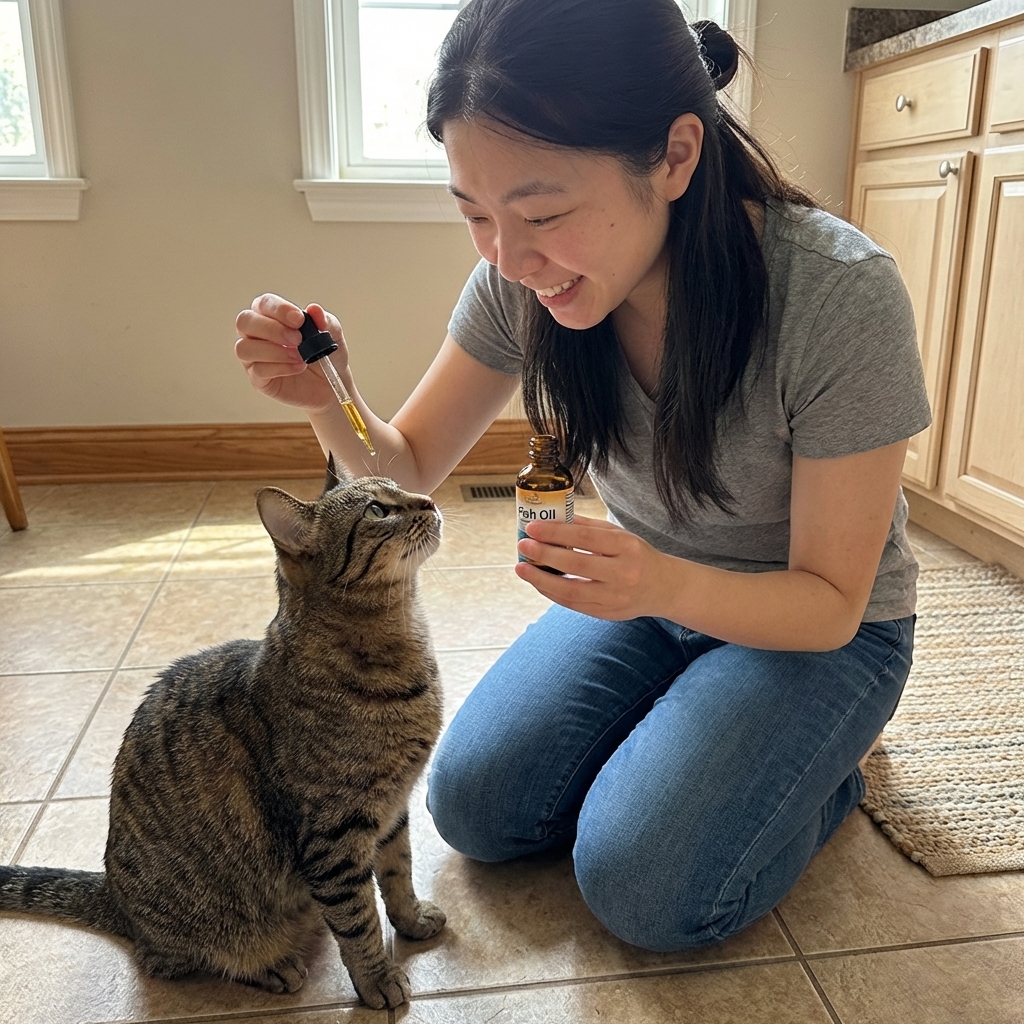
What omega-3s do for cats
Omega-3 fatty acids are a type of fat that the body uses to build cell membranes and help regulate inflammation. In cat supplements, the two most important omega-3s are:
- EPA (eicosapentaenoic acid): Often the main player for inflammation support, including skin allergies and joint comfort.
- DHA (docosahexaenoic acid): Important for brain and eye health, and it also supports anti-inflammatory pathways.
Most fish oil products contain both EPA and DHA, but the amounts vary widely. That is why label-reading matters more than the brand name on the front.
Benefits of fish oil for cats
Skin and coat
If your cat has itchy skin, dandruff, or a coat that looks dry and flat, omega-3s can help support the skin barrier and calm inflammatory itch patterns. It is not a quick fix, though. Most owners notice changes after 4 to 8 weeks of consistent use.
Joints and mobility
Arthritis is common in cats, especially seniors, and it can be subtle. Cats often hide pain by sleeping more, jumping less, or avoiding stairs. EPA and DHA can support healthier inflammatory signaling and may improve comfort when used alongside a vet-approved plan (weight management, joint-friendly activity, and prescribed pain control when needed).
Kidney support
Omega-3s are commonly discussed for kidney disease. In cats with chronic kidney disease (CKD), they may help some cats as part of an overall plan, but kidney outcomes are not consistent across all studies and species. Supplementation should be guided by your veterinarian, since appetite, nausea, and calorie needs can change quickly in CKD.
Heart and immune support
Omega-3s also play a role in cardiovascular and immune health. The biggest day-to-day wins for most cat parents, though, are skin, coat, and mobility.
EPA vs. DHA on labels
When a label says “1000 mg fish oil,” that is not the same as “1000 mg omega-3s.” The number you care about is the amount of EPA + DHA per serving (per capsule or per pump).
- For skin and joint goals: products with higher EPA can be especially useful.
- For general wellness: a balanced EPA and DHA profile is fine.
Action step: turn the bottle around and find the Supplement Facts (or Guaranteed Analysis) and write down the EPA mg and DHA mg per serving. That is what you will use to dose.
Safe dosage by weight
Because studies and veterinary protocols vary by condition, a safe, conservative approach for many generally healthy adult cats is to start around:
- EPA + DHA combined: approximately 20 to 30 mg per pound (45 to 70 mg per kg) per day
Important: therapeutic dosing for issues like arthritis, allergic skin disease, or CKD can differ and should follow your veterinarian’s specific recommendation, especially if your cat is medically complex.
Below are easy “starting range” totals for EPA + DHA combined per day.
- 5 lb cat: 100 to 150 mg daily
- 8 lb cat: 160 to 240 mg daily
- 10 lb cat: 200 to 300 mg daily
- 12 lb cat: 240 to 360 mg daily
- 15 lb cat: 300 to 450 mg daily
How to start: begin with about half the target dose for 5 to 7 days, then increase if stools stay normal. Cats are sensitive to diet changes, and slow is usually smoother.
Helpful tip: many human fish oil capsules are far too large for cats, and the EPA + DHA content may overshoot a cat dose. Pet-specific liquids or small softgels are often easier to measure accurately.
Quick label math example
If a capsule contains 180 mg EPA + 120 mg DHA, that is 300 mg EPA + DHA total. For a 10 lb cat starting around 200 mg/day, that is about two-thirds of that capsule. This is why many cat parents prefer a liquid or a smaller softgel for easier measuring.
Fish oil vs. krill vs. algae
Fish oil
- Pros: widely available, typically cost-effective, strong evidence base, often higher EPA and DHA per serving.
- Cons: can cause fishy breath or GI upset, quality varies. Needs good sourcing and oxidation control.
Krill oil
- Pros: omega-3s are largely phospholipid-bound, which may affect absorption. Often includes astaxanthin (an antioxidant).
- Cons: typically more expensive and usually provides lower EPA + DHA per serving, so dosing can be tricky. Comparative data in cats is limited.
Algae oil
- Pros: sustainable, fish-free, useful for cats that refuse fish products or for owners avoiding marine animal sources.
- Cons: often DHA-heavy with less EPA, so it may not match skin or joint goals as well unless it is formulated with enough EPA.
Bottom line: for most cats, a high-quality fish oil product with clearly stated EPA and DHA amounts is the most straightforward option. For cats that cannot tolerate fish oil, algae oil is a solid alternative if the label supports your target EPA + DHA dose.

Choosing a quality omega-3
Quality matters because omega-3 fats can oxidize (go rancid), and rancid oils can cause stomach upset and may reduce benefits.
- Look for transparency: EPA and DHA listed in mg per serving.
- Prefer pet-formulated dosing: easier to measure small amounts accurately.
- Choose added Vitamin E: long-term polyunsaturated fatty acid supplementation can increase Vitamin E needs. Look for Vitamin E on the label (often listed as d-alpha tocopherol or mixed tocopherols).
- Ask for proof of testing: third-party testing (for example IFOS, USP, NSF) or a certificate of analysis for oxidation and heavy metals is a plus.
- Check freshness practices: darker bottles, nitrogen-flushed packaging, or other anti-oxidation steps are helpful.
- Smell test: fish oil should not smell strongly rotten or paint-like.
- Storage: keep tightly closed, away from heat and sunlight. Some liquids are best refrigerated after opening. Follow the label.
Safety note: do not swap in fish liver oils (like cod liver oil) as a “fish oil equivalent.” Fish liver oils can be high in vitamins A and D and can create a different safety risk than standard fish body oil.
If your cat eats a therapeutic veterinary diet for a medical condition, ask your vet before adding omega-3s. Some diets already include targeted fatty acid levels.
Signs of too much
Omega-3s are generally safe, but excessive dosing can cause problems. Watch for:
- Diarrhea or greasy stools
- Vomiting or decreased appetite
- Weight gain (fish oil adds calories)
- Fishy breath that is new or strong
- Easy bruising or bleeding (uncommon at typical doses, but omega-3 effects on platelet function are dose-dependent and matter more if your cat is on blood-thinning meds)
If you notice these signs, stop the supplement and call your veterinarian for guidance. Many times, the fix is simply lowering the dose or switching the product form.
Who benefits most
Senior cats
Older cats commonly deal with arthritis, reduced grooming, and dry coat changes. Omega-3s can be a gentle support tool, especially when combined with weight management and veterinary pain control when needed.
Cats with kidney disease
CKD cats may benefit from omega-3 support, but dosing should be coordinated with your veterinarian. These cats can be more sensitive to appetite changes, nausea, and fat intolerance.
Cats with itchy skin
If fleas are controlled and your vet has ruled out parasites and infection, omega-3s can be part of an itch plan that may also include diet trials, medications, and environmental allergy management.
Cats on low omega-3 diets
Many indoor cats eat the same food daily for years. If that diet is low in omega-3s, supplementation can help balance fatty acids, especially if you are working on coat and skin goals.
How to give fish oil
- Mix into wet food: start with a tiny amount and increase slowly.
- Use a measured pump or dropper: accuracy is everything with small pets.
- Split the dose: morning and evening can be easier on the stomach.
- Try a different form: some cats do better with small softgels than liquids, or vice versa.
If your cat refuses food when fish oil is added, stop and regroup. A supplement that ruins appetite is not helping, especially for seniors and CKD cats.
Talk to your vet first
Please check in with your veterinarian before supplementing if your cat:
- Has chronic kidney disease, pancreatitis, or significant GI disease
- Has a known or suspected fish allergy (rare, but possible)
- Is on anticoagulants or antiplatelet medications or has a bleeding disorder
- Is taking long-term NSAIDs or steroids
- Is scheduled for a dental or surgery
- Is a kitten, pregnant, or nursing
If you do one thing today, make it this: dose based on EPA + DHA, not “total fish oil.” That one habit prevents most omega-3 mistakes I see.