A clear, vet-backed guide to canine Cushing’s disease: types, diagnosis tests, trilostane vs mitotane, surgery options, home care routines, recheck schedul...
Article
•
Designer Mixes
Dog Cushing’s Disease Symptoms: Facts Every Owner Should Know

Shari Shidate
Designer Mixes contributor
Cushing’s disease in dogs can feel sneaky. It often starts with small changes that are easy to blame on “getting older” or “being extra hungry lately.” But Cushing’s, also called hyperadrenocorticism, is a real medical condition where your dog’s body is exposed to too much cortisol over time.
As a veterinary assistant, I’ve seen how much better dogs do when owners recognize the patterns early, ask the right questions, and follow through with testing. Let’s walk through the symptoms and facts every pet-lover should know.
What is Cushing’s disease in dogs?
Cortisol is a normal hormone made by the adrenal glands. It helps regulate stress response, blood sugar, inflammation, and more. In Cushing’s disease, the body produces (or is exposed to) too much cortisol, and over time that can affect nearly every organ system.
The three main types
- Pituitary-dependent Cushing’s (PDH): The most common type. A pituitary tumor (usually benign, often a microadenoma) tells the adrenal glands to make excess cortisol.
- Adrenal-dependent Cushing’s (ADH): A tumor in an adrenal gland produces too much cortisol. This is often one-sided, but your vet will check both adrenal glands during the workup.
- Iatrogenic Cushing’s: Caused by long-term or high-dose steroid medications (like prednisone). This is one reason veterinarians are so careful with steroid dosing and tapering.
Most dogs diagnosed are middle-aged to senior, but age alone should never be the only explanation for major body changes.
Most common symptoms
These are the classic signs that make many vets think, “We should test for Cushing’s.” Your dog does not need to have every symptom to have the disease.
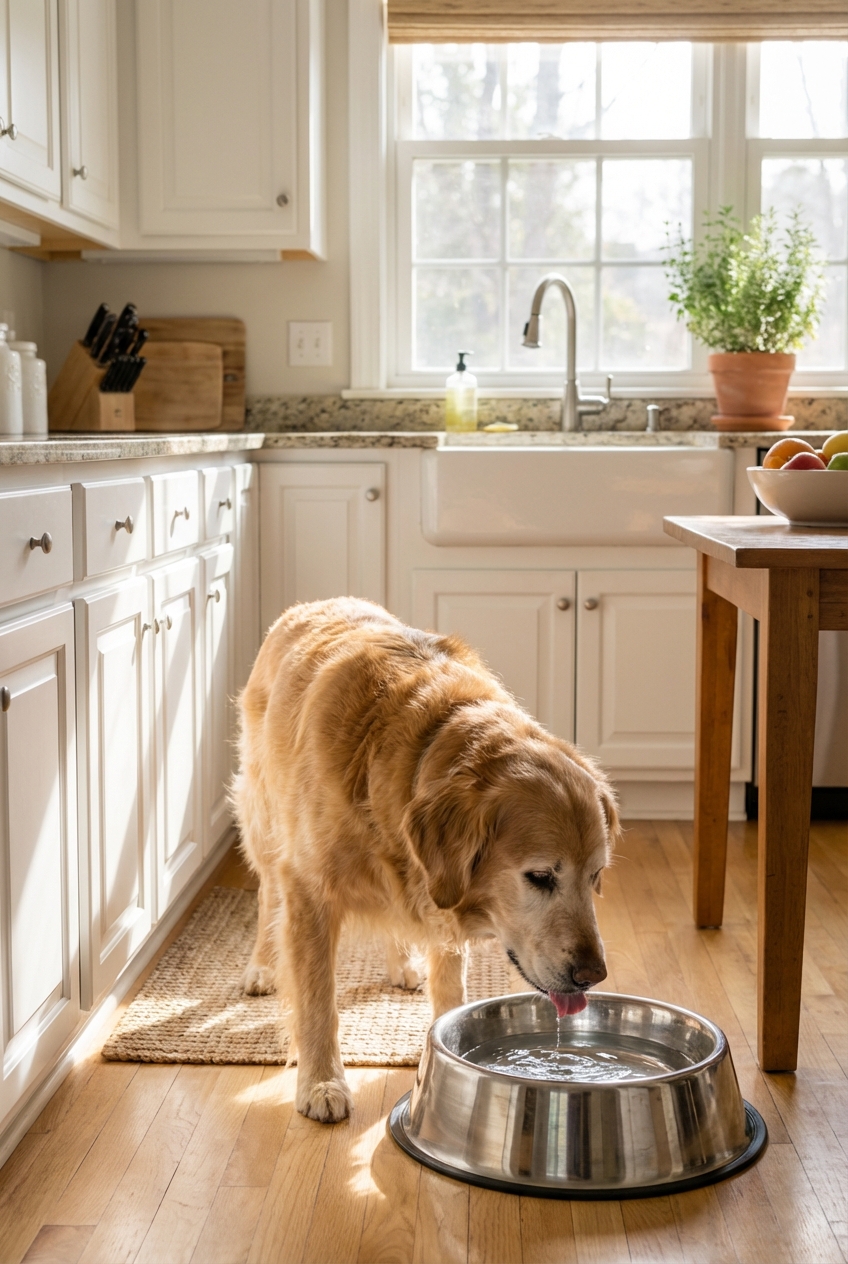
- Increased thirst (polydipsia): Emptying the water bowl faster than usual or seeking out extra water sources.
- Increased urination (polyuria): Larger urine puddles in the yard, longer urination times, needing more potty breaks, or new accidents in the house.
- Increased appetite (polyphagia): Acting “starving,” stealing food, counter surfing, getting pushy around meals.
- Pot-bellied appearance: A rounded abdomen caused by muscle weakness, fat redistribution, and often an enlarged liver.
- Panting: Especially at rest or in mild temperatures.
- Low energy: Less interest in walks, playing, stairs, or jumping into the car.
Skin and coat clues
Cushing’s is one of those conditions where the skin often tells a story. Cortisol affects hair growth, the immune system, and the skin’s ability to repair itself.
- Hair thinning or hair loss: Often on the sides of the body, neck, or tail, sometimes symmetrical.
- Recurrent skin infections: Bacterial or yeast infections that keep coming back.
- Thin skin: Skin may bruise easily or tear more easily than expected.
- Slow hair regrowth: After shaving for surgery or grooming.
- Blackheads or darkened skin: Sometimes noticed on the belly.
If your dog keeps getting skin issues that do not fully resolve, it is worth asking if Cushing’s could be contributing.
Less obvious symptoms
Some signs are easy to miss because they seem unrelated or develop slowly.
- Muscle weakness: Shaky back legs, trouble rising, or reduced stamina.
- Frequent urinary tract infections: Sometimes without obvious symptoms.
- Changes in behavior: Restlessness, increased anxiety, or disrupted sleep due to panting and thirst.
- High blood pressure: Not visible at home, but can be detected at the vet.
- Elevated liver enzymes: Often found on routine bloodwork.
If you are seeing “thirst + hunger + pot belly,” do not wait it out. That combination is a strong reason to schedule a veterinary visit.
Which dogs are at higher risk?
Any dog can develop Cushing’s, but it is diagnosed more often in:
- Middle-aged and senior dogs
- Small to medium breeds (PDH is common here)
- Dogs with a history of long-term steroid use
Mixed breeds can absolutely get Cushing’s too. In practice, I remind owners that breed can shift risk, but it never removes it.
How Cushing’s is diagnosed
Cushing’s is not a one-test-fits-all diagnosis. Your veterinarian will typically start with a physical exam and baseline labs, then choose specific hormone tests based on your dog’s history and results.
Common first steps
- Bloodwork and urinalysis: Helps evaluate liver values, cholesterol, blood sugar, infection, and urine concentration.
- Urine culture: UTIs can be silent in dogs with Cushing’s.
Common screening tests
- ACTH stimulation test: Measures adrenal response to stimulation. It is used for diagnosis in some cases and is commonly used to monitor dogs on treatment (especially trilostane).
- Low-dose dexamethasone suppression test (LDDST): A common screening test and often considered more sensitive for naturally occurring Cushing’s.
- Urine cortisol:creatinine ratio: Can be useful as an initial screen, but it is not definitive on its own.
Imaging
- Ultrasound: Helps evaluate adrenal glands, liver size, and other abdominal organs.
- Advanced imaging: CT or MRI may be recommended in complex cases, especially when a tumor is suspected.
If results are borderline or your dog is stressed or ill during testing, your vet may repeat testing. That can feel frustrating, but it is often the safest way to get the right answer.
What else could it be?
Cushing’s shares symptoms with several other common conditions. Increased thirst and urination, for example, can also be seen with diabetes, kidney disease, urinary tract infection, liver disease, and some medications (including steroids). That is why testing matters more than guessing.
Why treatment matters
Untreated Cushing’s can increase the risk of complications over time, including:
- Recurrent infections (skin and urinary)
- High blood pressure
- Increased risk of blood clots (in some dogs)
- Pancreatitis
- Diabetes mellitus
- Reduced muscle mass and mobility
The goal of treatment is not only “better lab numbers.” It is a better quality of life: less thirst, fewer accidents, improved comfort, stronger muscles, and healthier skin.
Treatment basics
Treatment depends on the type of Cushing’s and your dog’s overall health.
Medication
- Trilostane: Commonly used to reduce cortisol production. Requires monitoring and dosage adjustments.
- Mitotane: Used in some cases; your vet will advise based on the situation.
With either approach, monitoring is essential. The “right dose” is very individual, and follow-up tests help keep your dog safe.
Surgery
- Adrenal tumor surgery: May be recommended for certain adrenal-dependent cases, depending on tumor type, location, and surgical risk.
If steroids caused it
- Medication adjustment: Never stop steroids abruptly unless your veterinarian instructs you to. A gradual taper is often necessary to prevent serious complications.
After diagnosis
Most dogs with PDH are managed long-term with medication and rechecks. Many owners notice improvements like less thirst, fewer accidents, and less panting first, while coat and muscle changes can take longer.
Your veterinarian will tell you the recheck schedule for your dog, but expect follow-up blood tests and dose tweaks early on. This is normal, not a sign you are doing anything wrong.
What you can do at home
Even before a diagnosis, you can become your dog’s best advocate with simple tracking. This helps your veterinarian and helps you see patterns clearly.
- Measure water intake: For a few days, measure how much you pour in and how much is left. Note extra water sources (like outdoor bowls).
- Track potty habits: More frequent urination, accidents, or noticeably larger urine volume.
- Take monthly photos: A clear side view and top view can show belly changes and hair loss over time.
- Write down hunger behaviors: Begging intensity, food stealing, scavenging.
- Record panting and sleep: Panting at rest, nighttime restlessness.
Bring this information to your appointment. It can make the diagnostic path much faster and more accurate.
When to call the vet urgently
These urgent signs can happen in any dog, including dogs with suspected or treated Cushing’s:
- Sudden collapse, severe weakness, or extreme lethargy
- Vomiting or diarrhea that does not resolve
- Not eating, or acting painful in the belly
- Inability to urinate, straining without producing urine, or signs of a urinary blockage
- Severe panting with distress
Important safety note: If your dog is currently taking Cushing’s medication (especially trilostane or mitotane) and suddenly seems very weak, collapses, vomits repeatedly, has diarrhea, or will not eat, do not give the next dose and call your veterinarian or an emergency clinic right away. These can be signs that cortisol has been lowered too much and your dog needs immediate guidance.
A hopeful note
Cushing’s can be a lot to process, but many dogs do very well with proper monitoring and treatment. If your gut tells you something has changed, trust that instinct. You know your dog best, and your observations are powerful medical data.
If you are concerned, schedule a vet visit and ask directly about Cushing’s testing. It is one of those conditions where asking one good question can make a big difference.
Quick facts
- Cushing’s disease means the body is exposed to too much cortisol over time.
- Most common signs include increased thirst, increased urination, increased appetite, panting, pot belly, and coat changes.
- Diagnosis often requires a combination of lab work, hormone testing, and sometimes ultrasound.
- Treatment commonly involves medication and regular monitoring.
- Early recognition can improve comfort and reduce complications.