Is your cat yowling, restless, and trying to escape? Learn the signs and length of heat, calming care strategies, training tips, what to avoid, and why spayi...
Article
•
Designer Mixes
Do Cats Get Their Period?

Shari Shidate
Designer Mixes contributor
If you have ever noticed your female cat acting extra affectionate, vocal, or restless and wondered, “Is she on her period?” you are not alone. This is one of the most common questions I hear as a veterinary assistant. The short, science-based answer is this: cats do not get a period the way humans do. Instead, they go through a reproductive cycle called estrus , which simply means they are “in heat.”
Understanding what is normal during heat, what is not, and what you can do to keep your cat comfortable can save you a lot of worry and help your cat stay healthier long-term.
Quick note: This article is general education from a clinic perspective and is not a substitute for veterinary care. If something seems off, call your veterinarian.
Period vs. heat
In humans, a “period” happens when the uterine lining sheds, causing noticeable bleeding.
Most cats are seasonally polyestrous, meaning they have repeated heat cycles during certain times of the year (typically when days are longer). Cats also have a key difference from humans: they are usually induced ovulators. That means ovulation most often happens after mating.
One nuance I like to mention from the clinic side: while mating is the most common trigger, some cats can ovulate from other intense stimulation, and a small minority may ovulate spontaneously. It is not the norm, but it is a real exception.
Do cats bleed in heat?
Typically, no. Most cats in heat do not have visible bleeding. If you see blood on bedding, around the vulva, or in the litter box, it is worth calling your veterinarian because it can signal a medical problem rather than a normal heat cycle.
Signs of heat
Heat is more about behavior than bleeding. Some cats are subtle, while others are very dramatic.
- Increased vocalizing (loud meowing or yowling, often at night)
- Extra affection (rubbing on people, furniture, or doorframes)
- Rolling on the floor and stretching frequently
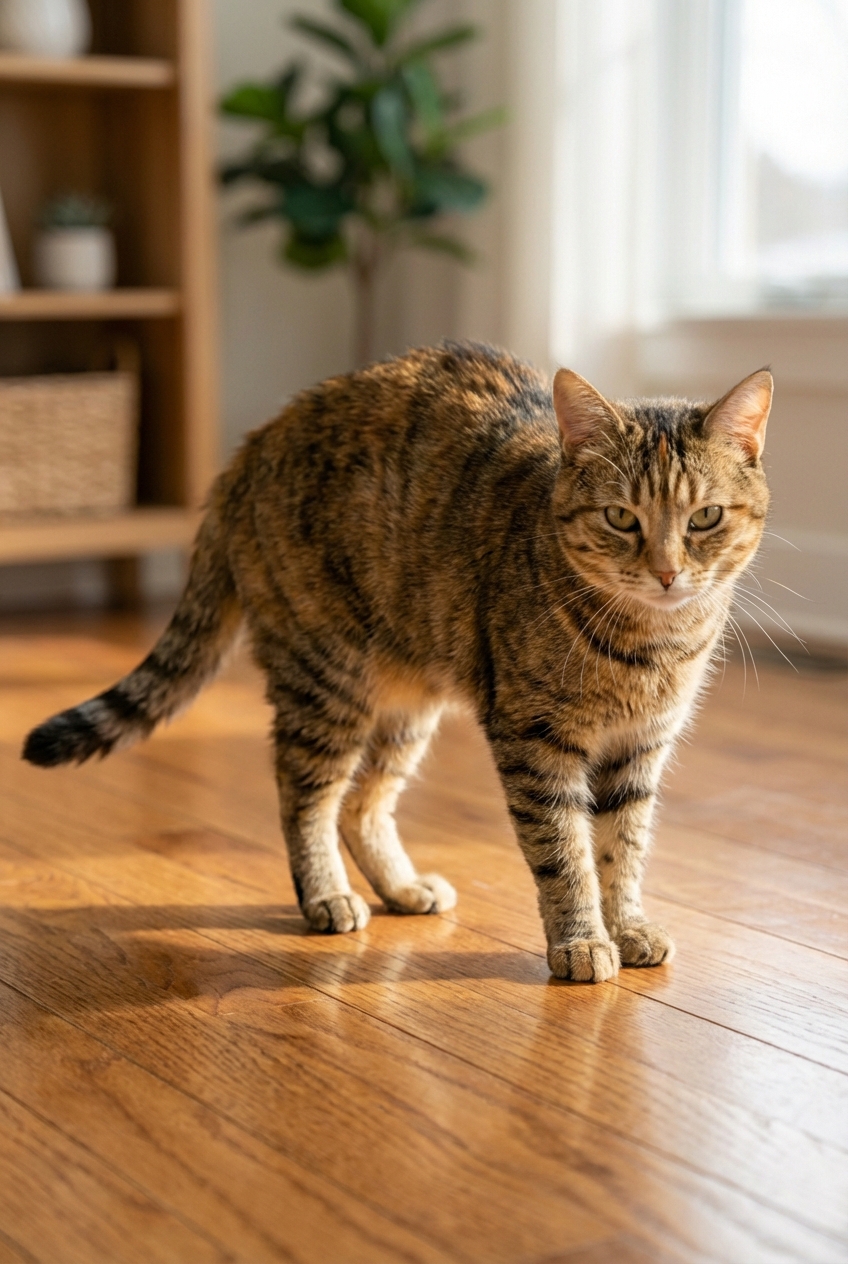
- Mating posture: rear raised, back arched, tail to the side
- Restlessness and pacing
- Trying to escape outdoors to find a mate
- Decreased appetite in some cats
- Spraying urine or more frequent urination in some cats
If you are thinking, “This does not look like a period,” you are not wrong. Those behaviors are driven by hormones and are your cat’s way of advertising that she is receptive.
Pregnancy reminder: Cats can become pregnant quickly once they are in heat. If you are not planning kittens, keep her indoors, even for quick door openings.
Timing and duration
Many cats have their first heat cycle around 4 to 9 months of age, depending on breed, season, body condition, and whether they live indoors with lots of artificial light.
General timelines (these can vary):
- Estrus (heat) : commonly 4 to 10 days, sometimes longer
- Time between heats: often 1 to 3 weeks if she does not mate
- Seasonality: more frequent cycles in spring and summer, but indoor cats can cycle year-round
This is why heat can feel never-ending. During breeding season, if a cat is not spayed and does not become pregnant, the cycle can repeat again and again.
Brief cycle stages (why it repeats)
If you like the science: the cycle is often described as proestrus (early signs), estrus (heat), interestrus (time between heats), and anestrus (resting phase, more common in shorter-day months). If ovulation occurs, some cats enter diestrus .
Is blood normal?
A small amount of discharge is not common during feline heat. When it does happen, it is usually clear or slightly cloudy, and it should not be foul-smelling or bloody.
Visible blood is not considered normal for most cats and should be taken seriously.
Call your veterinarian promptly if you notice:
- Blood or pus-like discharge from the vulva
- A bad smell from the discharge
- Straining to urinate or crying in the litter box
- Urinating outside the box with signs of pain
- Lethargy, fever, vomiting, or reduced appetite
- Increased thirst or a swollen belly
One major reason we worry about unspayed females is pyometra, a potentially life-threatening uterine infection that can occur after a heat cycle. It is more common in older intact females, but it can occur in younger cats too. It is treatable, but it is an emergency.
Other reasons you might see blood
Blood in or near the litter box is also commonly linked to issues like urinary tract infection, feline idiopathic cystitis (bladder inflammation), bladder stones, or trauma. This is exactly why a quick vet check is a smart move instead of assuming it is heat-related.
Helping a cat in heat
Your cat is not being “bad” when she is yowling or rolling around. She is responding to normal hormonal signals. Here are ways to help without risking her safety:
- Keep her indoors and double-check doors and windows. Cats in heat are motivated escape artists.
- Add play sessions with wand toys to burn off restless energy.
- Offer a warm, cozy spot like a heated cat bed (on a safe, low setting) or a warm blanket.
- Provide enrichment like puzzle feeders and scratching posts.
- Keep the litter box extra clean, since some cats urinate more frequently during this time.
A quick note from the clinic side: avoid giving human pain relievers or leftover pet medications. Many common household meds are toxic to cats, and heat is not pain in the same way an injury is.
Spaying
Spaying prevents heat cycles and pregnancy, but it also comes with important health benefits. In my experience working around veterinarians, spaying is one of the most protective choices you can make for a female cat.
- Stops heat behaviors and the stress they cause
- Prevents pyometra (uterine infection)
- Substantially lowers the risk of mammary cancer, especially when done before the first heat
- Helps reduce roaming and escape behavior
Many clinics recommend spaying around 4 to 6 months , but the best timing depends on your cat’s age, weight, overall health, and lifestyle. Your veterinarian can guide you based on what fits your situation.
Quick FAQs
Can a spayed cat go into heat?
Typically no. If a spayed cat shows heat-like behaviors, it is uncommon but possible (for example, if a small amount of ovarian tissue remains). A vet exam is the right next step.
Do male cats have anything like a period?
No. Male cats do not have estrus cycles. However, they can react strongly to a female in heat by yowling, spraying, pacing, and trying to get outside.
Does my cat need to mate to feel better?
No. Mating can lead to pregnancy and does not solve the repeating cycle long-term. Spaying is the most reliable way to stop heat cycles.
When to call the vet
If your cat is simply vocal, affectionate, and restless, she may be in heat. But if you see bleeding, a bad-smelling discharge, signs of pain, or sudden illness, call your veterinarian right away. When it comes to reproductive and urinary issues in cats, it is better to be cautious and get answers early.
Your cat depends on you to notice the small changes. With a little understanding and a solid plan, you can keep her comfortable now and protected for the future.