
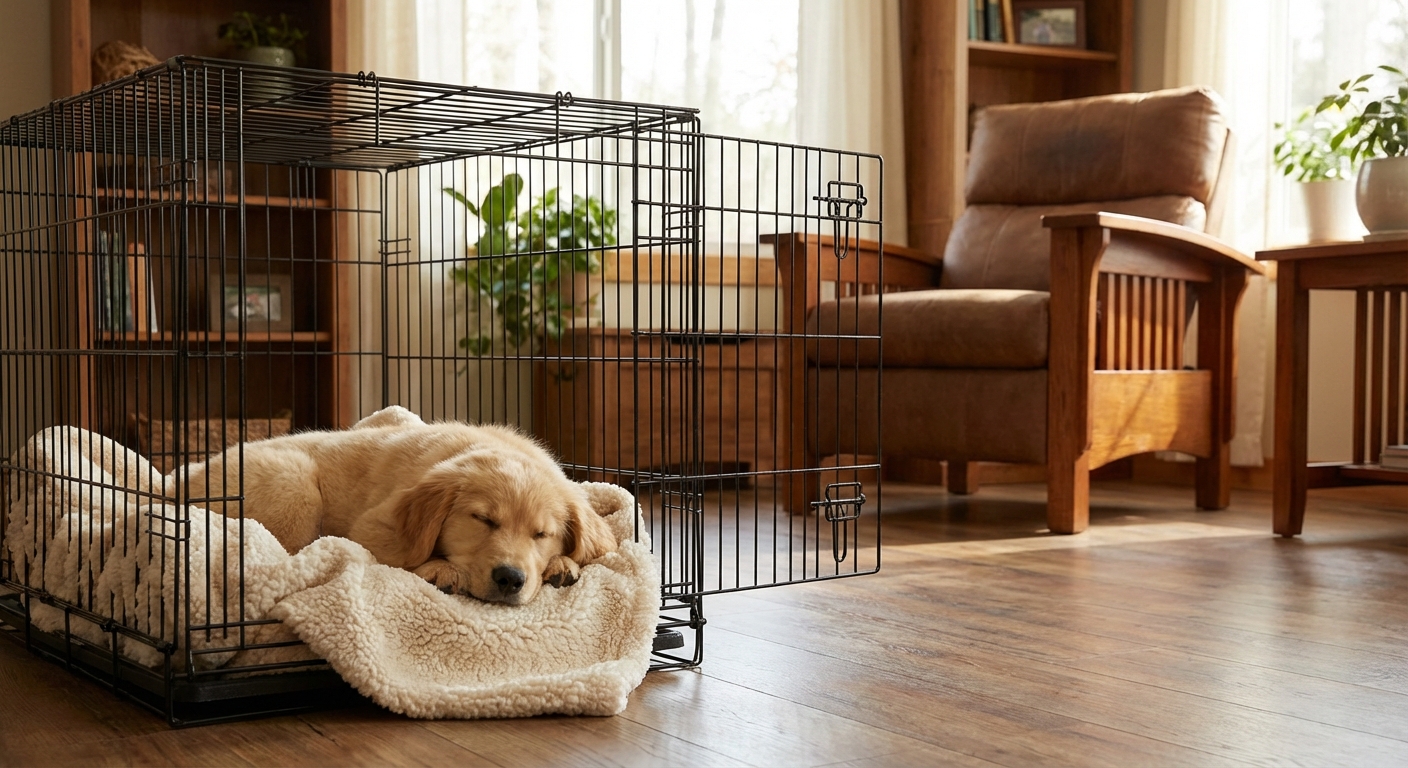
Learn a vet-backed, step-by-step puppy crate training routine for the first 14 days. Includes setup tips, daily schedules, night training, time limits, and t...
Article
•
Designer Mixes
Crate Training Schedule for Puppies and Adults

Shari Shidate
Designer Mixes contributor
Crate training is one of the kindest, most practical skills you can teach a dog. Done well, the crate becomes a calm, predictable “den” that supports house training, prevents unsafe chewing, and makes travel and vet visits less stressful. Done too fast, it can feel like confinement and create anxiety.
As a veterinary assistant in Frisco, Texas, I see crate training work beautifully when families follow two principles widely recommended by veterinary behaviorists and positive-reinforcement trainers: make the crate a place where good things happen and increase crate time gradually. Below you will find realistic schedules for puppies and adult dogs, plus simple adjustments for your home and your dog’s comfort level.
What you will need
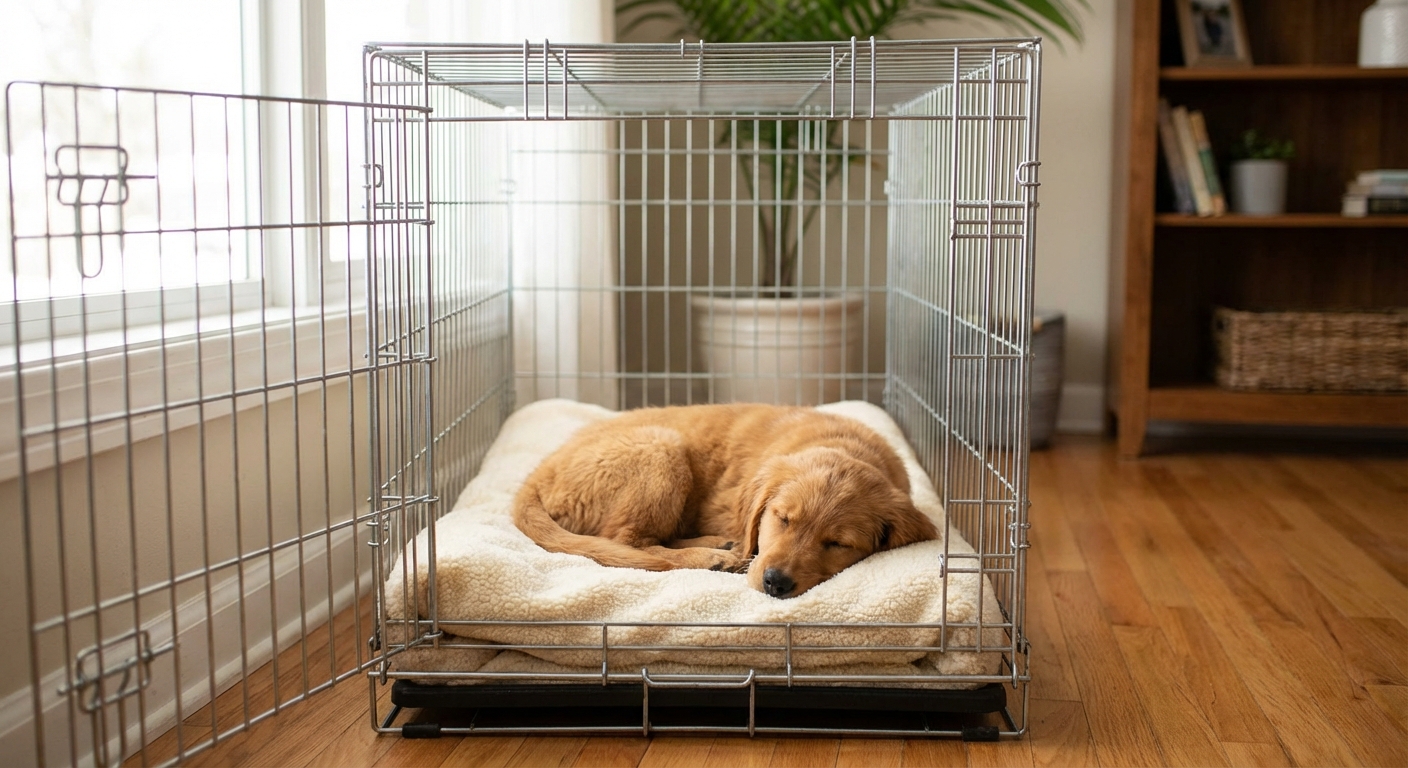
- A properly sized crate (with a divider if needed)
- Pea-sized treats and your dog’s regular food
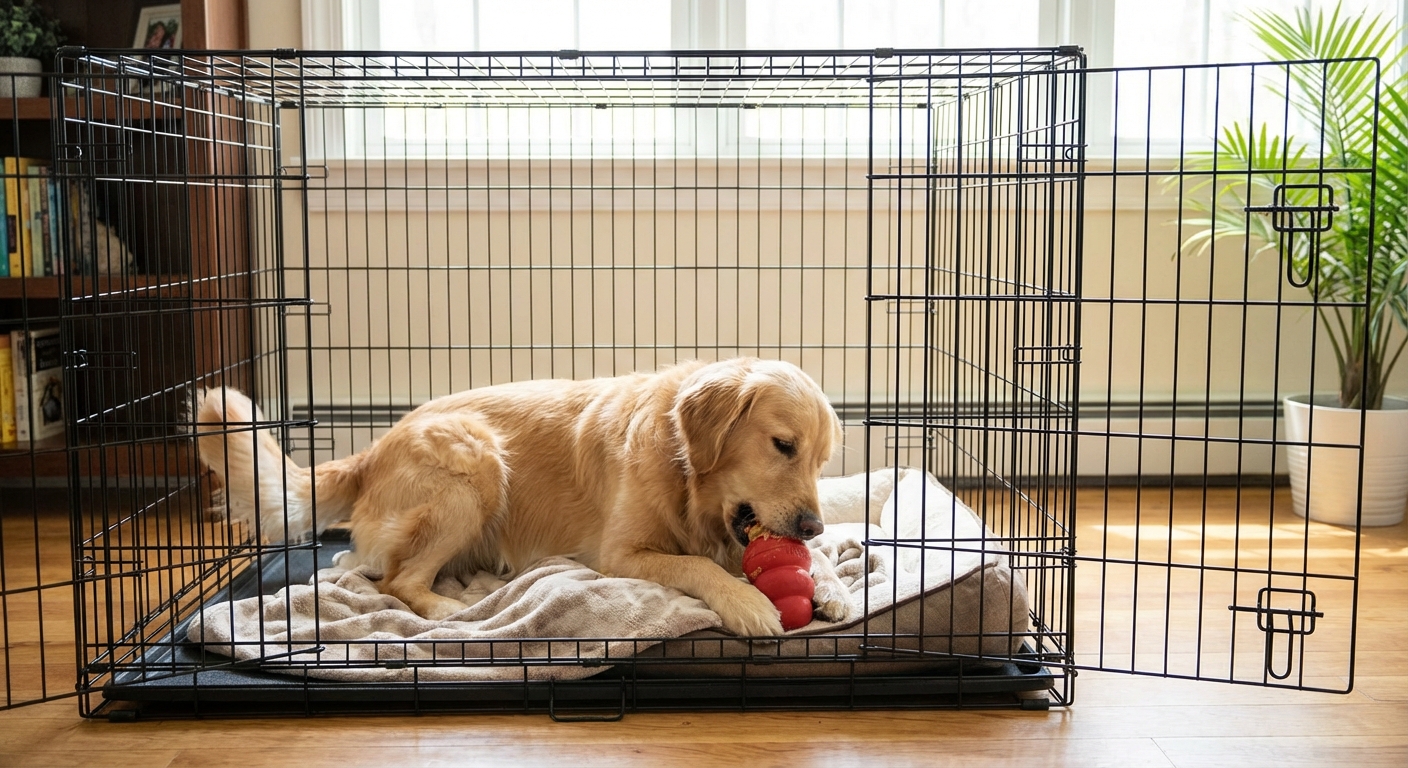
- A stuffed food toy (for example, a rubber toy you can freeze)
- Safe chews you trust your dog with
- Enzymatic cleaner for accident cleanup
- A simple timer or notes app to track potty times for a few days
Before you start: set the crate up for success
Pick the right crate and location
- Size: Your dog should be able to stand up, turn around, and lie down comfortably. For house training, too much extra room can lead to pottying in one corner.
- Location: Start in a family area where your dog can see and hear you. Many puppies do best with a second crate or a safe sleep setup in the bedroom for the first weeks.
- Type: Wire crates offer airflow and visibility. Plastic airline-style crates feel more den-like. Either can work if the training is gentle and consistent.
Make the crate inviting
- Bedding: Use a washable mat or blanket. If your dog shreds fabric or eats bedding, switch to a chew-resistant mat or go without bedding temporarily.
- Water: For long crating periods, consider a crate-mounted water bowl. For short naps, many dogs do fine without it in a comfortable indoor temperature, but always prioritize water access in warm rooms, after exercise, and for dogs who are prone to overheating.
- Chews and food toys: Stuffed food toys (like a frozen rubber toy) can turn crate time into “snack and relax” time. Choose items that match your dog’s chew style and supervise until you know they are safe with that toy.
Safety note: Remove collars with tags when your dog is unsupervised in a crate to reduce snag risk. Keep the crate away from cords, direct heat, and vents blowing hot air. Never attach a leash (including retractable or long lines) to a crate. Avoid leaving high-risk chew items unattended if your dog tends to gulp or break pieces off.
How long can dogs stay in a crate?
These are general guidelines for healthy dogs, assuming your dog has had exercise, a potty break, and something appropriate to chew. Individual needs vary by size, age, health, and prior crate experience. Seniors, dogs with medical conditions, and dogs on certain medications may need more frequent potty breaks and should follow your veterinarian’s guidance.
Puppy rule of thumb
A common rule of thumb is that many puppies can hold their bladder for about their age in months plus one hour during the day, sometimes longer overnight. This is not a goal and it is not true for every puppy. Smaller puppies, puppies who are awake and active, and puppies in a new environment often need more frequent breaks.
- 8 to 10 weeks: about 1 to 2 hours
- 10 to 12 weeks: about 2 hours
- 3 months: about 3 to 4 hours
- 4 months: about 4 to 5 hours
- 6 months: about 6 hours (some can do a bit longer)
Adult dogs
Many healthy adult dogs do well with 4 to 6 hours of daytime crate time when they have been properly exercised and trained to relax in the crate. While some dogs can go longer, routinely crating for 6 to 8 hours (or more) without a break is tough on many dogs, especially seniors, young adults with high exercise needs, and dogs with GI or urinary issues. If your schedule regularly exceeds that, plan for a midday break or a pet sitter.
Crate time should never replace daily exercise, enrichment, and social time. The crate is a tool, not a lifestyle.
Crate training schedule for puppies (first 2 weeks)
This schedule is designed for a typical puppy who is learning (1) the crate is safe, (2) alone time is temporary, and (3) potty breaks happen outside. Adjust faster or slower based on your puppy’s comfort. If crying escalates into panic (drooling, frantic scratching, trying to escape), you are moving too quickly.
Day 1 to 3: Introduce, then short closes
- Morning: Potty, play, breakfast. Toss a few pieces of kibble into the crate with the door open. Let puppy go in and out.
- Crate session 1 (3 to 5 minutes): Puppy goes in to lick a stuffed toy. Close door briefly while you sit nearby. Open before puppy gets upset.
- Crate session 2 (5 to 10 minutes): Repeat later, same approach.
- Naps: Encourage at least one nap in the crate with you in the same room.
- Night: Sleep crate near your bed. Plan for 1 to 2 overnight potty trips for very young puppies.
Day 4 to 7: Build predictable crate naps
Aim for 2 to 4 crate naps per day, plus nighttime sleep.
- Crate nap target: 30 to 60 minutes each (age and comfort dependent).
- Door closed: Yes, but stay nearby at first.
- Add one “step away” moment: Walk to the kitchen, return, and drop a treat calmly if puppy is quiet.
- Potty routine: Outside after waking, after eating, after play, and about every 1 to 2 hours for young puppies.
Day 8 to 14: Increase calm alone time
- Crate nap target: 60 to 120 minutes (if age appropriate and puppy stays relaxed).
- Practice short departures: 1 to 5 minutes at first, gradually up to 15 to 30 minutes.
- Meals in the crate: Feed at least one meal a day in the crate to keep the association positive.
Sample daily puppy schedule (8 to 12 weeks)
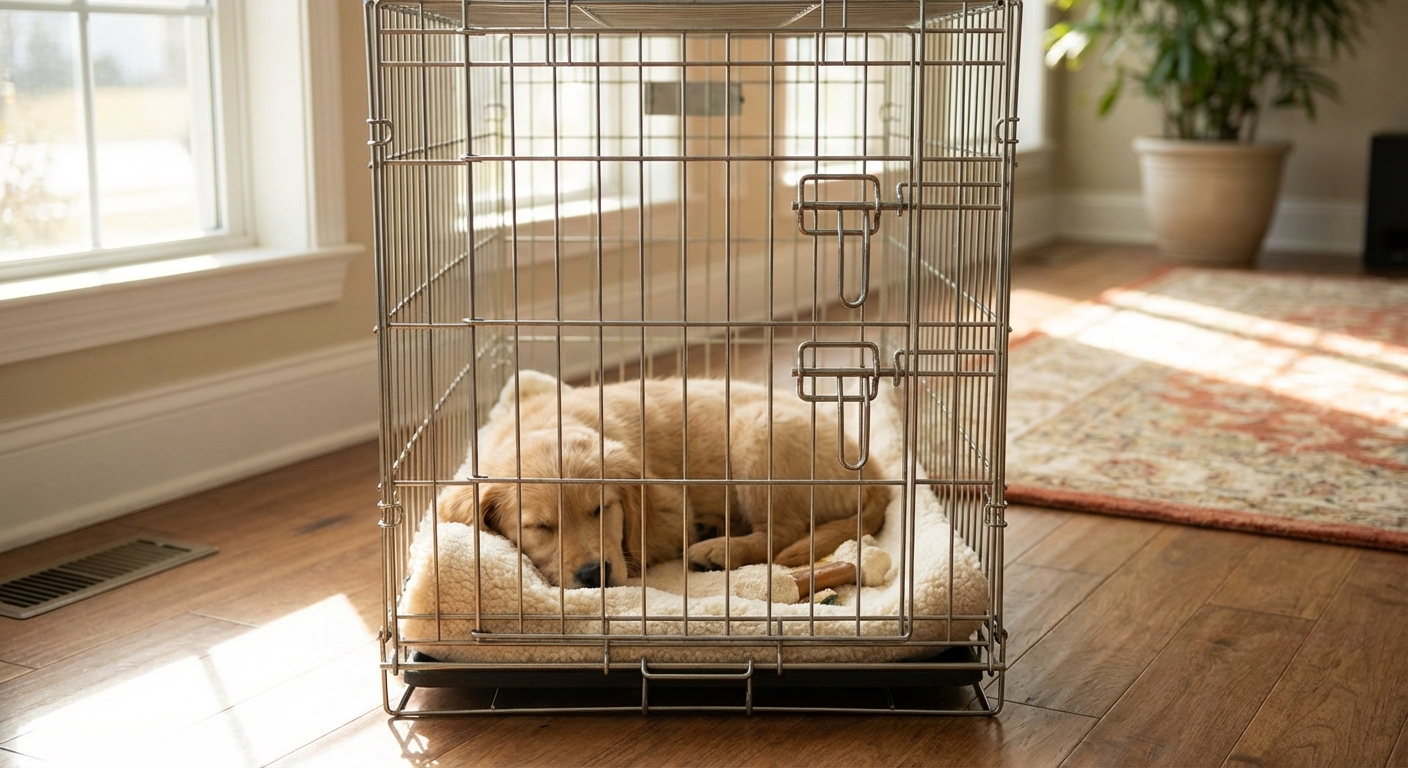
Use this as a flexible rhythm. Puppies thrive on predictable cycles of potty, play, eat, and sleep.
- 6:30 am Potty break
- 6:45 am Breakfast (ideally in the crate), then potty
- 7:15 am Play, training, gentle socialization
- 8:00 am Crate nap (45 to 90 minutes)
- 9:30 am Potty, short play
- 10:00 am Crate time with chew (15 to 30 minutes)
- 10:30 am Potty, supervised free time
- 12:00 pm Lunch, potty
- 12:30 pm Crate nap (60 to 120 minutes)
- 2:30 pm Potty, play, training
- 4:30 pm Dinner, potty
- Evening Alternating supervised time and short crate breaks
- 9:30 to 10:30 pm Final potty, settle for night
Tip: If your puppy gets “bitey” or zoomy, that is often an overtired puppy, not a naughty puppy. A crate nap can be the kindest reset.
How the crate helps with house training
Crates support house training because most dogs avoid soiling their sleeping space. The pattern that works best is simple: crate, out to potty, reward outside, then supervised freedom. When your puppy comes out of the crate, go straight outside, keep it boring until they go, then praise and reward. If nothing happens after a few minutes, back to the crate for a short reset and try again.
For overnight potty trips, keep lights low, use a calm voice, skip playtime, and go straight back to the crate. This helps puppies learn that nighttime is for sleeping.
Crate training schedule for adult dogs
Adults vary widely. A newly adopted adult may have never seen a crate, or they may have a history of being crated too long. Start with a decompression mindset: short, positive sessions that build trust.
Week 1: Comfort first
- Open-door phase: Keep the door open and toss treats in randomly throughout the day.
- Meal strategy: Feed meals at the crate entrance, then just inside, then farther back as comfort grows.
- Short close: Close the door for 10 to 60 seconds while your dog eats a high-value treat, then open.
- Goal: 3 to 5 short sessions daily, ending before stress.
Week 2: Real-life crate periods
- Build to 15 to 30 minutes while you are home and moving around.
- Add predictable routines: “Potty, chew, crate, nap.” Dogs relax when the pattern repeats.
- Practice brief departures: Step outside for 1 minute, then 3, then 5. Return calmly.
Week 3 and beyond: Maintenance
- Use the crate for naps even when you are home, so it does not only predict you leaving.
- Before longer crating: Potty break plus a short walk or play session.
- After crating: Potty break, then calm praise. Avoid huge “we are reunited!” energy if your dog gets overexcited.
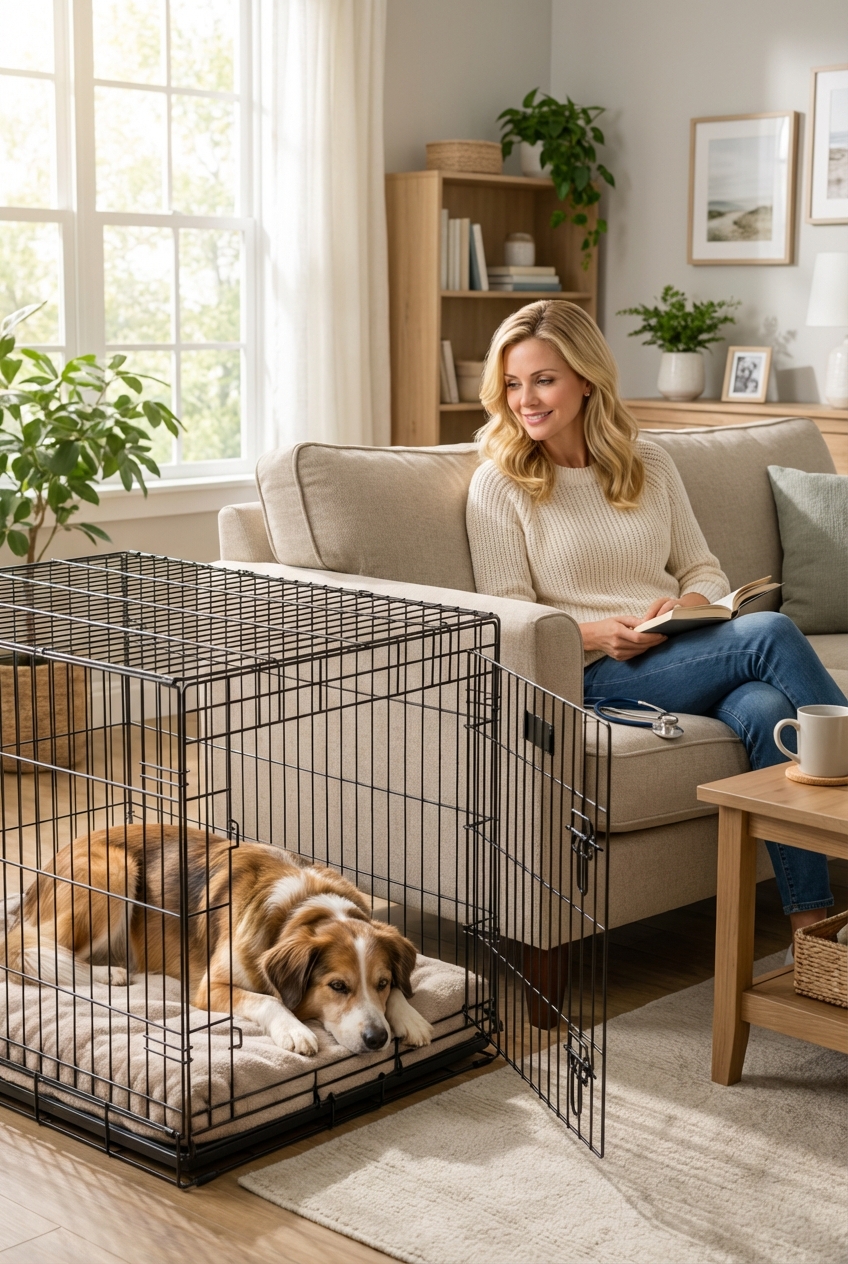
Nighttime crate schedule
Puppies
- Place the crate near your bed for the first 1 to 2 weeks.
- Expect at least one overnight potty trip for young puppies.
- If your puppy wakes and fusses, take them out quietly and briefly, then straight back to the crate.
Adults
- Many adult dogs sleep well crated if they have had adequate exercise and a last potty break.
- If your adult dog is restless, consider whether they need a later walk, a cooler sleeping spot, more airflow, or a different bedding setup.
Common problems and gentle fixes
Crying or barking
- Check needs first: Did they potty recently? Are they too hot? Is the crate in a high-traffic spot that keeps them alert?
- Reward quiet: Wait for a brief pause, then calmly offer a treat or let them out if it is time.
- Go back a step: Shorten crate time and increase value (better chew, meals in crate).
Accidents in the crate
- Recheck crate size (too large is a common issue).
- Increase potty frequency and supervise more closely outside the crate.
- Clean with an enzymatic cleaner to remove odor cues.
Chewing the crate or trying to escape
- Do not “power through” panic. Escaping can cause dental injury or broken nails.
- Talk with your veterinarian or a certified trainer. Some dogs need a different confinement setup and a separation-related plan.
Crate training vs separation anxiety
Crate training helps many dogs feel safe, but it does not automatically “fix” separation anxiety. If your dog panics when alone, adding a closed crate can sometimes make that panic worse. In those cases, a separation anxiety plan is the kindest path forward.
If you suspect separation anxiety (drooling, frantic escape attempts, self-injury, or severe distress), please contact your veterinarian. Treatment often involves behavior work and sometimes medication support, and outcomes can be excellent with a plan.
When not to crate
- Severe distress or panic in the crate, especially if your dog may injure themselves trying to escape
- Extreme heat risk or poor airflow, including garages and hot rooms
- Medical restrictions (post-surgery, orthopedic injuries, breathing issues) without a clear plan from your veterinarian on the safest setup and duration
Action steps you can start today
- Put the crate in a social area and leave the door open.
- Toss 10 pea-sized treats in the crate throughout the day, no fanfare.
- Feed one meal in the crate.
- Do one short “close the door” session paired with a stuffed food toy.
- Track potty times for 48 hours. A predictable potty schedule makes crate training dramatically easier.
With consistency and patience, most dogs learn to settle in their crate faster than you would expect. Start small, celebrate calm moments, and build from there.
References: For additional, science-forward guidance, see the American Veterinary Society of Animal Behavior (AVSAB) resources on humane training and behavior, and talk with your veterinarian if you have concerns about anxiety or safe confinement.