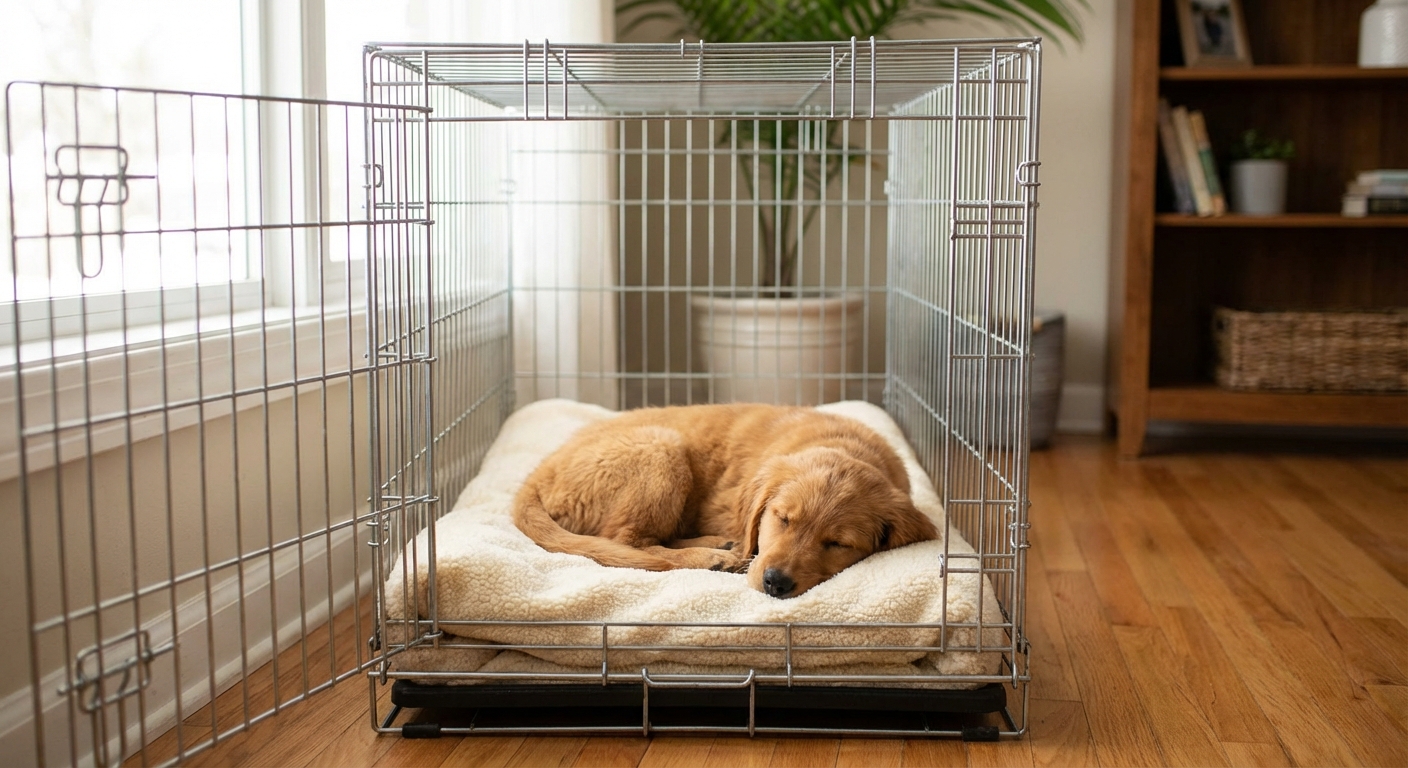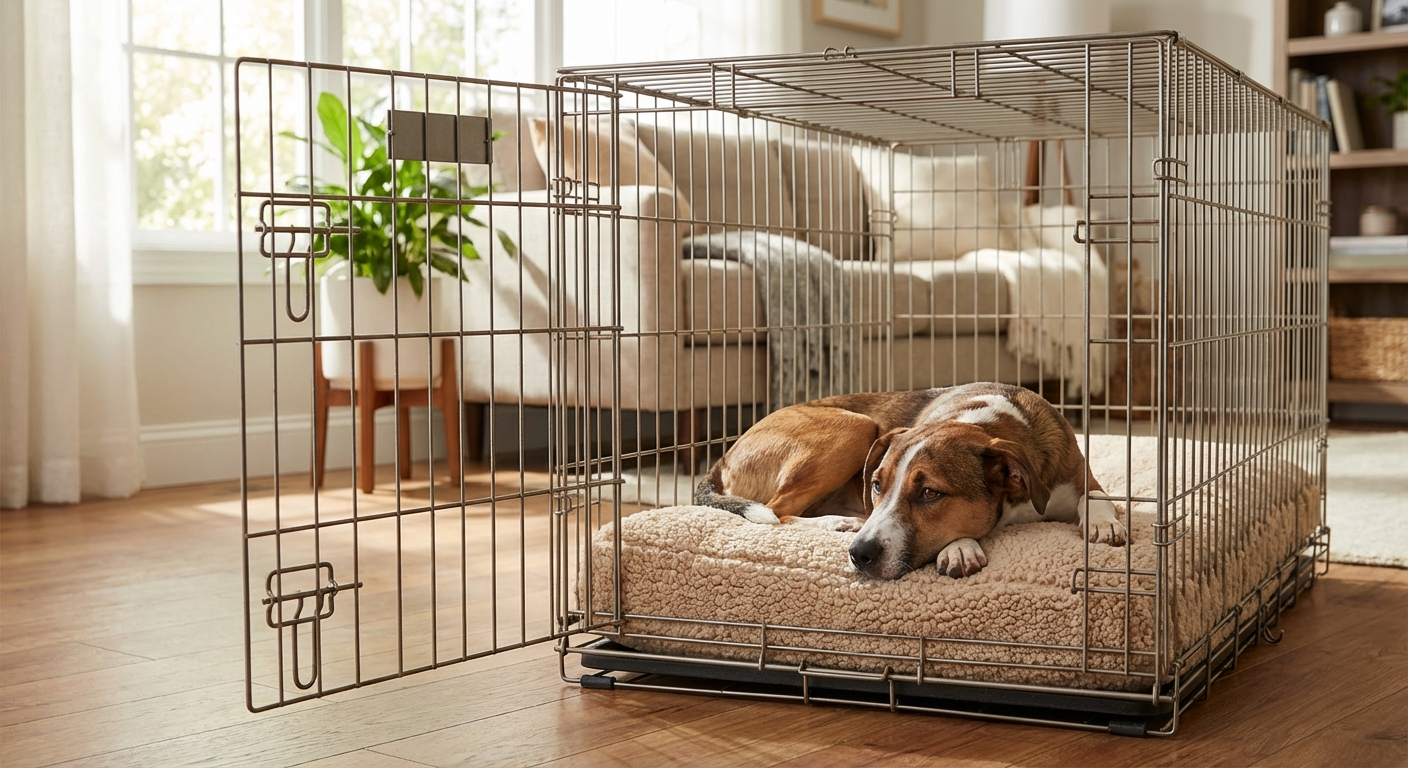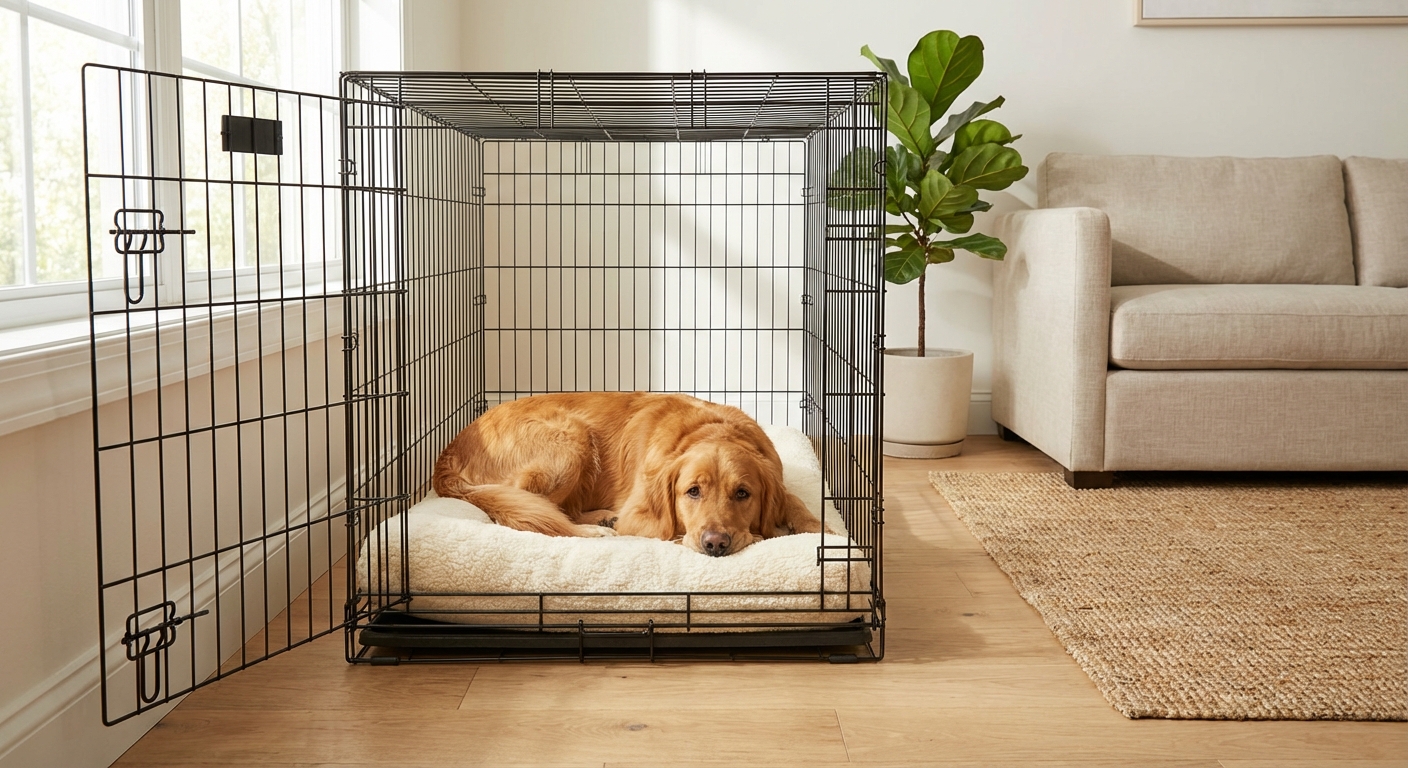
Crate training can help older dogs with separation anxiety when done slowly. Learn comfort-first setup, desensitization steps, micro-departures, common mista...
Article
•
Designer Mixes
Crate Training an Older Dog: Tips That Work

Shari Shidate
Designer Mixes contributor
Crate training is not just for puppies. Older dogs can often learn to feel safe and relaxed in a crate, even if they have never used one before. For many adult and senior dogs, a crate becomes a calm “off switch” during busy household moments, travel, recovery after surgery, or when guests come over.
As a veterinary assistant here in Frisco, Texas, I see crates used in the best way: as a predictable, comfortable space where a dog can truly rest. The key is to go slowly, use positive reinforcement, and set the crate up so it feels like a bedroom, not a time-out.
Quick safety note: Remove collars, tags, and anything that can snag before crating, especially in wire crates. This helps prevent painful accidents and strangulation risk.
Why it can be harder for older dogs
Older dogs are not “stubborn.” They are experienced. They have routines, preferences, and sometimes a history that affects how they feel about confinement. Common reasons adult dogs struggle at first include:
- Past negative experiences (being crated for long hours, punishment, shelter stress).
- Separation anxiety that shows up more clearly when movement is restricted.
- Physical discomfort from arthritis, hip dysplasia, dental pain, or pressure sores.
- Housetraining habits that were never fully established or have changed with age.
- Sensory changes like reduced hearing or vision, which can make a closed space feel startling.
If crate aversion appears suddenly, especially in a senior dog, consider pain or a medical change first. A quick check-in with your veterinarian can save you weeks of frustration.
The good news is that many adult dogs learn quickly when the crate consistently predicts comfort, food, and calm.
Pick the right crate
Before training, set yourself up for success with the right crate style and size.
Size matters
Your dog should be able to stand up, turn around easily, and lie on their side with legs extended. Too small feels restrictive. If your dog is still learning housetraining rules, has incontinence, or is recovering from illness, a crate that is too large can make it easier to potty in one corner and sleep in another. For fully housetrained adult dogs, a little extra room is often fine and can be more comfortable.
Wire vs. plastic vs. soft-sided
- Wire crates are airy and great for dogs who like to see what is happening. Add a cover if your dog relaxes better in a darker space.
- Plastic airline-style crates feel den-like and can be soothing for nervous dogs, especially during travel.
- Soft-sided crates can work for calm dogs but are not ideal for dogs who scratch, chew, or panic.
Comfort upgrades that help
- Non-slip orthopedic bed for seniors and dogs with joint pain.
- Thin blanket over part of the crate to reduce visual stimulation.
- White noise or a fan nearby for dogs startled by neighborhood sounds.
Set the crate location
Place the crate in a low-traffic area where your dog can still feel part of the family. Many dogs do best near the living room during the day and near the bedroom at night, at least at first.
Avoid:
- Direct sun, hot garages, or poorly ventilated areas
- Next to loud speakers or constantly slamming doors
- Isolation in a back room for a dog who craves social contact
Never use the crate as punishment
If the crate only appears when you are leaving or when your dog “did something wrong,” it becomes emotionally loaded. Instead, the crate should predict good things:
- Meals
- Chews and food puzzles
- Quiet praise
- Rest after a walk
When your dog chooses to step inside on their own, that is a huge win. Notice it. Reward it.
Step-by-step plan
Think in minutes, not hours. Most setbacks happen when we move too fast.
Timing note: The day-by-day suggestions below are a starting point, not a strict schedule. Move on only when your dog is relaxed at the current step. Some dogs need longer.
Step 1: Create curiosity (Day 1 to 3)
- Leave the door open.
- Toss a few high-value treats just inside the doorway, then a little deeper.
- Let your dog come out immediately if they want.
Goal: Your dog walks in and out with soft eyes, a loose body, and normal breathing.
Step 2: Add a cue (Day 2 to 7)
- Say “Crate” or “Bed.”
- Toss a treat into the crate.
- When your dog steps in, calmly praise and offer another treat inside.
Tip: Keep your voice soft. Excited, high-energy praise can make nervous dogs more jittery.
Step 3: Feed meals in the crate (Week 1)
Start with the bowl near the entrance, then slowly move it back. You are teaching: “Crate equals full belly and safety.”
Step 4: Add the door (Week 1 to 2)
- Close the door for 1 second, then open and treat.
- Gradually build to 5 seconds, 15 seconds, 30 seconds.
- Stay nearby at first.
Rule of thumb: If your dog starts whining, pawing, or panting, you progressed too fast. Go back to a shorter duration where your dog can succeed.
Step 5: Build calm time (Week 2+)
Offer a long-lasting, safe enrichment item only in the crate, like a stuffed frozen food toy. This helps older dogs settle and creates a strong positive association.
Chew safety: Choose chews based on your dog’s chewing style and dental health. Seniors are more prone to tooth fractures, and some dogs are fast “gulpers.” Supervise new chews at first and remove anything that splinters, breaks into sharp pieces, or is small enough to swallow.
Step 6: Brief absences (when Step 4 and 5 are easy)
Once your dog can relax in the crate with the door closed while you are nearby, add tiny departures:
- Step out of sight for 1 to 5 seconds, then return calmly before your dog worries.
- Repeat and slowly increase to 10 seconds, 30 seconds, 1 minute, and so on.
- Mix in easy reps so it does not always get harder.
This step is especially important for dogs who struggle with being alone. You are teaching that you always come back and the crate is not a “goodbye signal.”
How long is too long?
For adult dogs, many can handle a few hours when they are comfortable and properly exercised. For seniors, it depends on mobility, bladder health, and anxiety level.
In general:
- Start with minutes and build slowly.
- Plan potty breaks before and after crate time.
- Avoid long crating if your dog has urinary issues, diabetes, is on fluids, or is recovering from a GI upset.
If you need to be away for a full workday, consider a dog walker, pet sitter, a secure pen, or a safe dog-proofed room with a gate rather than expecting extended crating right away. Some dogs, especially those with true confinement panic, do better with alternative setups.
Common problems and fixes
Whining or barking
First, ask “why.” Is your dog anxious, under-exercised, or needing a potty break?
- Fix the routine: short walk, sniff time, potty, then crate with a chew.
- Reward quiet: drop a treat in when your dog is calm.
- Avoid yelling: it can accidentally reinforce the noise with attention.
Panic behaviors (drooling, frantic scratching, biting the bars)
This is not normal protesting. This can be true distress. Stop and consult your veterinarian or a qualified trainer experienced with separation anxiety. Some dogs need a different plan, like gradual departure exercises, medication support, or using a pen or gated room instead of a crate.
Refusal to enter the crate
- Check comfort first: bed thickness, temperature, draft, and crate size.
- Use higher-value rewards: tiny pieces of chicken, freeze-dried liver, or meat baby food in a lick mat (no xylitol, no onion, no garlic).
- Try a different crate style. Some dogs dislike wire crates but love plastic dens, or vice versa.
Accidents in the crate
This is usually a management or health issue, not “spite.” Consider:
- Too much time between potty breaks
- GI upset or diet change
- Urinary tract infection or age-related incontinence
- Crate is too large for a dog with housetraining or medical issues
- Anxiety (some dogs will soil even in an appropriately sized crate)
Talk with your veterinarian if accidents are new or frequent, especially in senior dogs.
Senior dog tips
Senior dogs often do best with small adjustments:
- Choose an orthopedic bed and ensure the crate floor is stable and non-slip.
- Use a low entry if your dog has arthritis. Some crates have higher lips that can be uncomfortable.
- Plan nighttime potty needs. Older dogs may need an extra late-night break.
- Support cognitive changes. Dogs with canine cognitive dysfunction may get disoriented. Keep the crate location consistent and the training routine gentle.
Nighttime crating
If you are introducing the crate to an older dog, many do better when the crate is close to you at night at first, like in or near the bedroom. It helps them feel secure and helps you hear if they truly need a potty break.
If your dog whines at night, keep your response boring and consistent. Take them out for a quick potty break if needed, then calmly return them to the crate. Avoid turning it into playtime.
Travel and vet visits
One of the biggest benefits of crate training an older dog is safety during travel and reduced stress at the vet or groomer.
- Practice short car rides with the crate secured using seatbelt attachments or anchor points, and avoid front-seat airbags.
- Bring a familiar blanket that smells like home.
- Use a calm routine: potty, brief walk, then crate time.
When a dog already sees a crate as a safe place, many situations become easier and safer for everyone.
When to get help
Please reach out to your veterinarian or a credentialed trainer if you notice:
- Signs of panic or self-injury risk
- A sudden change in behavior, especially in an older dog
- New accidents, increased thirst, or straining to urinate
- Extreme sensitivity to being alone
Crate training should build confidence. If it is escalating distress, you do not have to push through it alone.
Kindness is the shortcut. Slow steps, high-value rewards, and comfort-first setup are what help many older dogs learn to love their crate.