A vet-approved guide to crate training your puppy at night: ideal crate setup, safe comfort tips, bedtime routine, handling crying, and boring potty breaks f...
Article
•
Designer Mixes
Crate Training a Puppy the First Night

Shari Shidate
Designer Mixes contributor
Your puppy’s first night home is a big deal. Everything smells different, sounds different, and they have just left their mom and littermates. A crate can be a comforting, safe “den” that helps your puppy settle, sleep, and start learning good potty habits. The key is making the crate feel secure, not like a punishment.
Quick age note: most puppies go to new homes around 8 to 10 weeks. If a puppy is much younger, they may need extra support and guidance from a veterinarian or breeder because very young puppies typically do best staying with their mom and litter longer.
What to expect the first night
Even with the best setup, many puppies will whine, bark, or paw at the crate the first night. That doesn’t mean you’re failing. It usually means your puppy is overwhelmed and looking for reassurance.
- Normal: whining on and off, restless settling, needing 1 to 3 potty trips overnight (especially for very young puppies).
- Less common but important: nonstop distress that escalates, drooling, frantic scratching, or repeated attempts to escape. If you see panic behaviors, slow down and re-evaluate the setup and training pace.
Many trainers and veterinary behaviorists recommend avoiding “flooding” a puppy with more stress than they can handle. A calm, gradual approach builds long-term crate comfort.
Pick the right crate and location
Crate type
- Wire crates: great airflow and visibility. Consider a cover if your puppy settles better in a darker space.
- Plastic (airline-style) crates: more den-like and can feel cozy for some puppies. Make sure ventilation is good.
- Soft crates: usually best for already crate-trained dogs. Many puppies can chew or claw through them.
Crate size
A crate should be large enough for your puppy to stand up, turn around, and lie down comfortably. If it is too large, many puppies will potty in one corner and sleep in the other, which can slow house training.
- If your puppy will grow quickly, consider a crate with a divider panel so you can expand space as they mature.
Where to put the crate
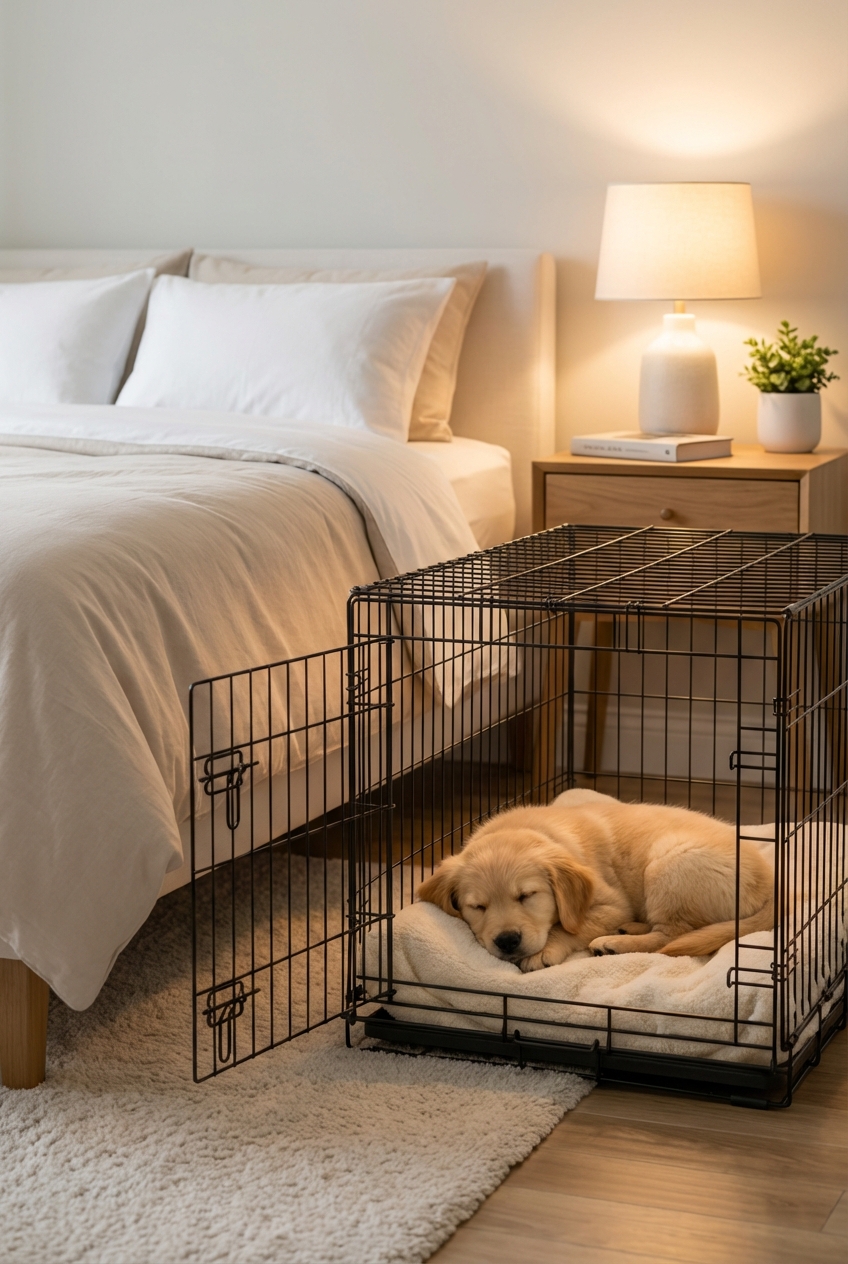
For the first few nights, place the crate in or near your bedroom. Most puppies sleep better when they can hear and smell you. This is not “creating bad habits.” It is meeting a normal social need for a baby animal. If you want the crate elsewhere long-term, you can gradually shift it once your puppy is settling well.
Set the crate up safely
Comfort matters, but safety matters more. Your goal is to create a cozy space that does not include items your puppy can chew apart and swallow.
- Remove collar and harness: do not crate a puppy wearing a collar, harness, or tags. It reduces strangulation and snagging risk.
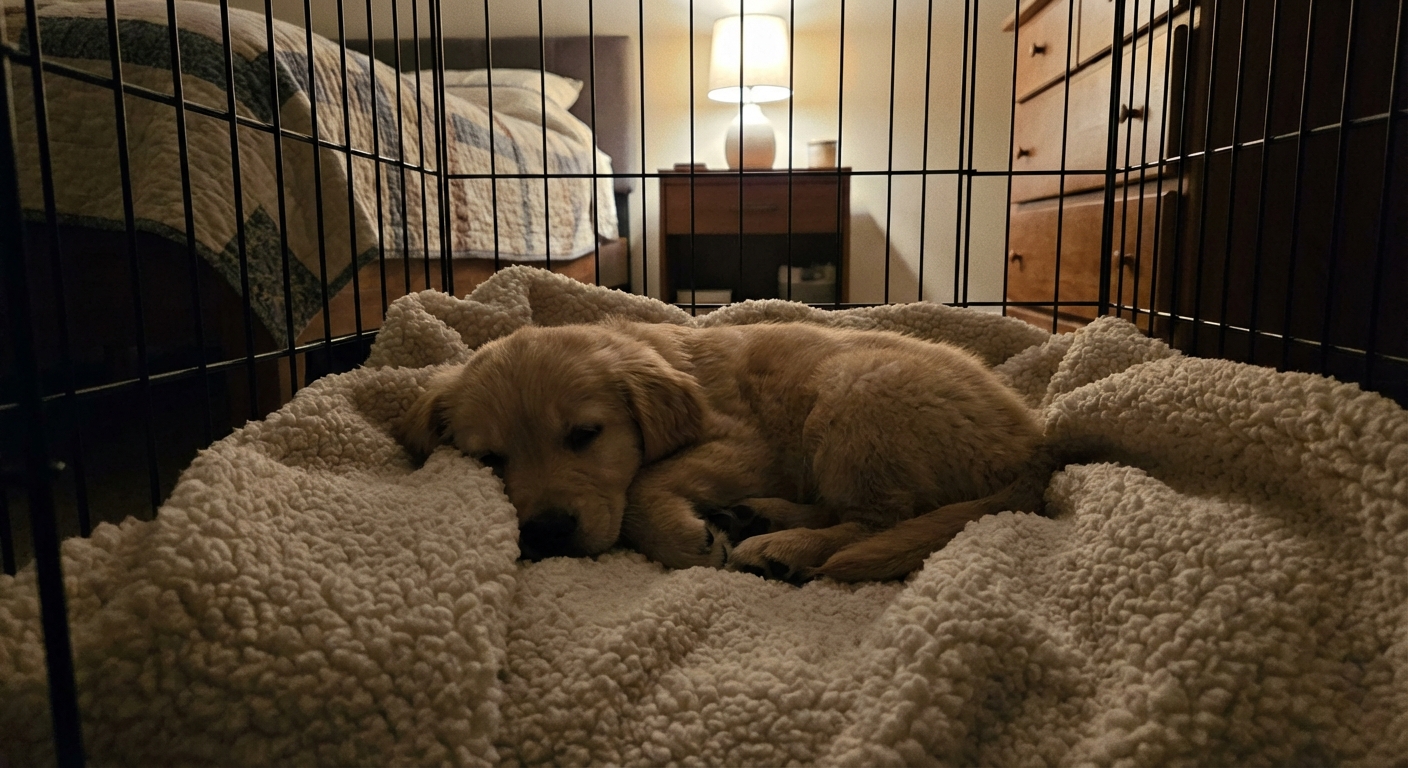
- Bedding: start with a simple, washable blanket or towel. If your puppy chews bedding, go simpler until that phase passes.
- Warmth: puppies can chill easily. A warm room and a light blanket often help.
- Water: for most healthy puppies, you can pick up water about 1 to 2 hours before bedtime to reduce overnight accidents, then offer water again first thing in the morning. Do not restrict water for long periods, and make sure your puppy has plenty of access during the day. If your puppy is very young, very small, or has a medical condition, ask your veterinarian what is appropriate.
- Calming aids: a white noise machine or a fan can reduce startling sounds. Some puppies may do better with an Adaptil-style pheromone diffuser or collar, though results vary by puppy.
- Crate zone safety: keep cords, blind strings, and anything dangling well away from the crate, especially if your puppy can reach through a wire crate.
A note on “heart-beat” toys and heat discs: many families love them, but always supervise at first. If your puppy chews them, skip them. Ingestion risk is not worth it.
A simple bedtime routine
Puppies thrive on predictable rhythms. Here is a routine I like because it is gentle and practical.
1 to 2 hours before bed
- For most healthy puppies, pick up the water about 1 to 2 hours before bedtime (not longer than necessary).
- Do a calm play session, then a decompression walk, meaning a slow “sniffy” walk or relaxed yard sniff time.
- Offer the last potty break on leash, in the same spot you want them to use long-term.
30 minutes before bed
- Bring the energy down: dim lights, quiet voices, no roughhousing.
- Do a short, positive crate session: toss in a treat, let your puppy walk in and out, praise calmly.
Bedtime
- Potty again right before crating.
- Guide your puppy into the crate with a treat, then close the door gently.
- Sit nearby for a few minutes if needed, then settle into bed.
If your puppy whines, pause and listen. A little complaining can be normal. But if it escalates or they have not pottied recently, take them out for a quick, boring potty trip.
What not to do: do not use the crate as punishment, bang on the crate, or let kids poke fingers through the bars or “check on” the puppy once lights are out. The crate should feel predictable and safe.
Nighttime potty breaks (keep it boring)
Overnight potty trips are where many families accidentally teach their puppy that crying makes fun things happen. You can avoid that with a boring, consistent process.
- Keep a leash by the crate.
- Carry small puppies to the potty area if possible to prevent accidents on the way.
- No play, no cuddling session, no roaming.
- Soft praise for potty, then right back to the crate.
Rule of thumb (use as a starting estimate): many puppies can manage roughly one hour per month of age, plus one hour, especially overnight while sleeping. So a 2-month-old puppy might manage around 3 hours. But this varies widely by individual, size, sleep state, and routine. Track your puppy’s pattern and adjust, and ask your veterinarian if you are unsure.
How to respond to crying
Many people worry that any response to crying will reinforce it. In reality, fear and distress are not the same as attention-seeking. Your job is to teach your puppy that the crate is safe and that you are predictable.
Try this ladder
- Wait briefly: if whining is mild and fading, give your puppy 30 to 90 seconds to settle.
- Use your voice: a calm “shhh” or “settle” from your bed can be enough.
- Offer proximity: sit beside the crate for a minute without opening it.
- Potty check: if it has been a while, take them out briefly to potty, then straight back to bed.
If you open the crate every time your puppy makes a noise, you may create a pattern. But if you never respond, some puppies escalate into panic. The sweet spot is calm reassurance paired with structure.
Daytime practice helps at night
If you can, start positive crate associations immediately, even before the first night.
- Feed meals near the crate, then inside the crate.
- Toss treats in randomly so your puppy chooses to enter.
- Practice very short “crate naps” with you nearby.
- Give a safe, veterinarian-approved chew during supervised crate time.
Short and successful is better than long and stressful.
Troubleshooting
Won’t enter the crate
- Prop the door open and toss treats just inside the doorway, then a little deeper as confidence grows.
- Feed meals at the crate entrance, then inside.
- Avoid pushing or pulling your puppy in. Let curiosity win.
Panics when the door closes
- Practice closing the door for 1 to 3 seconds, treat, then open. Repeat in tiny steps.
- Pair door closing with something soothing, like a lick mat or a safe chew, if your puppy can use it safely.
- If panic is intense, pause and consider professional help from a qualified trainer or veterinary behaviorist.
Accidents in the crate
- Double-check crate size and divider placement.
- Increase overnight potty opportunities temporarily, then stretch time gradually.
- Rule out medical issues with your veterinarian, especially if accidents are frequent or sudden.
Common first-night mistakes
- Using the crate only for bedtime: fix by adding short daytime sessions so the crate is not a surprise.
- Crate too far away: fix by moving it near your bed for the first week or two, then gradually shifting location if desired.
- Too much freedom before bed: fix by using a leash indoors or a puppy-safe pen so they do not get overtired and wild.
- Big late-night meal: fix by feeding dinner earlier and keeping bedtime calm.
- Ignoring signs of needing to potty: fix by learning your puppy’s signals and offering a predictable overnight break schedule at first.
When to call your veterinarian
Crate training should not be painful or scary. Contact your veterinarian if your puppy has:
- Vomiting or diarrhea
- Straining to urinate or very frequent urination
- Blood in stool or urine
- Extreme panic in the crate that does not improve with gradual training
- Lethargy, refusing food, or signs of illness
Medical issues can look like “behavior problems,” especially in a brand-new puppy adjusting to a new home.
A gentle goal for the first night
Instead of aiming for a perfect 8 hours, aim for a safe night with small wins: your puppy spends time in the crate, settles a bit faster each time, and learns that potty trips are quick and calm.
Kindness plus consistency is the fastest way to create a confident crate-trained puppy.