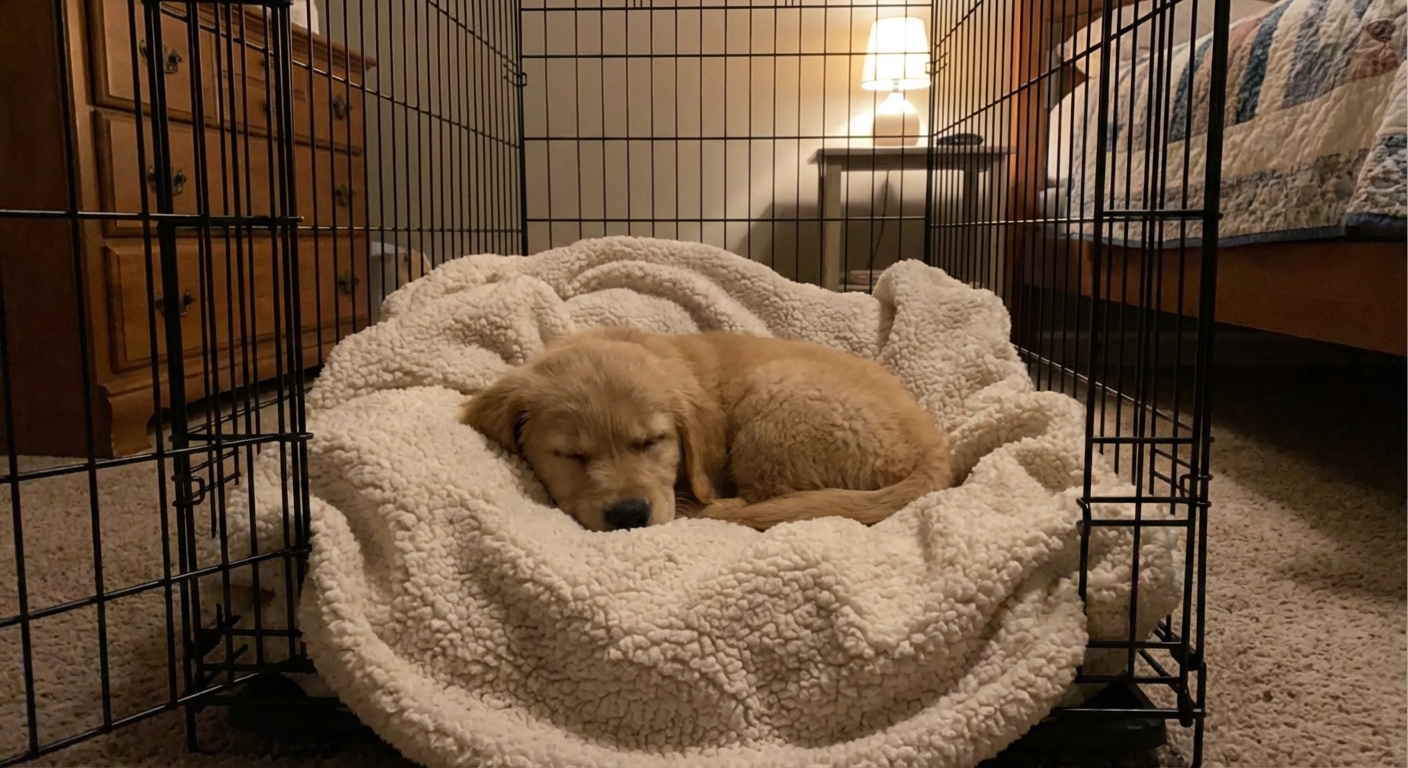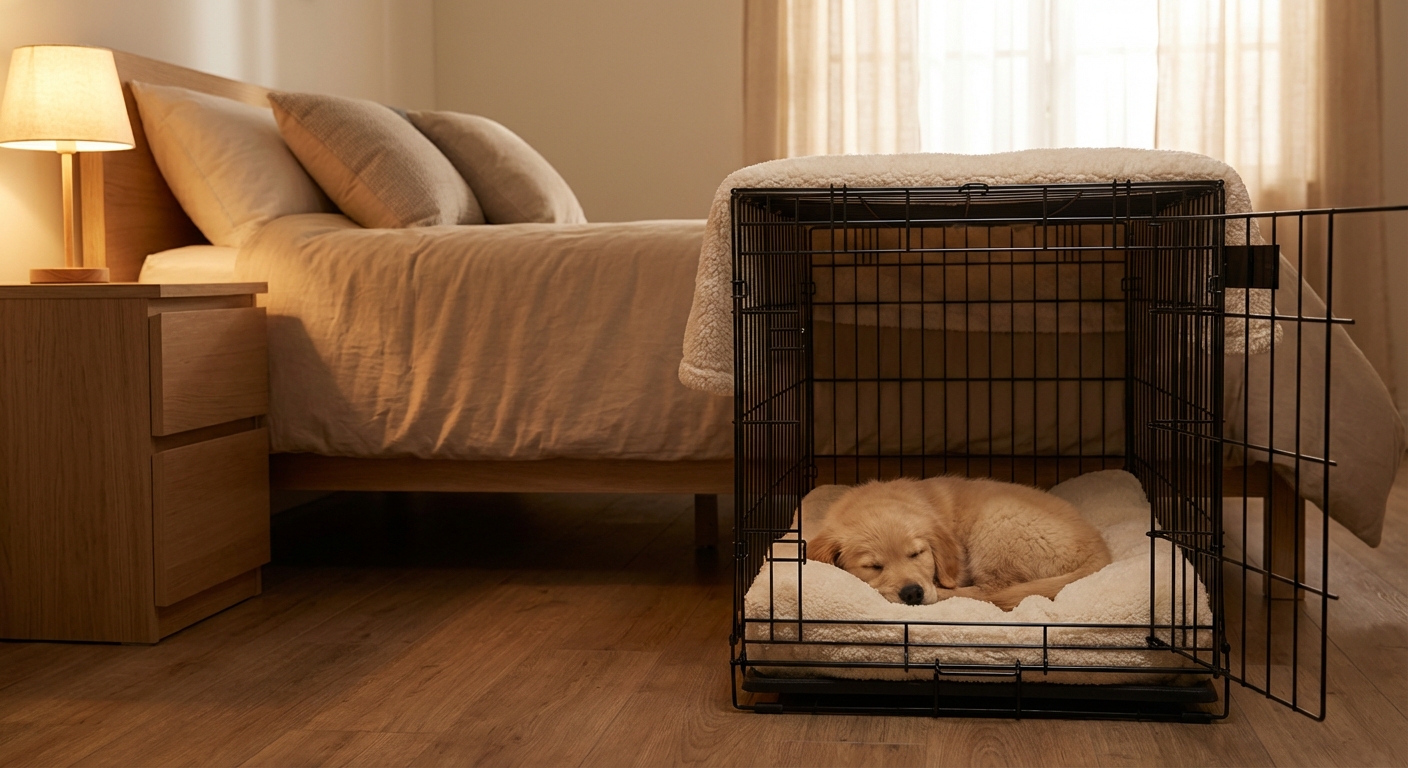
Learn a gentle, family-friendly nighttime crate training plan: ideal crate setup, predictable bedtime routine, potty-break expectations by age, and calm ways...
Article
•
Designer Mixes
Crate Training a Puppy at Night: Crying and Health

Shari Shidate
Designer Mixes contributor
Nighttime crate training can feel like the hardest part of bringing home a puppy. You are exhausted, your puppy is confused, and the crying can make you wonder if something is wrong. The good news is that a lot of nighttime crying is normal adjustment behavior, not a sign that you are being “mean” or that your puppy is broken. With a few health checks, a smart setup, and a consistent routine, many pups improve noticeably within the first week or two, although some need more time depending on age, temperament, and anxiety levels.
What success can look like early on: a few minutes of whining at bedtime, brief wake-ups, or a short protest after a potty break can be normal at first. Panicked, escalating distress for long stretches night after night means your plan needs adjustment.
Why puppies cry at night in the crate
From your puppy’s point of view, nighttime is suddenly very different. In their previous home, they likely slept near littermates and could hear, smell, and feel other warm bodies. Your home is quieter, the smells are new, and the crate can feel like separation.
- Separation distress: They want proximity and reassurance.
- Basic needs: They may need to potty, drink, or change positions.
- Overtired “toddler” energy: Some puppies cry more when they are actually too tired to settle.
- Learned behavior: If crying consistently results in being released for attention or play, it can become a habit.
My goal as a veterinary assistant is always twofold: support training and protect health. That means we take crying seriously, but we also do not assume every cry is an emergency.
Health first: when crying might be medical
Before you work on behavior, rule out discomfort. A puppy that is hurting, nauseated, itchy, or needing to potty urgently will not learn well. If you are unsure, call your veterinarian. It is always okay to be cautious with a brand new pup.
Common health or comfort triggers
- Potty urgency: Puppies have tiny bladders. Many truly cannot hold it overnight at first.
- GI upset: A new diet, new treats, stress, or parasites can cause gas, diarrhea, or belly cramps.
- Parasites: Roundworms, hookworms, giardia, and coccidia are common in puppies and can cause restlessness, tummy pain, or urgent stools.
- Cold or heat: Puppies do not regulate body temperature as well as adult dogs.
- Itchy skin or ear discomfort: Allergies, fleas, or ear infections can make it hard to settle.
Red flags: call a vet urgently
- Repeated vomiting, vomiting with lethargy, or vomiting with a swollen belly
- Diarrhea that is frequent, watery, bloody, or accompanied by weakness
- Straining to pee, crying while peeing, or no urine produced
- Abdominal distension, unproductive retching, or collapse
- Coughing, labored breathing, pale gums, or extreme lethargy
- Signs of pain: trembling, yelping when touched, hunched posture
Also remember: a new puppy is still completing vaccinations. Avoid high-traffic dog areas until your veterinarian confirms it is safe. Ask your vet about safer social options, such as visiting low-dog-traffic spots and meeting known, healthy, vaccinated dogs.
Nighttime potty expectations by age
You may hear the “months old plus one” rule, meaning a puppy can hold their bladder for about their age in months + 1 hour. This is often cited online and can be a very rough starting point, not a guarantee. Breed, individual development, sleep state, and schedule matter. Some puppies can hold it longer overnight than they can during the day, while others still need frequent breaks.
- 8 to 10 weeks: Many puppies need 1 to 2 nighttime potty trips.
- 10 to 12 weeks: Often 1 trip, sometimes none if the schedule is consistent.
- 12 to 16 weeks: Many puppies can sleep longer stretches, but some still need a break.
If your puppy is crying and it has been a few hours, assume potty first. Quietly take them out on leash, give them a chance to go, then right back to the crate.

Crate setup to reduce crying
Location matters
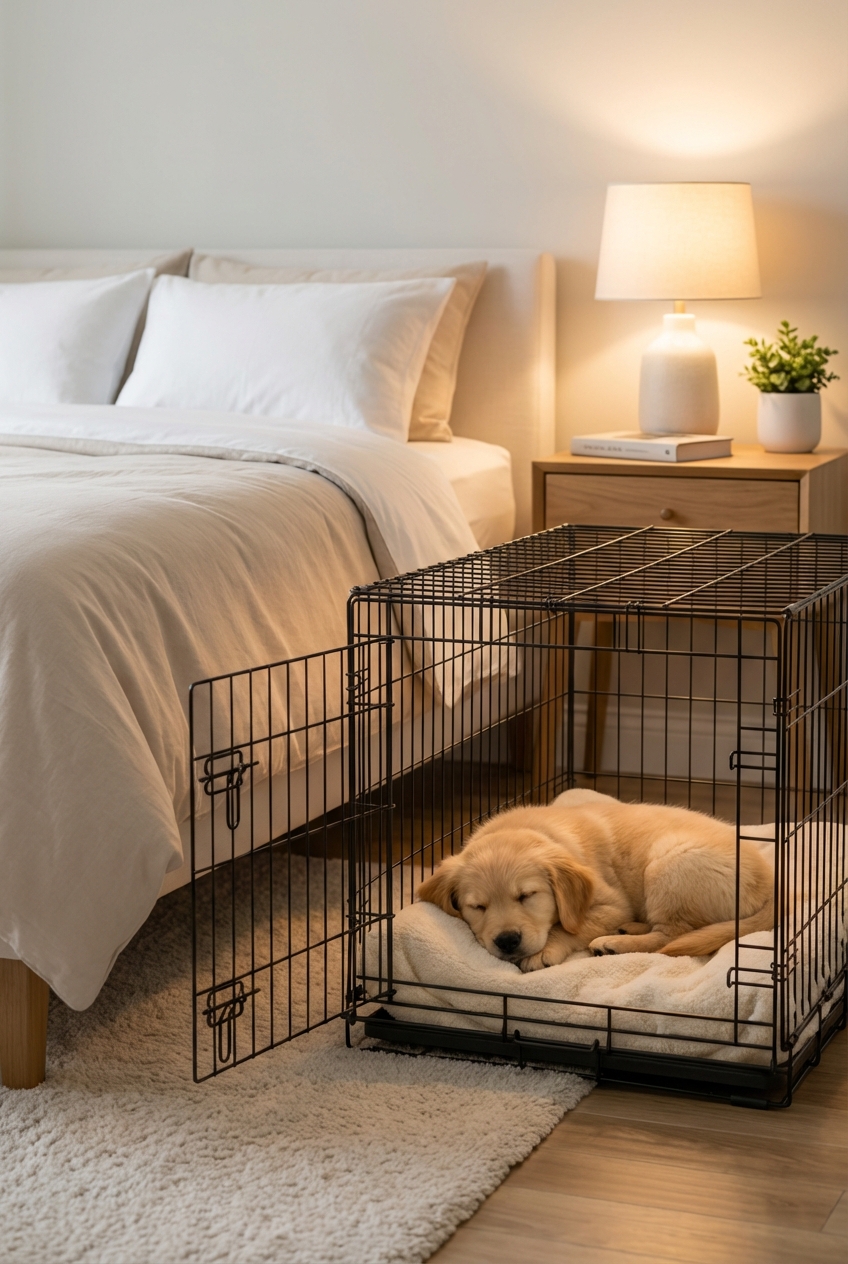
For most puppies, the fastest path to calm is sleeping near you at first. Place the crate beside your bed so your puppy can hear and smell you. Once they are sleeping well, you can gradually move the crate farther away if that is your long-term plan.
Make the crate feel safe
- Size: Big enough to stand, turn, and lie down, but not so large they can potty in one corner and sleep in another. Use a divider for growing pups.
- Comfort: Provide appropriate bedding. If your puppy chews and eats fabric, skip plush bedding and ask your vet about safer options.
- Covering: A light crate cover can reduce visual stimulation. Ensure airflow and keep it away from chewing reach.
- Sound: White noise or a fan can help some pups settle by masking small noises.
Crate safety basics
- Collar off: Remove collars, dangling tags, and anything that can snag, since they can pose a strangulation risk.
- Chew safety: Only leave items that are appropriate for unsupervised time and cannot be shredded and swallowed. When in doubt, ask your veterinarian.
- Check spacing: Make sure the crate is sturdy with no gaps a puppy can wedge into.
Safe soothing tools
- Comfort item: A soft toy can help, but supervise initially to ensure your puppy does not shred and ingest it.
- Warmth: A microwavable pet-safe warming disc can be calming for young puppies.
- Chew: A veterinarian-approved chew can help with self-soothing. Avoid anything that can splinter or be swallowed in large pieces.
Skip the idea of “just let them cry forever.” Some crying is normal, but excessive distress night after night means the plan needs adjustment.
Your evening routine
Puppies thrive on predictable patterns. A solid routine reduces crying because your puppy learns what happens next.
1) Build the day, then wind down
Night success is often a daytime issue. A puppy who is under-exercised or under-stimulated may struggle to settle, and a puppy who is over-aroused right before bed may also struggle.
- Daytime: Include age-appropriate play, short training sessions, sniff walks, and nap breaks.
- Last 60 to 90 minutes: Shift from wild play to calmer activities.
Good wind-down options include a short training session for kibble, gentle play, a lick mat used safely, or calm cuddles.
2) Food and water timing
Ask your veterinarian for guidance specific to your puppy, especially for very small breeds who may be prone to low blood sugar. In general, many families find it helpful to avoid a huge meal right before bed to reduce tummy upset and urgent poops.
Water note: Do not withhold water to “force” sleeping through the night. Fresh water should be available unless your veterinarian gives you a medical reason to do something different. If your puppy tends to chug an enormous amount right before bed, talk with your vet about a safe plan.
3) Last potty trip stays boring
Keep it quiet, on leash, minimal talking. You are not starting a midnight party. When they potty, praise softly and return inside.
4) Use a consistent bedtime cue
Say the same phrase every night such as “Bedtime.” Offer a small chew if appropriate, close the door, and settle.
5) Keep bedtime and wake time steady
Try to keep a consistent bedtime and wake-up time. If you need to shift your schedule, adjust in small steps of 10 to 15 minutes every couple of days. Consistency helps your puppy’s body clock, and it helps avoid accidentally rewarding early-morning crying.
What to do when your puppy cries
Here is the balance I recommend: respond to needs, do not accidentally reinforce the crying, and stay consistent.
First, pause and assess
- Did they just go potty recently?
- Are they escalating, or are they settling between cries?
- Do you hear gulping, gagging, repeated swallowing, or other signs they may feel unwell?
If you suspect potty, do a quick potty break
Take them straight out on leash. No play, no wandering. Give 3 to 5 minutes. If they go, back to the crate. If they do not, back to the crate anyway.
If it is not potty, offer calm reassurance
- Softly say your cue, like “Shhh, bedtime.”
- Place your fingers near the crate for a moment if the crate is by your bed.
- Wait for a brief quiet moment before offering attention.
Try not to open the crate door while your puppy is actively screaming. Instead, wait for a tiny pause, then calmly open and guide them to potty if needed. This helps them learn that quiet behavior makes good things happen.
Apartment and neighbor tips
- Use white noise: It can help your puppy and also reduces how far noise travels.
- Set a proactive potty alarm: For very young puppies, one planned break can prevent a long crying episode.
- Keep nighttime boring: Fast potty trip, then back to bed.
What not to do
- Do not punish crate crying. It increases fear and can make crate training harder long-term.
- Do not use the crate as a “time-out prison.” The crate should predict safety and rest.
- Do not add exciting attention. High-pitched talking, long cuddles, or play teaches your puppy to cry for entertainment.
Daytime crate work helps nights
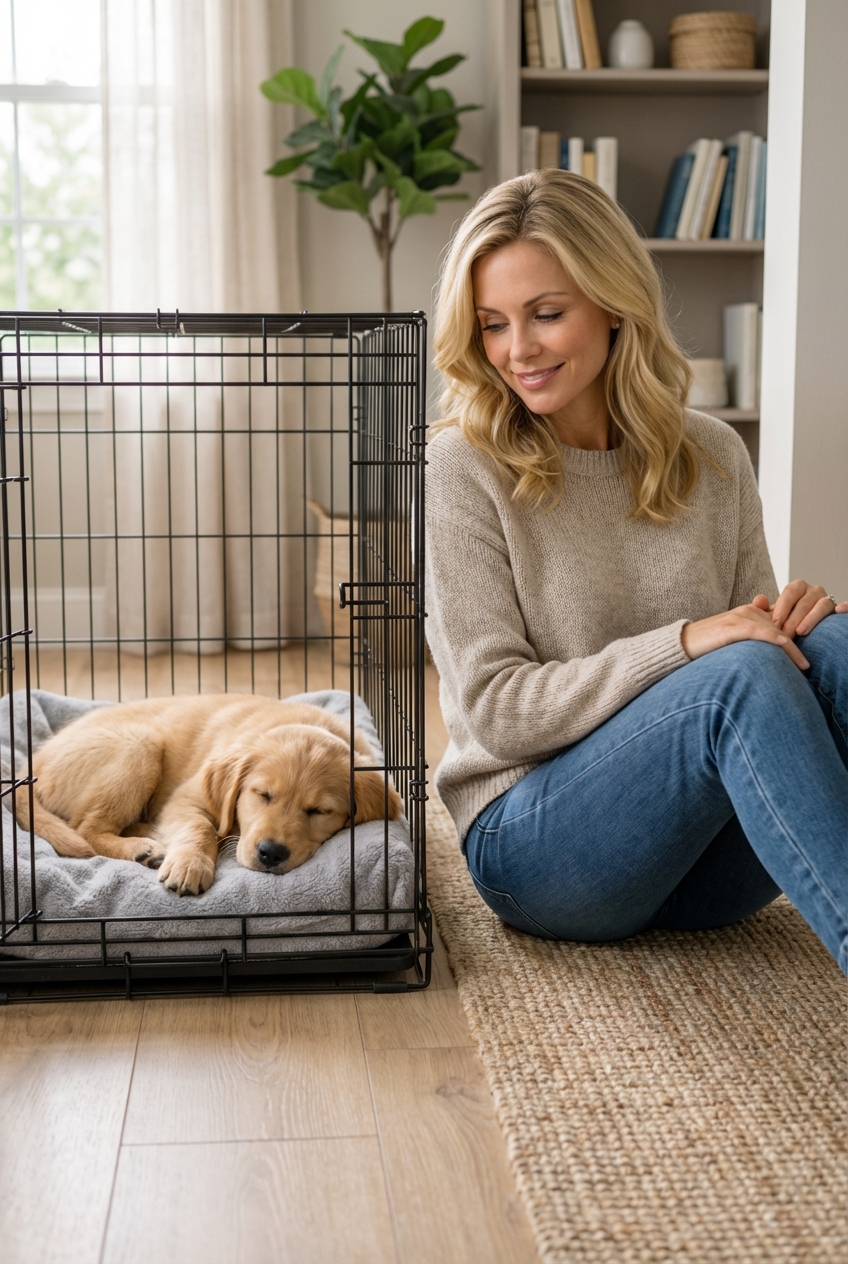
Night success is built in daylight. If your puppy only experiences the crate at bedtime, the crate can become a signal that you disappear.
Daily crate practice (5 to 10 minutes, several times a day)
- Drop treats into the crate and let your puppy enter voluntarily.
- Feed a meal in the crate with the door open at first.
- Close the door briefly while they chew a safe treat, then open before they fuss.
- Gradually increase time with short, calm separations.
If your puppy panics, you moved too fast. Go back to an easier step and build up again.
Digestion and sleep
In clinic, I see this a lot: sometimes “night crying” has a tummy component. Stress plus a sudden diet change can equal gas, loose stool, and discomfort.
Clues it might be a belly issue: frequent licking or swallowing, audible gurgling, restlessness plus loose stool, more crying after rich treats, or waking urgently to poop.
Tips to reduce nighttime GI issues
- Transition foods slowly: Over 7 to 10 days when possible, unless your veterinarian directs otherwise.
- Limit rich treats: New puppies often get too many training treats. Use a portion of their regular kibble for training.
- Ask about probiotics: Some puppies benefit from a vet-recommended probiotic during transitions.
- Check parasite prevention: Follow your vet’s deworming schedule and bring a fresh stool sample when requested.
If you are exploring homemade or fresh food options, please involve your veterinarian or a veterinary nutritionist so your puppy receives balanced calcium, phosphorus, and essential nutrients for growth.
A simple 7-night plan
Use this as a template. Younger puppies and puppies who are more sensitive may need you to repeat a step for longer than a couple of nights.
Nights 1 to 2: comfort and routine
- Crate next to your bed
- One planned potty break (set an alarm if needed)
- White noise and a consistent bedtime cue
Nights 3 to 4: build independence
- Continue nighttime potty only if your puppy truly needs it
- Wait for brief pauses before offering reassurance
- Increase daytime crate practice
Nights 5 to 7: reduce help gradually
- If potty trips are getting later, let your puppy sleep longer
- Shorten reassurance time, keep everything calm and boring
- Keep wake-up time consistent so mornings do not become a reward for crying early
Progress is rarely perfectly linear. A puppy may do great for two nights, then regress after a busy day, a vaccine appointment, or a new sound outside. Stick with the plan and keep the basics steady.
Frequently asked questions
Should I let my puppy cry it out?
A small amount of settling vocalization is normal. But prolonged, panicked crying night after night is a sign that the setup or pacing needs adjustment. You can be compassionate without teaching your puppy that screaming opens doors.
Is it okay for my puppy to sleep in my bed instead?
That is a personal choice. If your long-term goal is crate sleeping, it is usually easier to start that way. If you choose bed sleeping, keep safety in mind, especially for tiny puppies and households with children.
What if my puppy hates the crate?
Many puppies do not hate the crate. They hate being alone, or they are not yet conditioned to see it as a safe resting space. Go back to short, positive daytime sessions and consider a playpen setup temporarily if recommended by your trainer or vet.
When to get extra help
If crying persists beyond two weeks despite consistent training, or if your puppy shows intense panic, it is time to ask for support. Reach out to:
- Your veterinarian, to rule out pain, parasites, or GI problems
- A certified professional dog trainer who uses positive reinforcement
- A veterinary behaviorist for severe anxiety
Your puppy is not giving you a hard time. They are having a hard time. With the right routine and a quick health check, most families get their evenings back sooner than they think.