A step-by-step puppy crate training guide: choosing the right crate, building positive associations, first-week routines, nighttime potty breaks, and solutio...
Article
•
Designer Mixes
Crate Training a Puppy at Night

Shari Shidate
Designer Mixes contributor
Nighttime crate training can feel overwhelming, especially when your puppy cries the moment the lights go out. You are not doing anything “wrong.” You are teaching a baby animal a brand-new skill: how to feel safe, settle, and sleep without constant contact.
As a veterinary assistant here in Frisco, Texas, I always tell families the same thing: crate training should be kind, consistent, and based on what we know about puppy development. Done well, the crate becomes a cozy bedroom, not a punishment.
Why vets recommend nighttime crate training
Many veterinarians support crate training because it can improve safety, sleep, and housetraining success. A properly sized crate:
- Helps prevent injuries from chewing cords, swallowing items, or falling off furniture while you sleep.
- Supports faster potty training because most puppies avoid soiling their sleeping space.
- Creates a predictable routine, which lowers stress for many puppies.
- Makes vet visits and travel easier since crates are commonly used for transport and recovery.
Important note: crate training is not a substitute for exercise, companionship, or medical care. It is one tool in a bigger, loving routine.
Set up the crate the right way
Choose the right crate size
Your puppy should be able to stand up, turn around, and lie down comfortably. Too large and your puppy may potty in one corner and sleep in another, which slows housetraining.
If your puppy will grow quickly, use a crate with a divider so you can expand the space as they mature.
Make it feel safe and den-like
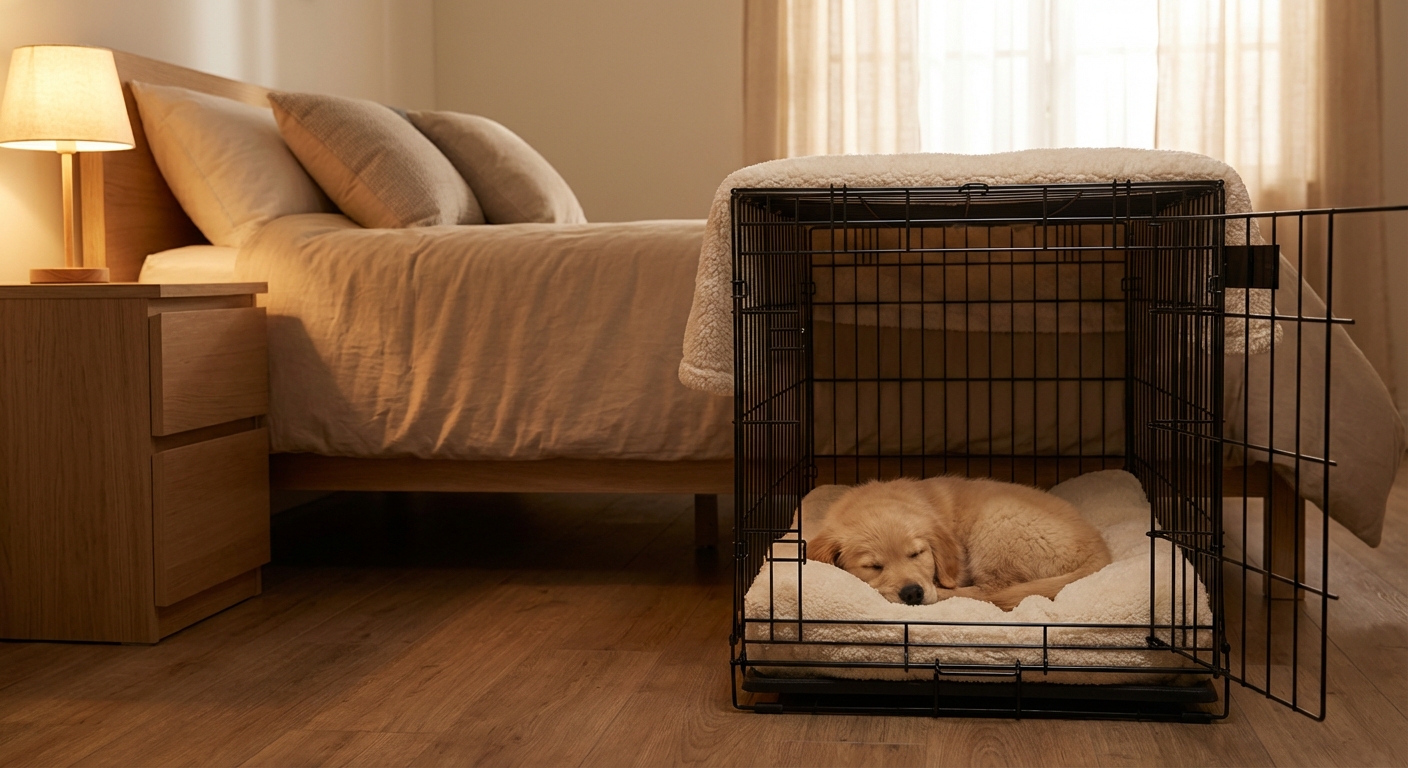
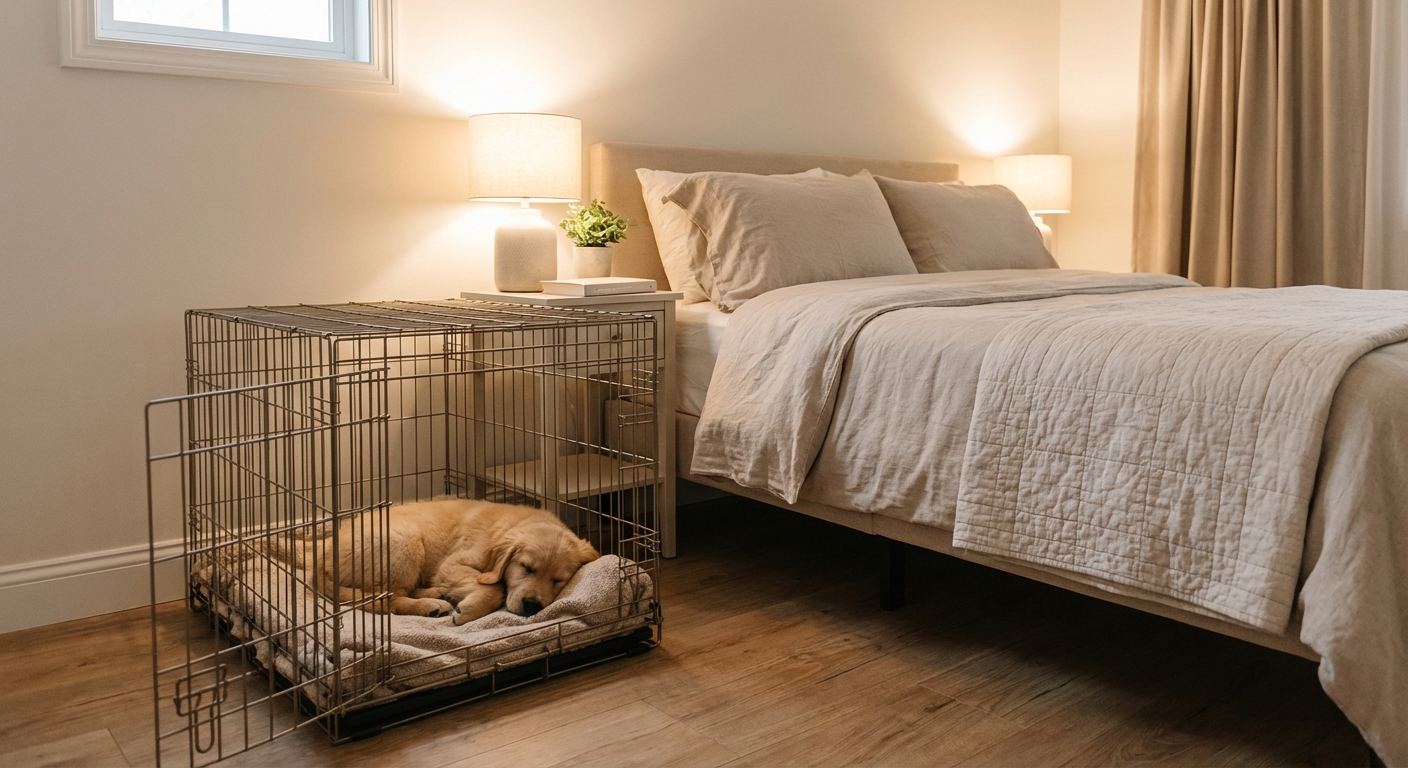
- Place the crate near you at night for the first week or two, often next to the bed. This reduces panic and helps you hear potty signals.
- Add comfortable bedding, but be cautious with puppies who chew. If your puppy shreds fabric, switch to a flatter, chew-resistant mat. In the clinic, we see intestinal blockages from swallowed bedding more often than people realize.
- Cover part of the crate with a light blanket to reduce visual stimulation, leaving plenty of airflow.
- Use a white noise machine or fan if household sounds trigger barking.
Collar and harness safety
Before crating for sleep, remove your puppy’s collar and harness, especially if they wear dangling tags. Tags can snag on crate wires and create a strangulation risk. If you need ID on overnight, ask your vet about microchipping and keep a collar on only when supervised.
Use a safe comfort item
Many puppies settle faster with a comfort aid, but safety matters.
- Snuggle toy with heartbeat can help some puppies.
- Warmth can be soothing, but avoid anything that can overheat or be chewed open.
- Chew items: only offer something if you are confident your puppy will not shred and swallow pieces. Even “tough” chews can be a choking or obstruction risk for aggressive chewers. When in doubt, keep the crate simple at night.
Safe placement and temperature
- Keep the crate away from cords, space heaters, fireplaces, and direct sun.
- Aim for a comfortable room temperature. Puppies can overheat under heavy covers or in stuffy rooms.
Before bed: the routine that helps
Most nighttime crate struggles are really “I am not tired” or “I have to potty” problems. A consistent evening routine fixes a lot.
1 to 2 hours before bed
- Exercise: age-appropriate play, a short training session, and calm enrichment. Avoid overly intense roughhousing right before sleep.
- Dinner timing: many puppies do best eating 3 to 4 hours before bedtime.
- Water: keep fresh water available during the day. In the evening, many families have success offering the last big drink about 1.5 to 2 hours before bed, then allowing small sips if needed. If your puppy seems excessively thirsty or is suddenly urinating much more than usual, check in with your veterinarian.
30 minutes before bed
- Potty break: take your puppy out on leash to the same spot. Consider adding a consistent cue like “go potty.”
- Calm wind-down: gentle petting, a little chew time (if safe), dim lights.
- One last potty break: yes, again. It is worth it.
Tip from the clinic: for many puppies, the “double potty” (once at 30 minutes, once right before crating) dramatically reduces middle-of-the-night wake-ups.
How to introduce the crate
Step 1: make the crate a treat zone
During the day, toss a few treats inside the crate and let your puppy go in and out freely. Feed meals near the crate, then inside the crate, with the door open.
Step 2: add a cue and short closures
Say a simple cue like “crate” or “bed,” lure your puppy in with a treat, then close the door for 5 to 10 seconds while you sit nearby. Open the door before your puppy escalates into frantic distress. Build up slowly.
Step 3: practice daytime naps
Nighttime is harder when the crate only appears at bedtime. If you can get even one daytime nap in the crate, you are teaching your puppy, “This is a normal resting place.”
What to do the first nights
Expect some crying, and respond strategically
Crying is common. Your goal is to meet needs, not accidentally train louder crying.
- If your puppy might need to potty, take them out calmly on leash, no play, no excitement, no long wandering. Potty, praise softly, back to the crate.
- If your puppy just wants company, try quiet reassurance first. You can place your fingers near the crate, speak softly, or sit beside the crate for a minute.
- Avoid letting your puppy out during active screaming when you are confident they have pottied. Wait for a brief pause (even 2 to 3 seconds), then open the door. This helps prevent teaching “noise opens doors.”
Use a flexible decision rule
Instead of a single hard rule, track your puppy’s pattern for a few nights and adjust. As a starting point:
- Very young puppies (8 to 10 weeks) often need 1 to 2 nighttime potty breaks.
- Small breeds commonly need more frequent trips than larger breeds.
You may hear the guideline that puppies can hold it about one hour per month of age. Think of this as a rough starting point, not a guarantee. Sleep, health, individual bladder size, and training all matter.
Nighttime potty breaks that stay boring
Think: boring, fast, and predictable.
- Carry small puppies to the potty spot if needed.
- Use a leash, even in fenced yards, to prevent play.
- Keep lights dim and your voice low.
- No treats for “coming out,” but you can quietly reward the potty itself.
- Back into the crate immediately after.
Pro tip: jot down the time of each nighttime potty for a few days. Patterns show up quickly, and it becomes easier to set an alarm before your puppy wakes and cries.
Common mistakes (and easy fixes)
1) The crate is too far away
If your puppy feels isolated, they may panic. Move the crate next to your bed at first. Later, you can gradually move it farther away over several nights.
2) Too much freedom too soon
If your puppy roams at night, accidents and chewing are more likely. Use the crate until housetraining is reliable, then consider a puppy-safe room or exercise pen if that fits your lifestyle.
3) Accident in the crate
Accidents happen. Clean with an enzymatic cleaner and reassess:
- Is the crate too big?
- Did your puppy have enough potty breaks?
- Is there diarrhea or increased urination that could be medical?
4) Using the crate as punishment
The crate should predict calm, safety, and rest. If you need a time-out, use a puppy-proofed area instead.
5) Unsafe gear or items in the crate
Remove collars and harnesses for sleep, and keep the overnight setup simple if your puppy is a chewer. When we see crate-related injuries, it is often from snagged tags or swallowed fabric, not the crate itself.
How long does it take?
Many puppies show noticeable improvement in 3 to 7 nights with consistency, but full comfort can take a few weeks. Progress is rarely perfectly linear. A tough night does not mean you failed, it usually means your puppy was overtired, overstimulated, or needed a schedule tweak.
Kind consistency is what teaches security. Your puppy is learning that nighttime is safe, predictable, and calm.
Sample schedule (10-week-old)
Every puppy is different, but here is a realistic example you can adjust:
- 6:30 p.m.: dinner
- 7:15 p.m.: potty, then play and a short training session
- 8:30 p.m.: calm enrichment (sniffing game, gentle chew if safe)
- 9:30 p.m.: potty break, then quiet wind-down
- 10:00 p.m.: last potty, collar off, into the crate
- 1:00 a.m.: quick potty trip (boring and on leash), back to crate
- 4:30 a.m.: quick potty trip (some puppies need this, some do not)
- 6:30 a.m.: wake up, potty, breakfast
If your puppy is waking at 12:30 a.m. every night, set your alarm for 12:15 a.m. for a few nights, then gradually push it later as they mature.
When it might be more than protesting
Normal puppy complaining usually improves with routine and repetition. If you are seeing signs of panic, it is time to get extra help.
Consider talking with your veterinarian and a qualified trainer or veterinary behavior professional if your puppy:
- Drools heavily, injures their nose/teeth trying to escape, or claws frantically at the crate
- Cannot settle even after potty, comfort, and a consistent routine
- Seems worse over time instead of better
These cases can look more like true separation-related distress than typical puppy fussing, and your puppy deserves a tailored plan.
When crying might be a medical issue
Contact your veterinarian promptly if your puppy’s nighttime distress comes with any of the following:
- Diarrhea, vomiting, or refusal to eat
- Frequent urination, straining, or blood in urine
- Sudden change in energy or behavior
- Coughing, labored breathing, or repeated gagging
- Persistent crying that does not improve with routine and training
Also ask your vet about parasite screening and appropriate deworming, especially for newly adopted puppies, since GI upset can sabotage sleep.
Nighttime crate training checklist
- Crate is the right size, with divider if needed
- Crate is next to the bed for the first phase
- Collar and harness are removed for sleep
- Crate is away from cords, heaters, and hot spots
- Evening exercise and calm wind-down are consistent
- Last potty break happens right before crating
- Night potty trips are boring and quick
- You log wake-ups for a few nights and adjust based on your puppy’s pattern
- You reward calm behavior and avoid reinforcing screaming
- You adjust based on your puppy’s age, breed, and comfort
If you stick with these basics, most puppies learn faster than you expect. Start small, stay gentle, and celebrate the quiet wins.