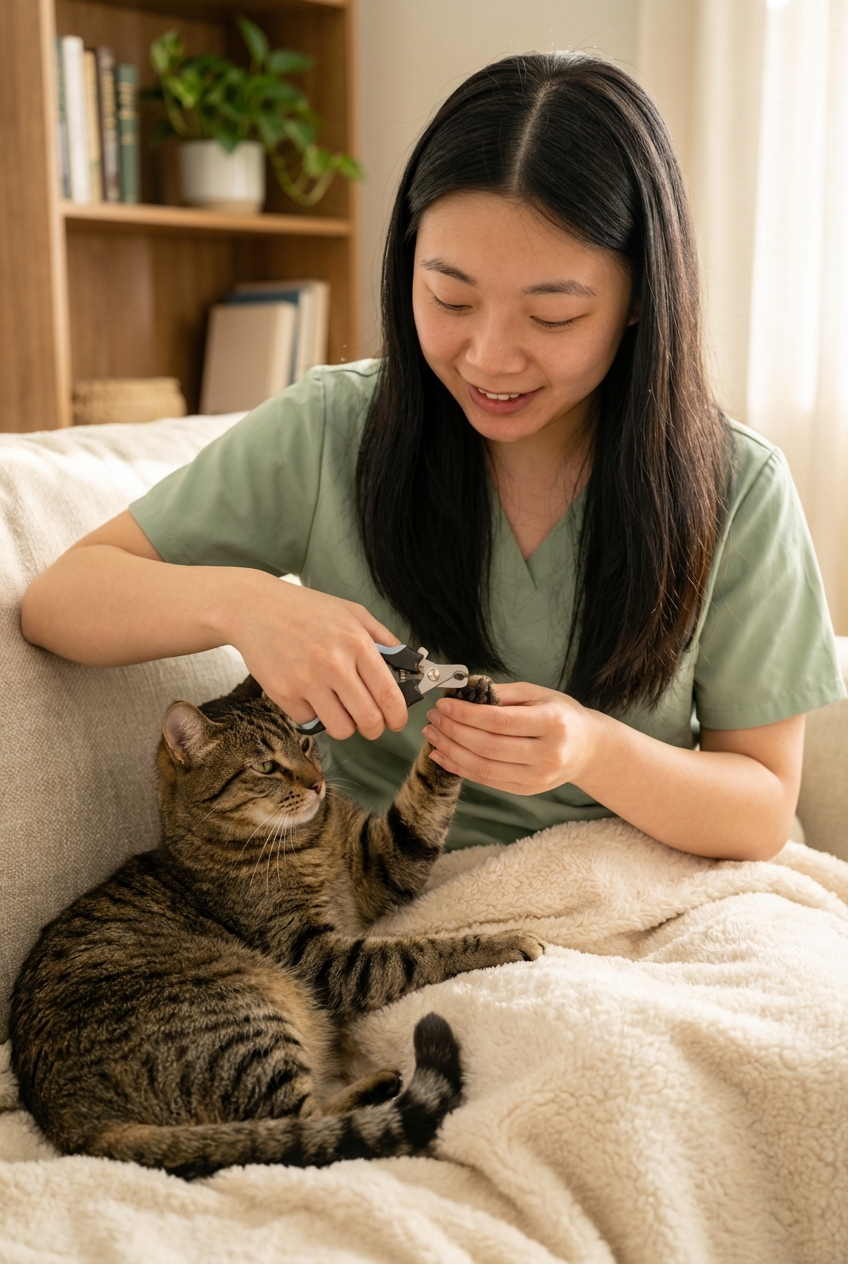
Trim your cat’s nails at home with calm, vet-approved techniques. Learn nail anatomy, the best clippers, how far to cut, low-stress handling, and what to d...
Article
•
Designer Mixes
Best Way to Trim Cat Nails (Vet-Approved)

Shari Shidate
Designer Mixes contributor
Trimming your cat’s nails can feel intimidating, especially the first few times. But with the right timing, tools, and a calm plan, most cats can learn to tolerate nail trims and some even come to accept them as part of normal care. As a veterinary assistant, I like to remind families of a practical, low-stress principle you will also hear from many veterinary teams and cat handling guidelines: small, regular trims are often safer and less stressful than waiting until nails are sharp, snagging, or overgrown.
This guide walks you through commonly vet-recommended technique, what to avoid, and how to make nail trims easier for both you and your cat.
Why trimming cat nails matters
Indoor cats still need nail care. Scratching posts and pads can help cats shed the outer nail sheaths and keep nails in better shape, but they do not always prevent sharp tips or overgrowth. Regular trims can help:
- Reduce painful snagging on carpet, blankets, and upholstery
- Prevent accidental scratches to people and other pets
- Lower the risk of nails curling into paw pads, especially in seniors
- Make handling and veterinary visits less stressful over time
If your cat’s nails are catching on fabric, you are hearing clicking on hard floors, or your cat is avoiding being touched on the paws, it is a good time to check nail length. While you are there, check the front dewclaws too, and note that some cats also have rear dewclaws.
What you need before you start
Choose the right nail trimmer
- Scissor-style cat nail clippers: Great control for most pet parents.
- Guillotine-style clippers: Can work, but some people find it harder to see the cutting edge clearly.
- Nail grinder: Helpful for smoothing, but many cats dislike the sound and vibration.
Whatever you choose, it should be sharp. Dull clippers can crush the nail instead of cutting cleanly, which can hurt and increase future resistance.
Helpful extras
- Styptic powder (or styptic pencil) for minor bleeding if you accidentally cut the quick
- Good lighting and a stable seat
- High-value treats (churu-style lickables often work wonderfully)
- A towel if your cat does better with gentle wrapping
Where to cut (and where not to)
Cat nails have a pink, sensitive area inside called the quick, which contains blood vessels and nerves. Cutting into the quick hurts and causes bleeding.
- On light-colored nails, the quick is often easy to see as a pink triangle.
- On dark nails, the quick is harder to visualize. Trim only the very tip and go slowly.
A safe rule: trim the sharp, clear hooked tip only. You do not need to take off much to make a meaningful difference.
Step by step nail trimming
1) Pick the right moment
Choose a time when your cat is naturally relaxed, like after a meal, after play, or during a cuddle session. Avoid chasing your cat or making nail trims feel like a surprise capture.
2) Set up your space
- Quiet room, minimal noise, no other pets hovering nearby
- Bright light aimed at the paws
- Everything within reach so you do not have to get up mid-trim
3) Watch for “stop signs”
End the session early if you see stress building. Common signs include tail flicking, tense body posture, ears turning sideways or flattening, lip licking, growling, swatting, or trying to leave. Stopping before your cat is overwhelmed is one of the fastest ways to make next time easier.
4) Use gentle paw handling
Hold your cat’s paw and apply soft pressure to the toe pad to extend the nail. Keep your grip light but secure. If your cat pulls away, pause and reset rather than tightening and escalating the struggle. Avoid punishing or scolding. Forced restraint can increase fear and make future handling harder.
5) Trim one nail at a time
Clip the sharp tip using a small cut, following the nail’s natural curve and angle. The goal is a clean, tiny trim.
- If your cat is calm, you can do all front nails in one session.
- If your cat is unsure, trim one to three nails, reward, and stop. Progress matters more than finishing.
6) Reward right away
Give a treat right after each nail, or after every paw, depending on your cat’s tolerance. This is not spoiling. It is training. You are building a positive association.
7) End on a good note
Stop before your cat hits their limit. Ending calmly teaches your cat that nail trims are short and safe.
How often to trim
Many cats do well with trims every 2 to 4 weeks, but there is a lot of individual variation. Age, activity level, nail thickness, and how much your cat uses scratching surfaces can all change the ideal schedule.
Front nails usually need trimming more often than back nails. Also remember the dewclaws on the front legs, and check for rear dewclaws if your cat has them, since these can overgrow if missed.
Make trims easier for nervous cats
Practice without trimming
Once daily for a few days, touch a paw for one second, reward, and stop. Then work up to pressing the toe pad to extend a nail, reward, and stop. When your cat stays relaxed, introduce the clipper without cutting, reward, and stop. Slow practice pays off.
Keep kitten sessions extra short
Kittens do best with tiny sessions. Aim for one or two nails, reward, and end the session while they are still calm. Early, gentle handling builds a lifetime skill.
Try a towel wrap for wiggly cats
A gentle kitty burrito can reduce stress for some cats by making them feel secure. Wrap snugly but never tightly. Make sure your cat can breathe comfortably and does not overheat.
Use a helper if needed
One person can calmly offer treats while the other trims. This is often safer than trying to manage restraint and clipping at the same time.
Consider pheromones
Some families find feline pheromone sprays or diffusers helpful for reducing overall stress. Spray the towel or bedding and allow it to dry before use.
If you cut the quick
It happens, even to professionals occasionally, especially with dark nails or sudden movement. If you nick the quick:
- Stay calm. Your cat will read your reaction.
- Apply styptic powder with gentle pressure for 10 to 30 seconds. Note that styptic can sting, so use only what you need.
- If you do not have styptic, cornstarch can help in a pinch.
- Keep powders away from your cat’s eyes and mouth.
- Stop the session and offer comfort and a treat.
Contact your veterinarian if bleeding does not stop within several minutes, if the nail is torn, or if your cat becomes very painful or limp.
When to call a vet or groomer
- Your cat growls, bites, or panics during handling
- Nails are curling toward the paw pad
- You notice swelling, redness, discharge, or limping
- Your cat has arthritis and resents paw manipulation
- You are not able to see where the quick is and feel unsure
In-clinic nail trims are quick, and many veterinary teams can show you exactly where to cut on your cat’s nails so you feel confident at home.
Common mistakes to avoid
- Cutting too much at once: This is the fastest way to hit the quick and create fear.
- Forcing a full trim session: It is okay to do a few nails and stop.
- Restraining too forcefully: If your cat is struggling, pause and try later or ask a professional for help.
- Using human nail clippers: They can crush the nail and are harder to control.
- Trimming right after a stressful event: Avoid trimming after the carrier, baths, or vet visits unless it is necessary.
- Skipping the reward: Treats are part of the training plan, not an optional extra.
Trimming is not declawing
A nail trim only shortens the sharp tip of the nail. Declawing is a surgical amputation of the last bone of each toe and is not recommended by many veterinary organizations. If you are struggling with scratching behavior, talk with your veterinary team about scratch-friendly setups, nail trims, and other humane options.
Quick trim checklist
- Calm cat, calm room, bright light
- Sharp cat nail clippers
- Trim just the sharp tip
- Reward after each nail or each paw
- Stop early if your cat is done
Slow is smooth, and smooth is fast. A few calm nails today beats a stressful full set that makes next time harder.