Making homemade cat food? Avoid nutrient gaps. Learn the core supplements cats need—taurine, calcium balance, vitamin/mineral premix, omega-3s, vitamin E, ...
Article
•
Designer Mixes
Best Supplements for Homemade Cat Food Safety

Shari Shidate
Designer Mixes contributor
Homemade cat food can be a beautiful way to care for your cat, especially if you love knowing exactly what goes into the bowl. But as a veterinary assistant, I want to say this clearly and kindly: cats are not small dogs. They are true carnivores, and they have a few non-negotiable nutrients that are easy to miss when you cook at home.
That is where supplements come in. The “best” supplements for homemade cat food safety are the ones that prevent the most common, most serious nutritional gaps: taurine, calcium (in the correct balance with phosphorus), essential fatty acids, key vitamins, and trace minerals. Let’s walk through what matters and why.
First: a safety note
For long-term feeding, homemade cat diets should be formulated to meet recognized nutritional standards (such as AAFCO or FEDIAF targets). “Looks healthy” and “high quality ingredients” do not guarantee nutritional completeness, especially for cats.
If your cat is a kitten, pregnant, nursing, has kidney disease, heart disease, urinary issues, or is on prescription medication, consult your veterinarian and consider a board-certified veterinary nutritionist (ACVN in the U.S. or ECVCN in Europe). Supplements can interact with medical conditions, and more is not always better.
- Do not rely on a multivitamin alone to “fix” a recipe that is missing key building blocks.
- Avoid guessing doses, especially with vitamins A and D, iodine, and calcium.
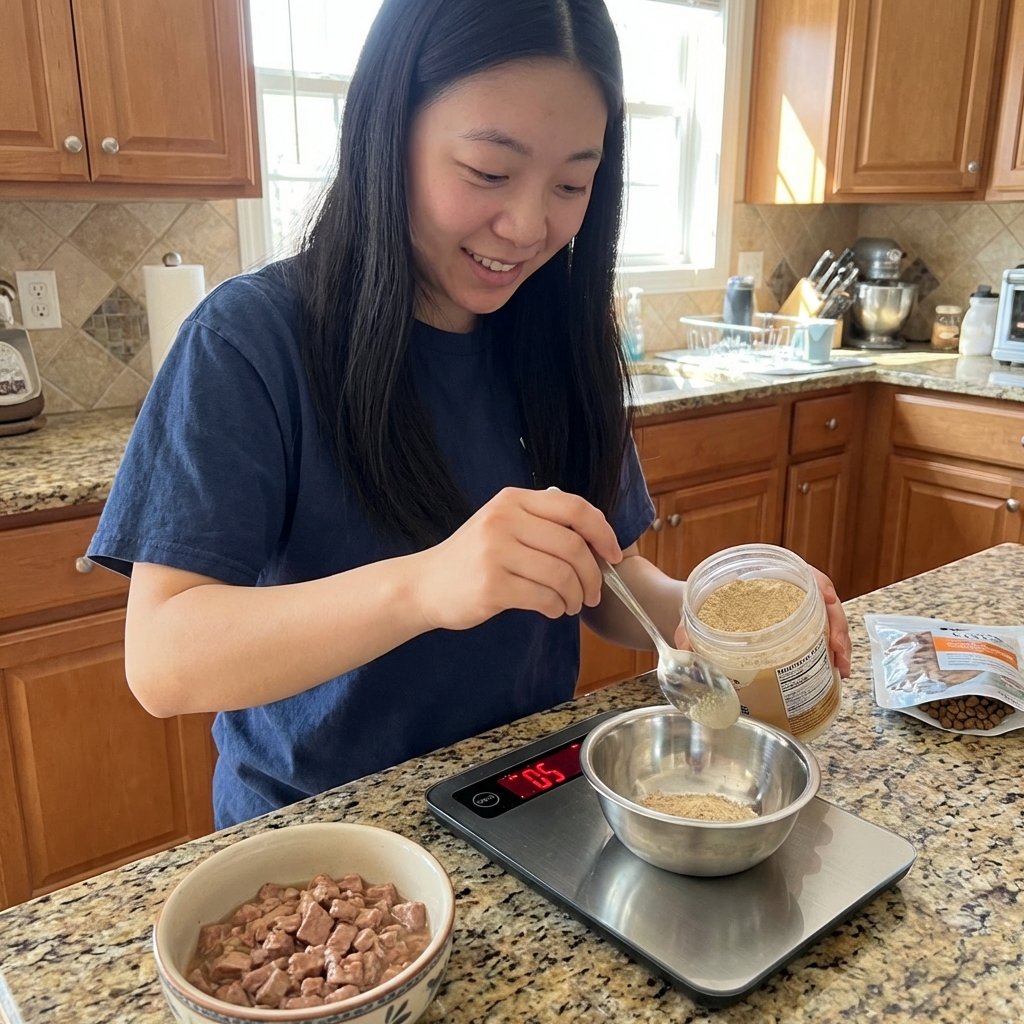
- Use a gram scale for powders. Teaspoons are not precise enough for many cat nutrients.
Top supplements for safety
1) Taurine (non-negotiable)
Taurine is the nutrient I worry about most in homemade cat food. Cats have a high taurine requirement and limited ability to make it themselves. Deficiency has been linked to serious issues including dilated cardiomyopathy (heart disease), vision problems (retinal degeneration), and reproductive problems.
Why homemade diets are at risk: Taurine levels vary by ingredient and can drop with certain processing and storage conditions. Even recipes that include meat may still come up short if not formulated.
- What to look for: Plain taurine powder (no added sweeteners).
- Safety tip: Split batches and mix thoroughly. Taurine is water-soluble, and consistent distribution matters.
2) Calcium source (balance phosphorus)
Most meats are high in phosphorus and low in calcium. If you feed a meat-based homemade diet without an appropriate calcium source, the calcium-to-phosphorus ratio can become unbalanced. Over time, that can stress bones and metabolism and contribute to nutritional secondary hyperparathyroidism.
A helpful target: Many complete feline diets land around a calcium:phosphorus ratio of about 1:1 to 1.5:1. The right ratio still depends on life stage and health, and the exact amount is recipe-specific.
Common calcium options used in homemade cat recipes:
- Eggshell powder (finely ground, measured by weight).
- Calcium carbonate (a consistent, commonly used supplement form).
- Bone meal (use caution due to variability and possible contaminant concerns; choose reputable testing).
Important: Calcium dosing is recipe-specific. The “right amount” depends on how much meat, organs, and other ingredients are included.
3) Omega-3s (EPA and DHA)
Omega-3s support skin and coat health, a healthy inflammatory response, brain health, and may be helpful for some cats with itchy skin or chronic inflammatory conditions. Cats can struggle to convert plant-based omega-3 (ALA) into the more useful forms (EPA and DHA), so marine sources are usually preferred.
- Best sources: Fish oil or algae-based EPA/DHA supplements designed for pets.
- Safety tip: Choose products with freshness protections (dark bottle, expiration date) and quality testing when possible. Rancid oils can do more harm than good.
- Vitamin E note: Higher polyunsaturated fat intake can increase vitamin E needs. This is one more reason to use a balanced formulation rather than adding nutrients “freehand.”
4) Cat premix (vitamins and minerals)
If you only take one shortcut to improve safety, let it be this: use a cat-specific premix intended for homemade diets. A good premix can help cover critical micronutrients like iodine, zinc, copper, manganese, selenium, B vitamins, and vitamins A, D, and E in amounts aligned to feline needs.
Why cat-specific matters: Cats have unique requirements, and human multis or “all-pets” powders may be missing taurine or may provide unsafe levels of certain nutrients for long-term feline use.
What to check on the label:
- Explicitly states it is for cats and for homemade diets.
- Clear directions by weight of food or calories.
- Includes or instructs taurine and calcium appropriately (some premixes include them, some require separate additions).
- Quality signals: Lot numbers, an expiration date, and third-party testing or a certificate of analysis (COA) when available.
5) B vitamins (thiamine matters)
B vitamins are involved in energy metabolism, nerve function, and appetite regulation. Certain B vitamins can be sensitive to heat and storage. While a quality premix often covers these needs, some homemade plans include extra B-complex depending on ingredients and preparation method.
A special safety callout: Thiamine (vitamin B1) deficiency can be serious in cats and has been associated with unbalanced homemade diets, certain preparation and storage issues, and some fish-heavy patterns. This is another reason to avoid improvising and to rely on a formulated recipe or premix.
- Especially relevant for: Cats with poor appetite, seniors, or cats with higher needs per veterinary guidance.
- Safety tip: Use only vet-recommended dosing. More is not always necessary.
6) Iodine (only if not covered)
Iodine is essential for thyroid hormone production. Homemade diets frequently miss iodine unless they include a measured iodine source. But iodine can also be overdosed easily if you “sprinkle” kelp casually.
- Preferred approach: Let a premix supply iodine in a controlled amount.
- Be careful with: Kelp and seaweed products, which can vary widely in iodine content.
7) Salt (sodium and chloride)
It surprises many cat parents, but sodium and chloride are essential nutrients. Some homemade recipes are unintentionally very low in these electrolytes.
Good news: This is usually handled through a properly formulated premix or a recipe designed by a veterinary nutritionist. Do not add salt freely if your cat has heart disease, kidney disease, or high blood pressure without veterinary guidance.
Common homemade pitfalls
If you want a quick “what goes wrong most often” list, here it is:
- Low taurine
- Calcium:phosphorus imbalance (meat-heavy diets without a calcium source)
- Missing or excessive iodine (especially unmeasured kelp)
- Too much liver leading to vitamin A excess over time
- Thiamine (B1) gaps in unbalanced plans
- Fatty acid imbalance (not enough EPA/DHA, or rancid oils)
Sometimes helpful (not automatic)
Probiotics
Probiotics may help some cats with stress-related digestive upset or after antibiotics, but results are strain-specific and not guaranteed. Choose a pet product with clear labeling (genus, species, strain, CFU at expiration), and introduce slowly.
Fiber (psyllium or pumpkin powder)
Some cats benefit from carefully dosed fiber for stool quality or hairball issues, but too much can reduce nutrient absorption or worsen constipation if hydration is poor. Use strategically and with your veterinarian’s input.
Joint support
Glucosamine, chondroitin, or green-lipped mussel can be great for many senior cats, but they do not make a diet complete. Think of this as a targeted add-on.
Red flags to avoid
- Human gummy vitamins (often include sweeteners, flavorings, and doses that are not appropriate for cats; some sugar-free products can include xylitol, so it is best to avoid human products altogether).
- Essential oils added to food. Many are risky for cats due to feline liver metabolism.
- Unmeasured kelp for iodine. Too variable.
- High-dose vitamin A or D without a formulated recipe. Toxicity is real and can be severe.
- Too much liver as an ingredient over time (a common cause of vitamin A excess in homemade diets).
- “One powder that does everything” with vague labeling or no feeding directions.
Using supplements correctly
Measure by weight
For powders, a digital gram scale is one of the simplest safety upgrades you can make. Small cats have small margins for error.
Mix thoroughly
Supplements should be evenly distributed so every meal is balanced. If your cat eats small portions, uneven mixing can create big daily swings.
Store smart
- Fish oil: Keep sealed, away from heat and light. Refrigerate if label directs.
- Powders: Keep dry, tightly sealed, and used within the expiration window.
- Prepared food: Freeze portions for freshness and safety, then thaw in the refrigerator.
Raw vs cooked
Some people prefer raw feeding. If you go that route, be extra careful about pathogen risk for both cats and humans in the home. Follow strict kitchen hygiene, avoid cross-contamination, freeze and thaw safely, and ask your vet what is appropriate for your household (especially if anyone is immunocompromised, very young, elderly, or pregnant).
Watch your cat
Energy level, coat shine, stool quality, weight trends, and thirst can all offer early clues that a diet needs tweaking. If you notice vomiting, diarrhea, constipation, dandruff, weight loss, or sudden hunger changes, pause and check in with your vet.
Safety-first checklist
If you are building or choosing a homemade cat recipe, aim for this baseline:
- Taurine
- Calcium source to balance phosphorus
- EPA/DHA omega-3
- Cat-specific vitamin and mineral premix (or a recipe formulated by a veterinary nutritionist that specifies each nutrient)
From there, you can add targeted extras based on your cat’s needs, your vet’s guidance, and your cat’s response.
When to get help
Homemade feeding is absolutely doable, but it is not the place to wing it. I strongly recommend professional formulation if:
- Your cat is a kitten or a senior
- Your cat has CKD, diabetes, hyperthyroidism, IBD, urinary crystals, or heart disease
- Your cat is a picky eater and you are struggling with consistency
- You want to feed homemade long-term, not as a short transition
The goal is simple: a diet that is not just delicious and loving, but complete, balanced, and safe.
Homemade cat food can be wonderfully nourishing, but supplements are what keep it nutritionally safe over the long run.